Loading page, please wait…
Vaidra Logo
Vaidra

Top 4 items + smart groups

UPSC GPT
New
Current Affairs
Daily Solutions
Daily Puzzle
Mains Evaluator

Version 2.0.0 • Built with ❤️ for UPSC aspirants

Loading...
Loading...
Loading...
Loading...
Loading...
Loading...
Loading...
Loading...
Loading...
Loading...
Loading...
Loading...
Loading...
Back
All Subjects

Topics

0 topics • 0 completed

Loading topics...
Loading...
Loading...
Loading...
Loading...
Loading...
Overall Progress0%

Tribal Revolts in Colonial India - UPSC History

What is Tribal Revolts in Colonial India in UPSC History?

Tribal Revolts in Colonial India is a key topic under History for UPSC Civil Services Examination. Key points include: Tribal revolts were diverse, spanning from late 18th century to independence.. Root causes included land alienation, restrictive forest laws, economic exploitation, and cultural interference.. Categorized into mainland (e.g., Santhal, Munda) and frontier (e.g., Kuki) revolts.. Understanding this topic is essential for both UPSC Prelims and Mains preparation.

Why is Tribal Revolts in Colonial India important for UPSC exam?

Tribal Revolts in Colonial India is a Medium-level topic in UPSC History. It is tested in both Prelims (factual MCQs) and Mains (analytical answer writing). Previous year UPSC questions have frequently covered aspects of Tribal Revolts in Colonial India, making it essential for comprehensive IAS preparation.

How to prepare Tribal Revolts in Colonial India for UPSC?

To prepare Tribal Revolts in Colonial India for UPSC: (1) Study the comprehensive notes covering all key concepts on Vaidra. (2) Practice previous year questions on this topic. (3) Connect it with current affairs using daily updates. (4) Revise using key takeaways and mind maps available for History. (5) Write practice answers linking Tribal Revolts in Colonial India to related GS Paper topics.

Key takeaways of Tribal Revolts in Colonial India for UPSC

  • Tribal revolts were diverse, spanning from late 18th century to independence.
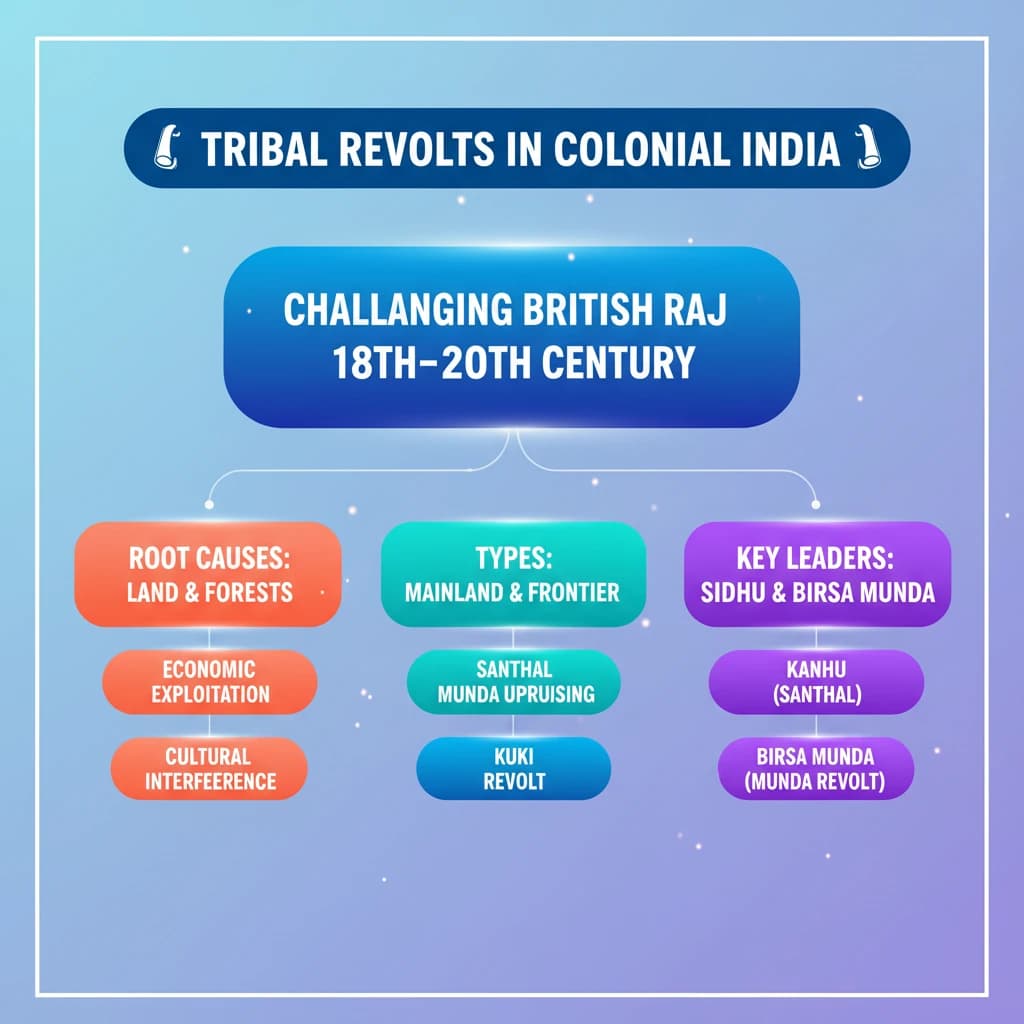
  • Root causes included land alienation, restrictive forest laws, economic exploitation, and cultural interference.
  • Categorized into mainland (e.g., Santhal, Munda) and frontier (e.g., Kuki) revolts.
  • Leaders like Sidhu, Kanhu, and Birsa Munda symbolized strong resistance.
  • These movements challenged British authority and influenced regional dynamics.
  • Their legacy continues to shape contemporary tribal rights and governance policies (e.g., FRA, PESA).
Tribal Revolts in Colonial India

Tribal Revolts in Colonial India

Medium⏱️ 7 min read✓ 95% Verified
history

📖 Introduction

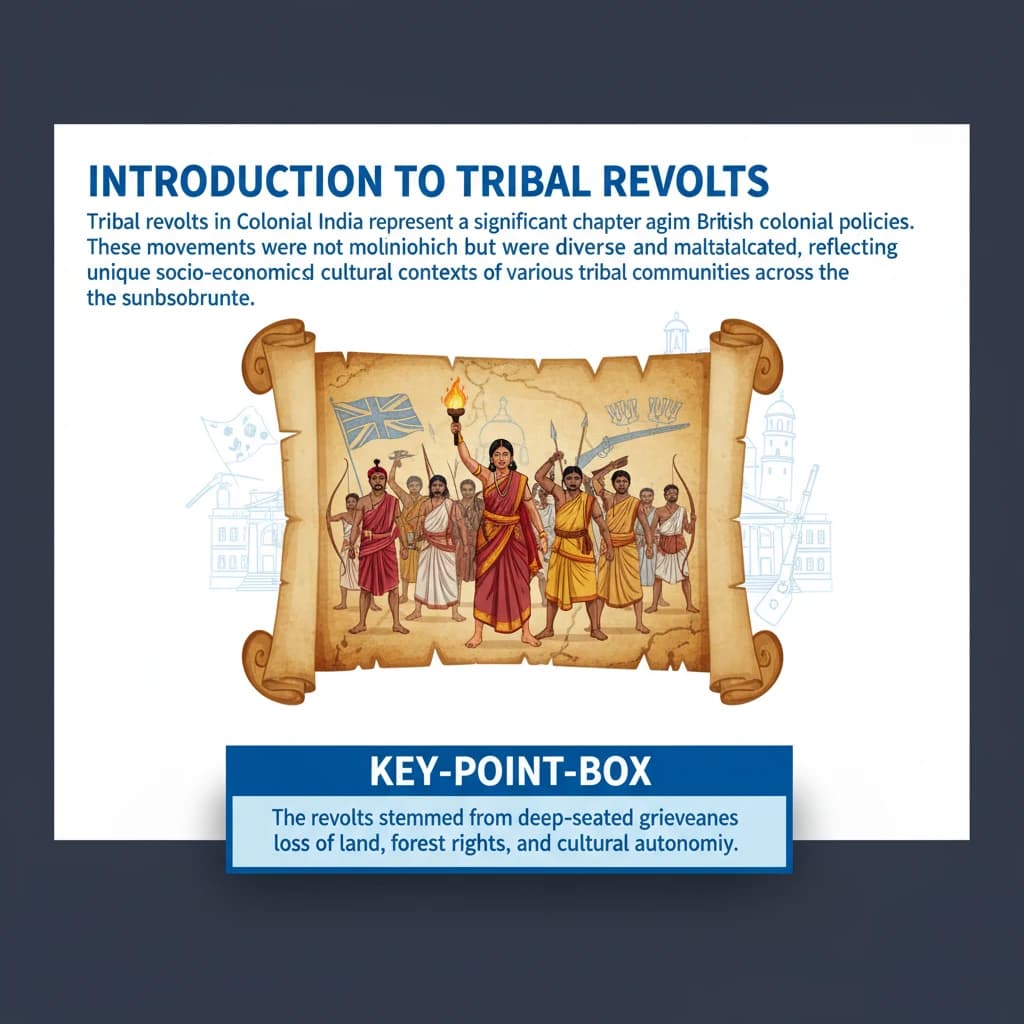
<h4>Introduction to Tribal Revolts</h4><p><strong>Tribal revolts</strong> in <strong>Colonial India</strong> represent a significant chapter of resistance against <strong>British colonial policies</strong>. These movements were not monolithic but were <strong>diverse and multifaceted</strong>, reflecting the unique socio-economic and cultural contexts of various tribal communities across the subcontinent.</p><div class='key-point-box'><p>The revolts stemmed from <strong>deep-seated grievances</strong>, primarily targeting the disruption of traditional tribal life, land systems, and forest rights by the colonial administration and its agents.</p></div><h4>Chronological Span and Categorization</h4><p>These powerful uprisings spanned a vast period, from the <strong>late 18th century</strong> right up to the <strong>eve of Indian independence</strong> in 1947. Their geographical spread allowed for a broad categorization into <strong>mainland tribal revolts</strong> and <strong>frontier tribal revolts</strong>.</p><div class='info-box'><p><strong>Mainland Revolts:</strong> Occurred in areas under direct British administration or princely states, often driven by land alienation, forest laws, and exploitation by moneylenders.</p><p><strong>Frontier Revolts:</strong> Took place in the North-Eastern regions, frequently involving conflicts over territorial sovereignty, cultural interference, and attempts to integrate tribal areas into the colonial administrative framework.</p></div><h4>Impact and Significance</h4><p>The tribal revolts significantly <strong>influenced regional dynamics</strong> and consistently <strong>challenged British authority</strong>. Although often localized and brutally suppressed, they highlighted the deep resentment against colonial exploitation and contributed to the broader narrative of anti-colonial resistance.</p><div class='exam-tip-box'><p>For UPSC, understanding the <strong>causes, nature, and impact</strong> of these revolts is crucial for both <strong>Prelims</strong> (facts, names, locations) and <strong>Mains</strong> (analysis of resistance movements, British policies, and their socio-economic consequences). Focus on the distinct characteristics of tribal resistance compared to peasant or civil uprisings.</p></div>
Concept Diagram

💡 Key Takeaways

  • •Tribal revolts were diverse, spanning from late 18th century to independence.
  • •Root causes included land alienation, restrictive forest laws, economic exploitation, and cultural interference.
  • •Categorized into mainland (e.g., Santhal, Munda) and frontier (e.g., Kuki) revolts.
  • •Leaders like Sidhu, Kanhu, and Birsa Munda symbolized strong resistance.
  • •These movements challenged British authority and influenced regional dynamics.
  • •Their legacy continues to shape contemporary tribal rights and governance policies (e.g., FRA, PESA).

🧠 Memory Techniques
Memory Aid
95% Verified Content

📚 Reference Sources

•Ramachandra Guha, The Unquiet Woods: Ecological Change and Peasant Resistance in the Himalaya
•NCERT History Textbooks (Class XII - Themes in Indian History Part III)
•Government of India Reports on Tribal Affairs
•Sumit Sarkar, Modern India (1885-1947)

Related Topics

Loading related topics...
Explore:History Topics·All Subjects·Daily Current Affairs·Editorial Analysis·Previous Year Questions·UPSC GPT
Tribal Revolts in Colonial India - UPSC History