Loading page, please wait…
Antyodaya Diwas 2024 - UPSC History
What is Antyodaya Diwas 2024 in UPSC History?
Antyodaya Diwas 2024 is a key topic under History for UPSC Civil Services Examination. Key points include: Antyodaya Diwas is observed on September 25th, commemorating Pandit Deendayal Upadhyaya's birth anniversary.. Antyodaya, meaning 'upliftment of the last person', is Deendayal Upadhyaya's core philosophy.. Integral Humanism is Upadhyaya's holistic philosophy for individual and collective welfare and self-reliance.. Understanding this topic is essential for both UPSC Prelims and Mains preparation.
Why is Antyodaya Diwas 2024 important for UPSC exam?
Antyodaya Diwas 2024 is a Medium-level topic in UPSC History. It is tested in both Prelims (factual MCQs) and Mains (analytical answer writing). Previous year UPSC questions have frequently covered aspects of Antyodaya Diwas 2024, making it essential for comprehensive IAS preparation.
How to prepare Antyodaya Diwas 2024 for UPSC?
To prepare Antyodaya Diwas 2024 for UPSC: (1) Study the comprehensive notes covering all key concepts on Vaidra. (2) Practice previous year questions on this topic. (3) Connect it with current affairs using daily updates. (4) Revise using key takeaways and mind maps available for History. (5) Write practice answers linking Antyodaya Diwas 2024 to related GS Paper topics.
Key takeaways of Antyodaya Diwas 2024 for UPSC
- Antyodaya Diwas is observed on September 25th, commemorating Pandit Deendayal Upadhyaya's birth anniversary.
- Antyodaya, meaning 'upliftment of the last person', is Deendayal Upadhyaya's core philosophy.
- Integral Humanism is Upadhyaya's holistic philosophy for individual and collective welfare and self-reliance.
- Jayaprakash Narayan championed Sarvodaya ('progress for all') and led the Total Revolution movement.
- Antyodaya Diwas was first observed on September 25, 2014.
- Both Antyodaya and Sarvodaya emphasize social justice, economic equality, and inclusive growth.
Antyodaya Diwas 2024
Medium⏱️ 7 min read
history
📖 Introduction
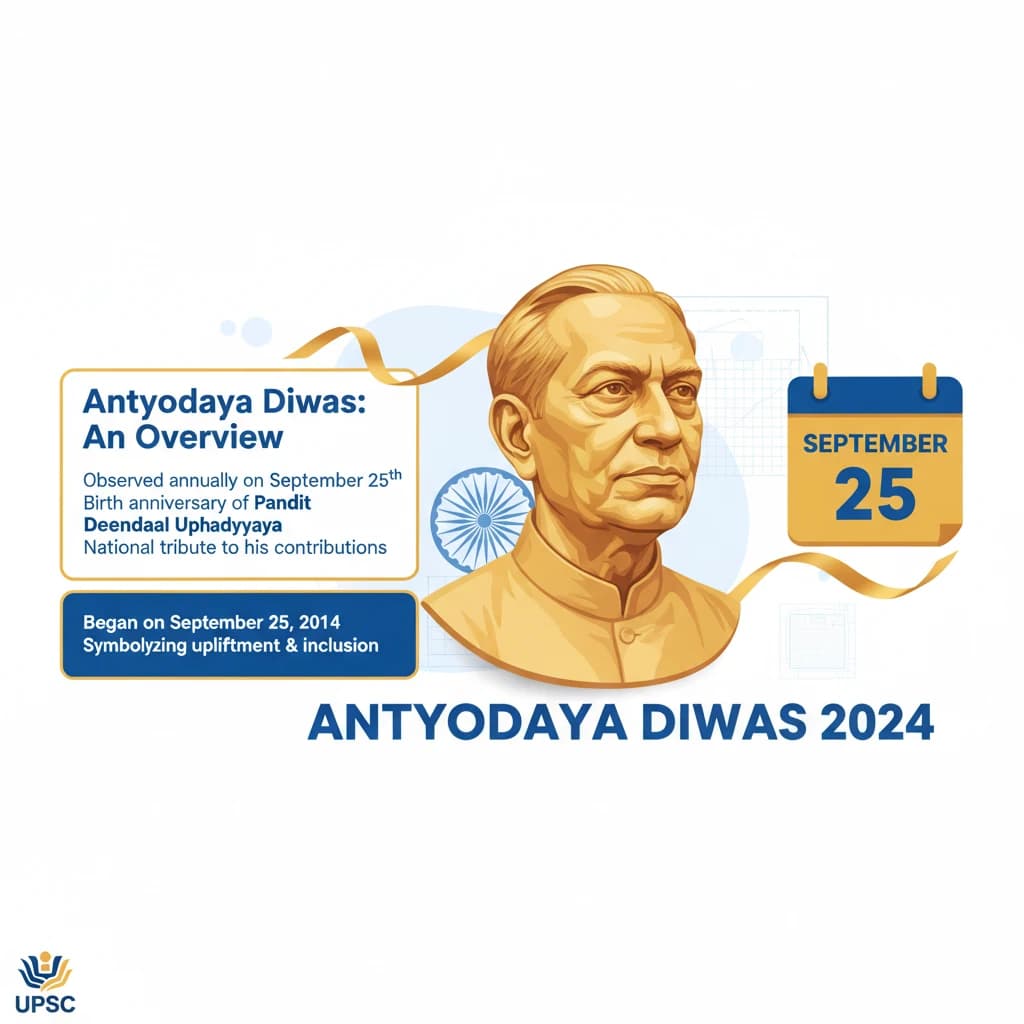
Antyodaya Diwas: An Overview
Antyodaya Diwas is observed annually on September 25th to commemorate the birth anniversary of Pandit Deendayal Upadhyaya. This day serves as a national tribute, recognizing his profound contributions to Indian politics and society.
The observance of Antyodaya Diwas officially began on September 25, 2014, symbolizing a commitment to his ideals of upliftment and inclusive growth.
Antyodaya Diwas 2024: Observed on September 25, 2024.
Purpose: To remember and celebrate the life and contributions of Pandit Deendayal Upadhyaya.
Pandit Deendayal Upadhyaya: Architect of Antyodaya
Pandit Deendayal Upadhyaya was a prominent philosopher, economist, sociologist, historian, and political activist. His core philosophy revolved around Antyodaya, a concept deeply embedded in Indian thought.
Antyodaya: This term literally means the 'upliftment of the last person'. It focuses on addressing the needs of the most disadvantaged and marginalized individuals in society, ensuring their welfare and progress.
He was also the proponent of Integral Humanism, a holistic philosophy that sought to integrate the individual with society, nation, and the universe.
Integral Humanism: This philosophy emphasizes the simultaneous well-being of the individual and society, promoting social justice, economic equality, and self-reliance. It rejects both Western capitalism and communism, advocating for a uniquely Indian approach to development.
Politically, Pandit Deendayal Upadhyaya was a co-founder of the Bharatiya Jana Sangh (BJS), which later evolved into the Bharatiya Janata Party (BJP). He was also a key ideologue and thinker for the Rashtriya Swayamsevak Sangh (RSS).
Jayaprakash Narayan: The Sarvodaya Visionary
While Antyodaya Diwas specifically honours Pandit Deendayal Upadhyaya, the broader theme of societal upliftment also connects to other significant figures like Jayaprakash Narayan (JP). His objective was to bring about societal change in line with the ideals of Sarvodaya.
Sarvodaya: A Gandhian philosophy that emphasizes the 'progress for all' or 'universal upliftment', aiming for the welfare of every individual in society without discrimination.
Jayaprakash Narayan's political career saw him join the Indian National Congress in 1929, actively participating in the Civil Disobedience Movement and the Quit India Movement. He was a staunch advocate for socialist principles.
- He co-founded the Congress Socialist Party, advocating for a left-wing approach within the Congress Party.
- He promoted the Bhoodan Gramdan Movement, initiated by Acharya Vinoba Bhave, which advocated for voluntary land redistribution for the landless.
- In 1959, he proposed a decentralized political structure with a four-tier system of governance, emphasizing grassroots democracy.
- He famously led the Total Revolution movement against the Emergency (1975 to 1977), becoming a vocal critic of corruption and authoritarianism.
Jayaprakash Narayan passed away on October 8, 1979, and was posthumously awarded India's highest civilian honour, the Bharat Ratna, in 1999 for his immense contributions to public life.
UPSC Insight: While Antyodaya Diwas is about Deendayal Upadhyaya, understanding Jayaprakash Narayan's contributions to Sarvodaya and social movements provides a broader context for philosophies of social justice and upliftment in India. Both figures represent different, yet complementary, approaches to national development and welfare.
💡 Key Takeaways
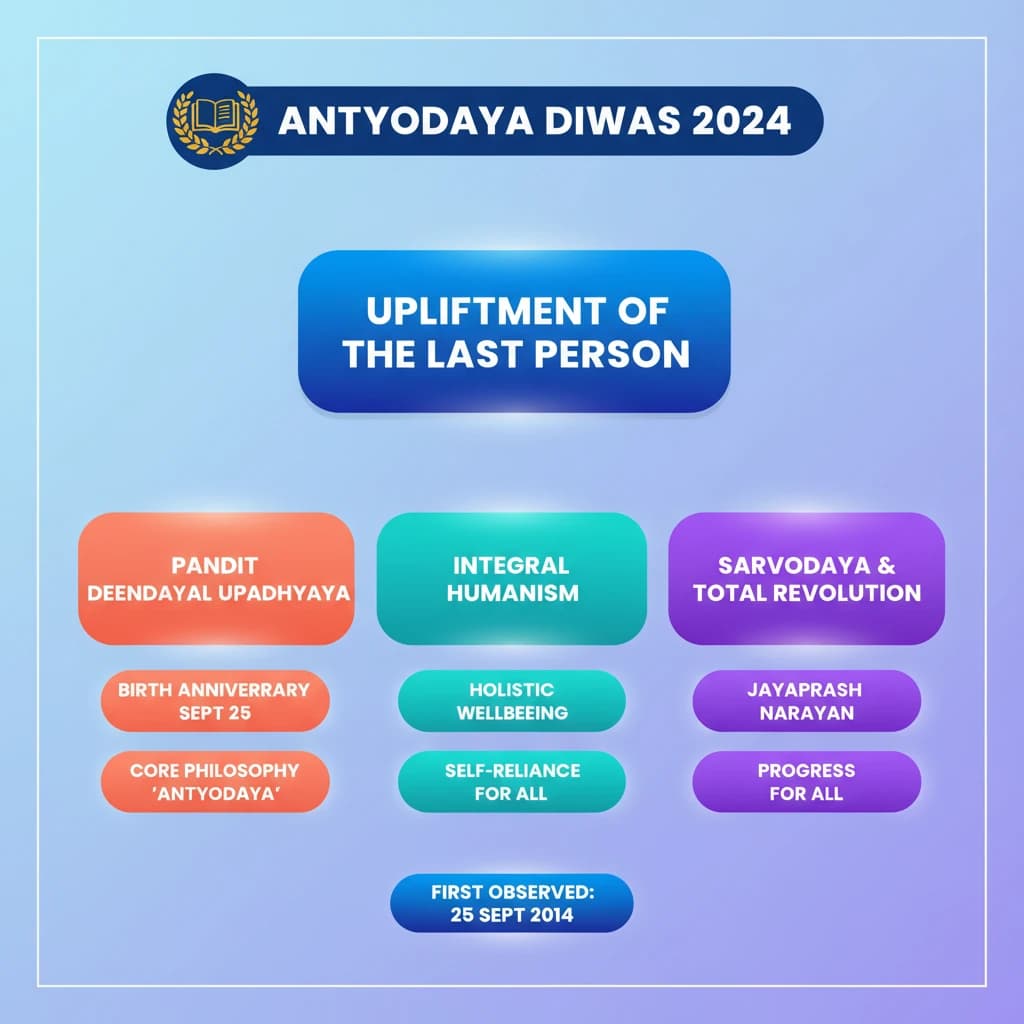
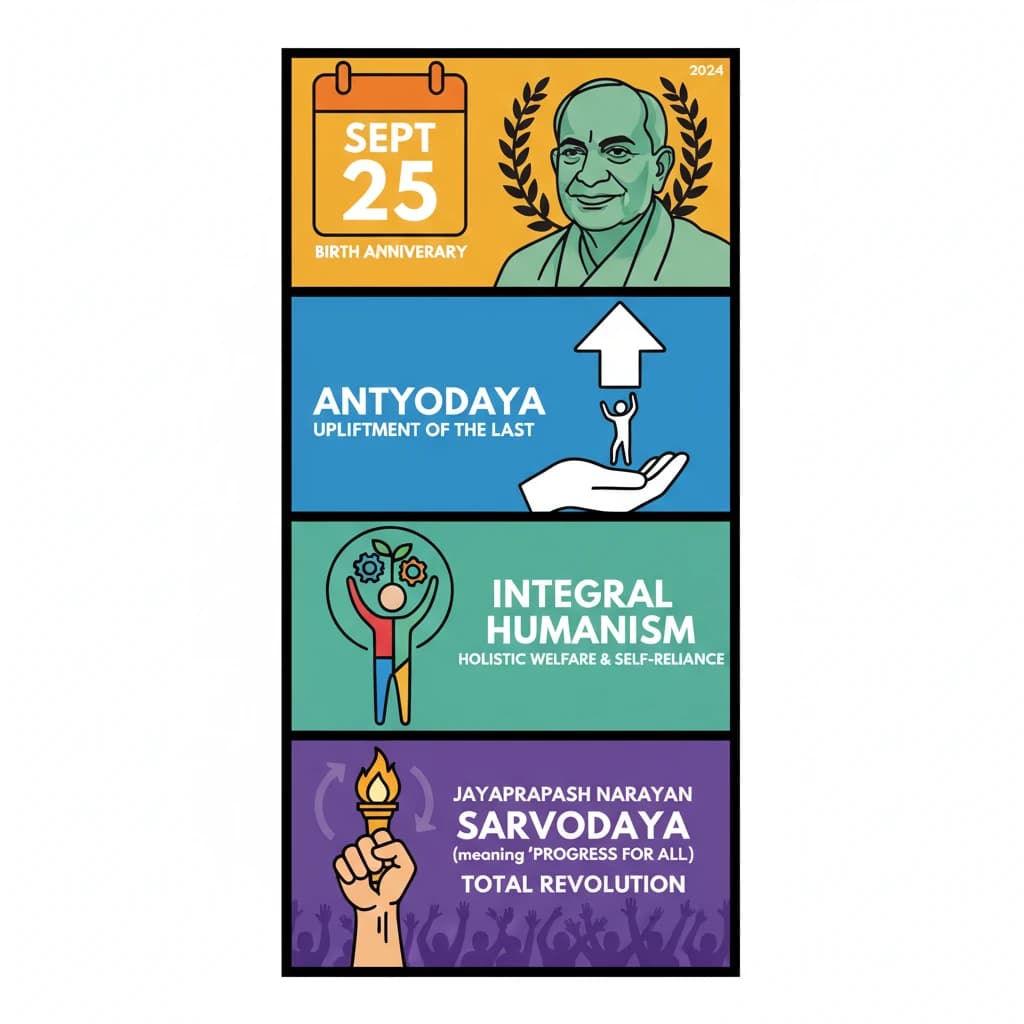
- •Antyodaya Diwas is observed on September 25th, commemorating Pandit Deendayal Upadhyaya's birth anniversary.
- •Antyodaya, meaning 'upliftment of the last person', is Deendayal Upadhyaya's core philosophy.
- •Integral Humanism is Upadhyaya's holistic philosophy for individual and collective welfare and self-reliance.
- •Jayaprakash Narayan championed Sarvodaya ('progress for all') and led the Total Revolution movement.
- •Antyodaya Diwas was first observed on September 25, 2014.
- •Both Antyodaya and Sarvodaya emphasize social justice, economic equality, and inclusive growth.
🧠 Memory Techniques
95% Verified Content
📚 Reference Sources
•Official Government of India websites (for scheme details and dates)
•Standard history and polity textbooks for UPSC preparation