Loading page, please wait…
Vaidra Logo
Vaidra

Top 4 items + smart groups

UPSC GPT
New
Current Affairs
Daily Solutions
Daily Puzzle
Mains Evaluator

Version 2.0.0 • Built with ❤️ for UPSC aspirants

Loading...
Loading...
Loading...
Loading...
Loading...
Loading...
Loading...
Loading...
Loading...
Loading...
Loading...
Loading...
Loading...
Dr. Rajendra Prasad - UPSC History
Back
All Subjects

Topics

0 topics • 0 completed

Loading topics...
Loading...
Loading...
Loading...
Loading...
Loading...
Overall Progress0%

Dr. Rajendra Prasad - UPSC History

What is Dr. Rajendra Prasad in UPSC History?

Dr. Rajendra Prasad is a key topic under History for UPSC Civil Services Examination. Key points include: Dr. Rajendra Prasad was India's first President, serving over 12 years (1950-1962).. He was the only President to be re-elected, serving two full terms.. He abandoned his legal career in 1920 to join the Independence movement, being imprisoned during Salt Satyagraha (1931) and Quit India Movement (1942).. Understanding this topic is essential for both UPSC Prelims and Mains preparation.

Why is Dr. Rajendra Prasad important for UPSC exam?

Dr. Rajendra Prasad is a Medium-level topic in UPSC History. It is tested in both Prelims (factual MCQs) and Mains (analytical answer writing). Previous year UPSC questions have frequently covered aspects of Dr. Rajendra Prasad, making it essential for comprehensive IAS preparation.

How to prepare Dr. Rajendra Prasad for UPSC?

To prepare Dr. Rajendra Prasad for UPSC: (1) Study the comprehensive notes covering all key concepts on Vaidra. (2) Practice previous year questions on this topic. (3) Connect it with current affairs using daily updates. (4) Revise using key takeaways and mind maps available for History. (5) Write practice answers linking Dr. Rajendra Prasad to related GS Paper topics.

Key takeaways of Dr. Rajendra Prasad for UPSC

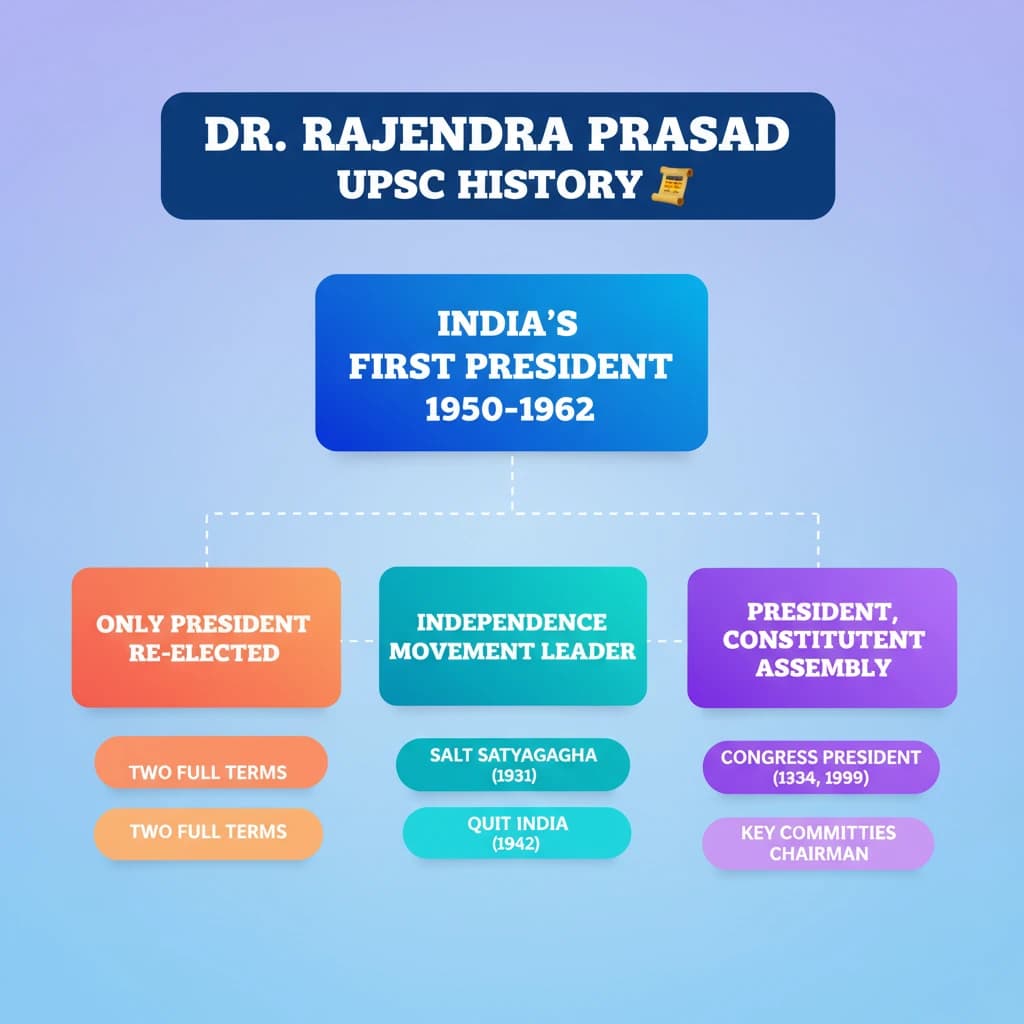
  • Dr. Rajendra Prasad was India's first President, serving over 12 years (1950-1962).
  • He was the only President to be re-elected, serving two full terms.
  • He abandoned his legal career in 1920 to join the Independence movement, being imprisoned during Salt Satyagraha (1931) and Quit India Movement (1942).
  • He presided over the Bombay session of Congress (1934) and became Congress President in 1939.
  • Crucially, he was the President of the Constituent Assembly (1946) and led key committees.
  • Awarded Bharat Ratna in 1962 for his exceptional service.
Dr. Rajendra Prasad

Dr. Rajendra Prasad

Medium⏱️ 8 min read✓ 95% Verified
history

📖 Introduction

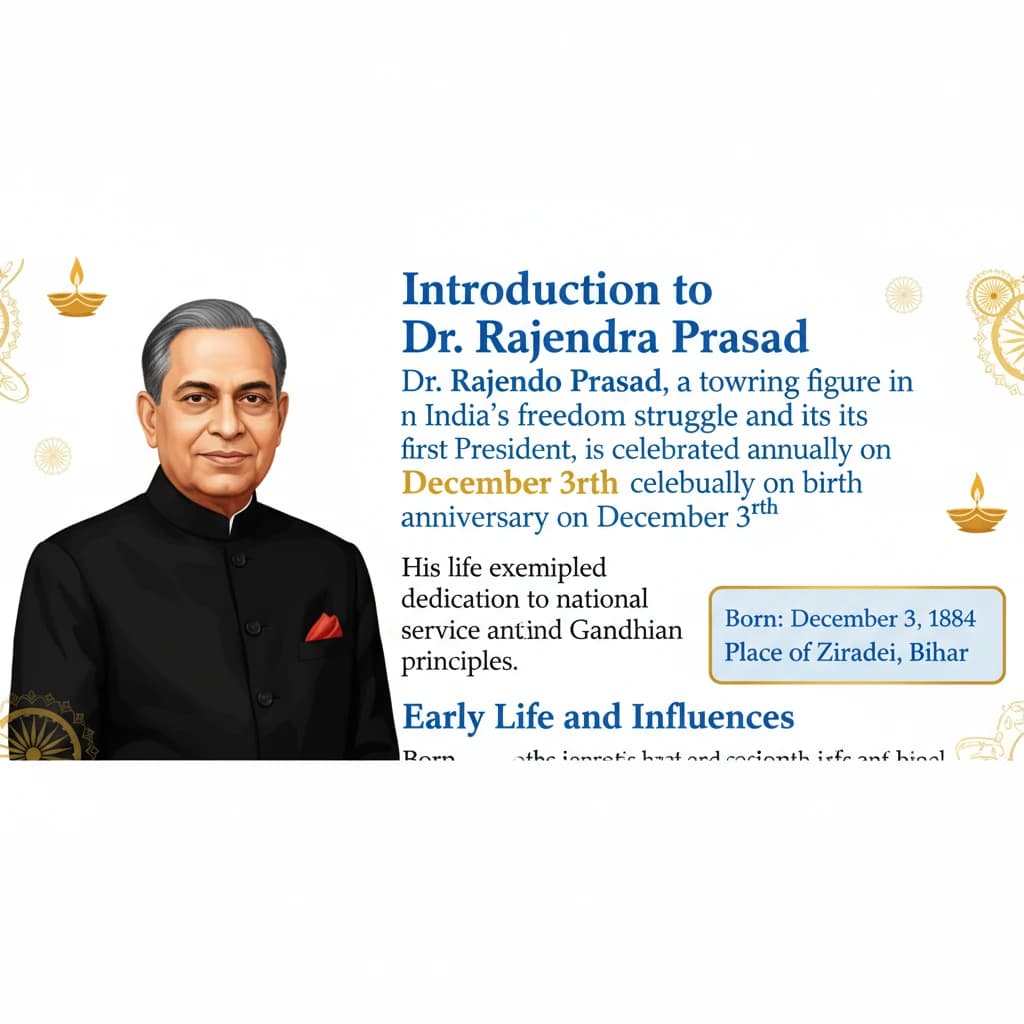
<h4>Introduction to Dr. Rajendra Prasad</h4><p><strong>Dr. Rajendra Prasad</strong>, a towering figure in India's freedom struggle and its first President, is celebrated annually on his birth anniversary on <strong>December 3rd</strong>. His life exemplified dedication to national service and adherence to Gandhian principles.</p><div class='info-box'><p><strong>Born:</strong> December 3, 1884</p><p><strong>Place of Birth:</strong> Ziradei, Bihar</p></div><h4>Early Life and Influences</h4><p>Born in <strong>Bihar</strong>, <strong>Rajendra Prasad</strong> was deeply influenced by <strong>Mahatma Gandhi's</strong> philosophy. He adopted a simple lifestyle, reflecting Gandhi's views on social equality and the eradication of <strong>caste</strong> and <strong>untouchability</strong>.</p><h4>Role in the Freedom Struggle</h4><p><strong>Dr. Rajendra Prasad</strong> made significant sacrifices for India's independence. He abandoned his promising legal career in <strong>1920</strong> to fully commit to the <strong>Independence movement</strong>.</p><p>His unwavering commitment led to multiple imprisonments. He was incarcerated during the pivotal <strong>Salt Satyagraha</strong> in <strong>1931</strong> and again during the momentous <strong>Quit India Movement</strong> in <strong>1942</strong>.</p><div class='key-point-box'><p><strong>Key Leadership Roles:</strong></p><ul><li>Presided over the <strong>Bombay session</strong> of the <strong>Indian National Congress</strong> in <strong>1934</strong>.</li><li>Became <strong>Congress President</strong> in <strong>1939</strong> after <strong>Subhash Chandra Bose's</strong> resignation.</li></ul></div><h4>Contribution to Constitutional Making</h4><p><strong>Dr. Rajendra Prasad's</strong> leadership was crucial during the formation of independent India's foundational document. He was appointed <strong>President of the Constituent Assembly</strong> in <strong>1946</strong>.</p><p>In this role, he guided the complex process of drafting the <strong>Indian Constitution</strong>, ensuring broad consensus and democratic principles were upheld.</p><div class='info-box'><p><strong>Key Committees Led:</strong></p><ul><li><strong>National Flag Committee</strong></li><li><strong>Rules of Procedure Committee</strong></li><li><strong>Finance and Staff Committee</strong></li></ul></div><h4>Literary Contributions</h4><p>Beyond his political and administrative roles, <strong>Dr. Rajendra Prasad</strong> was also a prolific writer. His literary works offer insights into the freedom struggle and his personal reflections.</p><div class='info-box'><p><strong>Notable Literary Works:</strong></p><ul><li><strong>Champaran Mein Champaran</strong> (1922)</li><li><strong>India Divided</strong> (1946)</li><li><strong>Atmakatha</strong> (Autobiography, 1946)</li><li><strong>Bapu ke Kadmon Mein</strong> (1954)</li></ul></div><h4>Presidency and Enduring Legacy</h4><p>In <strong>1950</strong>, <strong>Dr. Rajendra Prasad</strong> was elected as <strong>India's First President</strong>. He served for an unprecedented period of over <strong>12 years</strong>, retiring in <strong>1962</strong>.</p><p>He holds the unique distinction of being the <strong>only President to be re-elected</strong>, serving two full terms (1950-1957 and 1957-1962).</p><div class='highlight-box'><p>For his exceptional service to the nation, <strong>Dr. Rajendra Prasad</strong> was awarded the <strong>Bharat Ratna</strong>, India's highest civilian honor, in <strong>1962</strong>.</p></div><div class='exam-tip-box'><p><strong>UPSC Insight:</strong> Questions on <strong>Dr. Rajendra Prasad</strong> often focus on his multifaceted contributions – his role in the <strong>freedom struggle</strong>, his leadership in the <strong>Constituent Assembly</strong>, and his tenure as <strong>President</strong>. Emphasize his adherence to <strong>Gandhian principles</strong> in your answers.</p></div>
Concept Diagram

💡 Key Takeaways

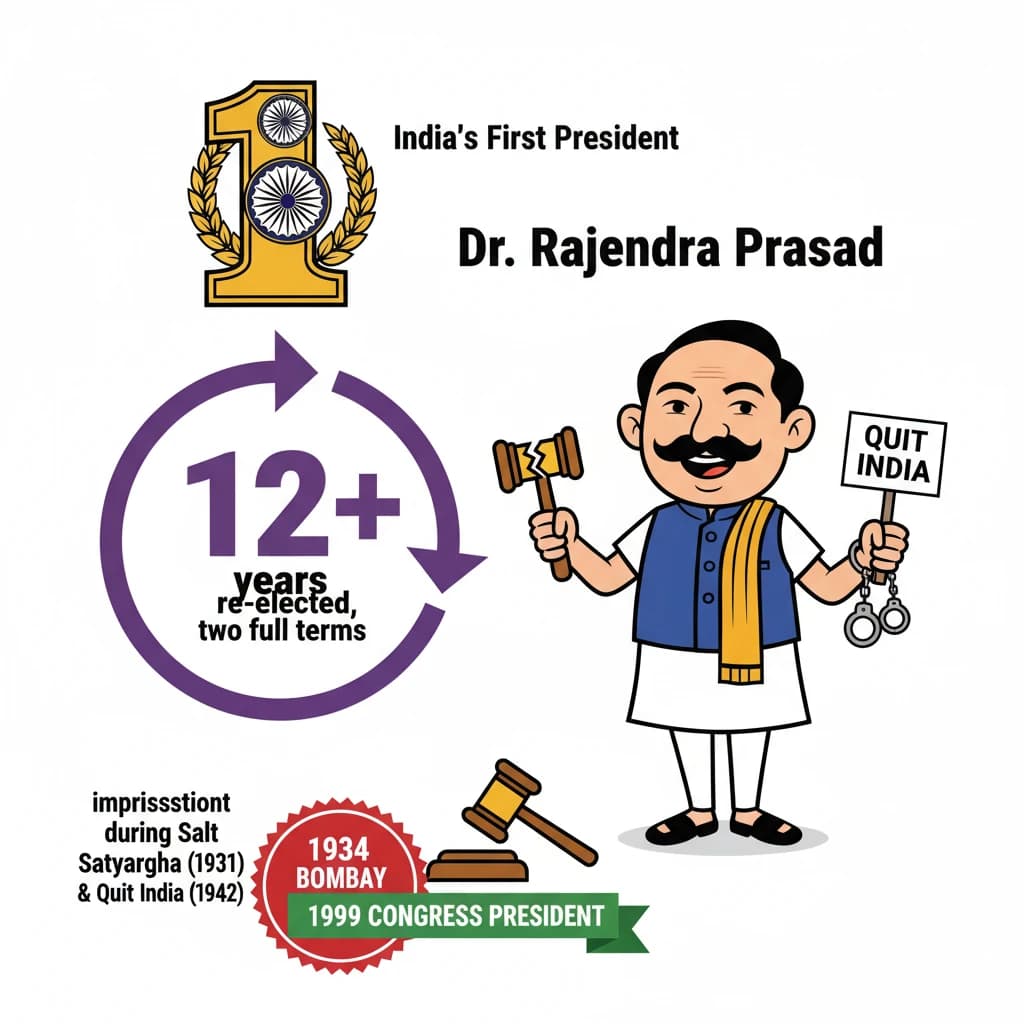
  • •Dr. Rajendra Prasad was India's first President, serving over 12 years (1950-1962).
  • •He was the only President to be re-elected, serving two full terms.
  • •He abandoned his legal career in 1920 to join the Independence movement, being imprisoned during Salt Satyagraha (1931) and Quit India Movement (1942).
  • •He presided over the Bombay session of Congress (1934) and became Congress President in 1939.
  • •Crucially, he was the President of the Constituent Assembly (1946) and led key committees.
  • •Awarded Bharat Ratna in 1962 for his exceptional service.

🧠 Memory Techniques
Memory Aid
95% Verified Content

Related Topics

Loading related topics...
Explore:History Topics·All Subjects·Daily Current Affairs·Editorial Analysis·Previous Year Questions·UPSC GPT