Loading page, please wait…
Vaidra Logo
Vaidra

Top 4 items + smart groups

UPSC GPT
New
Current Affairs
Daily Solutions
Daily Puzzle
Mains Evaluator

Version 2.0.0 • Built with ❤️ for UPSC aspirants

Loading...
Loading...
Loading...
Loading...
Loading...
Loading...
Loading...
Loading...
Loading...
Loading...
Loading...
Loading...
Loading...
Evolution of the Indian National Flag: From Swaraj Flag to Tricolour - UPSC History
Back
All Subjects

Topics

0 topics • 0 completed

Loading topics...
Loading...
Loading...
Loading...
Loading...
Loading...
Overall Progress0%

Evolution of the Indian National Flag: From Swaraj Flag to Tricolour - UPSC History

What is Evolution of the Indian National Flag: From Swaraj Flag to Tricolour in UPSC History?

Evolution of the Indian National Flag: From Swaraj Flag to Tricolour is a key topic under History for UPSC Civil Services Examination. Key points include: Pingali Venkayya designed the initial concepts for the Indian flag.. Mahatma Gandhi approved the Swaraj Flag in 1921, featuring red, green, and a charkha.. Gandhi later suggested adding a white band for peace.. Understanding this topic is essential for both UPSC Prelims and Mains preparation.

Why is Evolution of the Indian National Flag: From Swaraj Flag to Tricolour important for UPSC exam?

Evolution of the Indian National Flag: From Swaraj Flag to Tricolour is a Medium-level topic in UPSC History. It is tested in both Prelims (factual MCQs) and Mains (analytical answer writing). Previous year UPSC questions have frequently covered aspects of Evolution of the Indian National Flag: From Swaraj Flag to Tricolour, making it essential for comprehensive IAS preparation.

How to prepare Evolution of the Indian National Flag: From Swaraj Flag to Tricolour for UPSC?

To prepare Evolution of the Indian National Flag: From Swaraj Flag to Tricolour for UPSC: (1) Study the comprehensive notes covering all key concepts on Vaidra. (2) Practice previous year questions on this topic. (3) Connect it with current affairs using daily updates. (4) Revise using key takeaways and mind maps available for History. (5) Write practice answers linking Evolution of the Indian National Flag: From Swaraj Flag to Tricolour to related GS Paper topics.

Key takeaways of Evolution of the Indian National Flag: From Swaraj Flag to Tricolour for UPSC

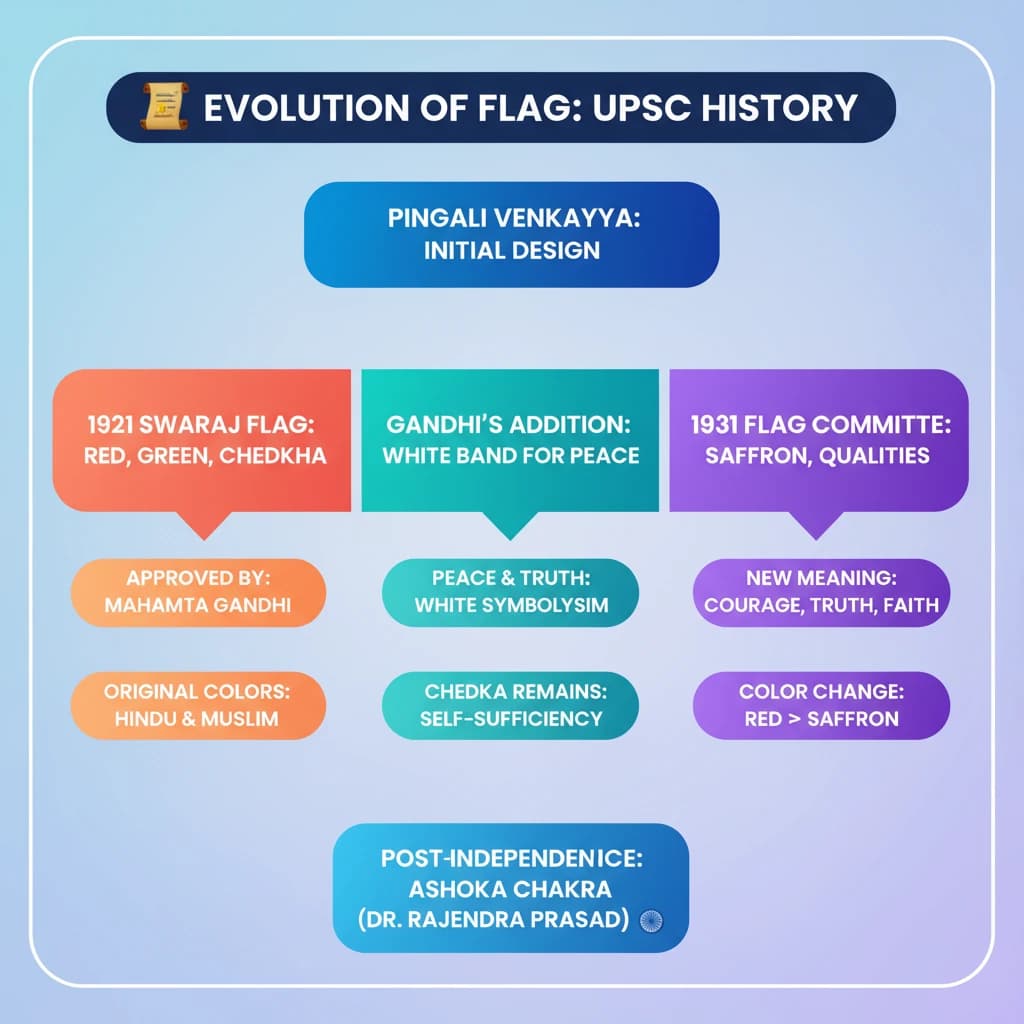
  • Pingali Venkayya designed the initial concepts for the Indian flag.
  • Mahatma Gandhi approved the Swaraj Flag in 1921, featuring red, green, and a charkha.
  • Gandhi later suggested adding a white band for peace.
  • The 1931 Flag Committee replaced red with saffron and redefined colors to represent qualities, not communities.
  • Post-Independence, the charkha was replaced by the Ashok Chakra under Dr. Rajendra Prasad's committee.
  • The flag's evolution reflects India's journey from communal representation to universal values and ancient heritage.
Evolution of the Indian National Flag: From Swaraj Flag to Tricolour

Evolution of the Indian National Flag: From Swaraj Flag to Tricolour

Medium⏱️ 7 min read✓ 98% Verified
history

📖 Introduction

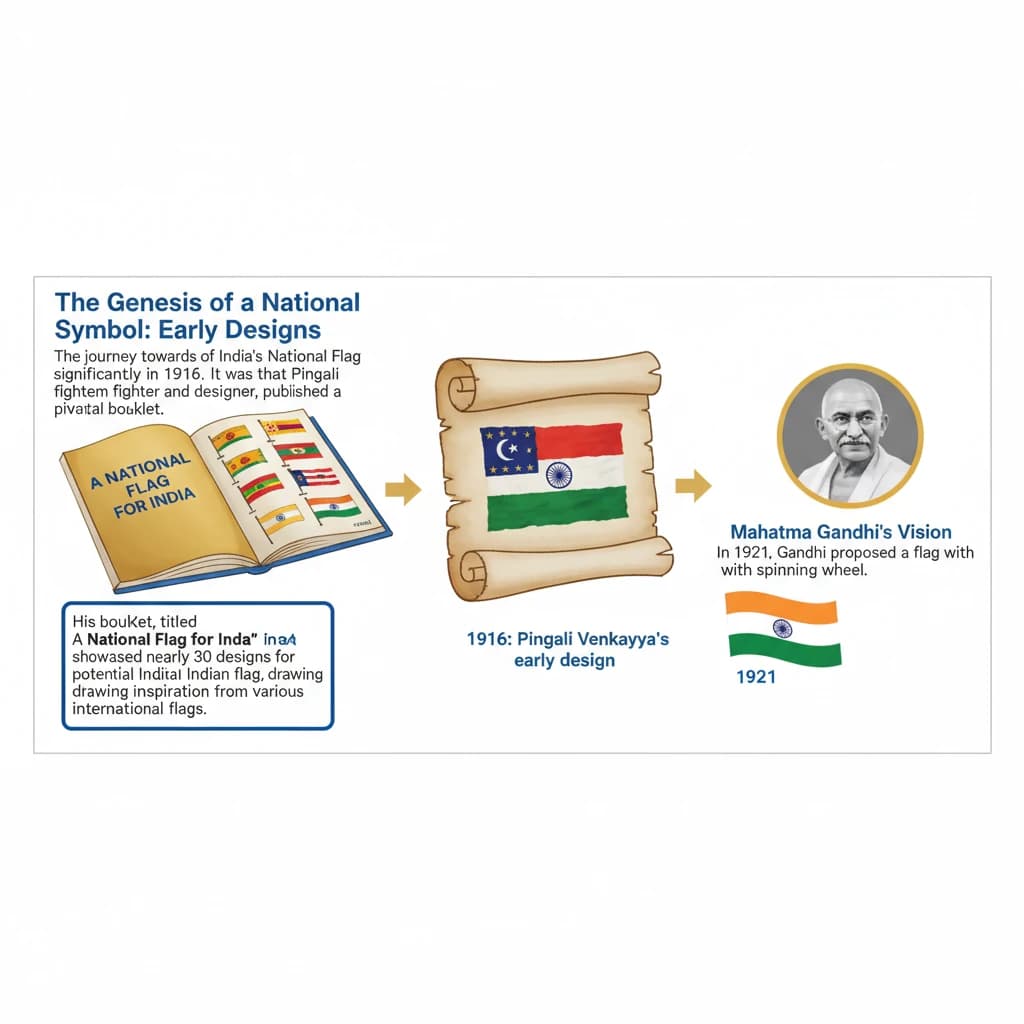
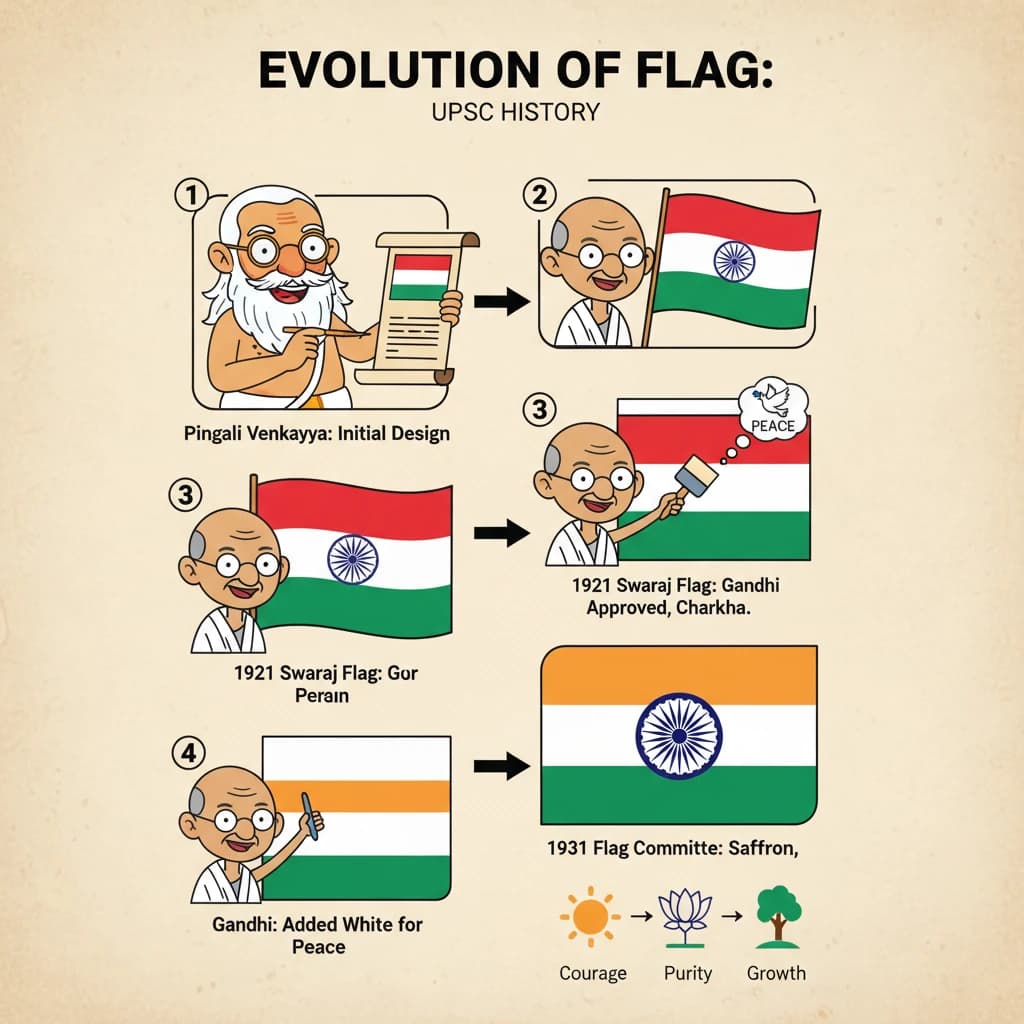
<h4>The Genesis of a National Symbol: Early Designs</h4><p>The journey towards India's National Flag began significantly in <strong>1916</strong>. It was then that <strong>Pingali Venkayya</strong>, a freedom fighter and designer, published a pivotal booklet.</p><div class='info-box'><p>His booklet, titled <strong>A National Flag for India</strong>, showcased nearly <strong>30 designs</strong> for a potential Indian flag, drawing inspiration from various international flags.</p></div><h4>Mahatma Gandhi's Influence and the Swaraj Flag</h4><p><strong>Venkayya's</strong> dedication bore fruit when his design for the National Flag received approval from <strong>Mahatma Gandhi</strong>.</p><p>This significant endorsement occurred during a <strong>Congress meeting</strong> held in <strong>Vijayawada</strong> in <strong>1921</strong>.</p><div class='info-box'><p>The initial flag, known as the <strong>Swaraj Flag</strong>, featured two prominent bands: <strong>red and green</strong>. These colors were intended to represent the <strong>Hindu and Muslim religious communities</strong>, respectively.</p></div><p>Crucially, the <strong>Swaraj Flag</strong> also incorporated a <strong>charkha</strong> (spinning wheel) in its design, symbolizing the concept of <strong>Swaraj</strong> or self-rule.</p><p>Later, <strong>Mahatma Gandhi</strong> suggested an important modification, advising <strong>Venkayya</strong> to add a <strong>white band</strong> to the flag. This addition was meant to symbolize <strong>peace</strong>.</p><h4>The Flag Committee of 1931: Redefining Symbolism</h4><p>A significant change in the flag's design and symbolism came with the formation of the <strong>Flag Committee</strong> in <strong>1931</strong>.</p><div class='info-box'><p>This committee decided to replace the <strong>red</strong> color with <strong>saffron</strong>. The new arrangement placed <strong>saffron</strong> at the top, followed by <strong>white</strong>, and then <strong>green</strong> at the bottom.</p></div><p>The <strong>charkha</strong>, a central element, was strategically placed on the <strong>white band</strong> in the middle of the flag.</p><div class='key-point-box'><p>Importantly, the interpretation of the colors shifted from representing communities to embodying universal qualities:</p><ul><li><strong>Saffron</strong>: Represented <strong>courage and sacrifice</strong>.</li><li><strong>White</strong>: Stood for <strong>truth and peace</strong>.</li><li><strong>Green</strong>: Symbolized <strong>faith and strength</strong>.</li></ul><p>The <strong>charkha</strong> continued to represent the <strong>welfare of the masses</strong> and self-reliance.</p></div><h4>Post-Independence Transformation: The Ashok Chakra</h4><p>Following India's <strong>Independence</strong> in <strong>1947</strong>, a crucial decision was made regarding the national flag.</p><p>A dedicated <strong>national flag committee</strong>, chaired by <strong>President Rajendra Prasad</strong>, was constituted to finalize the design.</p><div class='highlight-box'><p>The most significant change was the replacement of the <strong>charkha</strong> with the <strong>Ashok Chakra</strong> (Wheel of Dharma). This symbolized the nation's progress and eternal law.</p></div>
Concept Diagram

💡 Key Takeaways

  • •Pingali Venkayya designed the initial concepts for the Indian flag.
  • •Mahatma Gandhi approved the Swaraj Flag in 1921, featuring red, green, and a charkha.
  • •Gandhi later suggested adding a white band for peace.
  • •The 1931 Flag Committee replaced red with saffron and redefined colors to represent qualities, not communities.
  • •Post-Independence, the charkha was replaced by the Ashok Chakra under Dr. Rajendra Prasad's committee.
  • •The flag's evolution reflects India's journey from communal representation to universal values and ancient heritage.

🧠 Memory Techniques
Memory Aid
98% Verified Content

📚 Reference Sources

•NCERT History Textbooks (relevant chapters on Indian National Movement)
•Constituent Assembly Debates (specifically on the adoption of the National Flag)

Related Topics

Loading related topics...
Explore:History Topics·All Subjects·Daily Current Affairs·Editorial Analysis·Previous Year Questions·UPSC GPT