Loading page, please wait…
Vaidra Logo
Vaidra

Top 4 items + smart groups

UPSC GPT
New
Current Affairs
Daily Solutions
Daily Puzzle
Mains Evaluator

Version 2.0.0 • Built with ❤️ for UPSC aspirants

Loading...
Loading...
Loading...
Loading...
Loading...
Loading...
Loading...
Loading...
Loading...
Loading...
Loading...
Loading...
Loading...
Back
All Subjects

Topics

0 topics • 0 completed

Loading topics...
Loading...
Loading...
Loading...
Loading...
Loading...
Overall Progress0%
What are the Key Facts Regarding Punishments for Offences Under Sati Commission of Sati (Prevention) Act, 1987? - UPSC History

What are the Key Facts Regarding Punishments for Offences Under Sati Commission of Sati (Prevention) Act, 1987? - UPSC History

What is What are the Key Facts Regarding Punishments for Offences Under Sati Commission of Sati (Prevention) Act, 1987? in UPSC History?

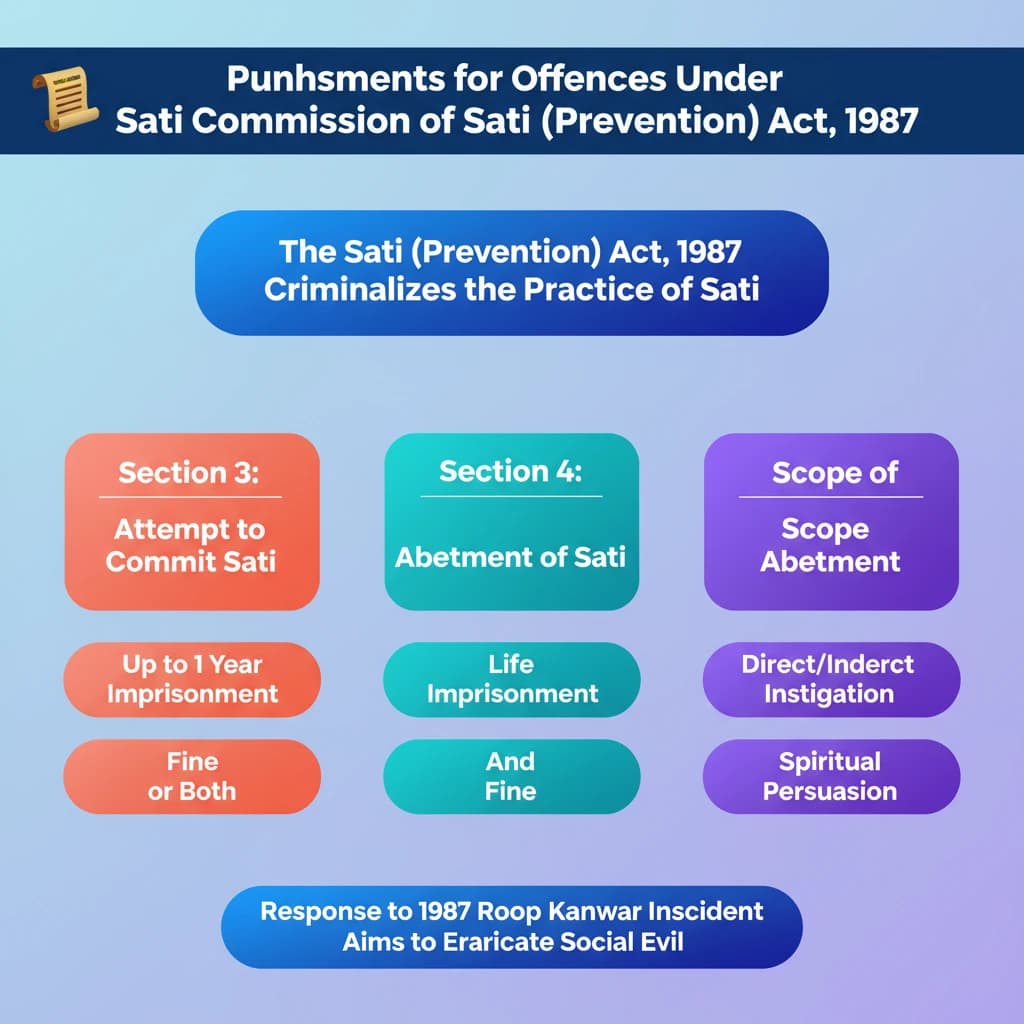
What are the Key Facts Regarding Punishments for Offences Under Sati Commission of Sati (Prevention) Act, 1987? is a key topic under History for UPSC Civil Services Examination. Key points include: The Sati (Prevention) Act, 1987, criminalizes the practice of Sati.. Section 3 punishes 'attempt to commit Sati' with up to one year imprisonment, a fine, or both.. Section 4 punishes 'abetment of Sati' with life imprisonment and a fine.. Understanding this topic is essential for both UPSC Prelims and Mains preparation.

Why is What are the Key Facts Regarding Punishments for Offences Under Sati Commission of Sati (Prevention) Act, 1987? important for UPSC exam?

What are the Key Facts Regarding Punishments for Offences Under Sati Commission of Sati (Prevention) Act, 1987? is a Medium-level topic in UPSC History. It is tested in both Prelims (factual MCQs) and Mains (analytical answer writing). Previous year UPSC questions have frequently covered aspects of What are the Key Facts Regarding Punishments for Offences Under Sati Commission of Sati (Prevention) Act, 1987?, making it essential for comprehensive IAS preparation.

How to prepare What are the Key Facts Regarding Punishments for Offences Under Sati Commission of Sati (Prevention) Act, 1987? for UPSC?

To prepare What are the Key Facts Regarding Punishments for Offences Under Sati Commission of Sati (Prevention) Act, 1987? for UPSC: (1) Study the comprehensive notes covering all key concepts on Vaidra. (2) Practice previous year questions on this topic. (3) Connect it with current affairs using daily updates. (4) Revise using key takeaways and mind maps available for History. (5) Write practice answers linking What are the Key Facts Regarding Punishments for Offences Under Sati Commission of Sati (Prevention) Act, 1987? to related GS Paper topics.

Key takeaways of What are the Key Facts Regarding Punishments for Offences Under Sati Commission of Sati (Prevention) Act, 1987? for UPSC

  • The Sati (Prevention) Act, 1987, criminalizes the practice of Sati.
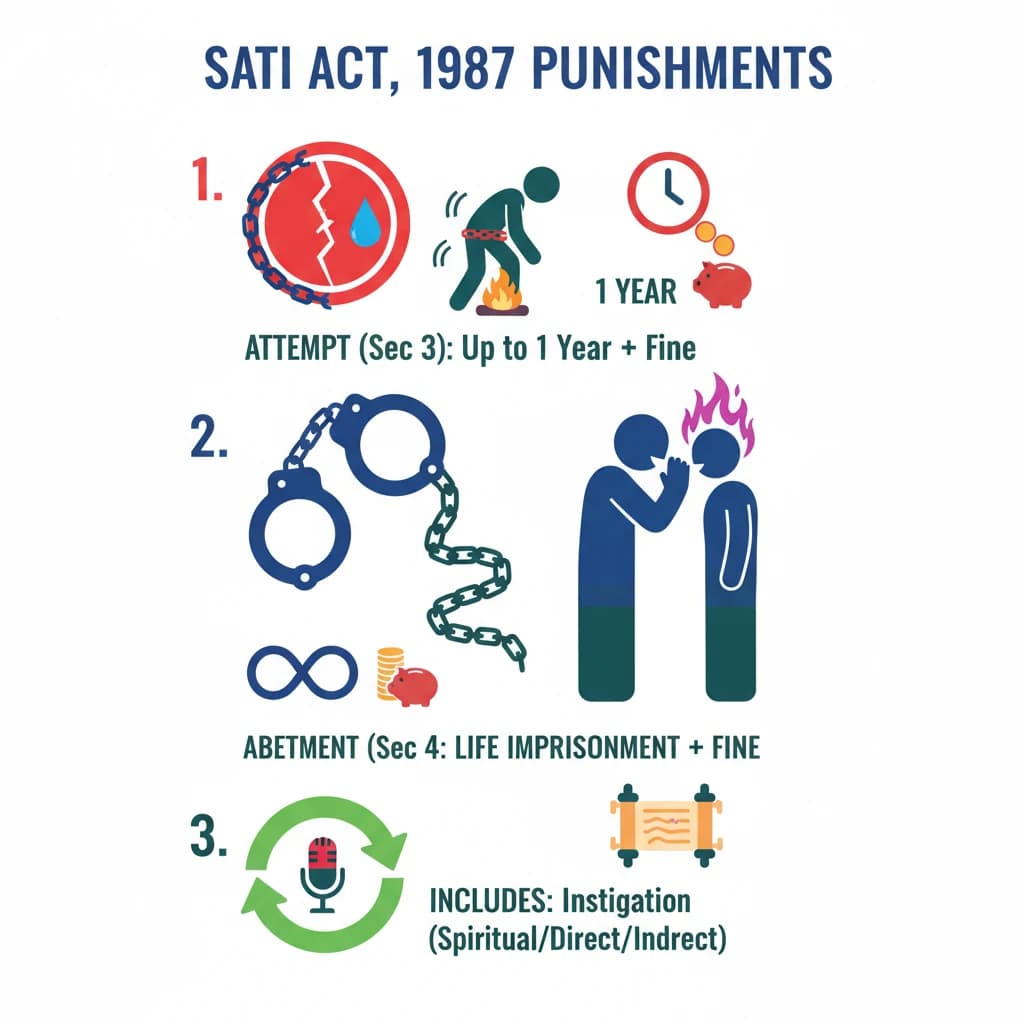
  • Section 3 punishes 'attempt to commit Sati' with up to one year imprisonment, a fine, or both.
  • Section 4 punishes 'abetment of Sati' with life imprisonment and a fine.
  • Abetment includes direct or indirect instigation, such as spiritual persuasion.
  • The Act was a response to the Roop Kanwar incident of 1987 and aims to eradicate this social evil.
  • It reflects India's commitment to human rights, gender equality, and social justice.
What are the Key Facts Regarding Punishments for Offences Under Sati Commission of Sati (Prevention) Act, 1987?

What are the Key Facts Regarding Punishments for Offences Under Sati Commission of Sati (Prevention) Act, 1987?

Medium⏱️ 6 min read✓ 98% Verified
history

📖 Introduction

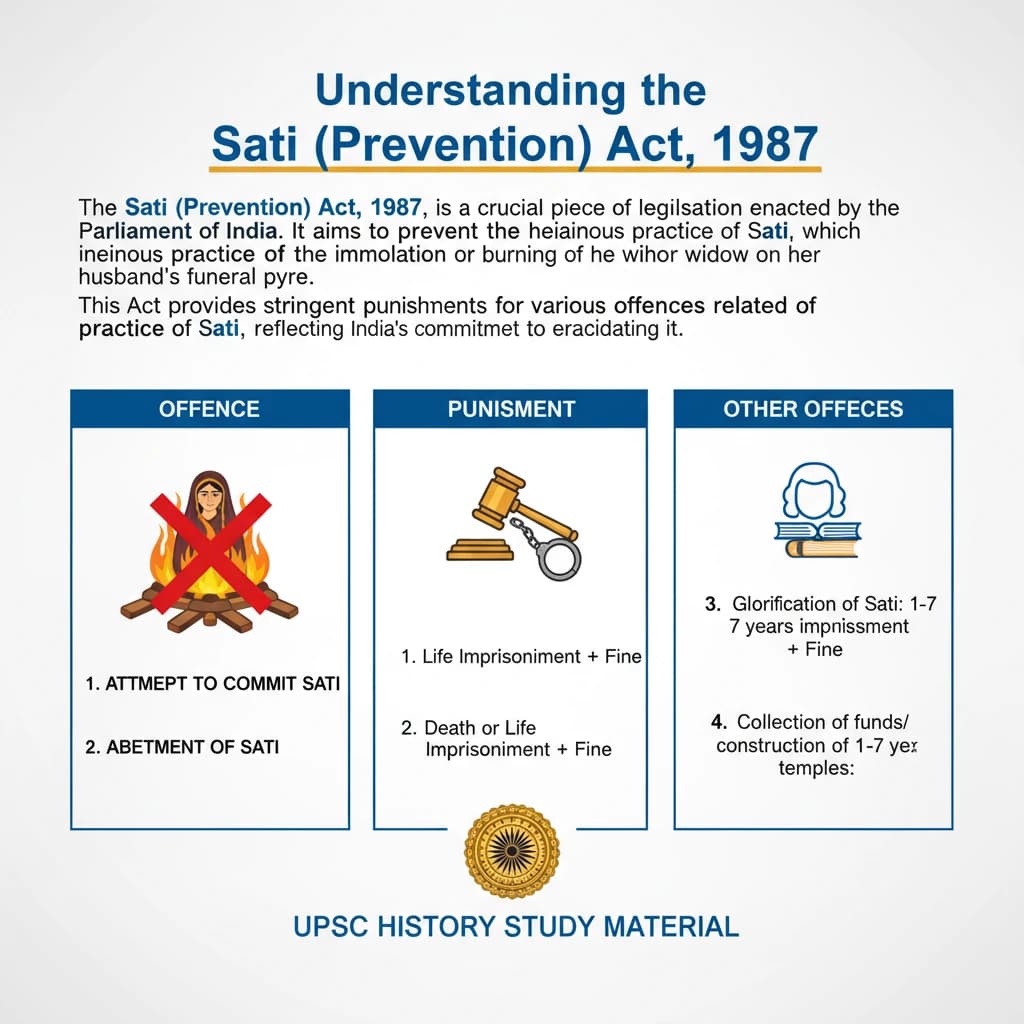
<h4>Understanding the <strong>Sati (Prevention) Act, 1987</strong></h4><p>The <strong>Sati (Prevention) Act, 1987</strong>, is a crucial piece of legislation enacted by the Parliament of India. It aims to prevent the heinous practice of <strong>Sati</strong>, which involves the immolation or burning of a widow on her husband's funeral pyre.</p><p>This Act provides stringent punishments for various offences related to the practice of <strong>Sati</strong>, reflecting India's commitment to eradicating this social evil and upholding human dignity.</p><h4>Punishment for <strong>Attempt to Commit Sati</strong></h4><p><strong>Section 3</strong> of the <strong>Sati (Prevention) Act, 1987</strong>, specifically addresses the act of attempting to commit <strong>Sati</strong>. It criminalizes any individual who takes direct action towards performing <strong>Sati</strong>.</p><div class='info-box'><p><strong>Penalty for Attempt to Commit Sati:</strong></p><ul><li>Up to <strong>one year of imprisonment</strong>.</li><li>A <strong>fine</strong>.</li><li>Or <strong>both</strong>.</li></ul></div><p>This provision ensures that even the initiation of such a practice is met with legal consequences, acting as a deterrent.</p><h4>Punishment for <strong>Abetment of Sati</strong></h4><p>The Act also targets those who encourage or facilitate the practice of <strong>Sati</strong>. <strong>Section 4</strong> deals with the offence of <strong>abetment of Sati</strong>, recognizing that such a practice often involves external pressure or instigation.</p><div class='info-box'><p><strong>Penalty for Abetment of Sati:</strong></p><ul><li><strong>Life imprisonment</strong>.</li><li>A <strong>fine</strong>.</li></ul></div><p><strong>Abetment</strong> can be direct or indirect, encompassing any act that leads a person to commit <strong>Sati</strong>. This includes psychological persuasion or creating an environment where <strong>Sati</strong> is seen as honorable.</p><div class='key-point-box'><p><strong>Example of Abetment:</strong> Convincing a widow or woman that committing <strong>Sati</strong> would bring spiritual benefits for her or her deceased husband, or improve the family’s well-being, falls under the definition of <strong>abetment</strong>.</p></div><div class='exam-tip-box'><p>For <strong>UPSC Mains GS-I (Social Issues)</strong>, understanding the specific sections and their punishments demonstrates a comprehensive grasp of legal frameworks against social evils. Highlight the distinction between 'attempt' and 'abetment' in your answers.</p></div>
Concept Diagram

💡 Key Takeaways

  • •The Sati (Prevention) Act, 1987, criminalizes the practice of Sati.
  • •Section 3 punishes 'attempt to commit Sati' with up to one year imprisonment, a fine, or both.
  • •Section 4 punishes 'abetment of Sati' with life imprisonment and a fine.
  • •Abetment includes direct or indirect instigation, such as spiritual persuasion.
  • •The Act was a response to the Roop Kanwar incident of 1987 and aims to eradicate this social evil.
  • •It reflects India's commitment to human rights, gender equality, and social justice.

🧠 Memory Techniques
Memory Aid
98% Verified Content

📚 Reference Sources

•Drishti IAS Study Material (provided source text)
•Indian Penal Code (IPC) - relevant sections for context on abetment

Related Topics

Loading related topics...
Explore:History Topics·All Subjects·Daily Current Affairs·Editorial Analysis·Previous Year Questions·UPSC GPT