Loading page, please wait…
Vaidra Logo
Vaidra

Top 4 items + smart groups

UPSC GPT
New
Current Affairs
Daily Solutions
Daily Puzzle
Mains Evaluator

Version 2.0.0 • Built with ❤️ for UPSC aspirants

Loading...
Loading...
Loading...
Loading...
Loading...
Loading...
Loading...
Loading...
Loading...
Loading...
Loading...
Loading...
Loading...
Stratigraphical and Typological Studies of Coins - UPSC History
Back
All Subjects

Topics

0 topics • 0 completed

Loading topics...
Loading...
Loading...
Loading...
Loading...
Loading...
Overall Progress0%

Stratigraphical and Typological Studies of Coins - UPSC History

What is Stratigraphical and Typological Studies of Coins in UPSC History?

Stratigraphical and Typological Studies of Coins is a key topic under History for UPSC Civil Services Examination. Key points include: Stratigraphical and Typological studies are core numismatic methods for dating and classifying ancient coins.. The Phanigiri excavations revealed a significant 3730-coin lead hoard attributed to the Ikshvaku period (3rd–4th century CE).. Phanigiri was a major Buddhist monastery strategically located on the ancient Dakshinapatha trade route.. Understanding this topic is essential for both UPSC Prelims and Mains preparation.

Why is Stratigraphical and Typological Studies of Coins important for UPSC exam?

Stratigraphical and Typological Studies of Coins is a Medium-level topic in UPSC History. It is tested in both Prelims (factual MCQs) and Mains (analytical answer writing). Previous year UPSC questions have frequently covered aspects of Stratigraphical and Typological Studies of Coins, making it essential for comprehensive IAS preparation.

How to prepare Stratigraphical and Typological Studies of Coins for UPSC?

To prepare Stratigraphical and Typological Studies of Coins for UPSC: (1) Study the comprehensive notes covering all key concepts on Vaidra. (2) Practice previous year questions on this topic. (3) Connect it with current affairs using daily updates. (4) Revise using key takeaways and mind maps available for History. (5) Write practice answers linking Stratigraphical and Typological Studies of Coins to related GS Paper topics.

Key takeaways of Stratigraphical and Typological Studies of Coins for UPSC

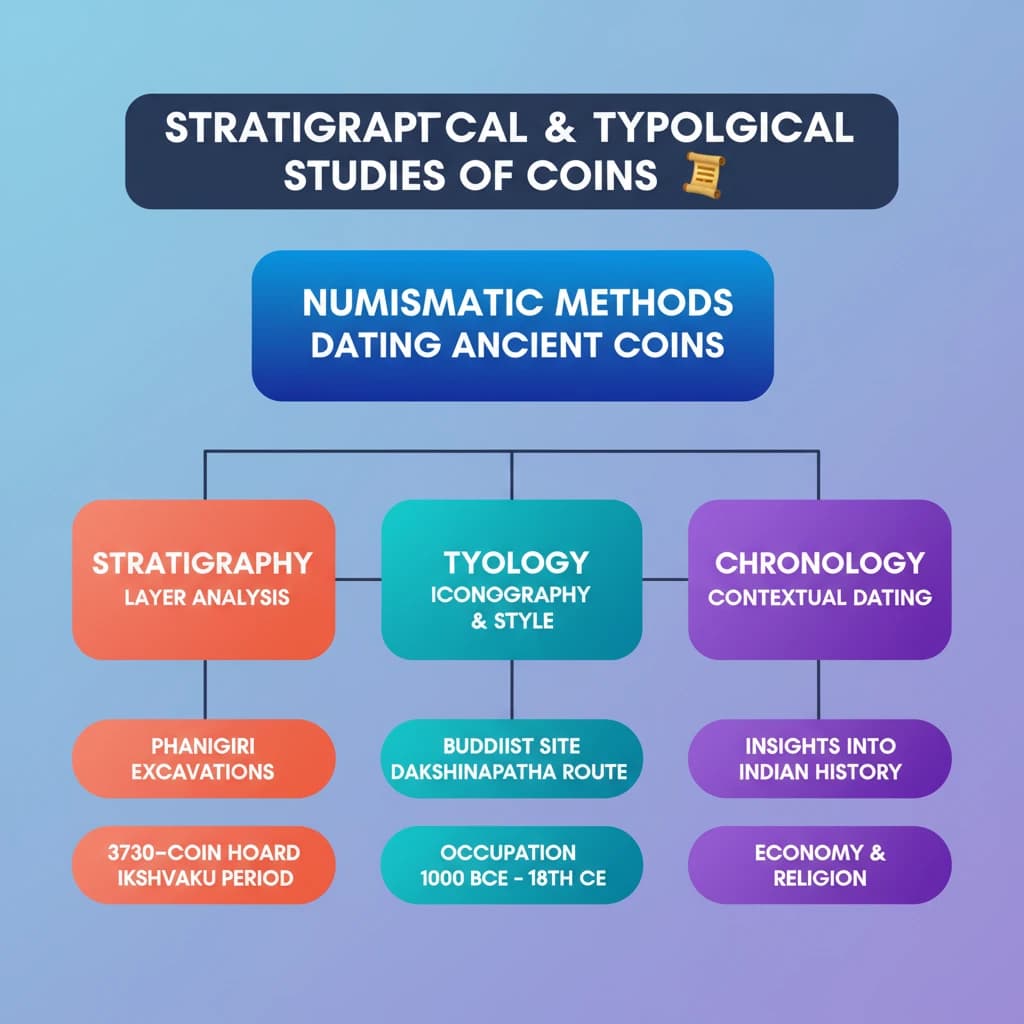
  • Stratigraphical and Typological studies are core numismatic methods for dating and classifying ancient coins.
  • The Phanigiri excavations revealed a significant 3730-coin lead hoard attributed to the Ikshvaku period (3rd–4th century CE).
  • Phanigiri was a major Buddhist monastery strategically located on the ancient Dakshinapatha trade route.
  • The site shows continuous occupation from 1000 BCE to the late 18th century CE, with a vibrant Buddhist complex surpassing Amaravathi and Nagarjunakonda.
  • Archaeological finds at Phanigiri, including coins and structural remains, provide invaluable insights into ancient Indian history, economy, and religious practices.
  • Numismatic evidence helps reconstruct political, economic, and cultural aspects of ancient dynasties like the Ikshvakus.
Stratigraphical and Typological Studies of Coins

Stratigraphical and Typological Studies of Coins

Medium⏱️ 8 min read✓ 95% Verified
history

📖 Introduction

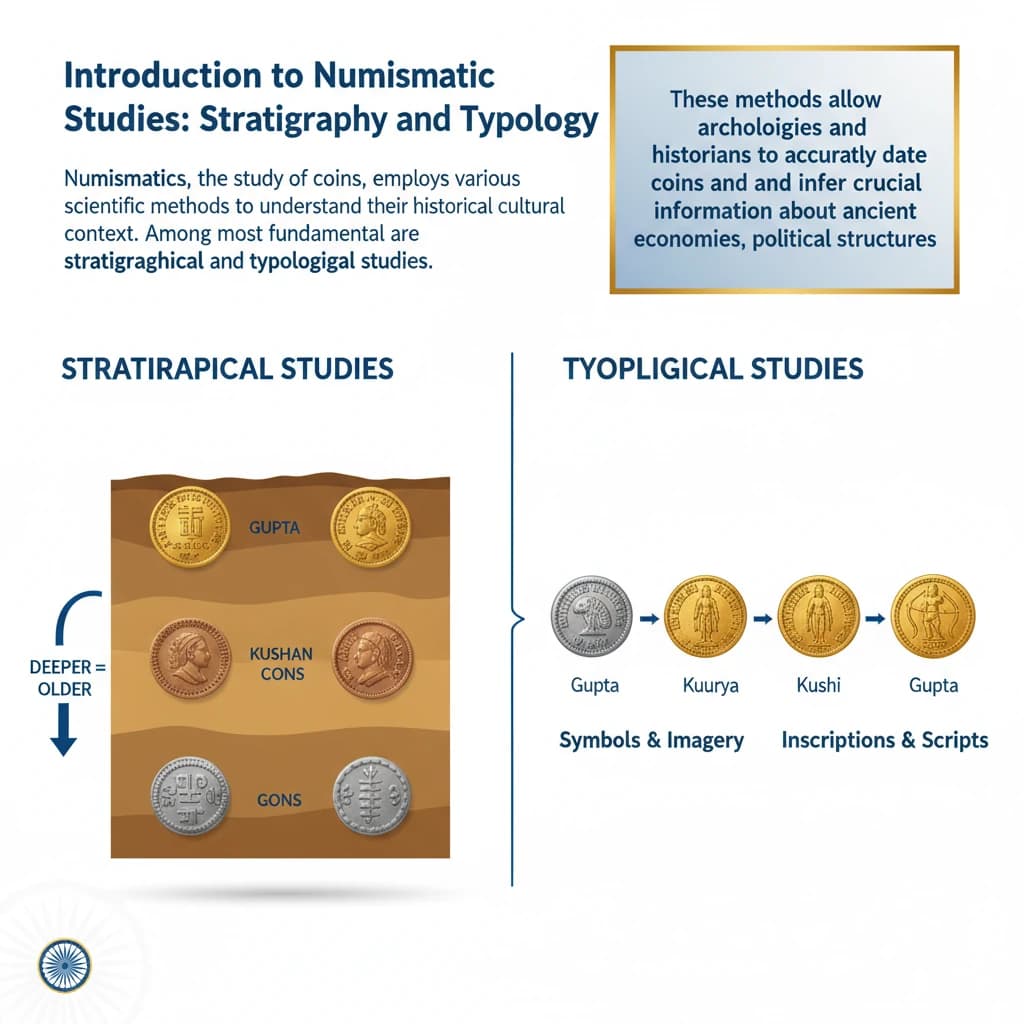
<h4>Introduction to Numismatic Studies: Stratigraphy and Typology</h4><p><strong>Numismatics</strong>, the study of coins, employs various scientific methods to understand their historical and cultural context. Among the most fundamental are <strong>stratigraphical</strong> and <strong>typological studies</strong>.</p><div class='key-point-box'><p>These methods allow archaeologists and historians to accurately date coins and infer crucial information about ancient economies, political structures, and artistic traditions.</p></div><h4>The Phanigiri Coin Hoard: A Significant Discovery</h4><p>During archaeological excavations at <strong>Phanigiri village</strong>, a remarkable hoard of coins was discovered. This find provides a practical illustration of these numismatic techniques.</p><p>The coins were found within a pot, which was carefully sealed with a shallow pot on the outside and a broken bowl base on the inside, indicating intentional burial.</p><div class='info-box'><p><strong>Hoard Details:</strong></p><ul><li><strong>Quantity:</strong> 3730 coins</li><li><strong>Average Weight:</strong> 2.3 grams each</li><li><strong>Material:</strong> Lead</li><li><strong>Obverse Symbol:</strong> Elephant</li><li><strong>Reverse Symbol:</strong> Ujjaini symbol</li></ul></div><p>Based on their appearance, material, and symbols, and critically, the archaeological layer in which they were found, these coins have been attributed to the <strong>Ikshvaku period</strong>.</p><div class='key-point-box'><p>Archaeologists conclude that all coins belong to the <strong>Ikshvaku period</strong> (<strong>3rd–4th century CE</strong>) based on both <strong>stratigraphical</strong> and <strong>typological studies</strong>.</p></div><h4>Other Artefacts Unearthed at Phanigiri</h4><p>Beyond the coin hoard, the excavations at <strong>Phanigiri</strong> brought to light a wealth of other cultural antiquities and structural remains, enriching our understanding of the site.</p><ul><li><strong>Beads:</strong> Stone and glass beads</li><li><strong>Bangle Fragments:</strong> Shell bangle pieces</li><li><strong>Decorative Elements:</strong> Stucco motifs</li><li><strong>Sculptures:</strong> Broken limestone sculptures</li><li><strong>Daily Life Items:</strong> Toy cartwheels, iron nails, pottery</li></ul><h4>Earlier Excavations and Discoveries</h4><p>The site of <strong>Phanigiri</strong> has been a subject of extensive archaeological work over several field seasons, revealing a comprehensive picture of its past.</p><p>Previous excavations uncovered a significant Buddhist monastic complex, highlighting the site's religious importance.</p><ul><li><strong>Major Structures:</strong> A <strong>Mahastupa</strong>, apsidal <strong>Chaitya Grihas</strong>, <strong>Votive stupas</strong>, pillared congregation halls, <strong>Viharas</strong>, platforms with staircases, and an octagonal stupa <strong>Chaitya</strong>.</li><li><strong>Associated Structures:</strong> A <strong>24-pillared mandapa</strong> and a <strong>circular chaitya</strong>.</li><li><strong>Cultural Materials:</strong> Terracotta beads, semi-precious beads, iron objects, shell bangle pieces, coins, stucco figures, <strong>Brahmi label inscriptions</strong>, and a <strong>holy relic casket</strong>.</li></ul><h4>Significance and Location of Phanigiri Village</h4><p><strong>Phanigiri village</strong> holds immense historical and geographical significance, situated strategically in the Deccan region.</p><p>It is located on the left bank of the <strong>Bikkeru Rivulet</strong>, a tributary of the <strong>Musi River</strong>, near <strong>Hyderabad</strong>.</p><div class='info-box'><p><strong>Etymology of Phanigiri:</strong></p><ul><li>The village name derives from a hillock on its northern side resembling a <strong>snake hood</strong>.</li><li>In <strong>Sanskrit</strong>, <strong>Phani</strong> means 'snake' and <strong>Giri</strong> means 'hillock'.</li></ul></div><p>Its location on a hilltop along the ancient trade route known as <strong>Dakshinapatha</strong>, which connected northern and southern India, made it a crucial hub.</p><div class='key-point-box'><p>This strategic position fostered its development as an important <strong>Buddhist monastery</strong>, facilitating cultural and economic exchange.</p></div><h4>Historical Occupation of Phanigiri</h4><p>The site of <strong>Phanigiri</strong> boasts a long and vibrant history of human occupation, spanning millennia.</p><p>It was continuously inhabited by various communities from the <strong>pre/proto-historic</strong>, <strong>early historic</strong>, <strong>early medieval</strong>, and <strong>Asaf Jahi period</strong> (<strong>1724-1948 CE</strong>).</p><div class='info-box'><p><strong>Period of Vibrant Life:</strong> From <strong>1000 BCE</strong> to the <strong>late 18th century CE</strong>.</p></div><p>The evolved <strong>Buddhist monastery</strong> at <strong>Phanigiri</strong> is considered to surpass the grandeur and scale of other renowned monasteries like <strong>Amaravathi</strong> and <strong>Vijayapuri</strong> (<strong>Nagarjunakonda</strong>) in <strong>Andhra Pradesh</strong>.</p><p>The early historic site was first discovered and protected during the <strong>Nizam's period</strong> and subsequently excavated by <strong>Sri Khaja Mahamad Ahmad</strong> from <strong>1941 to 1944</strong>.</p><h4>Other Buddhist Sites in the Region</h4><p>The region surrounding <strong>Phanigiri</strong> is rich in Buddhist heritage, with several other significant sites nearby.</p><ul><li><strong>Nearby Buddhist Sites:</strong> <strong>Vardhamanukota</strong>, <strong>Gajula Banda</strong>, <strong>Tirumalagiri</strong>, <strong>Nagaram</strong>, <strong>Singaram</strong>, <strong>Aravapalli</strong>, <strong>Ayyavaripalli</strong>, <strong>Arlagaddagudem</strong>, and <strong>Yeleswaram</strong>.</li></ul>
Concept Diagram

💡 Key Takeaways

  • •Stratigraphical and Typological studies are core numismatic methods for dating and classifying ancient coins.
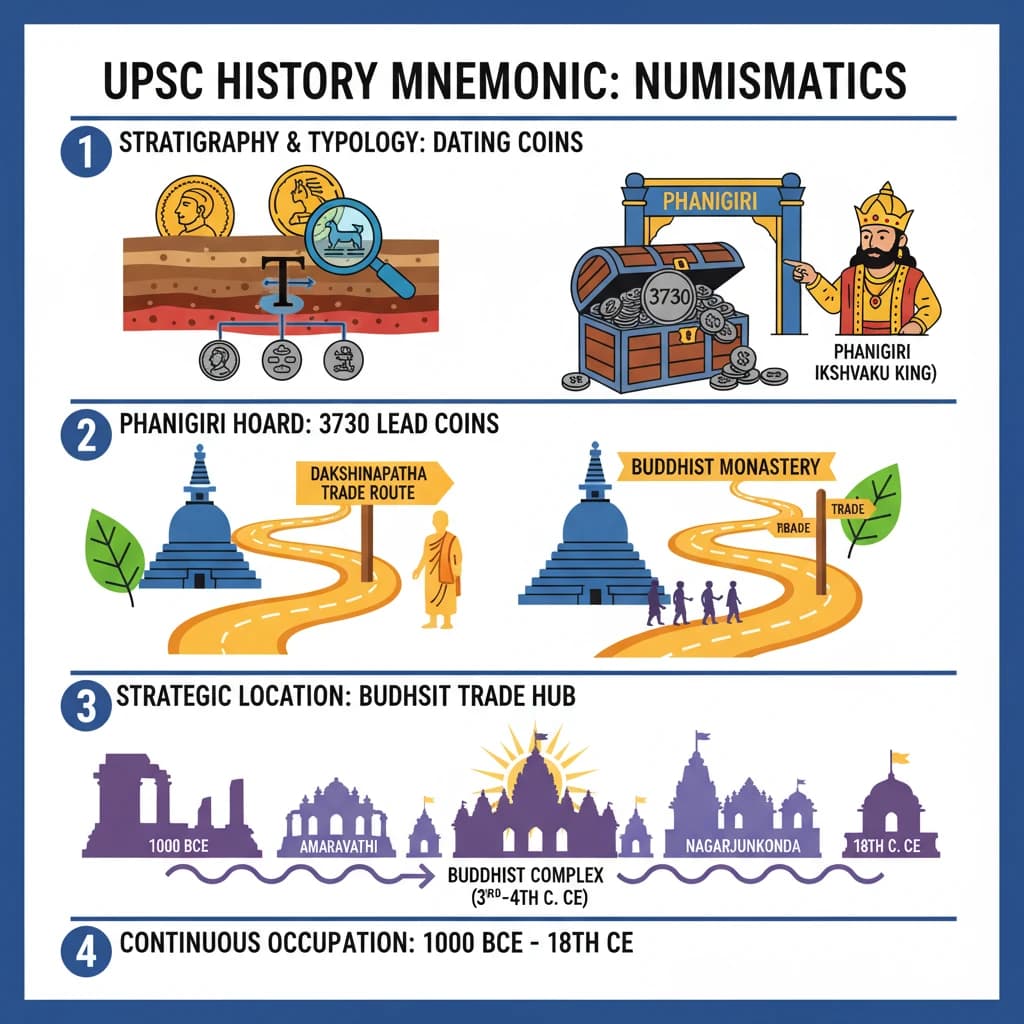
  • •The Phanigiri excavations revealed a significant 3730-coin lead hoard attributed to the Ikshvaku period (3rd–4th century CE).
  • •Phanigiri was a major Buddhist monastery strategically located on the ancient Dakshinapatha trade route.
  • •The site shows continuous occupation from 1000 BCE to the late 18th century CE, with a vibrant Buddhist complex surpassing Amaravathi and Nagarjunakonda.
  • •Archaeological finds at Phanigiri, including coins and structural remains, provide invaluable insights into ancient Indian history, economy, and religious practices.
  • •Numismatic evidence helps reconstruct political, economic, and cultural aspects of ancient dynasties like the Ikshvakus.

🧠 Memory Techniques
Memory Aid
95% Verified Content

Related Topics

Loading related topics...
Explore:History Topics·All Subjects·Daily Current Affairs·Editorial Analysis·Previous Year Questions·UPSC GPT