Loading page, please wait…
Bhakti Saints of Medieval India - UPSC History
What is Bhakti Saints of Medieval India in UPSC History?
Bhakti Saints of Medieval India is a key topic under History for UPSC Civil Services Examination. Key points include: Bhakti movement emphasized personal devotion to God over elaborate rituals and caste distinctions.. It originated in South India (Alvars, Nayanars) and spread across India, influencing various regions.. Prominent saints include Adi Shankara, Ramanujacharya, Basavanna, Guru Nanak, Kabir, Tulsidas, Mirabai, Chaitanya Mahaprabhu.. Understanding this topic is essential for both UPSC Prelims and Mains preparation.
Why is Bhakti Saints of Medieval India important for UPSC exam?
Bhakti Saints of Medieval India is a Medium-level topic in UPSC History. It is tested in both Prelims (factual MCQs) and Mains (analytical answer writing). Previous year UPSC questions have frequently covered aspects of Bhakti Saints of Medieval India, making it essential for comprehensive IAS preparation.
How to prepare Bhakti Saints of Medieval India for UPSC?
To prepare Bhakti Saints of Medieval India for UPSC: (1) Study the comprehensive notes covering all key concepts on Vaidra. (2) Practice previous year questions on this topic. (3) Connect it with current affairs using daily updates. (4) Revise using key takeaways and mind maps available for History. (5) Write practice answers linking Bhakti Saints of Medieval India to related GS Paper topics.
Key takeaways of Bhakti Saints of Medieval India for UPSC
- Bhakti movement emphasized personal devotion to God over elaborate rituals and caste distinctions.
- It originated in South India (Alvars, Nayanars) and spread across India, influencing various regions.
- Prominent saints include Adi Shankara, Ramanujacharya, Basavanna, Guru Nanak, Kabir, Tulsidas, Mirabai, Chaitanya Mahaprabhu.
- Bhakti saints used vernacular languages, significantly enriching regional literature and making spirituality accessible.
- The movement fostered social equality, challenged orthodoxies, and left a lasting legacy on Indian culture and values.
Bhakti Saints of Medieval India
Medium⏱️ 10 min read
history
📖 Introduction
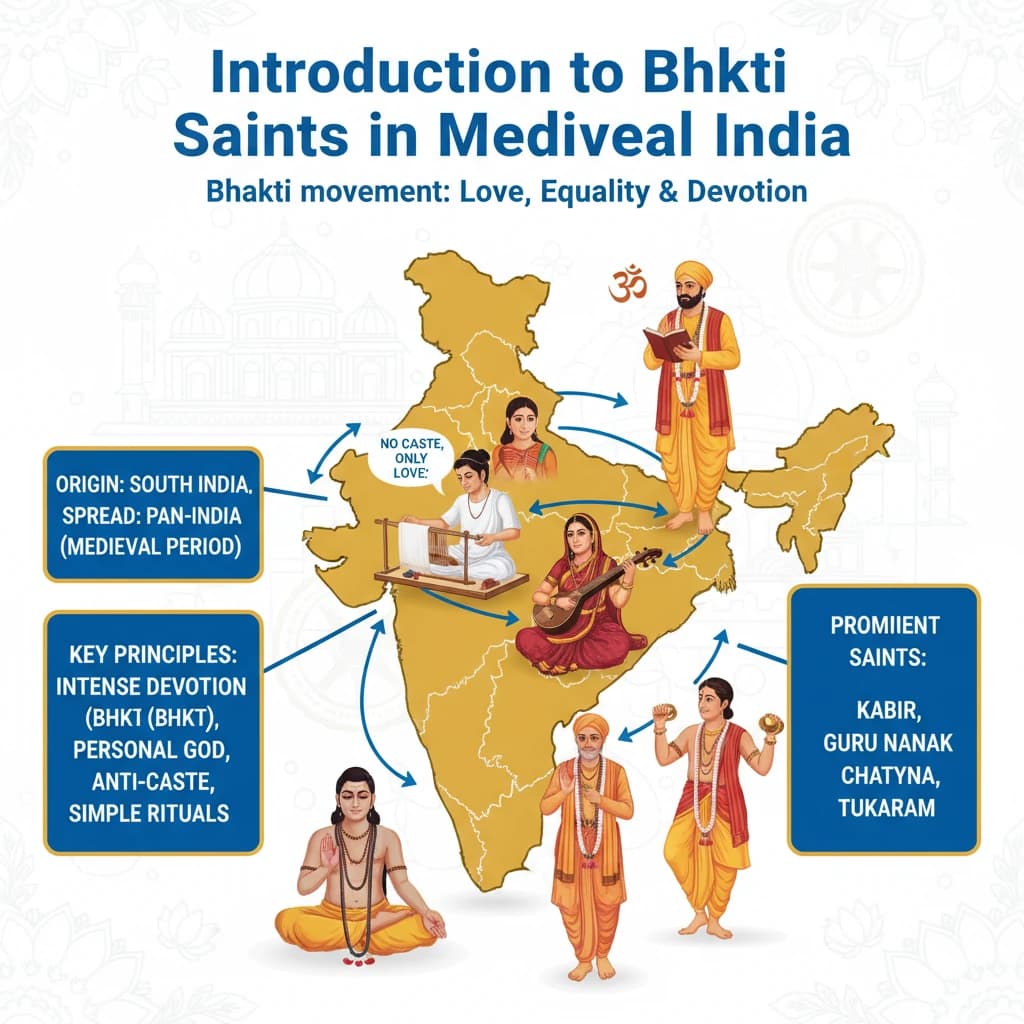
Introduction to Bhakti Saints in Medieval India
The Bhakti movement was a significant religious and social reform movement that originated in South India and spread across the subcontinent during the medieval period. It emphasized intense devotion (Bhakti) to a personal God, transcending rigid caste systems and elaborate rituals.
This movement saw the rise of numerous saints who preached messages of love, equality, and spiritual liberation through simple devotion, often in vernacular languages.
Early Bhakti Saints: Alvars and Nayanars (7th-8th Century)
The Bhakti tradition gained prominence in South India with the Alvar and Nayanar saints. These devotional poets and mystics expressed their love for Vishnu and Shiva, respectively.
The Alvars were devotees of Lord Vishnu, with Thondaradipodi, Nammalvar, and Andal (the only female Alvar) being prominent figures. The Nayanars were devotees of Lord Shiva, including figures like Appar, Sambandar, and Sundarar.
Adi Shankara and the Advaita Philosophy (8th Century)
While not a Bhakti saint in the devotional sense, Adi Shankara, an influential philosopher from the 8th century, significantly shaped Indian thought. He propounded the doctrine of Advaita Vedanta.
Advaita Vedanta emphasizes the ultimate oneness of the individual soul (Atman) with the ultimate reality (Brahman), advocating knowledge as the path to liberation.
Philosophical Foundations: Ramanujacharya (12th Century)
Ramanujacharya, a prominent philosopher of the 12th century, offered a different philosophical perspective known as Vishishtadvaita (qualified non-dualism). He integrated devotion with philosophical inquiry.
His teachings emphasized that the individual soul is a part of Brahman and that devotion to Lord Vishnu is the primary means to attain salvation.
Lingayat Saints (12th Century)
The Lingayat movement emerged in Karnataka in the 12th century, led by Basavanna. This movement strongly opposed the caste system, ritualism, and the authority of the Vedas.
Key Lingayat Saints include Basavanna, Allama Prabhu, and Akka Mahadevi. They advocated for social equality and personal devotion to Shiva, worshipped in the form of an Ishtalinga.
Maharashtra Bhakti Tradition (13th-17th Century)
The Bhakti movement flourished in Maharashtra, giving rise to the Varkari tradition. This regional movement centered around devotion to Vitthala (a form of Vishnu).
- Jnaneshwar (13th cent): Author of the Jnaneshwari, a commentary on the Bhagavad Gita in Marathi.
- Namdev (14th cent): A poet-saint whose devotional songs (abhangs) are revered.
- Family of Chokhamba (13th cent): A Dalit saint family who faced caste discrimination but preached devotion.
- Eknath (16th cent): Known for his Marathi commentaries and devotional compositions.
- Tukaram (17th cent): A prominent Varkari saint whose abhangs are central to Marathi spiritual life.
Northern Bhakti Saints (14th-17th Century)
The Bhakti movement spread to North India, evolving into diverse traditions with unique philosophical and social dimensions.
Ramananda (14th Century)
Ramananda was a pioneering saint in North India, credited with taking the Bhakti message to the common people. He accepted disciples from all castes, including women.
Laleshwari or Lal Ded (14th Century)
Laleshwari, also known as Lal Ded, was a female mystic of Kashmir. Her poetic verses, known as Vakhs, are a significant part of Kashmiri literature and philosophy, advocating for inner spiritual realization.
Guru Nanak (15th-16th Century)
Guru Nanak, the founder of Sikhism, preached a message of universal brotherhood, devotion to one God (Ik Onkar), and selfless service. His teachings are compiled in the Guru Granth Sahib.
Shankardeva (15th Century)
Shankardeva was a prominent saint from Assam who propagated Ekasarana Dharma, a monotheistic Vaishnavite tradition. He used music, drama (Ankia Naat), and poetry to spread his message.
Tulsidas (15th Century)
Tulsidas was a great poet-saint known for his devotion to Lord Rama. His most famous work is the Ramcharitmanas, a retelling of the Ramayana.
Tulsidas's works, primarily written in Brajbhasha and Awadhi dialects, significantly influenced Indian Literature and the development of the Hindi language.
Chaitanya Mahaprabhu (15th-16th Century)
Chaitanya Mahaprabhu was a Bengali saint who popularized the Hare Krishna mantra and the practice of Kirtan (congregational chanting). He emphasized ecstatic devotion to Lord Krishna.
Mirabai (15th-16th Century)
Mirabai was a Rajput princess and a devout devotee of Lord Krishna. Her devotional songs (bhajans) express her intense love and spiritual longing, often defying societal norms of her time.
Kabirdas (16th Century)
Kabirdas was a mystic poet and saint whose works profoundly influenced the Bhakti movement. He critiqued both Hindu and Islamic orthodoxies, advocating for a universal path of devotion.
Vallabhacharya (16th Century)
Vallabhacharya was a philosopher who founded the Pushtimarg sect of Vaishnavism. He advocated for Shuddhadvaita (pure non-dualism) and emphasized devotion to Lord Krishna through selfless love.
Raidas (16th Century)
Raidas (also Ravidas) was a Dalit saint and contemporary of Kabir. His devotional songs and verses criticized the caste system and promoted equality, inner purity, and devotion.
Surdas (16th Century)
Surdas was a blind poet-saint known for his devotion to Lord Krishna. His collection of poems, Sursagar, depicts the childhood pastimes of Krishna and Radha's love, written in Brajbhasha.
Dadu Dayal (16th-17th Century)
Dadu Dayal was a saint from Rajasthan who founded the Dadu Panth. He preached a non-sectarian path to God, emphasizing inner experience and devotion over external rituals.
💡 Key Takeaways
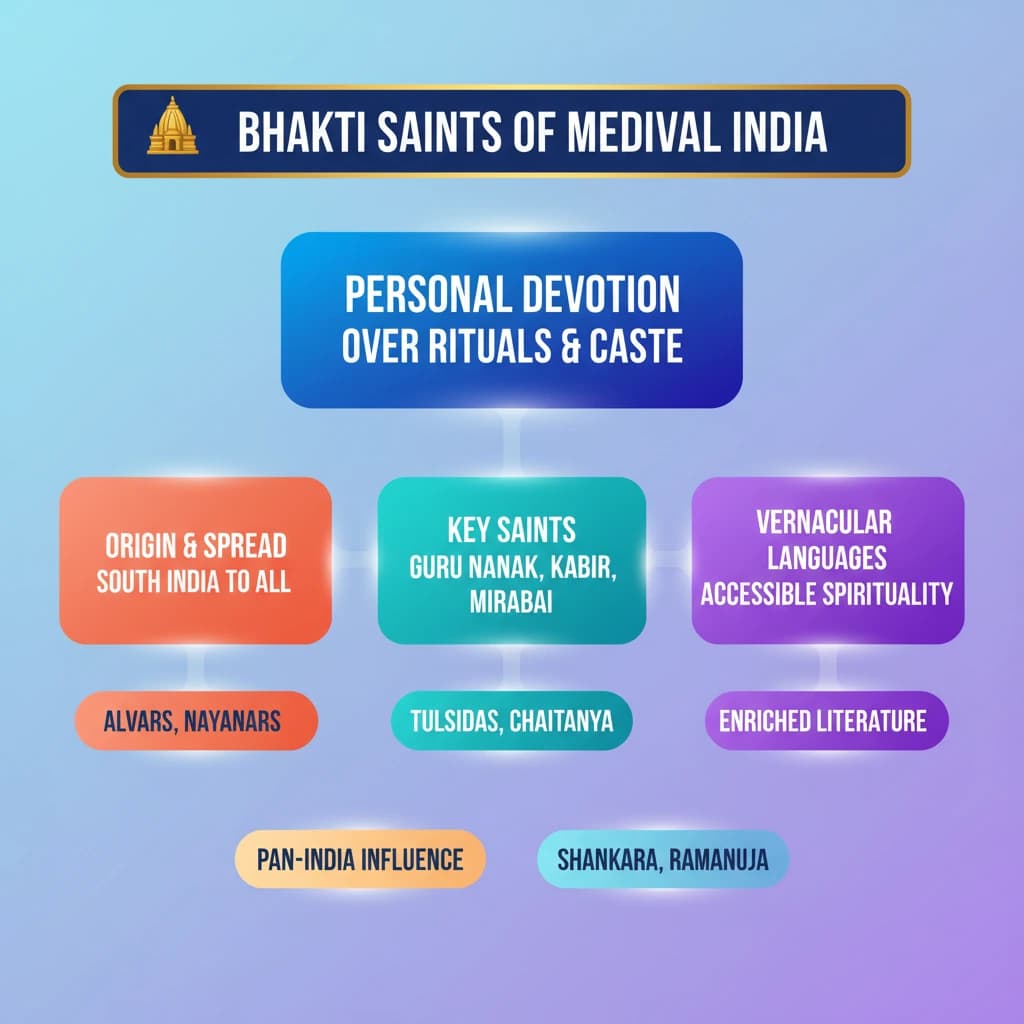
- •Bhakti movement emphasized personal devotion to God over elaborate rituals and caste distinctions.
- •It originated in South India (Alvars, Nayanars) and spread across India, influencing various regions.
- •Prominent saints include Adi Shankara, Ramanujacharya, Basavanna, Guru Nanak, Kabir, Tulsidas, Mirabai, Chaitanya Mahaprabhu.
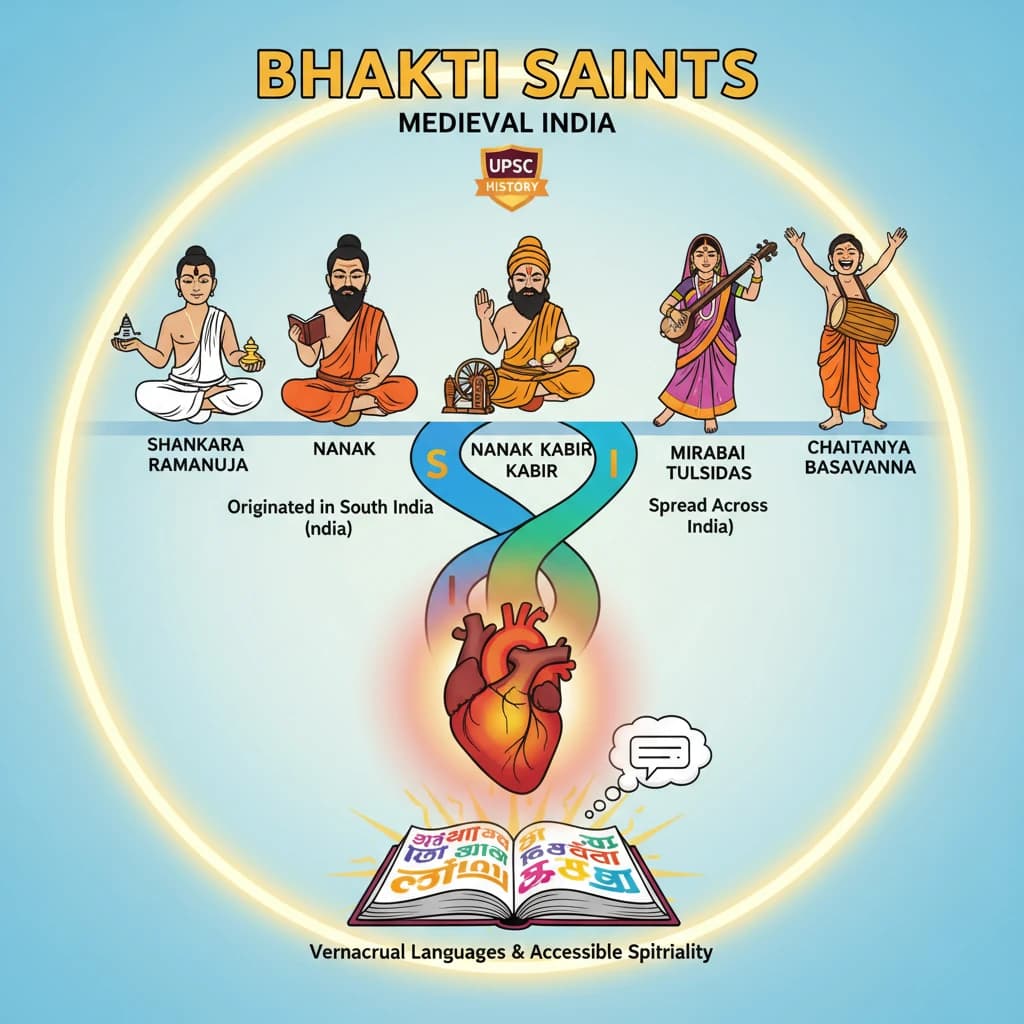
- •Bhakti saints used vernacular languages, significantly enriching regional literature and making spirituality accessible.
- •The movement fostered social equality, challenged orthodoxies, and left a lasting legacy on Indian culture and values.
🧠 Memory Techniques
95% Verified Content