📖 Introduction
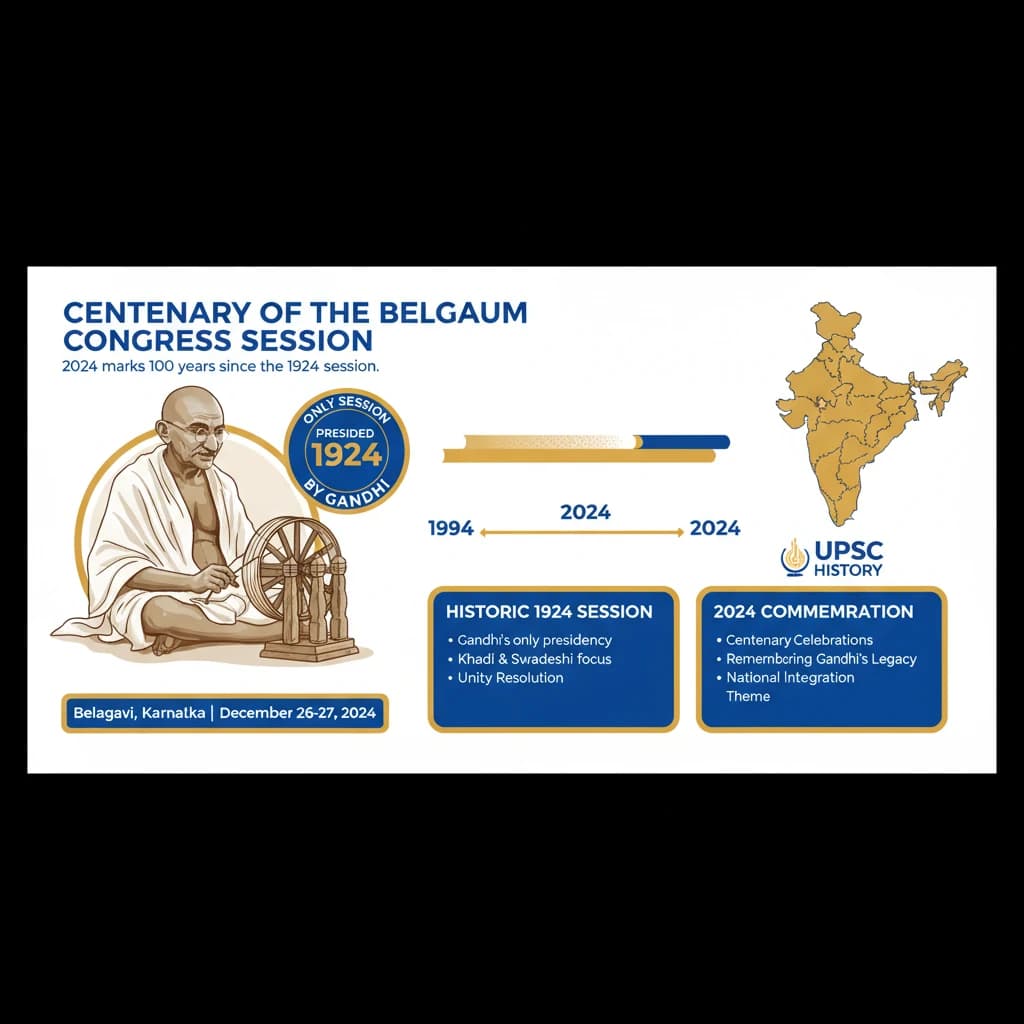
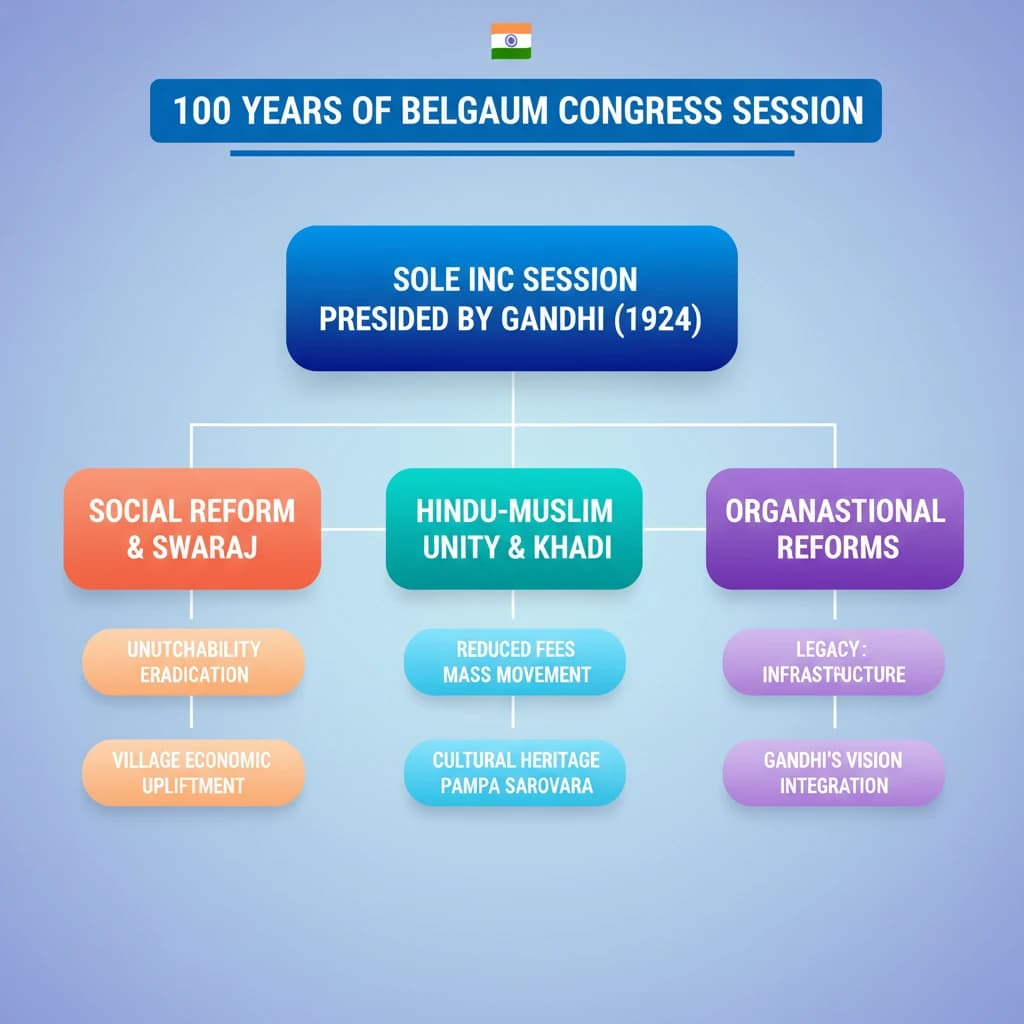
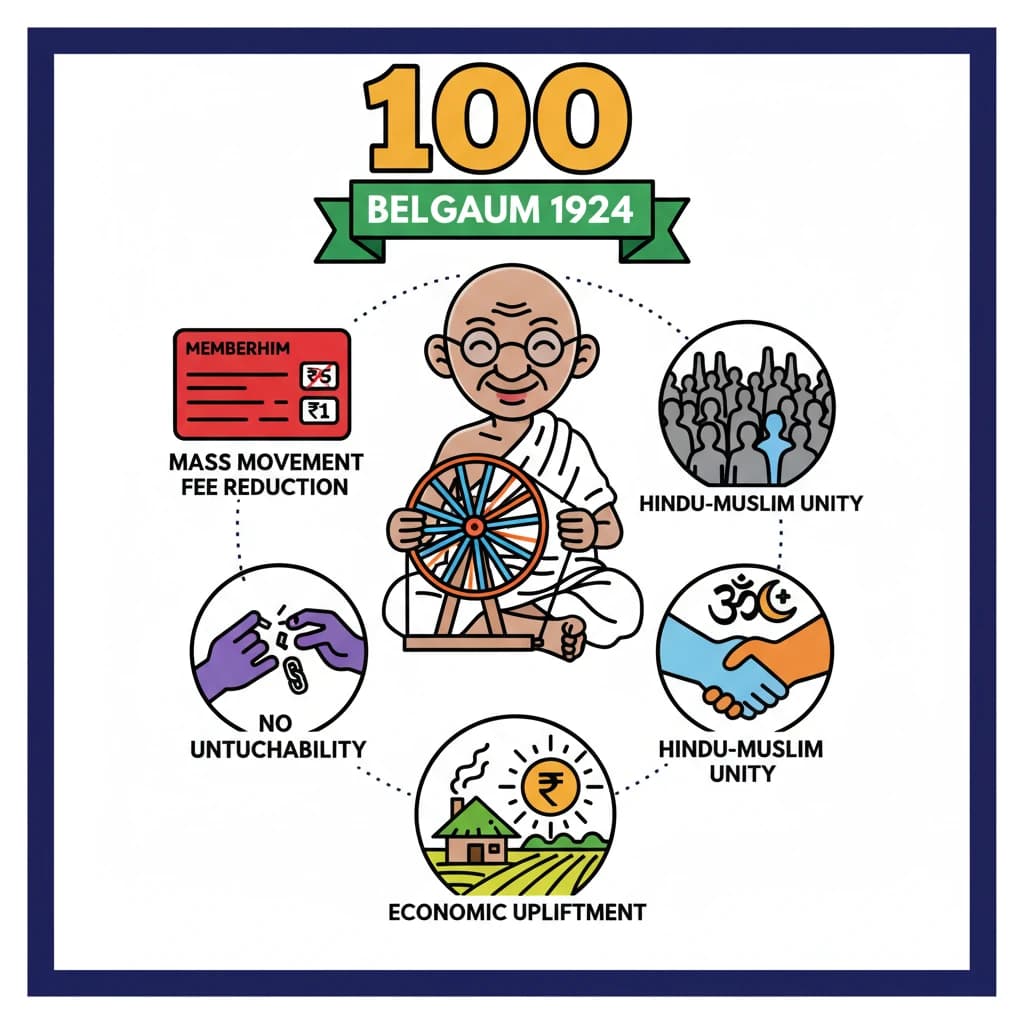
<h4>Centenary of the Belgaum Congress Session</h4><p>The year <strong>2024</strong> marks the <strong>centenary</strong> of the historic <strong>1924 Belgaum Congress session</strong>. This significant event is being commemorated in <strong>Belagavi, Karnataka</strong>, on <strong>December 26-27, 2024</strong>.</p><p>The session is particularly remembered for being the <strong>only All-India Congress session</strong> presided over by <strong>Mahatma Gandhi</strong>. His leadership brought pivotal changes to the party's ideology and organizational structure.</p><div class='info-box'><p><strong>Event:</strong> Centenary of 1924 Belgaum Congress Session</p><p><strong>Location:</strong> Belagavi, Karnataka</p><p><strong>Date:</strong> December 26-27, 2024</p></div><h4>Gandhi's Unique Leadership at Belgaum</h4><p><strong>Mahatma Gandhi</strong> served as the <strong>Congress President</strong> from <strong>December 1924 to April 1925</strong>, with the Belgaum session being his sole presidential tenure. His presence elevated the session's importance, making it a landmark event in the freedom struggle.</p><p>Gandhi's first visit to <strong>Belgaum</strong> was in <strong>1916</strong>, at the invitation of local leader <strong>Gangadharrao Deshpande</strong>. This laid the groundwork for his later association with the region.</p><div class='key-point-box'><p><strong>Key Fact:</strong> The <strong>1924 Belgaum session</strong> was the <strong>only Indian National Congress session</strong> ever presided over by <strong>Mahatma Gandhi</strong>.</p></div><h4>Emphasis on Social Change and Reform</h4><p>Under Gandhi's leadership, the <strong>Belgaum session</strong> transformed the <strong>Indian National Congress</strong> into a movement for both <strong>political independence</strong> and profound <strong>social reform</strong>. He advocated for several key social initiatives.</p><ul><li><strong>Combating Untouchability:</strong> Gandhi strongly emphasized the eradication of <strong>untouchability</strong>, integrating social equality into the national movement.</li><li><strong>Promoting Khadi:</strong> The session mandated <strong>khadi spinning</strong> for all Congress members, requiring the submission of <strong>2,000 yards of khadi cloth monthly</strong>.</li><li><strong>Supporting Village Industries:</strong> Gandhi championed <strong>village industries</strong> as a means of economic self-reliance and empowerment for the masses.</li></ul><h4>Organizational Reforms by Gandhi</h4><p>Gandhi also introduced significant organizational changes within the Congress to make it more inclusive and grassroots-oriented. He aimed to broaden the party's appeal and membership.</p><p>He drastically <strong>reduced Congress membership fees by 90%</strong>. This move made the party more accessible to ordinary people, strengthening its base across various sections of society.</p><h4>Advocacy for Hindu-Muslim Unity</h4><p>A crucial aspect of Gandhi's address at Belgaum was his fervent appeal for <strong>Hindu-Muslim unity</strong>. He recognized this unity as indispensable for the success of the broader freedom movement against British rule.</p><p>Gandhi also addressed the sensitive issue of <strong>cow protection</strong>, clarifying that his advocacy was rooted in economic upliftment for farmers and was not linked to religious conversion or violence against Muslims.</p><h4>Focus on Social and Economic Upliftment</h4><p>Beyond political and social reforms, Gandhi also highlighted practical aspects of community welfare. His vision encompassed a holistic development approach for Indian villages.</p><ul><li><strong>Sanitation and Town Planning:</strong> He focused on improving <strong>sanitation</strong> and promoting better <strong>town planning</strong>, recognizing their importance for public health and quality of life.</li><li><strong>Economic Use of Cows:</strong> Gandhi emphasized the economic utility of cows for farmers, advocating for their protection as an agricultural asset rather than solely a religious symbol.</li></ul><p>He lauded the <strong>sanitation volunteers</strong> at the session, noting that <strong>40 out of 70 were Brahmins</strong>. This highlighted the importance of social service transcending caste barriers.</p><h4>Critique of Extravagance and Call for Equality</h4><p>Gandhi, ever the advocate for simplicity and equality, openly criticized the <strong>excessive expenditure</strong> on VIPs during the session. He called for equal treatment for all members in future Congress sessions.</p><div class='exam-tip-box'><p><strong>UPSC Insight:</strong> Gandhi's actions at Belgaum demonstrate his commitment to <strong>inclusive politics</strong>, <strong>social justice</strong>, and <strong>ethical leadership</strong>, which are recurring themes in <strong>UPSC Mains GS Paper I (Modern Indian History)</strong> and <strong>GS Paper IV (Ethics)</strong>.</p></div><h4>Cultural Significance of the Session</h4><p>The <strong>Belgaum session</strong> was not just a political gathering but also a cultural landmark. It showcased the rich artistic heritage of India, integrating culture into the national movement.</p><p>Notable musical performances graced the session, including those by <strong>Hindustani maestro Vishnu Digambar Paluskar</strong> and a young <strong>Gangubai Hangal</strong>. The <strong>Kannada song “Udayavagali Namma Chaluva Kannada Nadu”</strong> was also sung, celebrating regional identity.</p><h4>Legacy of the Session</h4><p>The practical legacy of the session endures in Belagavi. The <strong>Pampa Sarovara well</strong>, dug specifically for the <strong>1924 session</strong>, continues to provide water to parts of <strong>south Belagavi</strong> even today.</p>