Loading page, please wait…
Vaidra Logo
Vaidra

Top 4 items + smart groups

UPSC GPT
New
Current Affairs
Daily Solutions
Daily Puzzle
Mains Evaluator

Version 2.0.0 • Built with ❤️ for UPSC aspirants

Loading...
Loading...
Loading...
Loading...
Loading...
Loading...
Loading...
Loading...
Loading...
Loading...
Loading...
Loading...
Loading...
Back
All Subjects

Topics

0 topics • 0 completed

Loading topics...
Loading...
Loading...
Loading...
Loading...
Loading...
Overall Progress0%

Vijayanagara Empire: Portuguese Relations, Trade, and Military Aid - UPSC History

What is Vijayanagara Empire: Portuguese Relations, Trade, and Military Aid in UPSC History?

Vijayanagara Empire: Portuguese Relations, Trade, and Military Aid is a key topic under History for UPSC Civil Services Examination. Key points include: Hampi, the capital of the Vijayanagara Empire, is a UNESCO World Heritage Site (1986).. Four dynasties ruled Vijayanagara: Sangama, Saluva, Tuluva, and Aravidu.. The empire flourished from 1336 to ~1660, declining after a major defeat by Deccan sultanates.. Understanding this topic is essential for both UPSC Prelims and Mains preparation.

Why is Vijayanagara Empire: Portuguese Relations, Trade, and Military Aid important for UPSC exam?

Vijayanagara Empire: Portuguese Relations, Trade, and Military Aid is a Medium-level topic in UPSC History. It is tested in both Prelims (factual MCQs) and Mains (analytical answer writing). Previous year UPSC questions have frequently covered aspects of Vijayanagara Empire: Portuguese Relations, Trade, and Military Aid, making it essential for comprehensive IAS preparation.

How to prepare Vijayanagara Empire: Portuguese Relations, Trade, and Military Aid for UPSC?

To prepare Vijayanagara Empire: Portuguese Relations, Trade, and Military Aid for UPSC: (1) Study the comprehensive notes covering all key concepts on Vaidra. (2) Practice previous year questions on this topic. (3) Connect it with current affairs using daily updates. (4) Revise using key takeaways and mind maps available for History. (5) Write practice answers linking Vijayanagara Empire: Portuguese Relations, Trade, and Military Aid to related GS Paper topics.

Key takeaways of Vijayanagara Empire: Portuguese Relations, Trade, and Military Aid for UPSC

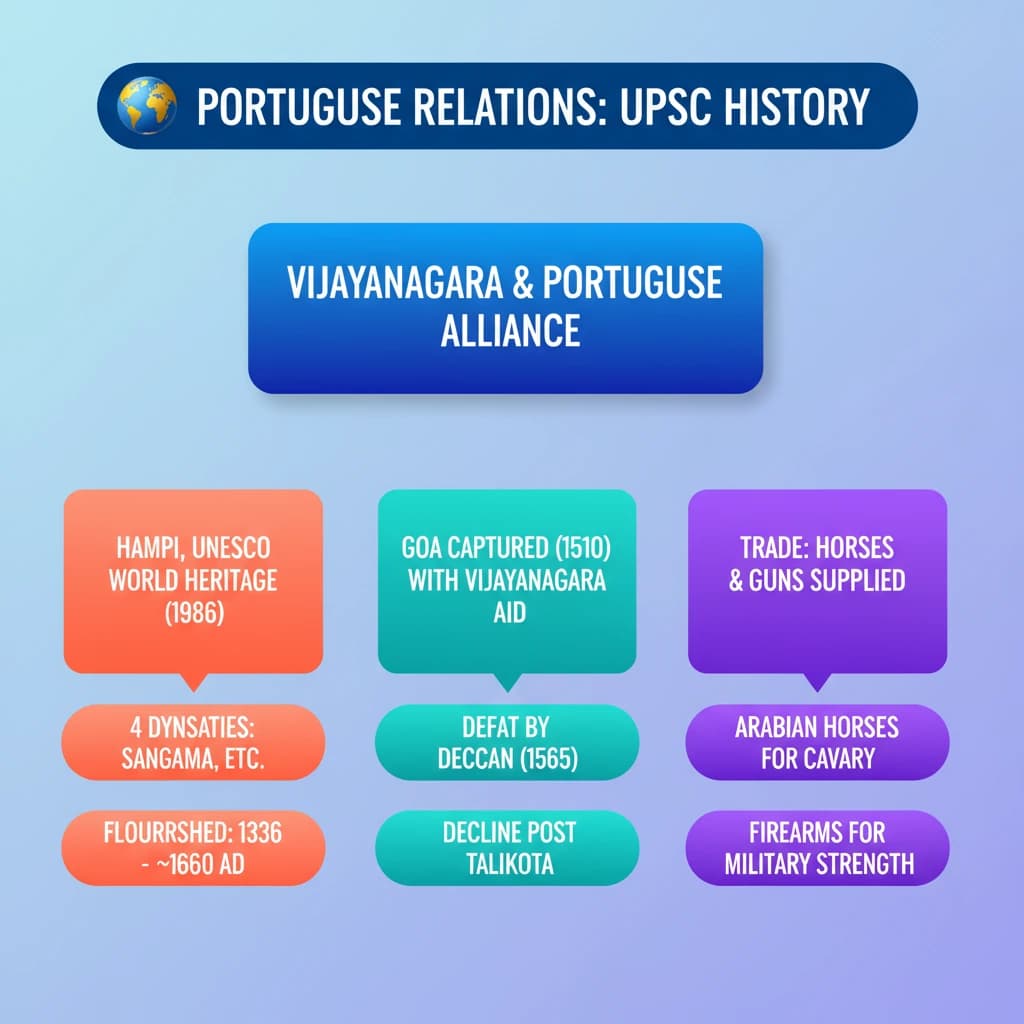
  • Hampi, the capital of the Vijayanagara Empire, is a UNESCO World Heritage Site (1986).
  • Four dynasties ruled Vijayanagara: Sangama, Saluva, Tuluva, and Aravidu.
  • The empire flourished from 1336 to ~1660, declining after a major defeat by Deccan sultanates.
  • Portuguese captured Goa around 1510 from Bijapur, with crucial support from Vijayanagara.
  • Portuguese supplied guns and Arabian horses to Vijayanagara.
  • Vijayanagara exported cotton, rice, sugar, spices, indigo, and wooden goods to the Portuguese.
Vijayanagara Empire: Portuguese Relations, Trade, and Military Aid

Vijayanagara Empire: Portuguese Relations, Trade, and Military Aid

Medium⏱️ 8 min read✓ 98% Verified
history

📖 Introduction

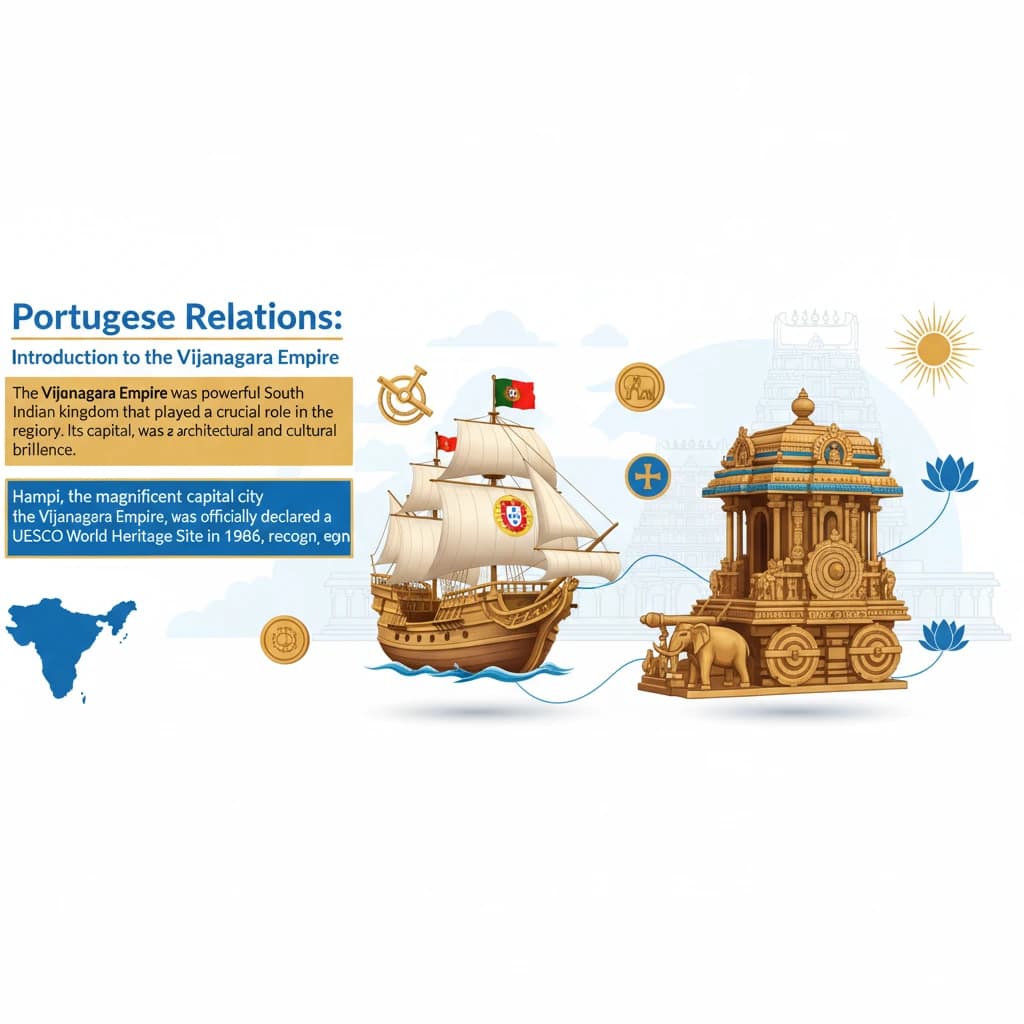
<h4>Introduction to the Vijayanagara Empire</h4><p>The <strong>Vijayanagara Empire</strong> was a powerful South Indian kingdom that played a crucial role in the region's history. Its capital, <strong>Hampi</strong>, was a center of architectural and cultural brilliance.</p><div class="info-box"><p><strong>Hampi</strong>, the magnificent capital city of the <strong>Vijayanagara Empire</strong>, was officially declared a <strong>UNESCO World Heritage Site</strong> in <strong>1986</strong>, recognizing its outstanding universal value.</p></div><h4>Dynasties of Vijayanagara</h4><p>The empire witnessed the rule of four prominent dynasties, each contributing to its legacy and expansion.</p><ul><li>The <strong>Sangama Dynasty</strong></li><li>The <strong>Saluva Dynasty</strong></li><li>The <strong>Tuluva Dynasty</strong></li><li>The <strong>Aravidu Dynasty</strong></li></ul><h4>Timeline and Decline of the Empire</h4><p>The <strong>Vijayanagara Empire</strong> flourished from its establishment in <strong>1336</strong> until approximately <strong>1660</strong>. However, its final century was marked by a gradual but significant decline.</p><p>This decline was largely precipitated by a devastating defeat at the hands of an alliance of <strong>Deccan sultanates</strong>. Following this, the capital city, <strong>Hampi</strong>, was captured, extensively looted, and subsequently destroyed.</p><h4>Early Portuguese Engagement with Vijayanagara</h4><p>The arrival of the <strong>Portuguese</strong> in India in the early 16th century led to new political and economic dynamics, particularly with powerful regional kingdoms like <strong>Vijayanagara</strong>.</p><div class="key-point-box"><p>A significant event demonstrating this interaction occurred around <strong>1510</strong>, when the <strong>Portuguese</strong> successfully captured <strong>Goa</strong>. This strategic acquisition, previously under the <strong>Sultan of Bijapur</strong>, was achieved with the crucial support and cooperation of the <strong>Vijayanagara Empire</strong>.</p></div><h4>Trade and Military Exchange</h4><p>The relationship between the <strong>Portuguese</strong> and the <strong>Vijayanagara Empire</strong> was characterized by a mutually beneficial trade and military exchange.</p><ul><li><strong>Portuguese Supplies:</strong> The <strong>Portuguese</strong> were key suppliers of essential military assets, including modern <strong>guns</strong> and high-quality <strong>Arabian horses</strong>, which were vital for the empire's cavalry.</li><li><strong>Vijayanagara Exports:</strong> In return, the <strong>Vijayanagara Empire</strong> exported a diverse range of valuable commodities, such as <strong>cotton</strong>, <strong>rice</strong>, <strong>sugar</strong>, various <strong>spices</strong>, <strong>indigo</strong>, and different types of <strong>wooden goods</strong>.</li></ul><div class="exam-tip-box"><p>Understanding these specific trade items and military alliances is crucial for <strong>UPSC Prelims</strong> and for enriching answers in <strong>UPSC Mains GS Paper 1 (History)</strong> on the economic and political impact of early European presence in India.</p></div>
Concept Diagram

💡 Key Takeaways

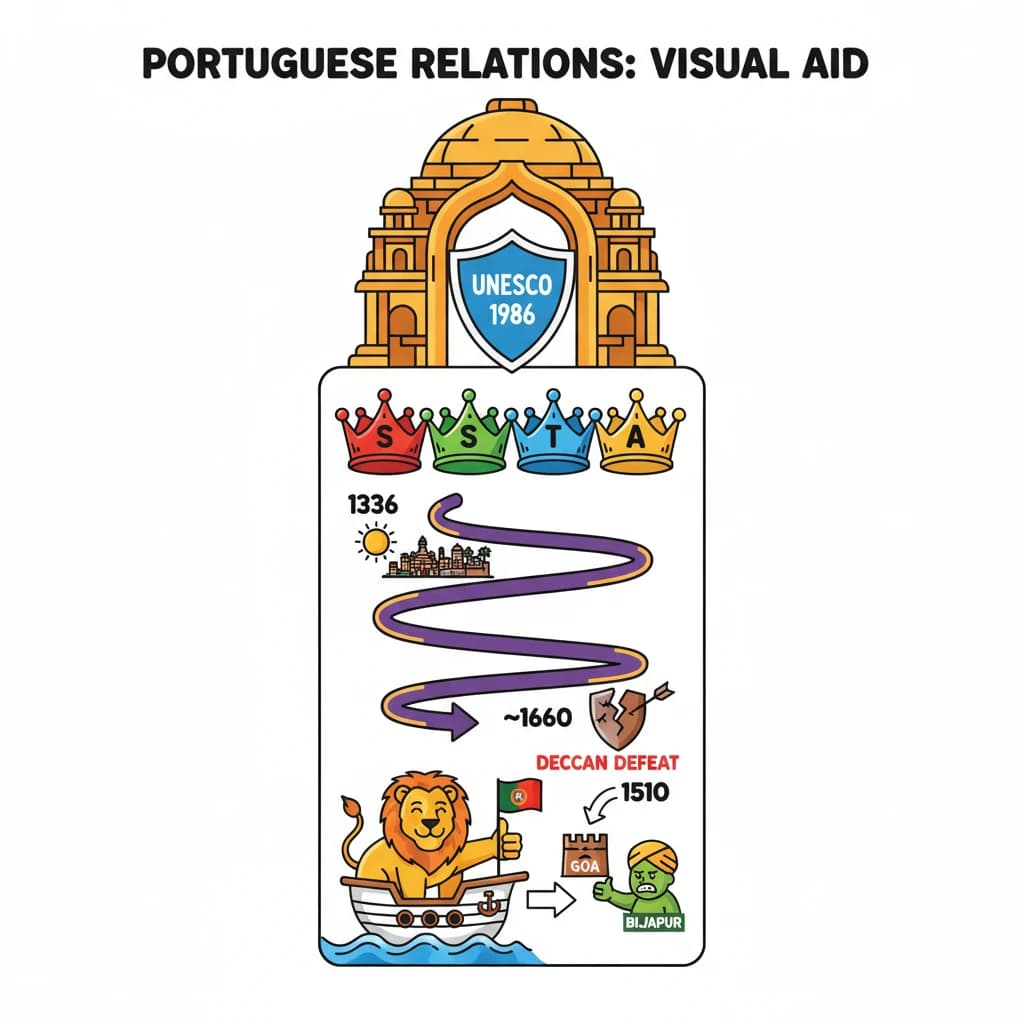
  • •Hampi, the capital of the Vijayanagara Empire, is a UNESCO World Heritage Site (1986).
  • •Four dynasties ruled Vijayanagara: Sangama, Saluva, Tuluva, and Aravidu.
  • •The empire flourished from 1336 to ~1660, declining after a major defeat by Deccan sultanates.
  • •Portuguese captured Goa around 1510 from Bijapur, with crucial support from Vijayanagara.
  • •Portuguese supplied guns and Arabian horses to Vijayanagara.
  • •Vijayanagara exported cotton, rice, sugar, spices, indigo, and wooden goods to the Portuguese.

🧠 Memory Techniques
Memory Aid
98% Verified Content

📚 Reference Sources

•NCERT History Textbooks (assumed general knowledge base for UPSC)
•Standard academic texts on Medieval Indian History and European Colonialism

Related Topics

Loading related topics...
Explore:History Topics·All Subjects·Daily Current Affairs·Editorial Analysis·Previous Year Questions·UPSC GPT
Vijayanagara Empire: Portuguese Relations, Trade, and Military Aid - UPSC History