Loading page, please wait…
Vaidra Logo
Vaidra

Top 4 items + smart groups

UPSC GPT
New
Current Affairs
Daily Solutions
Daily Puzzle
Mains Evaluator

Version 2.0.0 • Built with ❤️ for UPSC aspirants

Loading...
Loading...
Loading...
Loading...
Loading...
Loading...
Loading...
Loading...
Loading...
Loading...
Loading...
Loading...
Loading...
Social Reforms: English Education Act & Suppression of Thuggee - UPSC History
Back
All Subjects

Topics

0 topics • 0 completed

Loading topics...
Loading...
Loading...
Loading...
Loading...
Loading...
Overall Progress0%

Social Reforms: English Education Act & Suppression of Thuggee - UPSC History

What is Social Reforms: English Education Act & Suppression of Thuggee in UPSC History?

Social Reforms: English Education Act & Suppression of Thuggee is a key topic under History for UPSC Civil Services Examination. Key points include: Lord William Bentinck's tenure (1828-1835) was marked by significant social and administrative reforms.. The English Education Act of 1835 replaced Persian with English as the official language of government.. Bentinck successfully suppressed the criminal practice of Thuggee by the late 1830s.. Understanding this topic is essential for both UPSC Prelims and Mains preparation.

Why is Social Reforms: English Education Act & Suppression of Thuggee important for UPSC exam?

Social Reforms: English Education Act & Suppression of Thuggee is a Medium-level topic in UPSC History. It is tested in both Prelims (factual MCQs) and Mains (analytical answer writing). Previous year UPSC questions have frequently covered aspects of Social Reforms: English Education Act & Suppression of Thuggee, making it essential for comprehensive IAS preparation.

How to prepare Social Reforms: English Education Act & Suppression of Thuggee for UPSC?

To prepare Social Reforms: English Education Act & Suppression of Thuggee for UPSC: (1) Study the comprehensive notes covering all key concepts on Vaidra. (2) Practice previous year questions on this topic. (3) Connect it with current affairs using daily updates. (4) Revise using key takeaways and mind maps available for History. (5) Write practice answers linking Social Reforms: English Education Act & Suppression of Thuggee to related GS Paper topics.

Key takeaways of Social Reforms: English Education Act & Suppression of Thuggee for UPSC

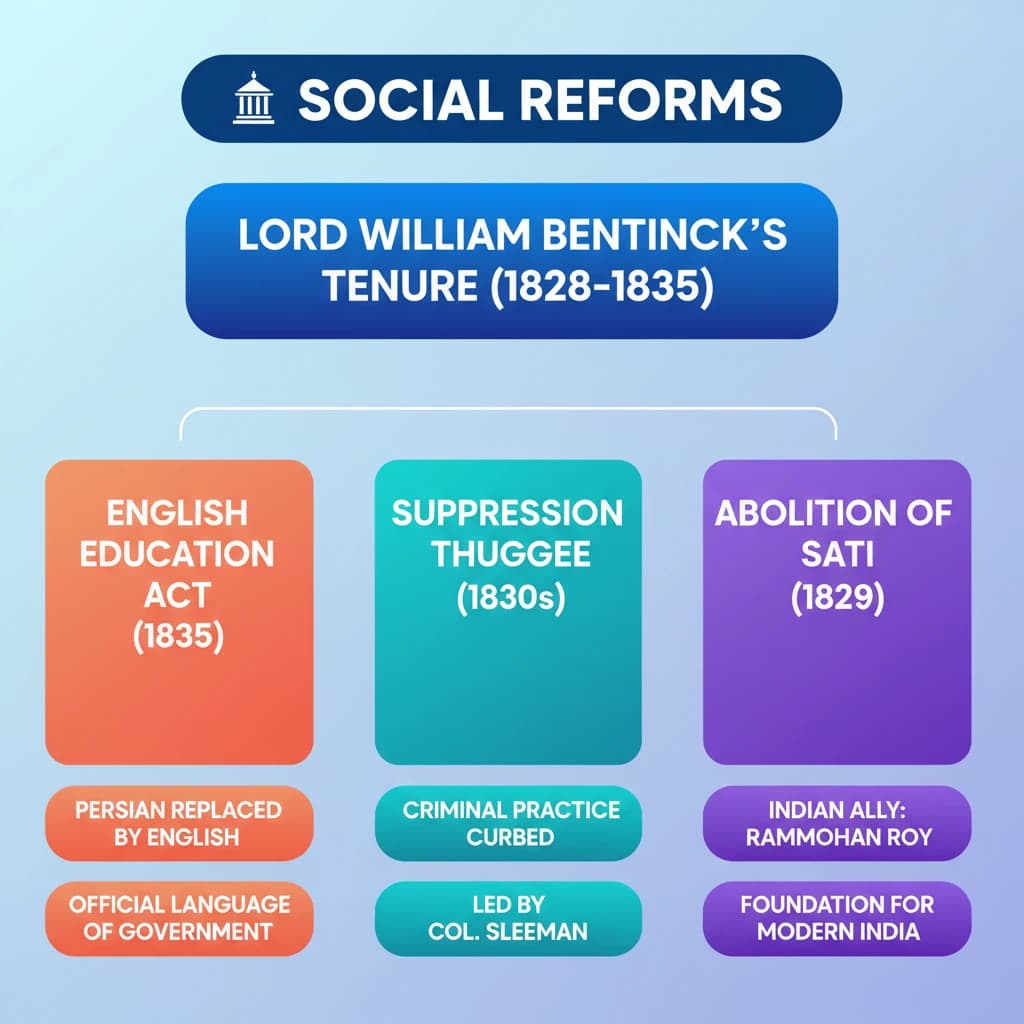
  • Lord William Bentinck's tenure (1828-1835) was marked by significant social and administrative reforms.
  • The English Education Act of 1835 replaced Persian with English as the official language of government.
  • Bentinck successfully suppressed the criminal practice of Thuggee by the late 1830s.
  • Indian reformers like Raja Rammohan Roy were crucial allies, advocating for changes like the abolition of Sati.
  • These reforms laid the foundation for modern Indian legal and social frameworks.

Social Reforms: English Education Act & Suppression of Thuggee

Social Reforms: English Education Act & Suppression of Thuggee

Medium⏱️ 7 min read✓ 95% Verified
history

📖 Introduction

<h4>Introduction to Social Reforms in British India</h4><p>The early <strong>19th century</strong> in <strong>British India</strong> witnessed significant administrative and social reforms, largely driven by the British administration and supported by prominent Indian reformers. These changes aimed to modernize governance and address prevalent social evils.</p><h4>The English Education Act of 1835</h4><p>A pivotal change in administrative policy occurred with the enactment of the <strong>English Education Act</strong> in <strong>1835</strong>. This act marked a significant shift in the official language of the <strong>Government of India</strong>.</p><div class='info-box'><p><strong>Key Change:</strong> The <strong>Persian language</strong>, which had been the official language for administrative and judicial purposes, was formally replaced by <strong>English</strong>.</p></div><p>This reform had far-reaching implications, influencing the education system and the future trajectory of Indian administration and intellectual discourse.</p><h4>Suppression of Thuggee by Lord William Bentinck</h4><p>One of the most notable social reforms undertaken during this period was the suppression of <strong>Thuggee</strong>. This was a significant step towards ensuring public safety and order.</p><div class='key-point-box'><p><strong>What was Thuggee?</strong> It referred to a highly organized <strong>criminal organisation</strong> in India. Its members were known as <strong>Thugs</strong>, who engaged in systematic <strong>robbery</strong> and ritualistic <strong>murder</strong>, often by strangulation, particularly targeting travellers.</p></div><p><strong>Lord William Bentinck</strong>, then the <strong>Governor-General of India</strong>, took decisive action against this practice. His efforts were instrumental in dismantling the network of Thugs.</p><div class='info-box'><p><strong>Outcome:</strong> By the end of the <strong>1830s</strong>, Bentinck's campaigns had successfully <strong>suppressed</strong> the practice of Thuggee, significantly alleviating the fears and anxieties of the populace across various regions.</p></div><h4>Support from Indian Reformers: Raja Rammohan Roy</h4><p>British reform efforts often found crucial support and impetus from enlightened Indian intellectuals and social reformers. Their advocacy played a vital role in the success and acceptance of these changes.</p><div class='key-point-box'><p><strong>Key Figure:</strong> One of the most prominent figures was <strong>Raja Rammohan Roy</strong>. He was a staunch advocate for social reform and actively campaigned against several entrenched social evils.</p></div><p>Roy's support for reforms like the abolition of <strong>Sati</strong> demonstrated the growing internal demand for societal change. His collaboration with the British administration was pivotal in bringing about these reforms.</p><div class='exam-tip-box'><p><strong>UPSC Insight:</strong> Understanding the dual role of British policy and Indian reform movements is crucial. Reforms were not solely imposed but often emerged from a complex interplay of internal and external pressures.</p></div>
Concept Diagram

💡 Key Takeaways

  • •Lord William Bentinck's tenure (1828-1835) was marked by significant social and administrative reforms.
  • •The English Education Act of 1835 replaced Persian with English as the official language of government.
  • •Bentinck successfully suppressed the criminal practice of Thuggee by the late 1830s.
  • •Indian reformers like Raja Rammohan Roy were crucial allies, advocating for changes like the abolition of Sati.
  • •These reforms laid the foundation for modern Indian legal and social frameworks.

🧠 Memory Techniques
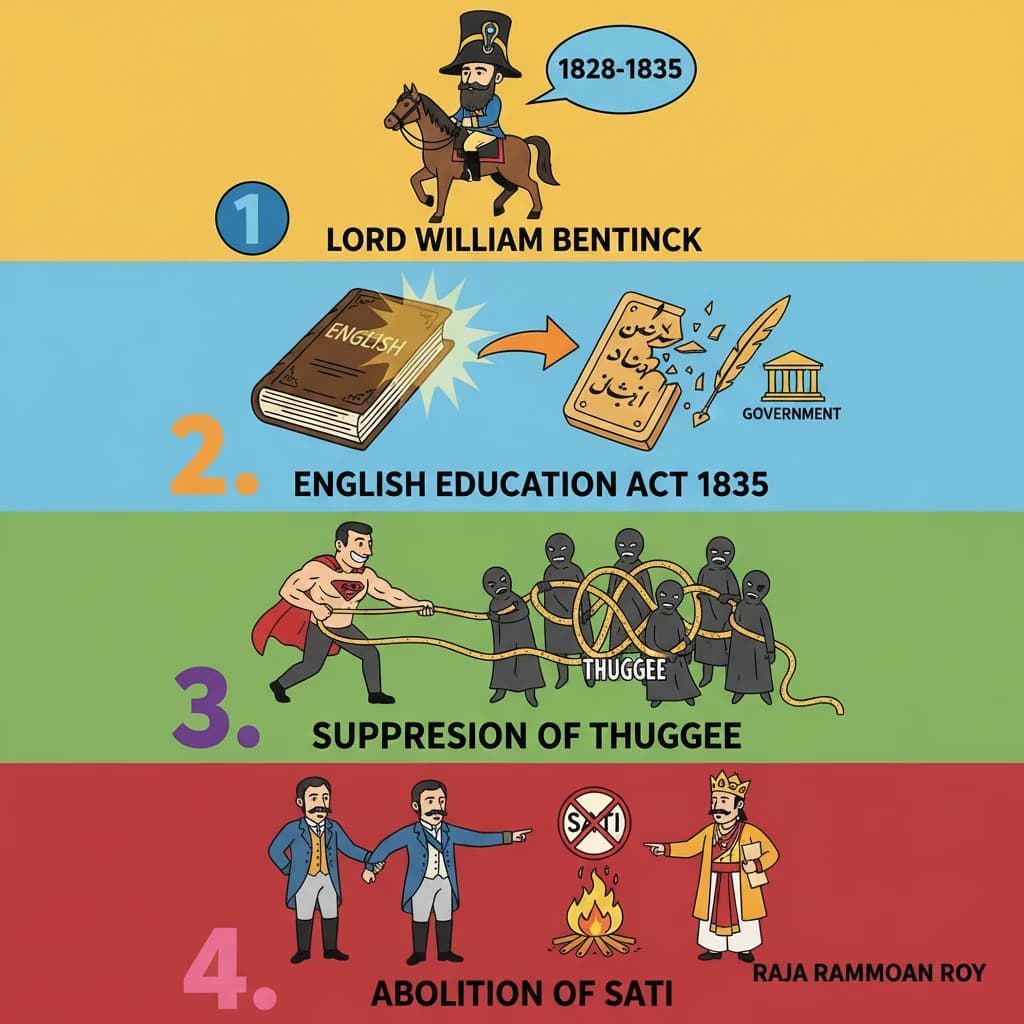
Memory Aid
95% Verified Content

📚 Reference Sources

•Bipan Chandra, India's Struggle for Independence
•Spectrum Modern Indian History
•NCERT History Textbooks (Class XII)

Related Topics

Loading related topics...
Explore:History Topics·All Subjects·Daily Current Affairs·Editorial Analysis·Previous Year Questions·UPSC GPT