Loading page, please wait…
Vaidra Logo
Vaidra

Top 4 items + smart groups

UPSC GPT
New
Current Affairs
Daily Solutions
Daily Puzzle
Mains Evaluator

Version 2.0.0 • Built with ❤️ for UPSC aspirants

Loading...
Loading...
Loading...
Loading...
Loading...
Loading...
Loading...
Loading...
Loading...
Loading...
Loading...
Loading...
Loading...
Back
All Subjects

Topics

0 topics • 0 completed

Loading topics...
Loading...
Loading...
Loading...
Loading...
Loading...
Overall Progress0%

Who was C. Rajagopalachari? - UPSC History

What is Who was C. Rajagopalachari? in UPSC History?

Who was C. Rajagopalachari? is a key topic under History for UPSC Civil Services Examination. Key points include: C. Rajagopalachari was born in Salem, Madras Province in 1878 and became a lawyer.. Inspired by Tilak and opposed Lord Curzon's Partition of Bengal.. Joined INC and actively participated in the freedom struggle.. Understanding this topic is essential for both UPSC Prelims and Mains preparation.

Why is Who was C. Rajagopalachari? important for UPSC exam?

Who was C. Rajagopalachari? is a Easy-level topic in UPSC History. It is tested in both Prelims (factual MCQs) and Mains (analytical answer writing). Previous year UPSC questions have frequently covered aspects of Who was C. Rajagopalachari?, making it essential for comprehensive IAS preparation.

How to prepare Who was C. Rajagopalachari? for UPSC?

To prepare Who was C. Rajagopalachari? for UPSC: (1) Study the comprehensive notes covering all key concepts on Vaidra. (2) Practice previous year questions on this topic. (3) Connect it with current affairs using daily updates. (4) Revise using key takeaways and mind maps available for History. (5) Write practice answers linking Who was C. Rajagopalachari? to related GS Paper topics.

Key takeaways of Who was C. Rajagopalachari? for UPSC

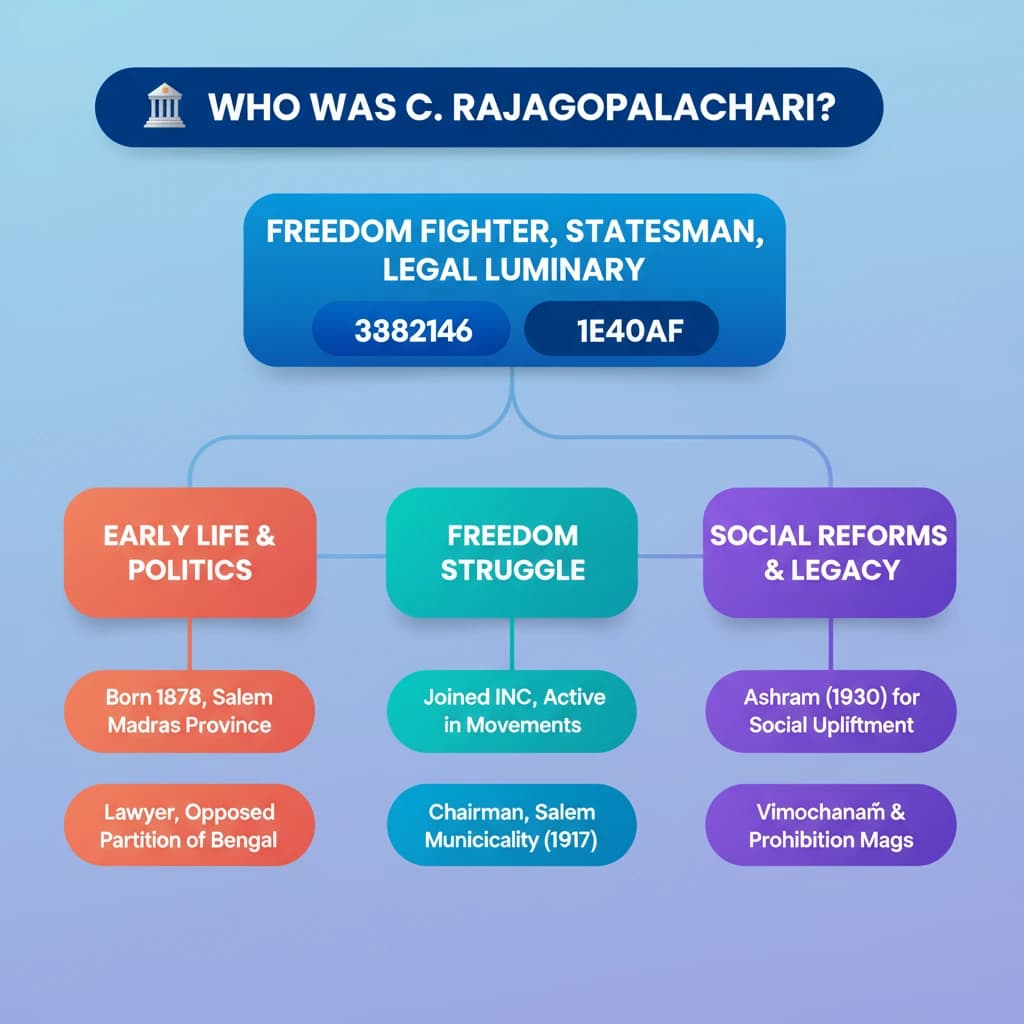
  • C. Rajagopalachari was born in Salem, Madras Province in 1878 and became a lawyer.
  • Inspired by Tilak and opposed Lord Curzon's Partition of Bengal.
  • Joined INC and actively participated in the freedom struggle.
  • Served as Chairman of Salem Municipality (1917), focusing on backward classes' welfare.
  • Established an Ashram (1930) for social upliftment, publishing Vimochanaṁ and Prohibition magazines.
Who was C. Rajagopalachari?

Who was C. Rajagopalachari?

Easy⏱️ 4 min read✓ 95% Verified
history

📖 Introduction

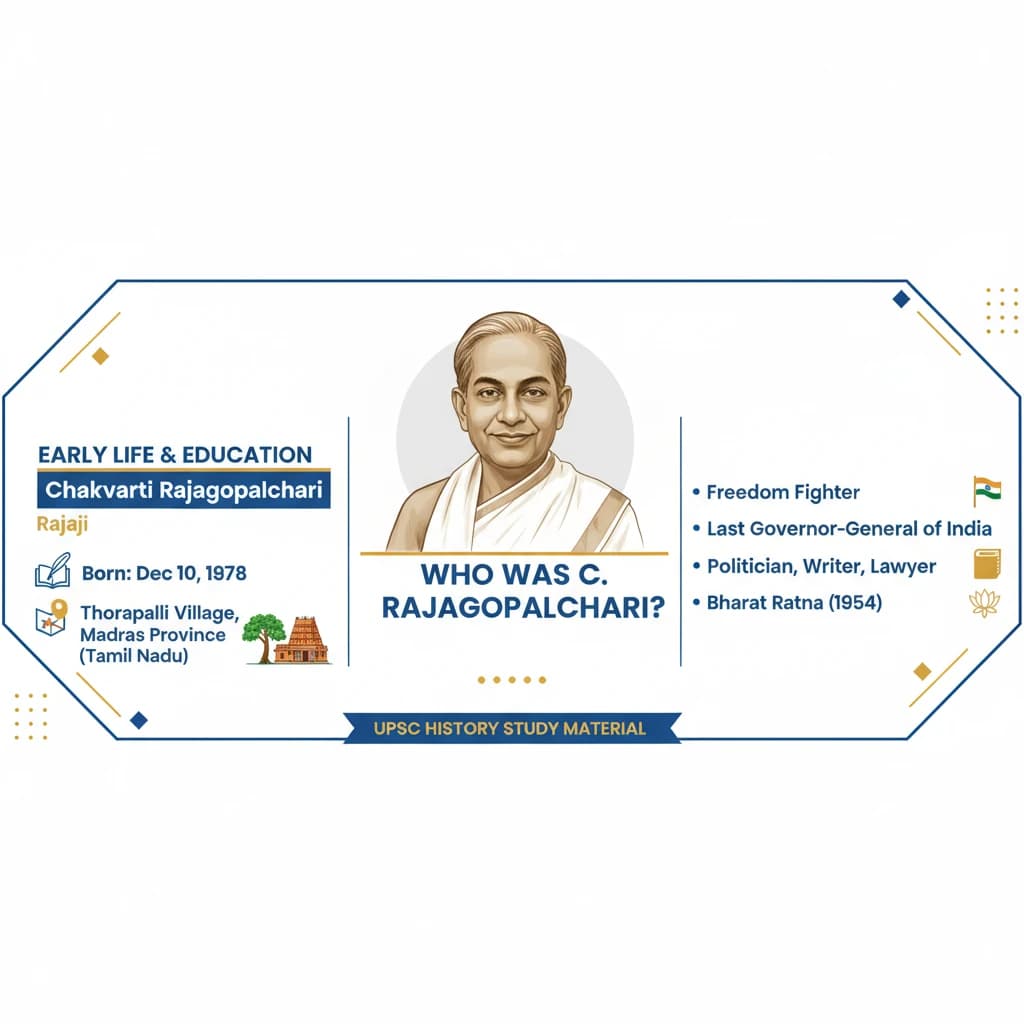
<h4>Early Life and Education of C. Rajagopalachari</h4><p><strong>Chakravarti Rajagopalachari</strong>, often referred to as <strong>"Rajaji"</strong>, was a prominent figure in India's freedom struggle and post-independence politics. He was born on <strong>December 10, 1878</strong>, in <strong>Thorapalli village</strong>, near <strong>Hosur</strong>, in the <strong>Salem district</strong> of the then <strong>Madras Province</strong> (present-day <strong>Tamil Nadu</strong>).</p><div class='info-box'><ul><li><strong>Born:</strong> December 10, 1878</li><li><strong>Place:</strong> Salem, Madras Province (now Tamil Nadu)</li></ul></div><p>His academic journey led him to pursue law. He successfully completed his <strong>Bachelor of Law</strong> degree in <strong>1899</strong>. Following his graduation, <strong>Rajagopalachari</strong> embarked on his legal career, establishing his practice in <strong>Salem</strong>.</p><h4>Political Awakening and Early Influences</h4><p><strong>Rajagopalachari's</strong> political consciousness was profoundly shaped by significant events of his time. He was particularly disturbed by <strong>Lord Curzon's</strong> controversial decision to <strong>partition Bengal</strong> in <strong>1905</strong>, which was largely based on communal lines.</p><p>This period of political turmoil also saw him draw inspiration from the fervent nationalism advocated by <strong>Lokmanya Bal Gangadhar Tilak</strong>. <strong>Tilak's</strong> powerful call for <strong>'Swaraj'</strong> (complete independence) resonated deeply with <strong>Rajagopalachari</strong>, guiding his early political leanings.</p><div class='key-point-box'><p><strong>Key Influences:</strong></p><ul><li><strong>Lord Curzon's Partition of Bengal</strong> (1905)</li><li><strong>Lokmanya Bal Gangadhar Tilak's</strong> call for <strong>complete independence</strong></li></ul></div><h4>Engagement with the Indian National Congress</h4><p>Driven by his nationalist convictions, <strong>C. Rajagopalachari</strong> formally joined the <strong>Indian National Congress (INC)</strong>. This marked his active entry into the mainstream of <strong>India's freedom struggle</strong>, where he quickly rose to prominence.</p><p>He dedicated himself to the cause of independence, participating in various movements and playing a crucial role in shaping the strategies of the <strong>Congress party</strong> during a critical juncture in Indian history.</p><h4>Contributions to Local Administration and Social Reforms</h4><p>Beyond national politics, <strong>Rajagopalachari</strong> also made significant contributions at the local level. In <strong>1917</strong>, he was elected as the <strong>Chairman of Salem Municipality</strong>, demonstrating his commitment to public service and local governance.</p><p>During his tenure, he focused extensively on implementing social welfare measures. A primary concern was the upliftment and well-being of the <strong>backward classes</strong>, for whom he initiated various reforms and programs.</p><div class='info-box'><p><strong>Municipal Role:</strong></p><ul><li><strong>Year:</strong> 1917</li><li><strong>Position:</strong> Chairman of Salem Municipality</li><li><strong>Focus:</strong> Social welfare of backward classes</li></ul></div><h4>Establishment of Ashram and Publications</h4><p>His commitment to social upliftment extended beyond municipal administration. In <strong>1930</strong>, <strong>Rajagopalachari</strong> established an <strong>Ashram</strong> in the <strong>Madras Province</strong>. This institution was dedicated to fostering social reform and community development.</p><p>The <strong>Ashram</strong> served as a hub for various activities aimed at improving societal conditions. It also played a role in disseminating his ideas and promoting social change through its publications.</p><div class='info-box'><p><strong>Ashram Details:</strong></p><ul><li><strong>Established:</strong> 1930</li><li><strong>Location:</b> Madras Province</li><li><strong>Purpose:</strong> Social upliftment</li></ul></div><p>To further its mission and reach a wider audience, the <strong>Ashram</strong> published two distinct magazines. These publications were instrumental in advocating for the causes championed by <strong>Rajagopalachari</strong> and his associates.</p><div class='info-box'><p><strong>Ashram Magazines:</strong></p><ul><li><strong>Vimochanaṁ</strong> (Tamil)</li><li><strong>Prohibition</strong> (English)</li></ul></div><div class='exam-tip-box'><p><strong>UPSC Insight:</strong> Questions on <strong>C. Rajagopalachari</strong> often focus on his diverse roles – from early nationalist to social reformer and administrator. Remember his connection to <strong>Salem</strong> and his publications for specific factual recall.</p></div>
Concept Diagram

💡 Key Takeaways

  • •C. Rajagopalachari was born in Salem, Madras Province in 1878 and became a lawyer.
  • •Inspired by Tilak and opposed Lord Curzon's Partition of Bengal.
  • •Joined INC and actively participated in the freedom struggle.
  • •Served as Chairman of Salem Municipality (1917), focusing on backward classes' welfare.
  • •Established an Ashram (1930) for social upliftment, publishing Vimochanaṁ and Prohibition magazines.

🧠 Memory Techniques
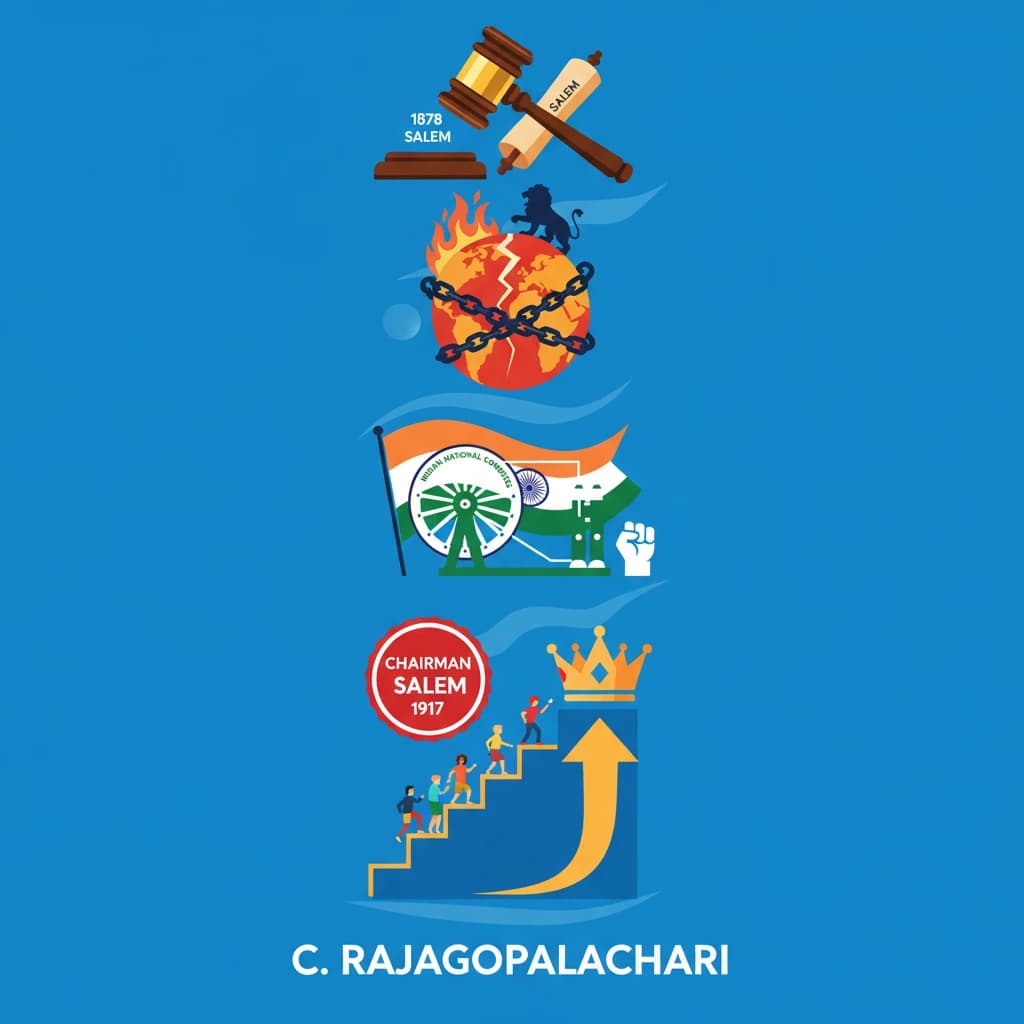
Memory Aid
95% Verified Content

Related Topics

Loading related topics...
Explore:History Topics·All Subjects·Daily Current Affairs·Editorial Analysis·Previous Year Questions·UPSC GPT
Who was C. Rajagopalachari? - UPSC History