Loading page, please wait…
Vaidra Logo
Vaidra

Top 4 items + smart groups

UPSC GPT
New
Current Affairs
Daily Solutions
Daily Puzzle
Mains Evaluator

Version 2.0.0 • Built with ❤️ for UPSC aspirants

Loading...
Loading...
Loading...
Loading...
Loading...
Loading...
Loading...
Loading...
Loading...
Loading...
Loading...
Loading...
Loading...
Back
All Subjects

Topics

0 topics • 0 completed

Loading topics...
Loading...
Loading...
Loading...
Loading...
Loading...
Overall Progress0%

Acharya J. B. Kripalani - UPSC History

What is Acharya J. B. Kripalani in UPSC History?

Acharya J. B. Kripalani is a key topic under History for UPSC Civil Services Examination. Key points include: Acharya J. B. Kripalani was a prominent Gandhian leader, born in 1888 in Hyderabad (Sind).. He actively participated in major Satyagrahas: Champaran (1917), Kheda (1918), Ahmedabad Mill Strike (1918), and Salt Satyagraha (1930).. He served as President of the Indian National Congress in 1946, a pivotal year for independence.. Understanding this topic is essential for both UPSC Prelims and Mains preparation.

Why is Acharya J. B. Kripalani important for UPSC exam?

Acharya J. B. Kripalani is a Medium-level topic in UPSC History. It is tested in both Prelims (factual MCQs) and Mains (analytical answer writing). Previous year UPSC questions have frequently covered aspects of Acharya J. B. Kripalani, making it essential for comprehensive IAS preparation.

How to prepare Acharya J. B. Kripalani for UPSC?

To prepare Acharya J. B. Kripalani for UPSC: (1) Study the comprehensive notes covering all key concepts on Vaidra. (2) Practice previous year questions on this topic. (3) Connect it with current affairs using daily updates. (4) Revise using key takeaways and mind maps available for History. (5) Write practice answers linking Acharya J. B. Kripalani to related GS Paper topics.

Key takeaways of Acharya J. B. Kripalani for UPSC

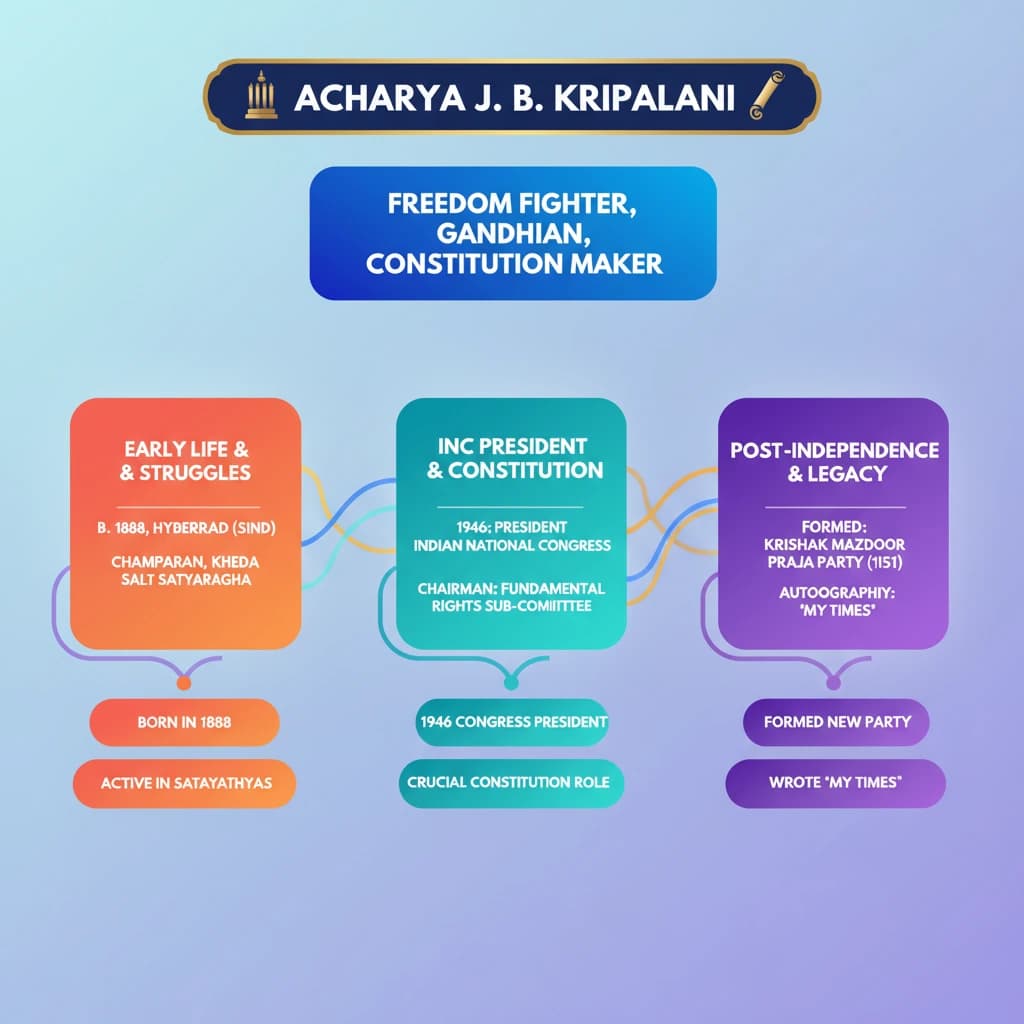
  • Acharya J. B. Kripalani was a prominent Gandhian leader, born in 1888 in Hyderabad (Sind).
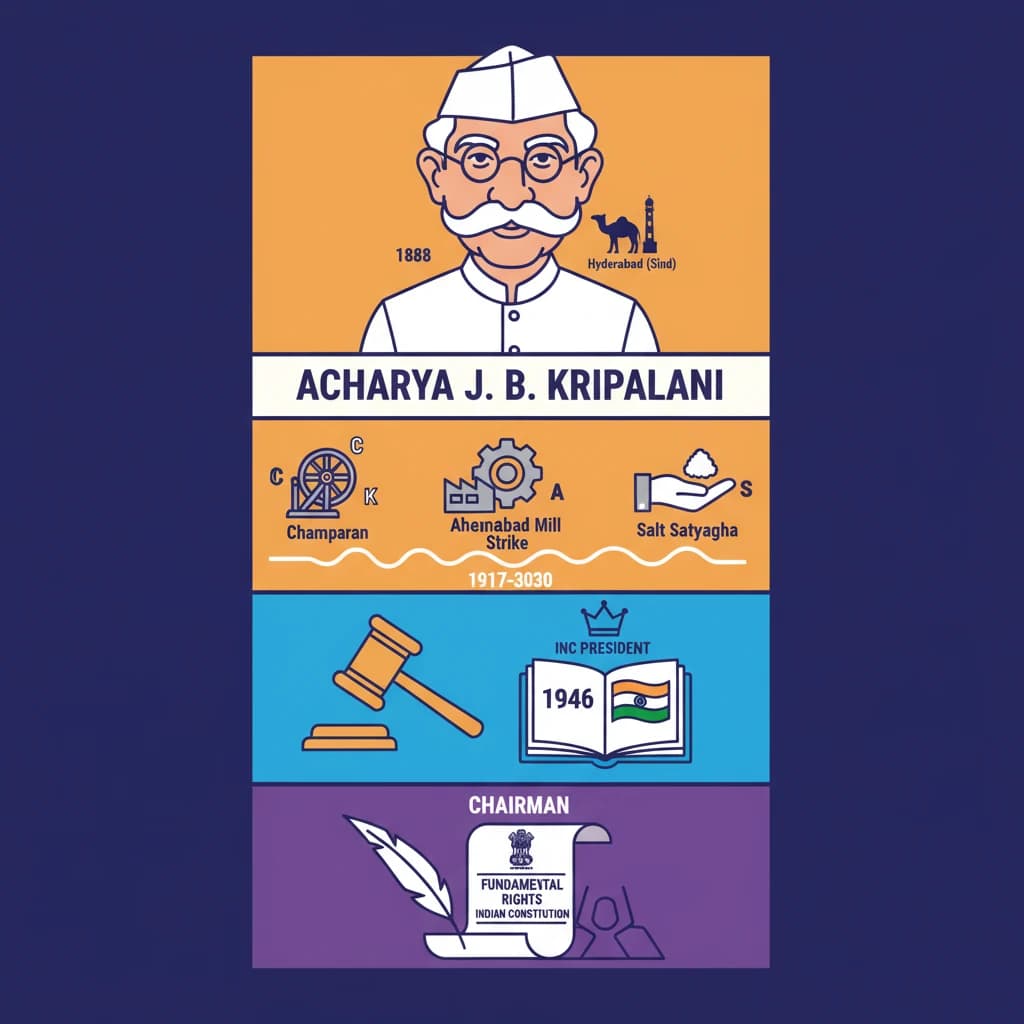
  • He actively participated in major Satyagrahas: Champaran (1917), Kheda (1918), Ahmedabad Mill Strike (1918), and Salt Satyagraha (1930).
  • He served as President of the Indian National Congress in 1946, a pivotal year for independence.
  • As Chairman of the Fundamental Rights Sub-Committee, he significantly contributed to the Indian Constitution.
  • Post-independence, he formed the Krishak Mazdoor Praja Party (1951) and authored his autobiography 'My Times'.
  • His economic philosophy advocated for decentralized industrialization, rural development, and small/cottage industries.
Acharya J. B. Kripalani

Acharya J. B. Kripalani

Medium⏱️ 6 min read✓ 95% Verified
history

📖 Introduction

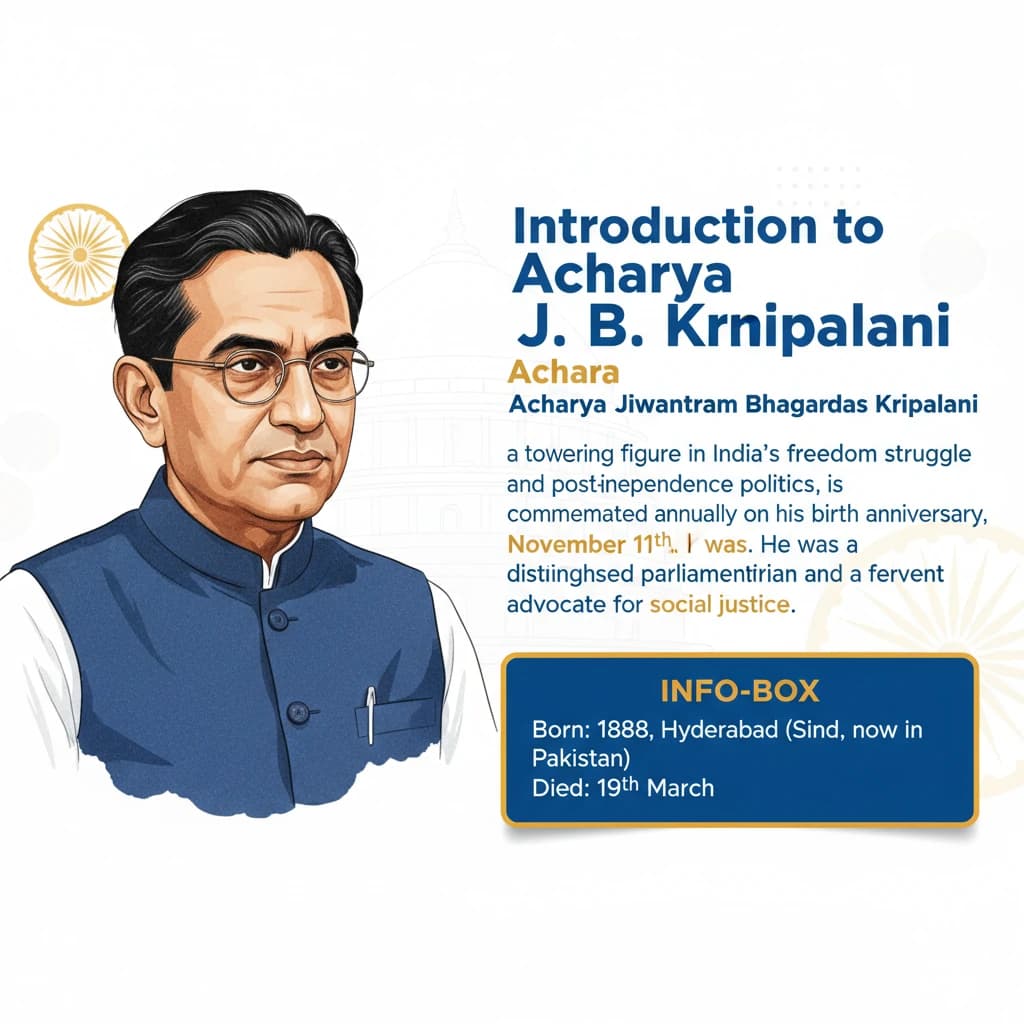
<h4>Introduction to Acharya J. B. Kripalani</h4><p><strong>Acharya Jiwantram Bhagwandas Kripalani</strong>, a towering figure in India's freedom struggle and post-independence politics, is commemorated annually on his birth anniversary, <strong>November 11th</strong>. He was a distinguished parliamentarian and a fervent advocate for <strong>social justice</strong>.</p><div class='info-box'><p><strong>Born:</strong> 1888, Hyderabad (Sind, now in Pakistan)</p><p><strong>Died:</strong> 19th March 1982</p></div><h4>Early Life and Gandhian Influence</h4><p>Born in <strong>Hyderabad (Sind)</strong> in <strong>1888</strong>, Kripalani's early life laid the foundation for his future activism. He was profoundly influenced by <strong>Mahatma Gandhi's philosophy</strong>, which shaped his commitment to non-violence and social reform.</p><div class='key-point-box'><p><strong>Key Inspiration:</strong> Deeply inspired by <strong>Mahatma Gandhi's principles</strong> of truth, non-violence, and self-reliance.</p></div><h4>Role in the Independence Movement</h4><p>Acharya Kripalani was an active participant in several pivotal movements during the Indian freedom struggle. His dedication saw him join the <strong>Congress Party</strong> in the <strong>1920s</strong>.</p><ul><li>He played a crucial role in the <strong>Champaran Satyagraha (1917)</strong>, supporting Gandhi's fight for indigo farmers.</li><li>His involvement extended to the <strong>Kheda Satyagraha (1918)</strong>, advocating for farmers against unjust tax collection.</li><li>He was also active in the <strong>Ahmedabad Mill Strike (1918)</strong>, supporting textile workers' rights.</li><li>A significant moment was his participation in the <strong>Salt Satyagraha (1930)</strong>, challenging the British salt monopoly.</li></ul><div class='exam-tip-box'><p><strong>UPSC Insight:</strong> Kripalani's participation in early Gandhian movements highlights the spread of Gandhi's influence beyond Bihar and Gujarat. Mentioning his diverse involvement adds depth to answers on the <strong>Freedom Struggle (GS-I)</strong>.</p></div><h4>Leadership in the Indian National Congress</h4><p>Kripalani's leadership capabilities were recognized within the Congress Party. He ascended to the prestigious position of <strong>President of the Indian National Congress</strong> in <strong>1946</strong>, a critical juncture leading up to India's independence.</p><div class='highlight-box'><p><strong>Crucial Role:</strong> Served as <strong>President of the Indian National Congress</strong> during the momentous year of <strong>1946</strong>, overseeing the transition to independence.</p></div><h4>Contributions to Independent India</h4><p>Post-independence, Acharya Kripalani continued to contribute significantly to nation-building. He was a member of the <strong>Constituent Assembly</strong>, instrumental in drafting the Indian Constitution.</p><ul><li>He chaired the <strong>Fundamental Rights Sub-Committee</strong>, playing a key role in shaping the rights guaranteed to Indian citizens.</li></ul><h4>Post-Independence Political Journey</h4><p>After independence, Kripalani's political journey saw him explore different avenues. He formed the <strong>Krishak Mazdoor Praja Party (KMPP)</strong> in <strong>1951</strong>.</p><p>This party later merged with the <strong>Praja Socialist Party</strong>. Subsequently, he also served as an <strong>independent Member of Parliament</strong>, continuing his public service.</p><h4>Literary and Journalistic Endeavors</h4><p>Beyond politics, Acharya Kripalani was also a prolific writer. He penned his autobiography, titled <strong>'My Times'</strong>, offering insights into his life and the era he lived through.</p><p>He also ran a weekly journal named <strong>'Vigil'</strong>, using it as a platform to express his views and engage with public discourse.</p>
Concept Diagram

💡 Key Takeaways

  • •Acharya J. B. Kripalani was a prominent Gandhian leader, born in 1888 in Hyderabad (Sind).
  • •He actively participated in major Satyagrahas: Champaran (1917), Kheda (1918), Ahmedabad Mill Strike (1918), and Salt Satyagraha (1930).
  • •He served as President of the Indian National Congress in 1946, a pivotal year for independence.
  • •As Chairman of the Fundamental Rights Sub-Committee, he significantly contributed to the Indian Constitution.
  • •Post-independence, he formed the Krishak Mazdoor Praja Party (1951) and authored his autobiography 'My Times'.
  • •His economic philosophy advocated for decentralized industrialization, rural development, and small/cottage industries.

🧠 Memory Techniques
Memory Aid
95% Verified Content

Related Topics

Loading related topics...
Explore:History Topics·All Subjects·Daily Current Affairs·Editorial Analysis·Previous Year Questions·UPSC GPT
Acharya J. B. Kripalani - UPSC History