Loading page, please wait…
Vaidra Logo
Vaidra

Top 4 items + smart groups

UPSC GPT
New
Current Affairs
Daily Solutions
Daily Puzzle
Mains Evaluator

Version 2.0.0 • Built with ❤️ for UPSC aspirants

Loading...
Loading...
Loading...
Loading...
Loading...
Loading...
Loading...
Loading...
Loading...
Loading...
Loading...
Loading...
Loading...
Harappan Civilization: Religious Beliefs and Practices - UPSC History
Back
All Subjects

Topics

0 topics • 0 completed

Loading topics...
Loading...
Loading...
Loading...
Loading...
Loading...
Overall Progress0%

Harappan Civilization: Religious Beliefs and Practices - UPSC History

What is Harappan Civilization: Religious Beliefs and Practices in UPSC History?

Harappan Civilization: Religious Beliefs and Practices is a key topic under History for UPSC Civil Services Examination. Key points include: Harappan religion is inferred from archaeological findings, not deciphered texts.. Prominent worship of a Mother Goddess (fertility cult) through terracotta figurines.. A male deity on a seal, identified as Pashupati Mahadeva (proto-Shiva), in yogic posture, surrounded by animals.. Understanding this topic is essential for both UPSC Prelims and Mains preparation.

Why is Harappan Civilization: Religious Beliefs and Practices important for UPSC exam?

Harappan Civilization: Religious Beliefs and Practices is a Medium-level topic in UPSC History. It is tested in both Prelims (factual MCQs) and Mains (analytical answer writing). Previous year UPSC questions have frequently covered aspects of Harappan Civilization: Religious Beliefs and Practices, making it essential for comprehensive IAS preparation.

How to prepare Harappan Civilization: Religious Beliefs and Practices for UPSC?

To prepare Harappan Civilization: Religious Beliefs and Practices for UPSC: (1) Study the comprehensive notes covering all key concepts on Vaidra. (2) Practice previous year questions on this topic. (3) Connect it with current affairs using daily updates. (4) Revise using key takeaways and mind maps available for History. (5) Write practice answers linking Harappan Civilization: Religious Beliefs and Practices to related GS Paper topics.

Key takeaways of Harappan Civilization: Religious Beliefs and Practices for UPSC

  • Harappan religion is inferred from archaeological findings, not deciphered texts.
  • Prominent worship of a Mother Goddess (fertility cult) through terracotta figurines.
  • A male deity on a seal, identified as Pashupati Mahadeva (proto-Shiva), in yogic posture, surrounded by animals.
  • Evidence of fertility symbols (phallus, yoni) indicating strong emphasis on procreation.
  • Widespread veneration of animals (unicorn, humped bull) and trees (Pipal).
  • Amulets were commonly used, likely for protection or religious purposes.

Harappan Civilization: Religious Beliefs and Practices

Harappan Civilization: Religious Beliefs and Practices

Medium⏱️ 6 min read✓ 95% Verified
history

📖 Introduction

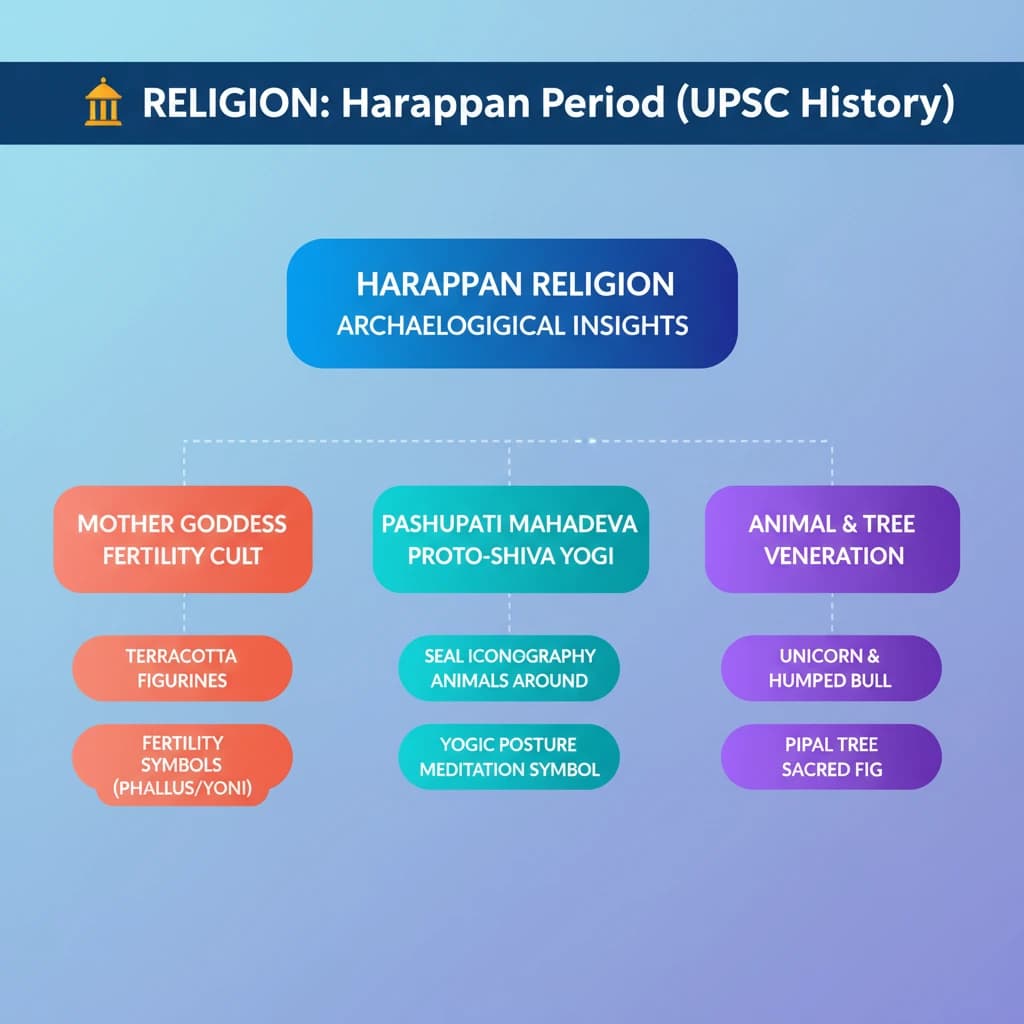
<h4>Introduction to Harappan Religious Practices</h4><p>The religious beliefs and practices of the <strong>Indus Valley Civilization</strong> (IVC) are primarily reconstructed from archaeological findings, as their script remains undeciphered. These findings offer glimpses into their spiritual world, which appears distinct from later Vedic traditions.</p><div class='exam-tip-box'><p><strong>UPSC Insight:</strong> Understanding Harappan religion is crucial for Mains GS Paper 1, especially for questions on ancient Indian history and cultural evolution. Focus on archaeological evidence and interpretations.</p></div><h4>Worship of the Mother Goddess</h4><p>Numerous <strong>terracotta figurines of women</strong> have been discovered across Harappan sites. These figures, often depicted with prominent breasts and hips, strongly suggest the worship of a <strong>fertility goddess</strong>.</p><p>This practice is thought to be similar to the veneration of fertility deities found in other ancient civilizations, such as the Egyptian goddess <strong>Isis</strong>. The abundance of these figurines indicates a widespread cult.</p><div class='info-box'><p><strong>Key Fact:</strong> The figurines are often found in domestic settings, suggesting household worship or personal devotion to the Mother Goddess.</p></div><h4>The Male Deity: Pashupati Mahadeva</h4><p>A significant discovery is a <strong>seal</strong> depicting a <strong>male deity</strong>. This figure is shown in a <strong>yogic posture</strong>, seated with knees bent and heels touching, often identified as <strong>Pashupati Mahadeva</strong>, a proto-Shiva figure.</p><p>The deity has <strong>three horned heads</strong>, symbolizing perhaps a multifaceted nature or divinity. He is surrounded by various animals, including an <strong>elephant, tiger, rhinoceros, and buffalo</strong>, suggesting a connection to nature and dominion over animals.</p><div class='key-point-box'><p><strong>Important Concept:</strong> The 'Pashupati Seal' is a cornerstone for interpreting Harappan religion, hinting at early forms of Shaivism and yoga.</p></div><h4>Fertility Cults</h4><p>Beyond the Mother Goddess, other symbols point to a strong emphasis on <strong>fertility worship</strong>. These include the presence of symbols resembling the <strong>phallus</strong> (male sex organ) and <strong>female sex organs</strong> (yoni).</p><p>Such artifacts underscore the importance of procreation, agricultural abundance, and life-giving forces in Harappan society. This focus was common in many ancient agrarian societies.</p><h4>Animal and Tree Worship</h4><p>The Harappans held a deep reverence for nature, evident in their worship of both <strong>animals and trees</strong>. Several animals appear prominently on seals and pottery, suggesting sacred status.</p><p>Among the most significant are the mythical <strong>unicorn</strong> (possibly representing a rhinoceros) and the powerful <strong>humped bull</strong>. The humped bull, in particular, may have symbolized strength, fertility, or even a deity.</p><div class='info-box'><p><strong>Notable Animals:</strong> Besides the unicorn and humped bull, other animals like goats, tigers, and elephants are frequently depicted, indicating their cultural or religious significance.</p></div><h4>Role of Amulets</h4><p>Numerous <strong>amulets</strong> have been unearthed at Harappan sites. These small, often inscribed objects were likely worn by individuals.</p><p>Their probable function was for <strong>protection</strong> against evil spirits or misfortune, or for other <strong>religious purposes</strong>, such as good luck or healing. This indicates a belief in supernatural forces and personal piety.</p>
Concept Diagram

💡 Key Takeaways

  • •Harappan religion is inferred from archaeological findings, not deciphered texts.
  • •Prominent worship of a Mother Goddess (fertility cult) through terracotta figurines.
  • •A male deity on a seal, identified as Pashupati Mahadeva (proto-Shiva), in yogic posture, surrounded by animals.
  • •Evidence of fertility symbols (phallus, yoni) indicating strong emphasis on procreation.
  • •Widespread veneration of animals (unicorn, humped bull) and trees (Pipal).
  • •Amulets were commonly used, likely for protection or religious purposes.

🧠 Memory Techniques
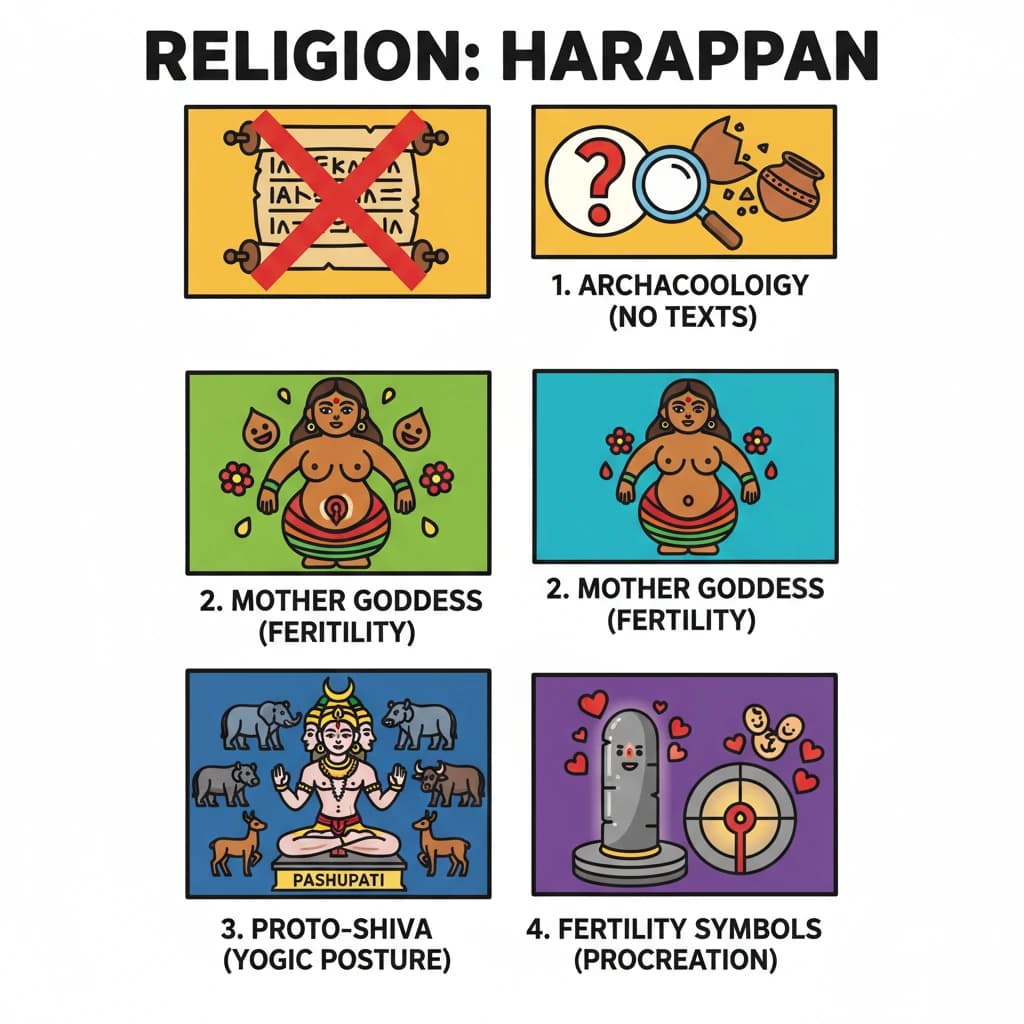
Memory Aid
95% Verified Content

📚 Reference Sources

•NCERT Class XI: An Introduction to Indian Art (Chapter 1)
•NCERT Class VI: Our Pasts – I (Chapter 3)
•Upinder Singh: A History of Ancient and Early Medieval India

Related Topics

Loading related topics...
Explore:History Topics·All Subjects·Daily Current Affairs·Editorial Analysis·Previous Year Questions·UPSC GPT