Loading page, please wait…
Dadabhai Naoroji - UPSC History
What is Dadabhai Naoroji in UPSC History?
Dadabhai Naoroji is a key topic under History for UPSC Civil Services Examination. Key points include: Dadabhai Naoroji was known as the "Grand Old Man of India".. He was the first Indian elected to the British Parliament (1892, Central Finsbury, Liberal Party).. He founded the London Indian Society (1865) and East India Association (1866).. Understanding this topic is essential for both UPSC Prelims and Mains preparation.
Why is Dadabhai Naoroji important for UPSC exam?
Dadabhai Naoroji is a Medium-level topic in UPSC History. It is tested in both Prelims (factual MCQs) and Mains (analytical answer writing). Previous year UPSC questions have frequently covered aspects of Dadabhai Naoroji, making it essential for comprehensive IAS preparation.
How to prepare Dadabhai Naoroji for UPSC?
To prepare Dadabhai Naoroji for UPSC: (1) Study the comprehensive notes covering all key concepts on Vaidra. (2) Practice previous year questions on this topic. (3) Connect it with current affairs using daily updates. (4) Revise using key takeaways and mind maps available for History. (5) Write practice answers linking Dadabhai Naoroji to related GS Paper topics.
Key takeaways of Dadabhai Naoroji for UPSC
- Dadabhai Naoroji was known as the "Grand Old Man of India".
- He was the first Indian elected to the British Parliament (1892, Central Finsbury, Liberal Party).
- He founded the London Indian Society (1865) and East India Association (1866).
- He served as Congress President three times (1886 Calcutta, 1893 Lahore, 1906 Calcutta).
- He propounded the "Drain Theory" (1867) and authored "Poverty and Un-British Rule in India" (1901).
Dadabhai Naoroji
Medium⏱️ 8 min read
history
📖 Introduction
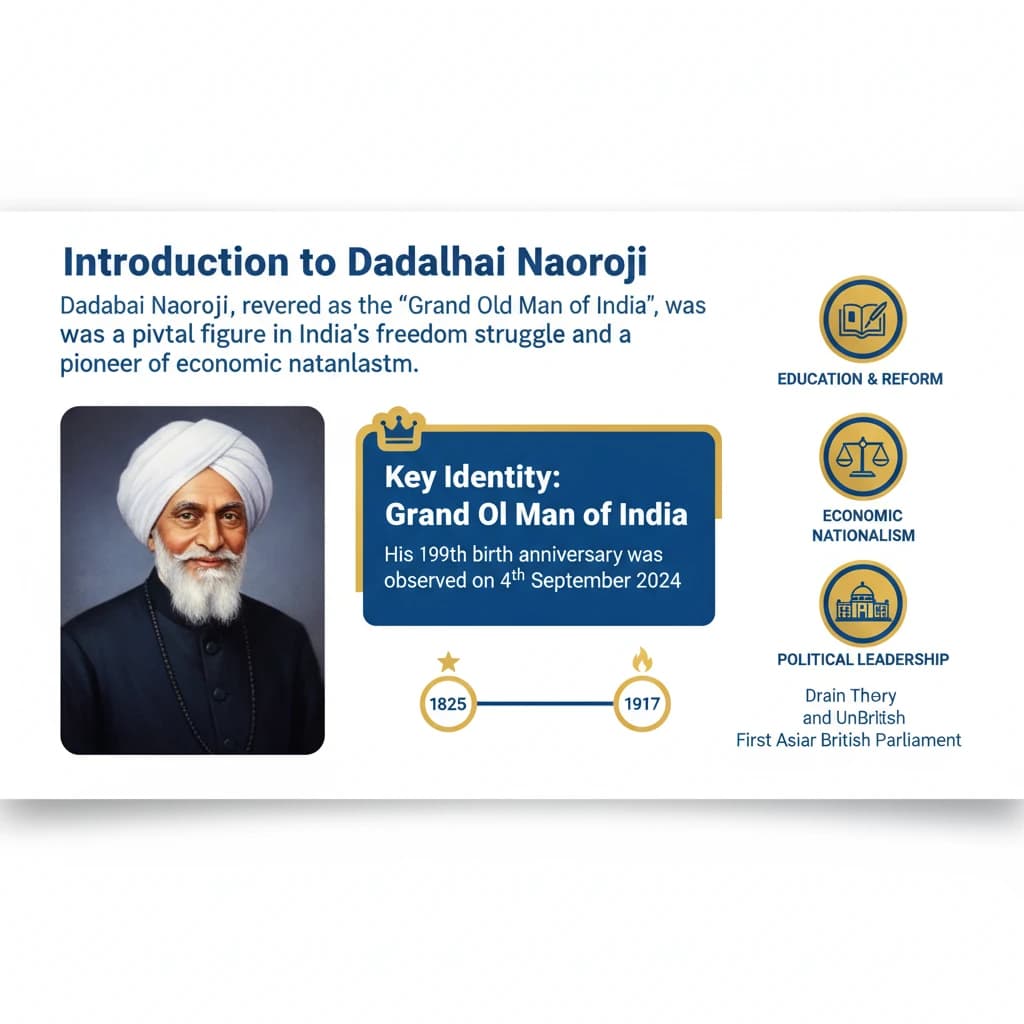
Introduction to Dadabhai Naoroji
Dadabhai Naoroji, revered as the “Grand Old Man of India”, was a pivotal figure in India's freedom struggle and a pioneer of economic nationalism.
His 199th birth anniversary was observed on 4th September 2024, highlighting his enduring legacy and contributions to modern India.
Key Identity: Known as the “Grand Old Man of India”.
Birth Anniversary: 199th observed on 4th September 2024.
First Indian Member of British Parliament
One of Naoroji's most significant achievements was becoming the first Indian to be elected to the British Parliament.
He won the Central Finsbury seat in 1892, representing the Liberal Party, providing a direct voice for Indian concerns.
- Constituency: Central Finsbury
- Year of Election: 1892
- Political Party: Liberal Party
Establishment of Organizations in England
Dadabhai Naoroji played a crucial role in establishing platforms in England to voice Indian grievances and advocate for reforms.
These organizations were instrumental in raising awareness about Indian issues among the British public and politicians.
- In 1865, he co-founded the London Indian Society.
- In 1866, he established the East India Association, which served as a prominent forum for discussing Indian affairs.
These bodies were vital in shaping British public opinion and lobbying for Indian rights.
Leadership in the Indian National Congress
Naoroji's influence extended to India's burgeoning nationalist movement, where he served as the President of the Indian National Congress multiple times.
His presidencies spanned crucial periods, guiding the early direction and demands of the organization.
Congress Presidencies:
- 1886: Calcutta Session
- 1893: Lahore Session
- 1906: Calcutta Session (where he articulated the demand for Swaraj or self-rule)
Pioneer of the Drain Theory
Dadabhai Naoroji is widely recognized as a key proponent of the “Drain Theory”, first articulated around 1867.
This theory exposed the systematic economic exploitation of India by the British, detailing how India's wealth was siphoned off to Britain without adequate returns.
Drain Theory (1867): Argued that British rule was economically impoverishing India by draining its resources and wealth, leading to poverty.
Literary Contributions
To disseminate his economic theories and critique of British rule, Naoroji authored influential works.
His most famous book, “Poverty and Un-British Rule in India”, published in 1901, became a foundational text for Indian economic nationalism.
Key Publication: “Poverty and Un-British Rule in India” (1901)
Other Political Advocacy
Beyond his parliamentary role and organizational work, Naoroji engaged in various forms of political advocacy for Indian rights.
- He advocated for a standing committee in the British House of Commons to address protests from Indian legislative bodies.
- In 1893, he formed an Indian parliamentary committee in the British parliament to lobby for reforms in India.
- He was appointed to the Royal Commission on Indian Expenditure in 1895, where he highlighted the financial burdens imposed on India.
UPSC Insight: Naoroji's multifaceted contributions demonstrate his strategic approach to challenging British rule both within and outside India, using constitutional means and intellectual arguments.
💡 Key Takeaways
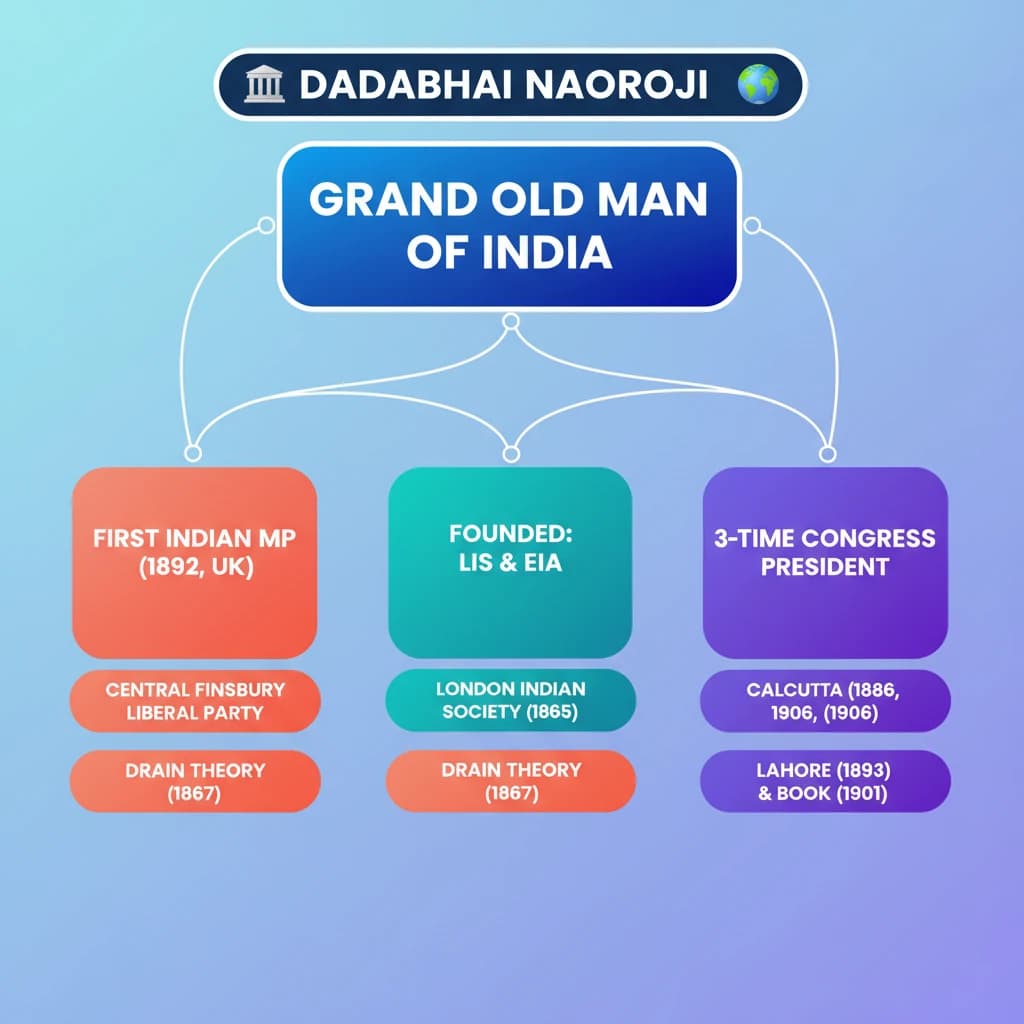
- •Dadabhai Naoroji was known as the "Grand Old Man of India".
- •He was the first Indian elected to the British Parliament (1892, Central Finsbury, Liberal Party).
- •He founded the London Indian Society (1865) and East India Association (1866).
- •He served as Congress President three times (1886 Calcutta, 1893 Lahore, 1906 Calcutta).
- •He propounded the "Drain Theory" (1867) and authored "Poverty and Un-British Rule in India" (1901).
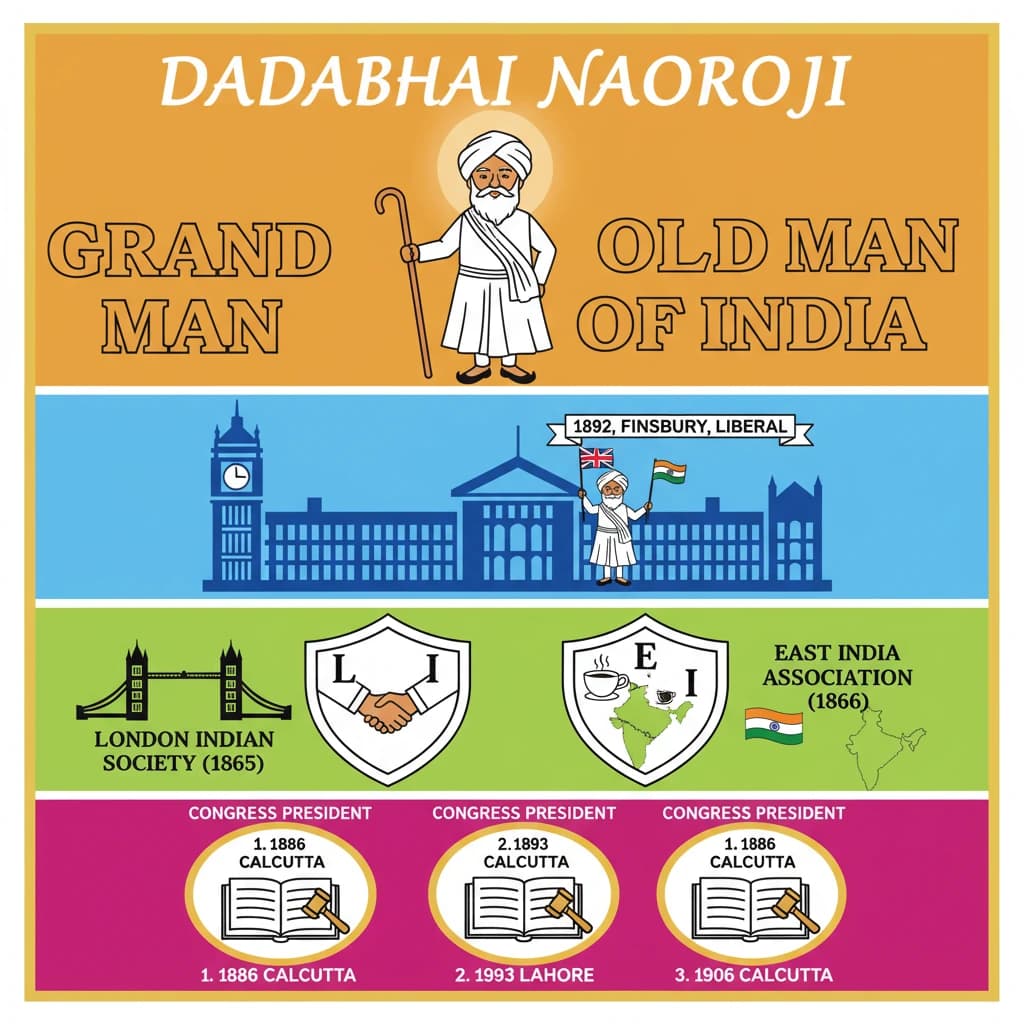
🧠 Memory Techniques
95% Verified Content