Loading page, please wait…
Vaidra Logo
Vaidra

Top 4 items + smart groups

UPSC GPT
New
Current Affairs
Daily Solutions
Daily Puzzle
Mains Evaluator

Version 2.0.0 • Built with ❤️ for UPSC aspirants

Loading...
Loading...
Loading...
Loading...
Loading...
Loading...
Loading...
Loading...
Loading...
Loading...
Loading...
Loading...
Loading...
What is Jainism - UPSC History

What is Jainism - UPSC History

What is What is Jainism in UPSC History?

What is Jainism is a key topic under History for UPSC Civil Services Examination. Key points include: Jainism derives from 'Jina' (conqueror), emphasizing conquest of inner passions.. Central to Jainism is Ahimsa (non-violence) towards all living beings.. Five Mahavratas (great vows) include Ahimsa, Satya, Asteya, Aparigraha, and Brahmacharya (added by Mahavira).. Understanding this topic is essential for both UPSC Prelims and Mains preparation.

Why is What is Jainism important for UPSC exam?

What is Jainism is a Medium-level topic in UPSC History. It is tested in both Prelims (factual MCQs) and Mains (analytical answer writing). Previous year UPSC questions have frequently covered aspects of What is Jainism, making it essential for comprehensive IAS preparation.

How to prepare What is Jainism for UPSC?

To prepare What is Jainism for UPSC: (1) Study the comprehensive notes covering all key concepts on Vaidra. (2) Practice previous year questions on this topic. (3) Connect it with current affairs using daily updates. (4) Revise using key takeaways and mind maps available for History. (5) Write practice answers linking What is Jainism to related GS Paper topics.

Key takeaways of What is Jainism for UPSC

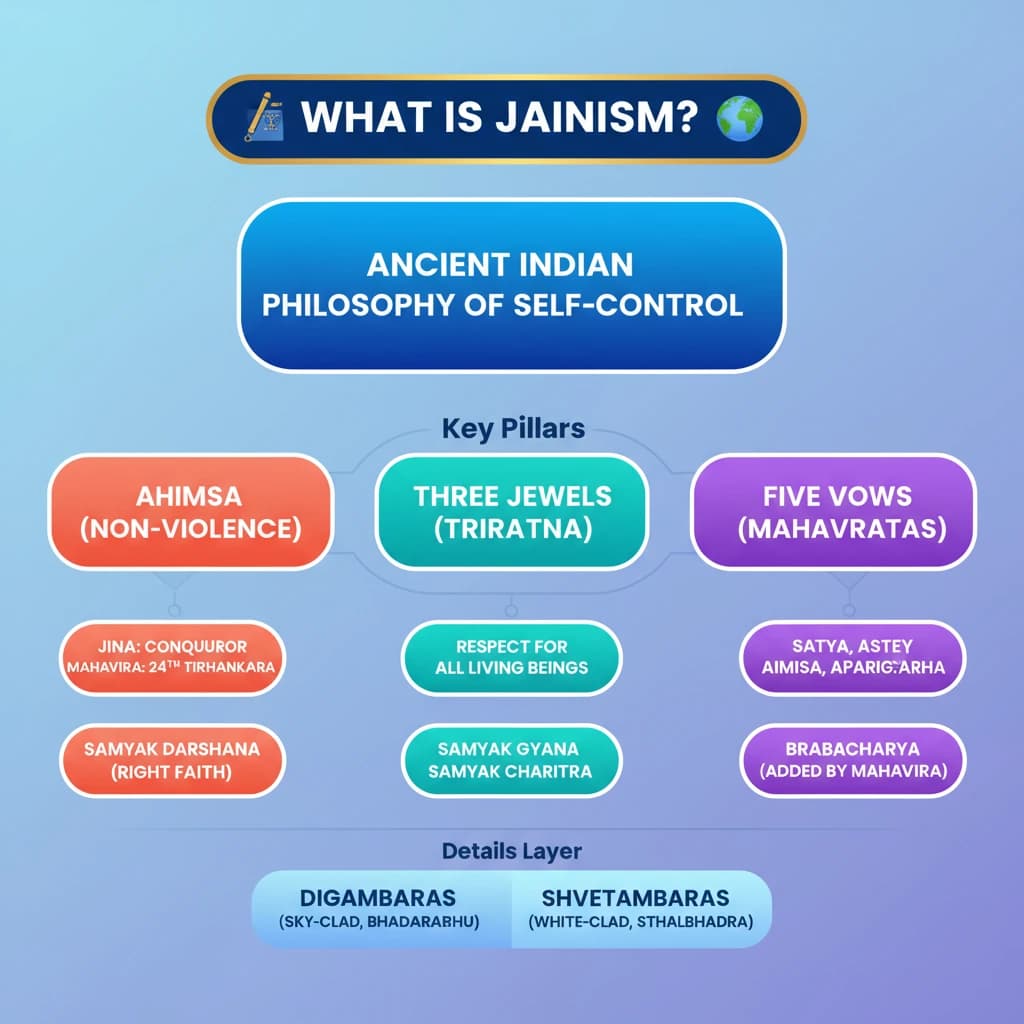
  • Jainism derives from 'Jina' (conqueror), emphasizing conquest of inner passions.
  • Central to Jainism is Ahimsa (non-violence) towards all living beings.
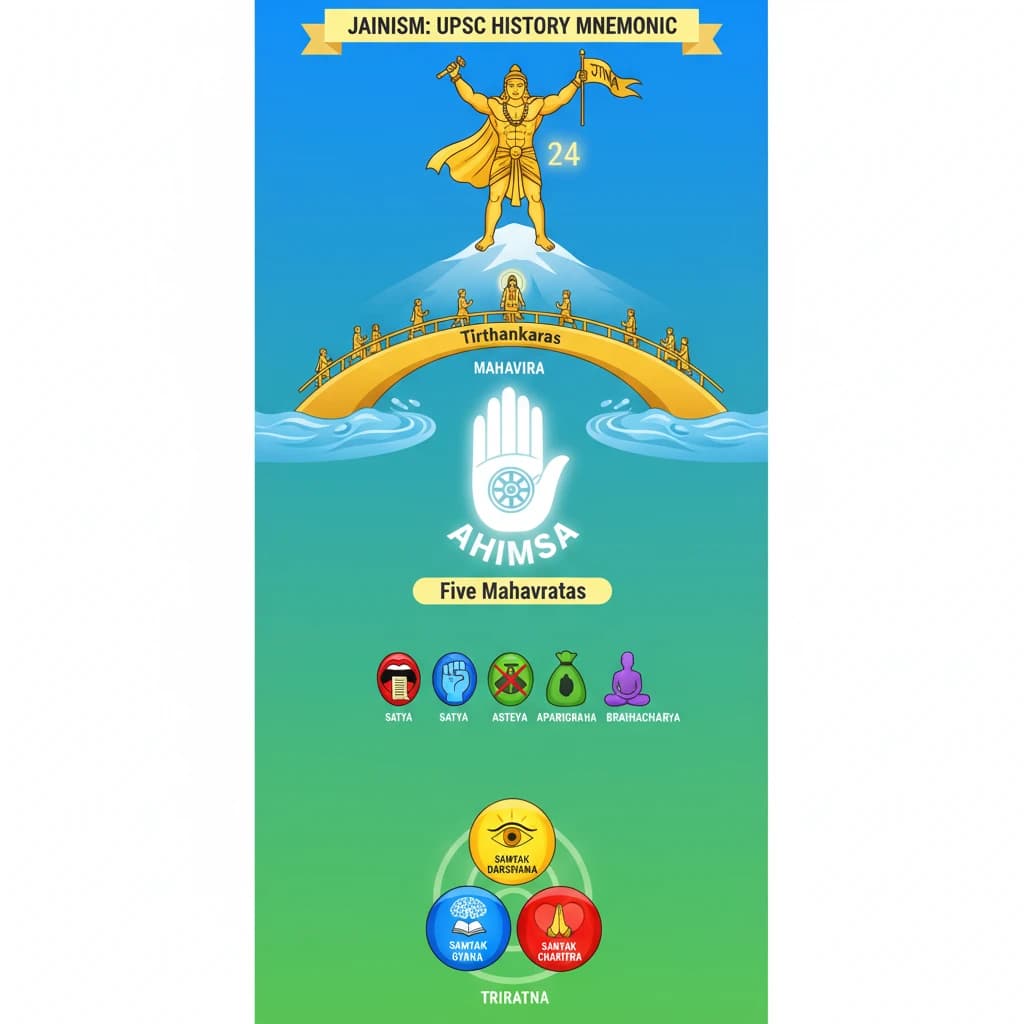
  • Five Mahavratas (great vows) include Ahimsa, Satya, Asteya, Aparigraha, and Brahmacharya (added by Mahavira).
  • Triratna (three jewels) for liberation are Samyak Darshana (right faith), Gyana (right knowledge), and Charitra (right conduct).
  • Jain philosophy believes the entire world is animated and karma shapes rebirth.
  • Asceticism and penance are key to freeing the soul from karma.
  • Jainism split into Shvetambaras (white-clad, Sthalabahahu) and Digambaras (sky-clad, Bhadrabahu).
  • Santhara/Sallekhana (fasting unto death) is a Jain practice, currently sub-judice in the Supreme Court after a Rajasthan High Court ruling.
What is Jainism

What is Jainism

Medium⏱️ 8 min read✓ 95% Verified
history

📖 Introduction

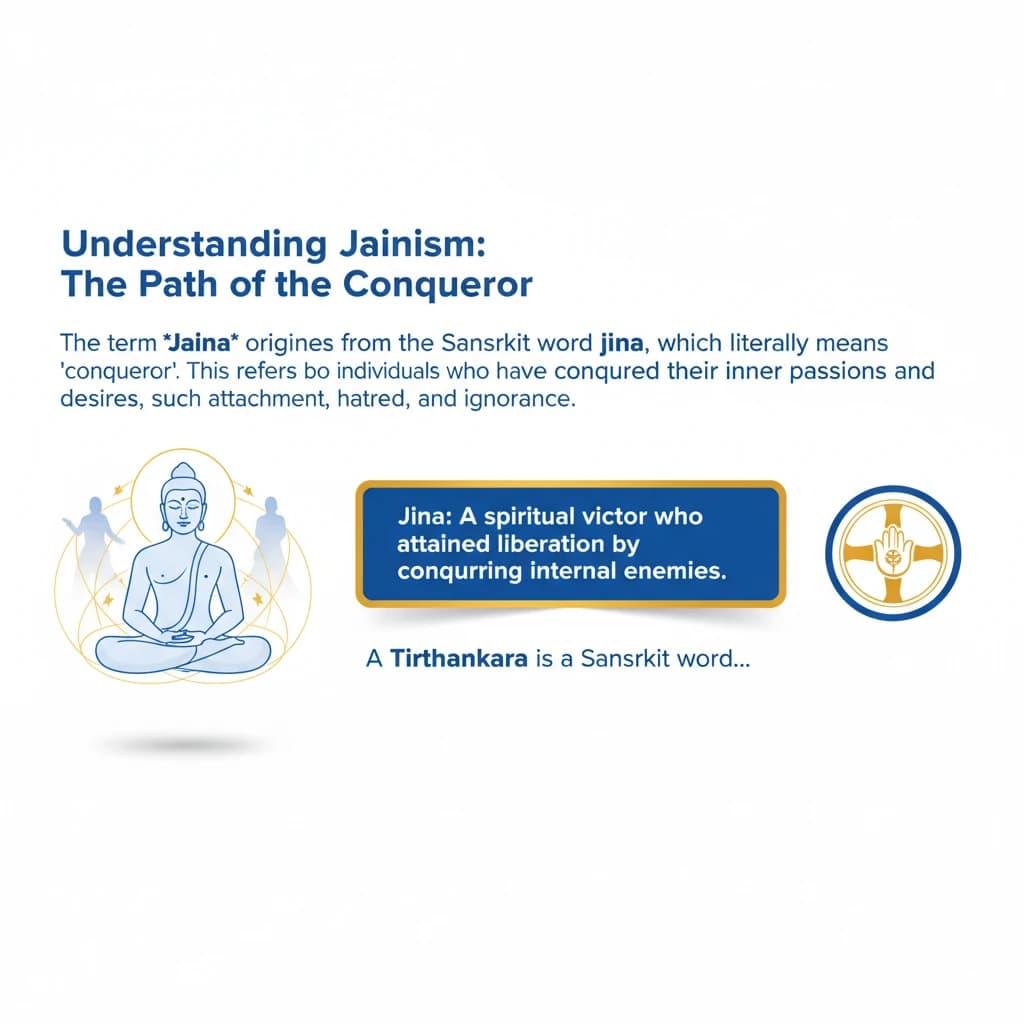
<h4>Understanding Jainism: The Path of the Conqueror</h4><p>The term <strong>Jainism</strong> originates from the Sanskrit word <strong>Jina</strong>, which translates to 'conqueror'. This signifies one who has conquered their inner passions and desires, such as attachment, hatred, and anger.</p><div class='info-box'><p>A <strong>Tirthankara</strong> is a Sanskrit word meaning 'ford maker'. It refers to an individual who has successfully crossed beyond the perpetual flow of earthly life, guiding others on the path to liberation.</p></div><h4>Core Principles: Ahimsa and the Mahavratas</h4><p>At the heart of <strong>Jainism</strong> lies the principle of <strong>Ahimsa</strong>, or <strong>non-violence</strong>. This tenet is given utmost importance, extending to all forms of life.</p><p>Jainism prescribes five great vows, known as <strong>Mahavratas</strong>, for its adherents to follow:</p><ul><li><strong>Ahimsa</strong> (Non-violence): Refraining from causing harm to any living being.</li><li><strong>Satya</strong> (Truth): Speaking the truth and being honest in all dealings.</li><li><strong>Asteya</strong> or <strong>Acharya</strong> (Non-stealing): Not taking anything that is not freely given.</li><li><strong>Aparigraha</strong> (Non-attachment/Non-possession): Limiting one's possessions and detaching from material things.</li><li><strong>Brahmacharya</strong> (Celibacy/Chastity): Abstinence from sensual pleasures, particularly sexual activity.</li></ul><p>Significantly, the vow of <strong>Brahmacharya</strong> was added to the existing four by <strong>Mahavira</strong>, the 24th and last <strong>Tirthankara</strong>.</p><h4>The Three Jewels (Triratna)</h4><p>The path to spiritual liberation in Jainism is guided by the <strong>Triratna</strong>, or the three jewels:</p><ul><li><strong>Samyak Darshana</strong> (Right Faith): Believing in the truths of Jainism and the <strong>Tirthankaras</strong>.</li><li><strong>Samyak Gyana</strong> (Right Knowledge): Having accurate and complete understanding of Jain philosophy.</li><li><strong>Samyak Charitra</strong> (Right Conduct): Living according to the <strong>Mahavratas</strong> and other ethical principles.</li></ul><h4>Jain Cosmology and Karma</h4><p>A fundamental idea in <strong>Jainism</strong> is the belief that the entire world is animated. This means that even inanimate objects like <strong>stones</strong>, <strong>rocks</strong>, and <strong>water</strong> are believed to possess life.</p><div class='key-point-box'><p>The philosophy of <strong>Jainism</strong> places <strong>non-injury</strong> to living beings at its core. This includes humans, animals, plants, and even insects, reflecting the deep reverence for all forms of life.</p></div><p>According to Jain teachings, the cycle of <strong>birth and rebirth</strong> is directly influenced and shaped by one's <strong>karma</strong>. Actions, both good and bad, accumulate as karmic particles that cling to the soul.</p><p>To achieve the liberation of the soul and free oneself from the cycle of <strong>karma</strong>, the practices of <strong>asceticism</strong> and <strong>penance</strong> are considered essential. These involve rigorous self-discipline and austerity.</p><h4>Santhara / Sallekhana: Fasting Unto Death</h4><p>The practice of <strong>Santhara</strong> (also known as <strong>Sallekhana</strong>) is a significant ritual within <strong>Jainism</strong>. It involves the ritual of <strong>fasting unto death</strong>, undertaken voluntarily by individuals, typically at the end of their life, as a means of purifying the soul.</p><div class='info-box'><p><strong>Shvetambara</strong> Jains refer to this practice as <strong>Santhara</strong>, while <strong>Digambara</strong> Jains call it <strong>Sallekhana</strong>.</p></div><div class='exam-tip-box'><p>The practice of <strong>Santhara</strong> has been a subject of legal debate. In the <strong>Nikhil Soni vs Union Of India Case</strong>, the <strong>Rajasthan High Court</strong> declared it an offence punishable under the <strong>Indian Penal Code (IPC)</strong>. However, the matter is still <strong>sub-judice</strong> in the <strong>Supreme Court</strong>, highlighting the conflict between religious freedom and the right to life.</p></div><h4>Sectarian Divisions in Jainism</h4><p>Over time, <strong>Jainism</strong> experienced a significant division, leading to the formation of two major sects:</p><ul><li><strong>Shvetambaras</strong> (white-clad): This sect developed under the leadership of <strong>Sthalabahahu</strong>. They traditionally wear white clothes.</li><li><strong>Digambaras</strong> (sky-clad): This sect emerged under the leadership of <strong>Bhadrabahu</strong>. Monks of this sect traditionally practice nudity, symbolizing complete non-possession.</li></ul>
Concept Diagram

💡 Key Takeaways

  • •Jainism derives from 'Jina' (conqueror), emphasizing conquest of inner passions.
  • •Central to Jainism is Ahimsa (non-violence) towards all living beings.
  • •Five Mahavratas (great vows) include Ahimsa, Satya, Asteya, Aparigraha, and Brahmacharya (added by Mahavira).
  • •Triratna (three jewels) for liberation are Samyak Darshana (right faith), Gyana (right knowledge), and Charitra (right conduct).
  • •Jain philosophy believes the entire world is animated and karma shapes rebirth.
  • •Asceticism and penance are key to freeing the soul from karma.
  • •Jainism split into Shvetambaras (white-clad, Sthalabahahu) and Digambaras (sky-clad, Bhadrabahu).
  • •Santhara/Sallekhana (fasting unto death) is a Jain practice, currently sub-judice in the Supreme Court after a Rajasthan High Court ruling.

🧠 Memory Techniques
Memory Aid
95% Verified Content

📚 Reference Sources

•NCERT Class XI History (Themes in Indian History Part I)
•Standard textbooks on Indian History and Culture

Related Topics

Loading related topics...
Explore:History Topics·All Subjects·Daily Current Affairs·Editorial Analysis·Previous Year Questions·UPSC GPT
Back
All Subjects

Topics

0 topics • 0 completed

Loading topics...
Loading...
Loading...
Loading...
Loading...
Loading...
Overall Progress0%