Loading page, please wait…
Vaidra Logo
Vaidra

Top 4 items + smart groups

UPSC GPT
New
Current Affairs
Daily Solutions
Daily Puzzle
Mains Evaluator

Version 2.0.0 • Built with ❤️ for UPSC aspirants

Loading...
Loading...
Loading...
Loading...
Loading...
Loading...
Loading...
Loading...
Loading...
Loading...
Loading...
Loading...
Loading...
Back
All Subjects

Topics

0 topics • 0 completed

Loading topics...
Loading...
Loading...
Loading...
Loading...
Loading...
Overall Progress0%

99% of human history - UPSC History

What is 99% of human history in UPSC History?

99% of human history is a key topic under History for UPSC Civil Services Examination. Key points include: The Stone Age constitutes 99% of human history, laying the foundation for all subsequent development.. It is divided into Paleolithic, Mesolithic, and Neolithic periods, reflecting technological and cultural evolution.. Indian geography played a crucial role in early human settlement patterns during the Stone Age.. Understanding this topic is essential for both UPSC Prelims and Mains preparation.

Why is 99% of human history important for UPSC exam?

99% of human history is a Easy-level topic in UPSC History. It is tested in both Prelims (factual MCQs) and Mains (analytical answer writing). Previous year UPSC questions have frequently covered aspects of 99% of human history, making it essential for comprehensive IAS preparation.

How to prepare 99% of human history for UPSC?

To prepare 99% of human history for UPSC: (1) Study the comprehensive notes covering all key concepts on Vaidra. (2) Practice previous year questions on this topic. (3) Connect it with current affairs using daily updates. (4) Revise using key takeaways and mind maps available for History. (5) Write practice answers linking 99% of human history to related GS Paper topics.

Key takeaways of 99% of human history for UPSC

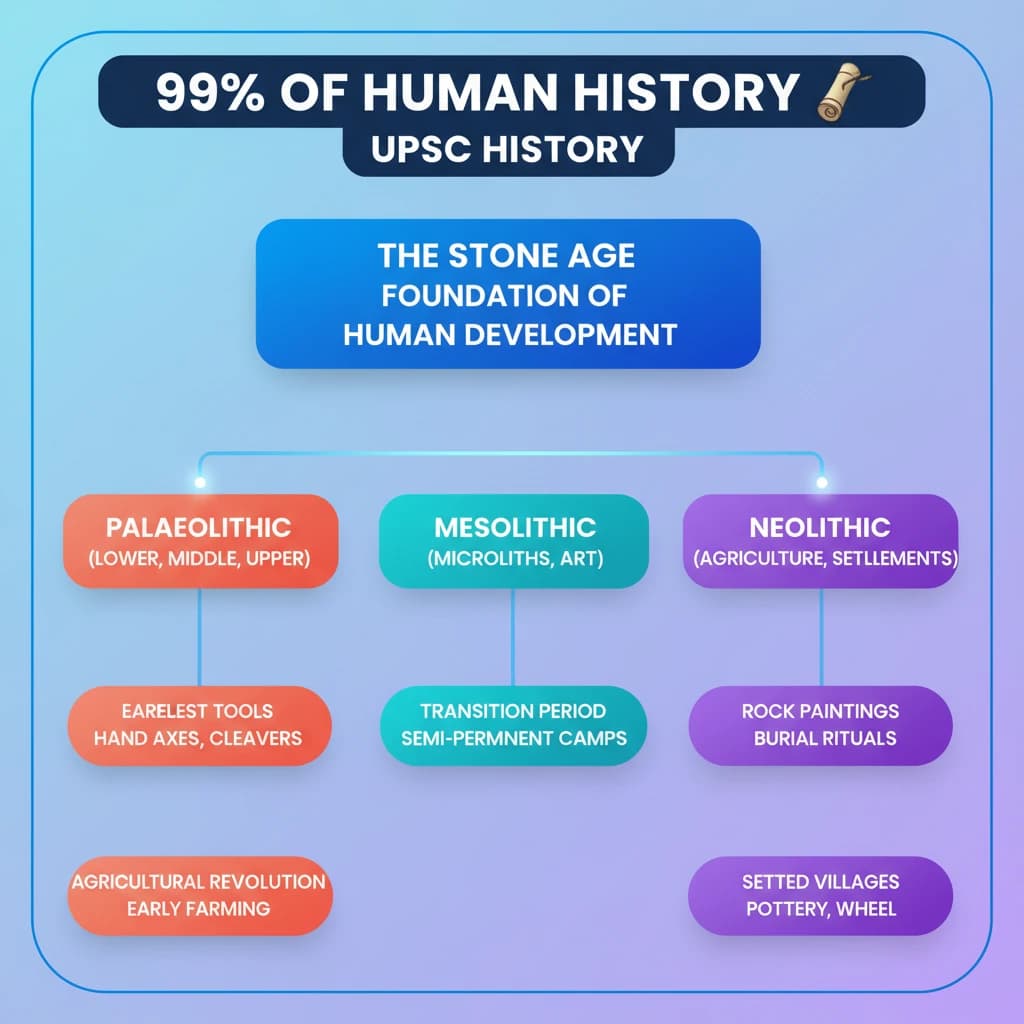
  • The Stone Age constitutes 99% of human history, laying the foundation for all subsequent development.
  • It is divided into Paleolithic, Mesolithic, and Neolithic periods, reflecting technological and cultural evolution.
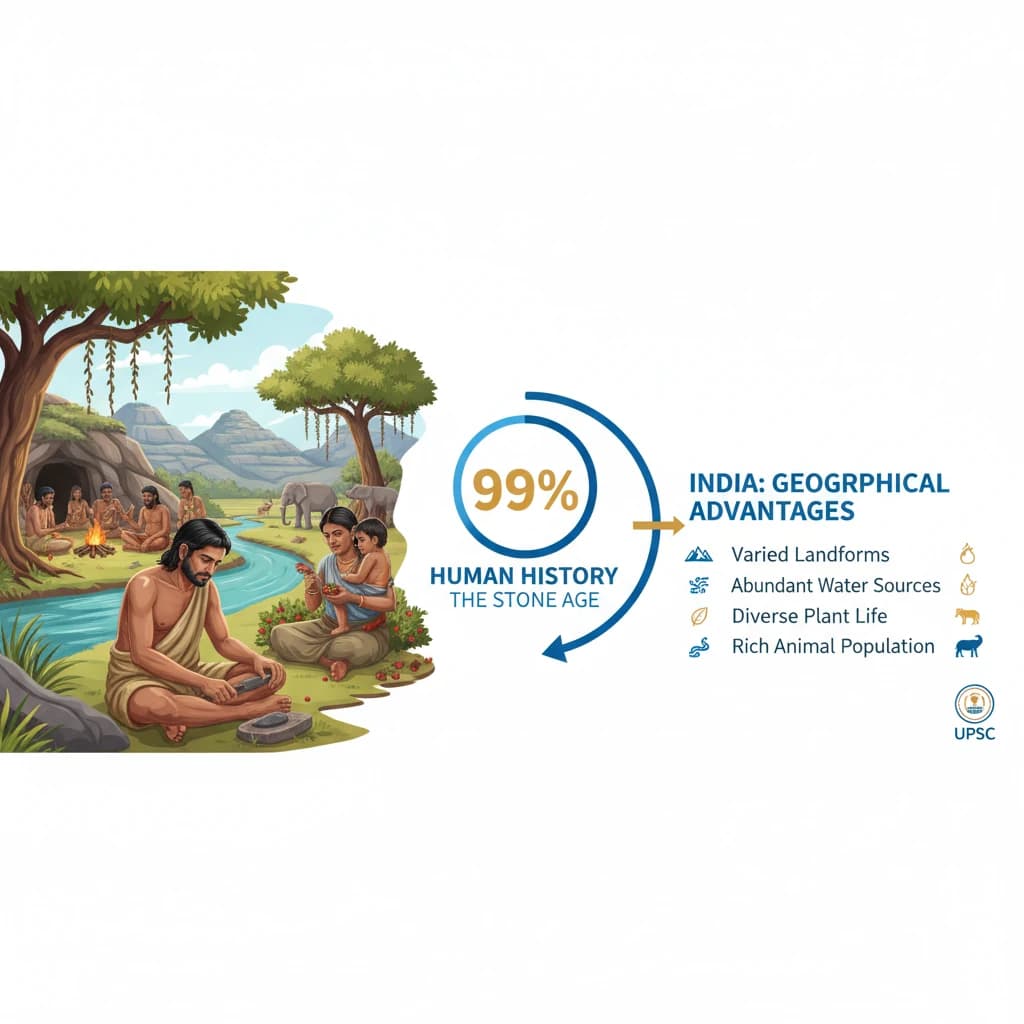
  • Indian geography played a crucial role in early human settlement patterns during the Stone Age.
  • The Paleolithic period in India had three phases (Lower, Middle, Upper) with distinct tool types (e.g., hand axes, scrapers, blades).
  • The Mesolithic period is characterized by microlithic tools, semi-permanent settlements, and early art/burial rituals.
  • The Neolithic period marked the revolutionary shift to agriculture and animal domestication, leading to settled life.
  • Early evidence of Neolithic culture is found in the Fertile Crescent, Indus region, Ganges Valley, and China.
99% of human history

99% of human history

Easy⏱️ 6 min read✓ 95% Verified
history

📖 Introduction

<h4>Introduction to Human History: The Stone Age</h4><p>The vast majority, approximately <strong>99%</strong>, of all <strong>human history</strong> is encompassed within the <strong>Stone Age</strong>. This period is crucial for understanding the foundational developments of human civilization.</p><p>In <strong>India</strong>, the diverse geographical features including varied landforms, abundant water sources, diverse plant life, and a rich animal population, facilitated human habitation across most regions. Exceptions were primarily the high <strong>Himalayas</strong> and the heavily riverine <strong>Indo-Gangetic plains</strong> during certain early phases of the Stone Age.</p><div class='key-point-box'><p>The <strong>Stone Age</strong> is broadly categorized into three principal periods based on technological advancements and cultural characteristics:</p><ul><li><strong>Paleolithic Period</strong> (Old Stone Age)</li><li><strong>Mesolithic Period</strong> (Middle Stone Age)</li><li><strong>Neolithic Period</strong> (New Stone Age)</li></ul></div><h4>The Paleolithic Period in India</h4><p>The <strong>Indian Paleolithic</strong> era itself is further subdivided into three distinct developmental stages, reflecting progressive changes in tool-making techniques and human adaptation.</p><h5>Lower Paleolithic (600,000 BP to 150,000 BP)</h5><p>This earliest phase of the Paleolithic period is characterized by the use of relatively large and crude tools. Early humans primarily utilized <strong>large pebbles</strong> or <strong>flakes</strong> to craft their implements.</p><div class='info-box'><p><strong>Key Tools:</strong> <strong>Choppers</strong>, <strong>chopping tools</strong>, <strong>hand axes</strong>, <strong>cleavers</strong>, and <strong>knives</strong> were common during this period.</p></div><p>The <strong>Lower Paleolithic</strong> in India is distinguished by two prominent cultural traditions:</p><ul><li>The <strong>Soanian pebble-tool tradition</strong>, primarily found in the north-west.</li><li>The <strong>Peninsular Indian handaxe-cleaver tradition</strong>, widespread across the Indian subcontinent.</li></ul><h5>Middle Paleolithic (165,000 BP to 31,000 BP)</h5><p>This phase represents a refinement in tool-making. It is marked by a shift towards tools made from a variety of <strong>flakes</strong>, which were carefully struck from stone cores.</p><div class='info-box'><p><strong>Key Tools:</strong> Common tools included <strong>scrapers</strong>, <strong>points</strong>, and <strong>borers</strong>, indicating more specialized functions compared to the Lower Paleolithic.</p></div><h5>Upper Paleolithic (40,000 BP to 12,000 BP)</h5><p>The <strong>Upper Paleolithic</strong> period witnessed significant improvements in tool technology and diversity. Humans began creating more sophisticated and specialized tools.</p><div class='info-box'><p><strong>Advanced Techniques:</strong> This phase saw the development of the <strong>punch technique</strong>, allowing for the creation of long, parallel-sided blades.</p><p><strong>Key Tools:</strong> Tools such as <strong>blunted blades</strong>, <strong>penknife blades</strong>, <strong>blades with serrated edges</strong>, and <strong>arrow points</strong> became prevalent, suggesting advancements in hunting and processing.</p></div><h4>The Mesolithic Culture</h4><p>The <strong>Mesolithic era</strong>, or Middle Stone Age, served as a transitional period between the Paleolithic and Neolithic. It is characterized by significant changes in human lifestyle and technology.</p><div class='key-point-box'><p><strong>Key Features of Mesolithic Culture:</strong></p><ul><li><strong>Settlements:</strong> People inhabited both <strong>semi-permanent</strong> and <strong>temporary settlements</strong>.</li><li><strong>Habitats:</strong> They utilized natural shelters like <strong>caves</strong> as well as <strong>open areas</strong> for living.</li><li><strong>Rituals:</strong> Evidence of <strong>burial rituals</strong> indicates developing social structures and beliefs.</li><li><strong>Art:</strong> Demonstrated significant <strong>artistic abilities</strong>, often seen in cave paintings.</li><li><strong>Continuity:</strong> Maintained a strong sense of <strong>cultural continuity</strong> from previous periods.</li><li><strong>Tools:</strong> The defining characteristic was the use of <strong>microlithic tools</strong> (small, geometric stone tools), ideal for hunting smaller prey.</li></ul></div><h4>The Neolithic Period</h4><p>The <strong>Neolithic period</strong>, or New Stone Age, marks one of the most transformative phases in human history, often referred to as the <strong>Neolithic Revolution</strong>.</p><div class='highlight-box'><p>This period fundamentally changed human society by marking the definitive <strong>beginning of agriculture</strong> and the widespread practice of <strong>animal domestication</strong>.</p></div><p>Early evidence for the development of <strong>Neolithic culture</strong> is found in several key regions globally. These areas became cradles of early agricultural societies.</p><div class='info-box'><p><strong>Early Neolithic Evidence Locations:</strong></p><ul><li>The <strong>Fertile Crescent region</strong> of <strong>Egypt</strong> and <strong>Mesopotamia</strong>.</li><li>The <strong>Indus region</strong> of present-day India and Pakistan.</li><li>The <strong>Ganges Valley</strong> of India.</li><li>Various sites across <strong>China</strong>.</li></ul></div>
Concept Diagram

💡 Key Takeaways

  • •The Stone Age constitutes 99% of human history, laying the foundation for all subsequent development.
  • •It is divided into Paleolithic, Mesolithic, and Neolithic periods, reflecting technological and cultural evolution.
  • •Indian geography played a crucial role in early human settlement patterns during the Stone Age.
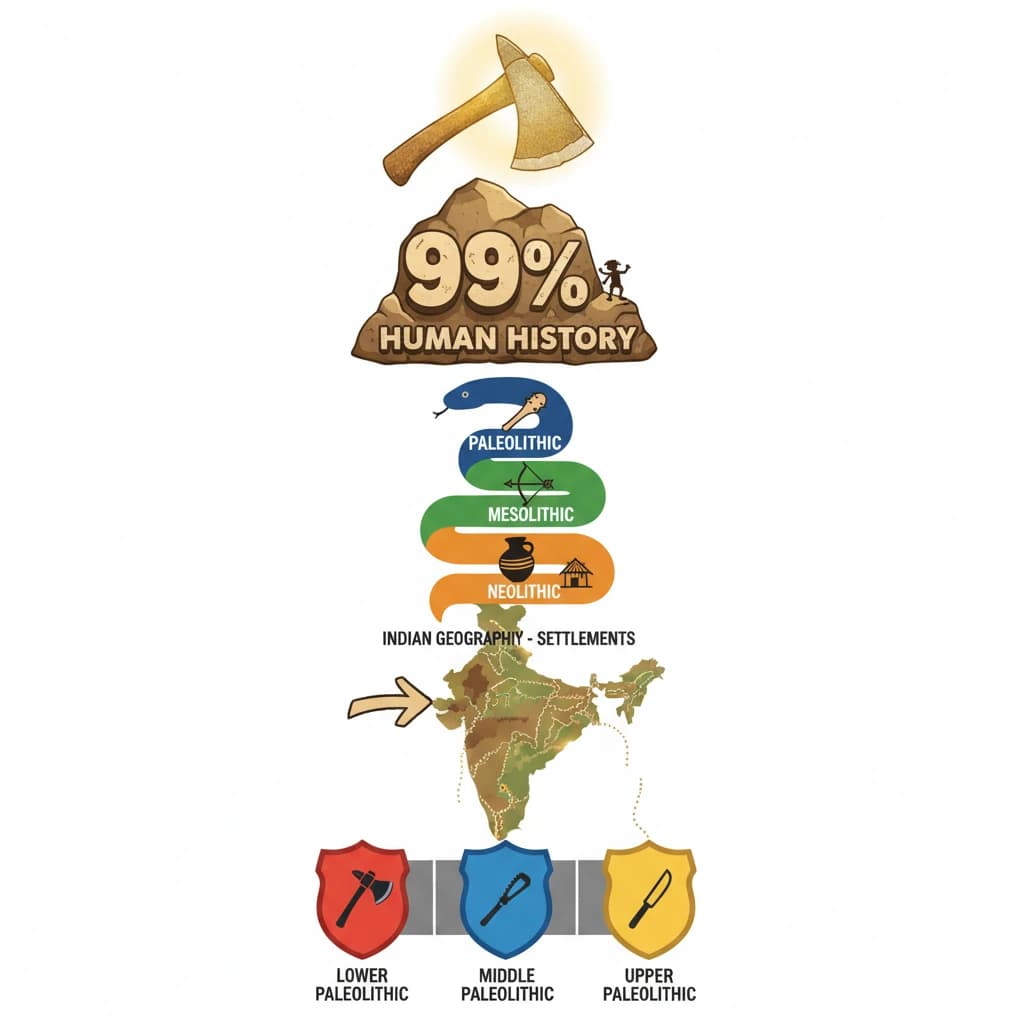
  • •The Paleolithic period in India had three phases (Lower, Middle, Upper) with distinct tool types (e.g., hand axes, scrapers, blades).
  • •The Mesolithic period is characterized by microlithic tools, semi-permanent settlements, and early art/burial rituals.
  • •The Neolithic period marked the revolutionary shift to agriculture and animal domestication, leading to settled life.
  • •Early evidence of Neolithic culture is found in the Fertile Crescent, Indus region, Ganges Valley, and China.

🧠 Memory Techniques
Memory Aid
95% Verified Content

Related Topics

Loading related topics...
Explore:History Topics·All Subjects·Daily Current Affairs·Editorial Analysis·Previous Year Questions·UPSC GPT
99% of human history - UPSC History