Loading page, please wait…
Vaidra Logo
Vaidra

Top 4 items + smart groups

UPSC GPT
New
Current Affairs
Daily Solutions
Daily Puzzle
Mains Evaluator

Version 2.0.0 • Built with ❤️ for UPSC aspirants

Loading...
Loading...
Loading...
Loading...
Loading...
Loading...
Loading...
Loading...
Loading...
Loading...
Loading...
Loading...
Loading...

Key Sessions of the Indian National Congress - UPSC History

What is Key Sessions of the Indian National Congress in UPSC History?

Key Sessions of the Indian National Congress is a key topic under History for UPSC Civil Services Examination. Key points include: INC sessions were annual platforms for nationalist discourse and strategy formulation.. Early sessions established foundational leadership and represented diverse groups (first Muslim, first English, first woman presidents).. Key sessions marked significant shifts in strategy (Swadeshi, Swaraj) and internal dynamics (Surat Split).. Understanding this topic is essential for both UPSC Prelims and Mains preparation.

Why is Key Sessions of the Indian National Congress important for UPSC exam?

Key Sessions of the Indian National Congress is a Medium-level topic in UPSC History. It is tested in both Prelims (factual MCQs) and Mains (analytical answer writing). Previous year UPSC questions have frequently covered aspects of Key Sessions of the Indian National Congress, making it essential for comprehensive IAS preparation.

How to prepare Key Sessions of the Indian National Congress for UPSC?

To prepare Key Sessions of the Indian National Congress for UPSC: (1) Study the comprehensive notes covering all key concepts on Vaidra. (2) Practice previous year questions on this topic. (3) Connect it with current affairs using daily updates. (4) Revise using key takeaways and mind maps available for History. (5) Write practice answers linking Key Sessions of the Indian National Congress to related GS Paper topics.

Key takeaways of Key Sessions of the Indian National Congress for UPSC

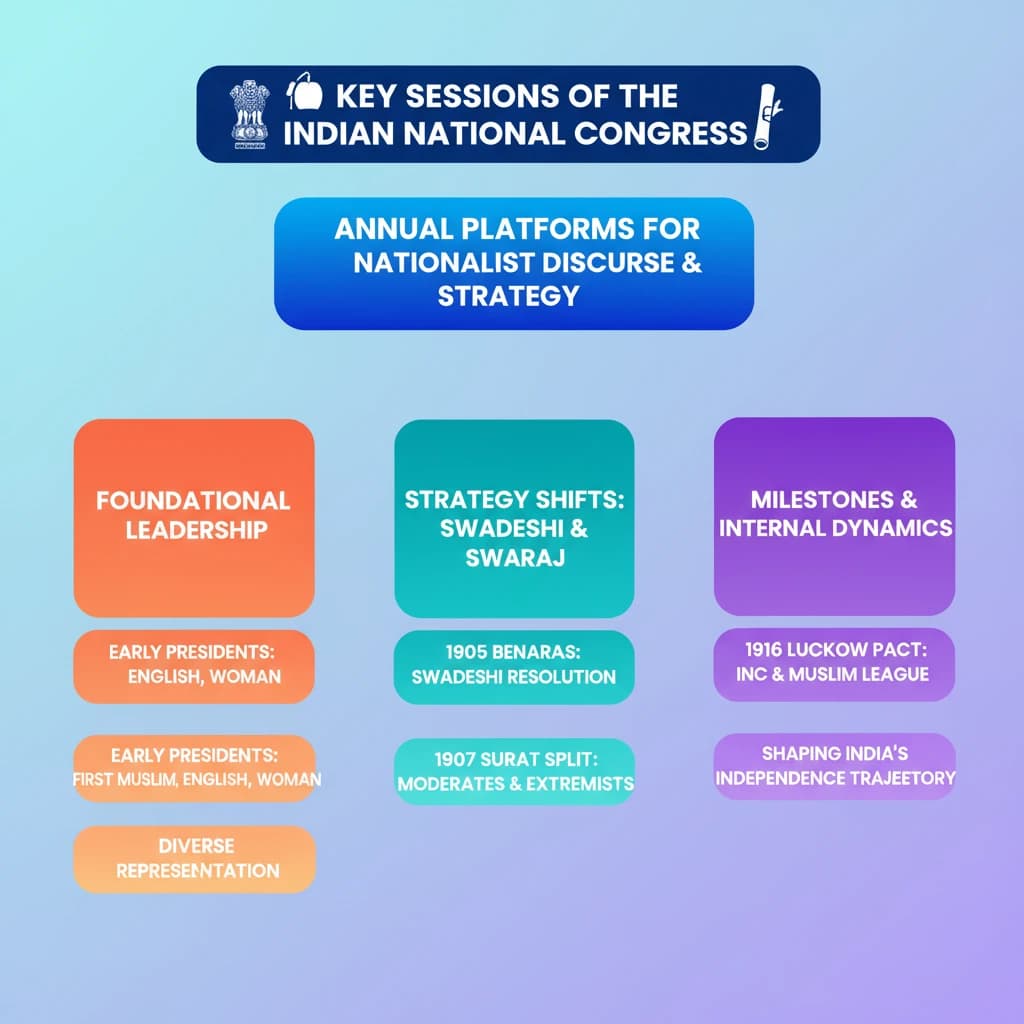
  • INC sessions were annual platforms for nationalist discourse and strategy formulation.
  • Early sessions established foundational leadership and represented diverse groups (first Muslim, first English, first woman presidents).
  • Key sessions marked significant shifts in strategy (Swadeshi, Swaraj) and internal dynamics (Surat Split).
  • Important milestones include the formal proclamation of Swadeshi (1905) and the Lucknow Pact (1916).
  • These sessions collectively shaped the trajectory and leadership of India's independence movement.
Key Sessions of the Indian National Congress

Key Sessions of the Indian National Congress

Medium⏱️ 10 min read✓ 95% Verified
history

📖 Introduction

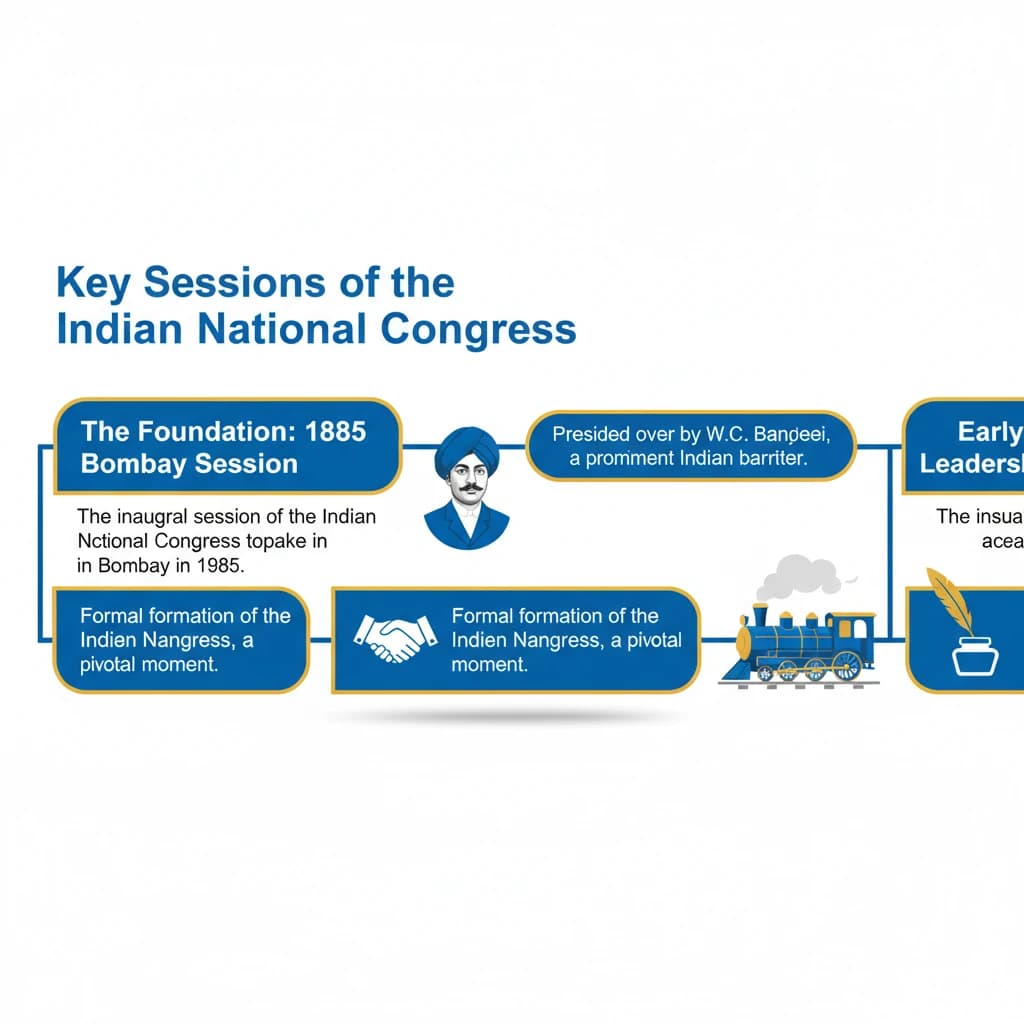
<h4>The Foundation: 1885 Bombay Session</h4><p>The inaugural session of the <strong>Indian National Congress</strong> took place in <strong>Bombay</strong> in <strong>1885</strong>.</p><div class='info-box'><p>It was presided over by <strong>W.C. Banerjee</strong>, a prominent Indian barrister.</p></div><div class='key-point-box'><p>This session marked the formal <strong>formation of the Indian National Congress</strong>, a pivotal moment in India's freedom struggle.</p></div><h4>Early Leadership: 1886 Calcutta Session</h4><p>The second session was held in <strong>Calcutta</strong> in <strong>1886</strong>.</p><div class='info-box'><p>It was presided over by the respected nationalist leader, <strong>Dadabhai Naoroji</strong>, often known as the 'Grand Old Man of India'.</p></div><h4>Breaking Barriers: 1887 Madras Session</h4><p>The third annual session convened in <strong>Madras</strong> in <strong>1887</strong>.</p><div class='info-box'><p><strong>Syed Badruddin Tyabji</strong> made history by becoming the <strong>First Muslim President</strong> of the Indian National Congress during this session.</p></div><h4>International Representation: 1888 Allahabad Session</h4><p>The fourth session was held in <strong>Allahabad</strong> in <strong>1888</strong>.</p><div class='info-box'><p>This session saw <strong>George Yule</strong> elected as the president, making him the <strong>First English President</strong> of the Congress.</p></div><h4>Cultural Significance: 1896 Calcutta Session</h4><p>The <strong>Calcutta</strong> session of <strong>1896</strong> holds cultural importance.</p><div class='key-point-box'><p>During this session, the <strong>National Song 'Vande Mataram'</strong> was sung for the first time by <strong>Rabindranath Tagore</strong>.</p></div><h4>A Future Leader Emerges: 1901 Calcutta Session</h4><p>The <strong>Calcutta</strong> session of <strong>1901</strong> marked a significant moment for the future of Indian nationalism.</p><div class='info-box'><p>It was here that <strong>Mahatma Gandhi</strong> made his <strong>first appearance</strong> on the Congress platform, after his work in South Africa.</p></div><h4>The Rise of Swadeshi: 1905 Benaras Session</h4><p>The <strong>Benaras</strong> session in <strong>1905</strong> was crucial in the anti-partition movement.</p><div class='key-point-box'><p>It saw the <strong>formal proclamation of the Swadeshi Movement</strong>, advocating for self-reliance and boycott of foreign goods.</p></div><div class='info-box'><p>This session was held under the presidency of the moderate leader, <strong>Gopal Krishna Gokhale</strong>.</p></div><h4>Defining National Goals: 1906 Calcutta Session</h4><p>The <strong>Calcutta</strong> session of <strong>1906</strong> was presided over by <strong>Dadabhai Naoroji</strong> again.</p><div class='key-point-box'><p>It passed significant resolutions on <strong>Swaraj</strong> (self-rule), <strong>Boycott</strong>, <strong>Swadeshi</strong>, and <strong>National Education</strong>, outlining the Congress's core objectives.</p></div><h4>The Great Divide: 1907 Surat Session</h4><p>The <strong>Surat</strong> session in <strong>1907</strong> is infamous for a major internal conflict.</p><div class='info-box'><p>Presided over by <strong>Rash Bihari Ghosh</strong>, this session witnessed the unfortunate <strong>split between the Moderates and Extremists</strong> within the Congress.</p></div><div class='exam-tip-box'><p>This split significantly impacted the pace and strategy of the national movement for several years.</p></div><h4>Reconciliation and Alliance: 1916 Lucknow Session</h4><p>The <strong>Lucknow</strong> session of <strong>1916</strong>, presided by <strong>A.C. Majumdar</strong>, was a landmark event.</p><div class='key-point-box'><p>It achieved <strong>unity between the Moderates and Extremists</strong>, who had split at Surat.</p></div><div class='info-box'><p>Crucially, the <strong>Lucknow Pact</strong> was signed during this session, forging an alliance between the <strong>Indian National Congress</strong> and the <strong>Muslim League</strong>.</p></div><h4>Pioneering Leadership: 1917 Calcutta Session</h4><p>The <strong>Calcutta</strong> session of <strong>1917</strong> broke new ground in terms of representation.</p><div class='key-point-box'><p><strong>Annie Besant</strong> became the <strong>First Woman President of Congress</strong>, a significant step towards gender inclusivity in national leadership.</p></div><h4>Post-War Developments: 1919 Amritsar Session</h4><p>The <strong>Amritsar</strong> session in <strong>1919</strong>, presided by <strong>Motilal Nehru</strong>, addressed post-World War I issues.</p><div class='info-box'><p>The Congress expressed its <strong>support for the Khilafat Movement</strong>, aligning with Muslim sentiments regarding the Ottoman Caliphate.</p></div><div class='exam-tip-box'><p>This session demonstrated a strategic alliance between Hindu and Muslim political forces against British rule.</p></div>
Concept Diagram

💡 Key Takeaways

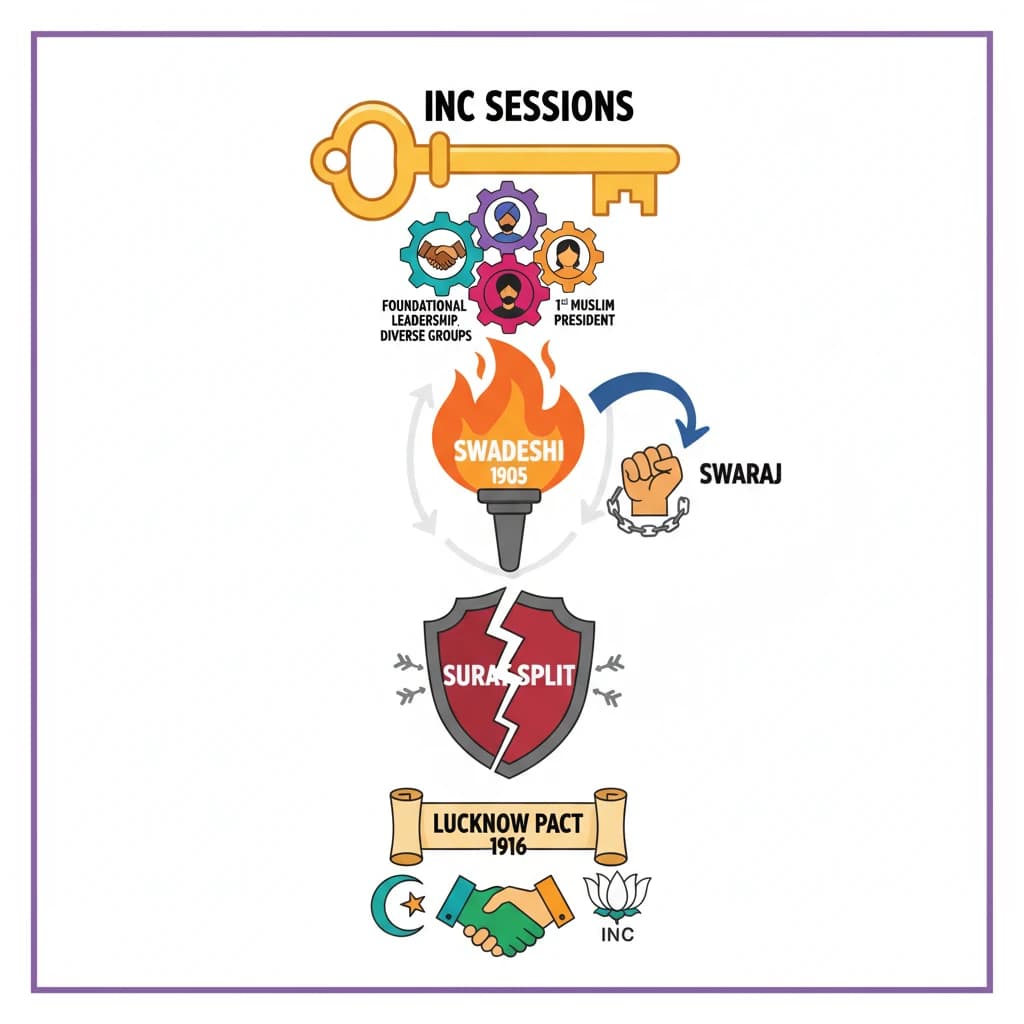
  • •INC sessions were annual platforms for nationalist discourse and strategy formulation.
  • •Early sessions established foundational leadership and represented diverse groups (first Muslim, first English, first woman presidents).
  • •Key sessions marked significant shifts in strategy (Swadeshi, Swaraj) and internal dynamics (Surat Split).
  • •Important milestones include the formal proclamation of Swadeshi (1905) and the Lucknow Pact (1916).
  • •These sessions collectively shaped the trajectory and leadership of India's independence movement.

🧠 Memory Techniques
Memory Aid
95% Verified Content

Related Topics

Loading related topics...
Explore:History Topics·All Subjects·Daily Current Affairs·Editorial Analysis·Previous Year Questions·UPSC GPT
Back
All Subjects

Topics

0 topics • 0 completed

Loading topics...
Loading...
Loading...
Loading...
Loading...
Loading...
Overall Progress0%
Key Sessions of the Indian National Congress - UPSC History