Loading page, please wait…
Vaidra Logo
Vaidra

Top 4 items + smart groups

UPSC GPT
New
Current Affairs
Daily Solutions
Daily Puzzle
Mains Evaluator

Version 2.0.0 • Built with ❤️ for UPSC aspirants

Loading...
Loading...
Loading...
Loading...
Loading...
Loading...
Loading...
Loading...
Loading...
Loading...
Loading...
Loading...
Loading...
Back
All Subjects

Topics

0 topics • 0 completed

Loading topics...
Loading...
Loading...
Loading...
Loading...
Loading...
Overall Progress0%

What are the Key Facts Related to Saint Narahari Tirtha? - UPSC History

What is What are the Key Facts Related to Saint Narahari Tirtha? in UPSC History?

What are the Key Facts Related to Saint Narahari Tirtha? is a key topic under History for UPSC Civil Services Examination. Key points include: Saint Narahari Tirtha (1243-1333 AD) was a Dvaita philosopher, statesman, and ruler in the Madhva tradition.. He hailed from Chikakolu (modern Srikakulam) in Andhra Pradesh, within the Gajapati empire of Odisha.. Served the Eastern Ganga Dynasty for over 30 years, advising on Sanātana Dharma and structuring temple administration.. Understanding this topic is essential for both UPSC Prelims and Mains preparation.

Why is What are the Key Facts Related to Saint Narahari Tirtha? important for UPSC exam?

What are the Key Facts Related to Saint Narahari Tirtha? is a Medium-level topic in UPSC History. It is tested in both Prelims (factual MCQs) and Mains (analytical answer writing). Previous year UPSC questions have frequently covered aspects of What are the Key Facts Related to Saint Narahari Tirtha?, making it essential for comprehensive IAS preparation.

How to prepare What are the Key Facts Related to Saint Narahari Tirtha? for UPSC?

To prepare What are the Key Facts Related to Saint Narahari Tirtha? for UPSC: (1) Study the comprehensive notes covering all key concepts on Vaidra. (2) Practice previous year questions on this topic. (3) Connect it with current affairs using daily updates. (4) Revise using key takeaways and mind maps available for History. (5) Write practice answers linking What are the Key Facts Related to Saint Narahari Tirtha? to related GS Paper topics.

Key takeaways of What are the Key Facts Related to Saint Narahari Tirtha? for UPSC

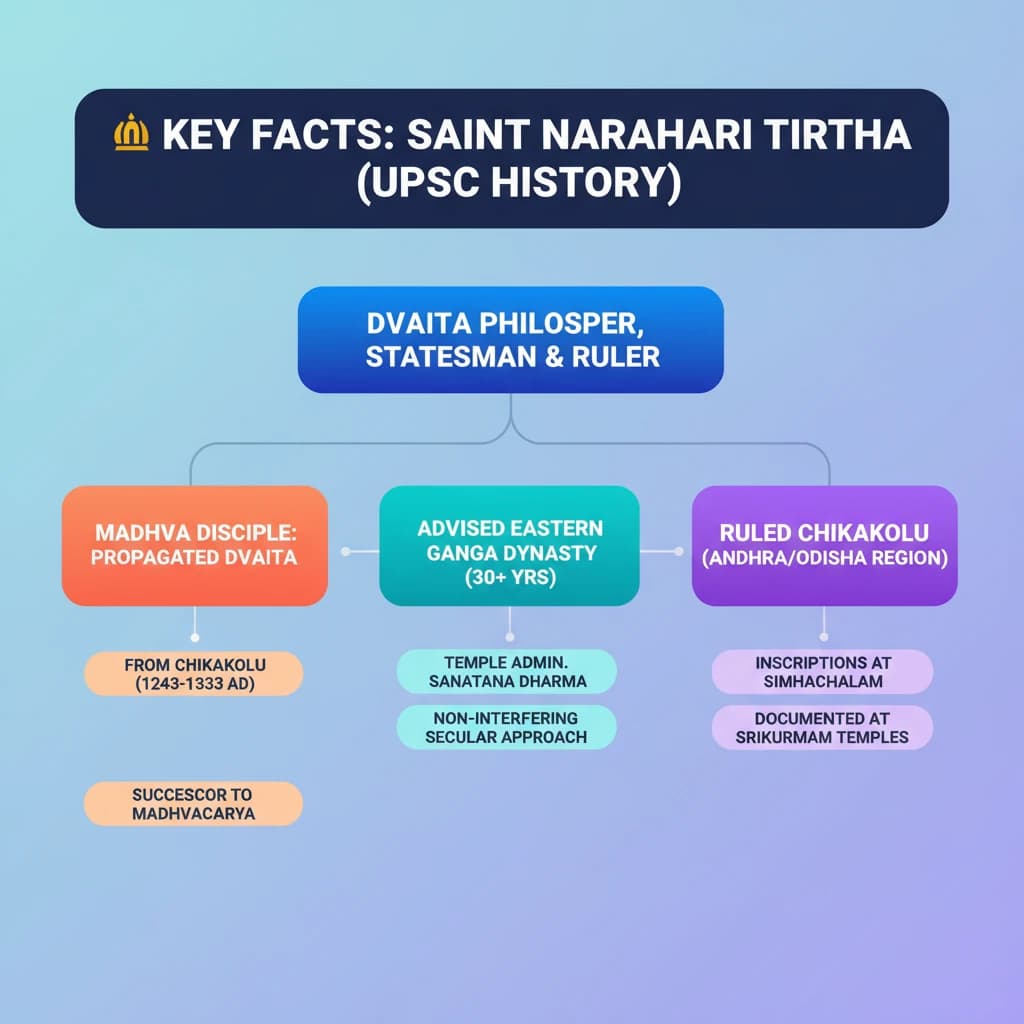
  • Saint Narahari Tirtha (1243-1333 AD) was a Dvaita philosopher, statesman, and ruler in the Madhva tradition.
  • He hailed from Chikakolu (modern Srikakulam) in Andhra Pradesh, within the Gajapati empire of Odisha.
  • Served the Eastern Ganga Dynasty for over 30 years, advising on Sanātana Dharma and structuring temple administration.
  • A direct disciple of Madhvacharya, he significantly propagated Dvaita Vaishnavism in a non-interfering, secular manner.
  • His contributions are historically documented through inscriptions found at Simhachalam and Srikurmam temples.
What are the Key Facts Related to Saint Narahari Tirtha?

What are the Key Facts Related to Saint Narahari Tirtha?

Medium⏱️ 5 min read✓ 95% Verified
history

📖 Introduction

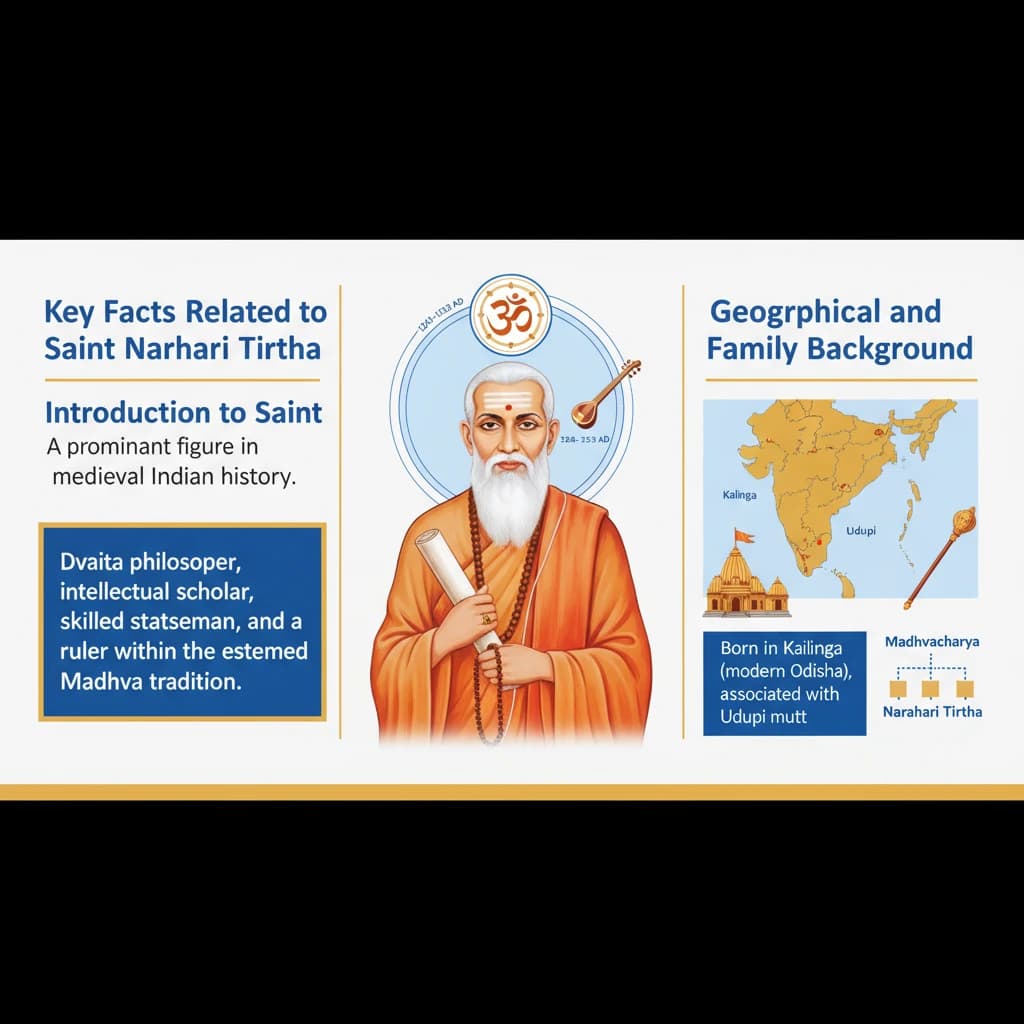
<h4>Introduction to Saint Narahari Tirtha</h4><p><strong>Saint Narahari Tirtha</strong> (<strong>1243-1333 AD</strong>) was a prominent figure in medieval Indian history, known for his multifaceted contributions.</p><div class='info-box'>He was a renowned <strong>Dvaita philosopher</strong>, an <strong>intellectual scholar</strong>, a skilled <strong>statesman</strong>, and a <strong>ruler</strong> within the esteemed <strong>Madhva tradition</strong>.</div><h4>Geographical and Family Background</h4><p>He originated from <strong>Chikakolu</strong>, which is identified with modern-day <strong>Srikakulam</strong> in <strong>Andhra Pradesh</strong>.</p><p><strong>Narahari Tirtha</strong> was born into an <strong>aristocratic family</strong>, deeply rooted in the powerful <strong>Gajapati empire</strong> of <strong>Odisha</strong>.</p><h4>Role in the Eastern Ganga Dynasty</h4><p>For a significant period, <strong>Narahari Tirtha</strong> served and assisted the kings of the <strong>Eastern Ganga Dynasty</strong>.</p><div class='info-box'>His service to the dynasty spanned over <strong>30 years</strong>, demonstrating long-term commitment and influence.</div><p>He played a crucial role in guiding the rulers to adhere to <strong>Sanātana Dharma</strong> principles.</p><p>Furthermore, he was instrumental in establishing a structured <strong>executive system</strong> specifically for managing <strong>temple affairs</strong>.</p><p>Evidence of his significant efforts and contributions is well-documented in various <strong>inscriptions</strong> found at the revered <strong>Simhachalam</strong> and <strong>Srikurmam</strong> temples.</p><h4>Religious Contributions and Dvaita Philosophy</h4><p><strong>Narahari Tirtha</strong> was a dedicated follower and direct disciple of <strong>Madhvacharya</strong>.</p><div class='key-point-box'><strong>Madhvacharya</strong> is widely recognized as the original proponent and founder of the <strong>Dvaita philosophy</strong>.</div><p>He actively propagated <strong>Madhvacharya's Vaishnavism</strong> throughout the region.</p><p>His approach ensured the firm establishment of this tradition in a <strong>non-interfering</strong> and notably <strong>secular manner</strong>.</p><p>His profound influence was vital in successfully maintaining the rich <strong>religious and cultural traditions</strong> of the region.</p><h4>Titles and Honors</h4><p>In recognition of his diverse and significant contributions, <strong>Narahari Tirtha</strong> was bestowed with several prestigious titles of honor.</p><div class='info-box'>These esteemed titles include <strong>“Yoka Sarakaraou Ati Nipunah”</strong> and <strong>“Yo Avati Kalinga-Bhu Samabhavan”</strong>.</div><div class='exam-tip-box'>UPSC Insight: Understanding figures like <strong>Narahari Tirtha</strong> is crucial for <strong>Mains GS Paper 1</strong> (Indian History and Culture) and <strong>Prelims</strong> for factual questions on medieval saints and philosophical traditions. Focus on his dual role as a <strong>statesman</strong> and <strong>religious propagator</strong>.</div>
Concept Diagram

💡 Key Takeaways

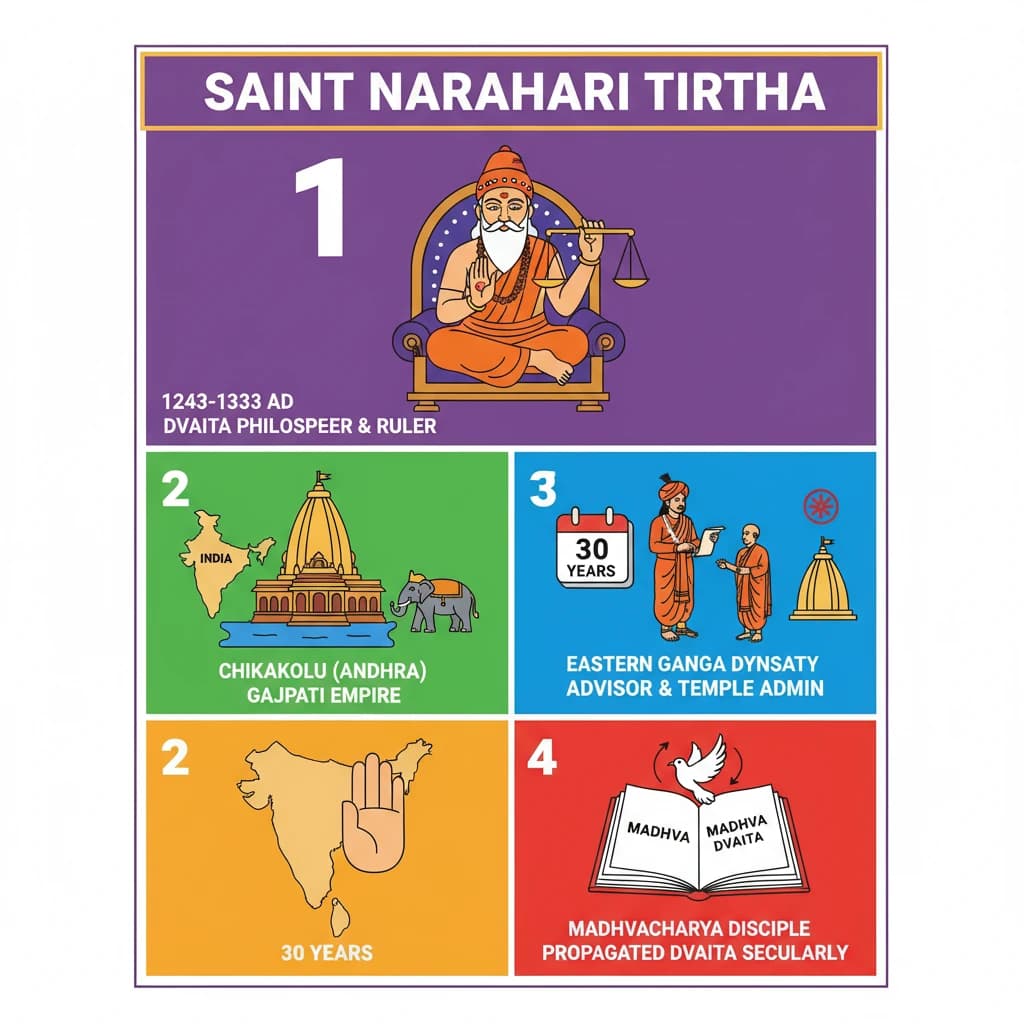
  • •Saint Narahari Tirtha (1243-1333 AD) was a Dvaita philosopher, statesman, and ruler in the Madhva tradition.
  • •He hailed from Chikakolu (modern Srikakulam) in Andhra Pradesh, within the Gajapati empire of Odisha.
  • •Served the Eastern Ganga Dynasty for over 30 years, advising on Sanātana Dharma and structuring temple administration.
  • •A direct disciple of Madhvacharya, he significantly propagated Dvaita Vaishnavism in a non-interfering, secular manner.
  • •His contributions are historically documented through inscriptions found at Simhachalam and Srikurmam temples.

🧠 Memory Techniques
Memory Aid
95% Verified Content

📚 Reference Sources

•General historical texts on Eastern Ganga Dynasty and Dvaita philosophy

Related Topics

Loading related topics...
Explore:History Topics·All Subjects·Daily Current Affairs·Editorial Analysis·Previous Year Questions·UPSC GPT
What are the Key Facts Related to Saint Narahari Tirtha? - UPSC History