📖 Introduction
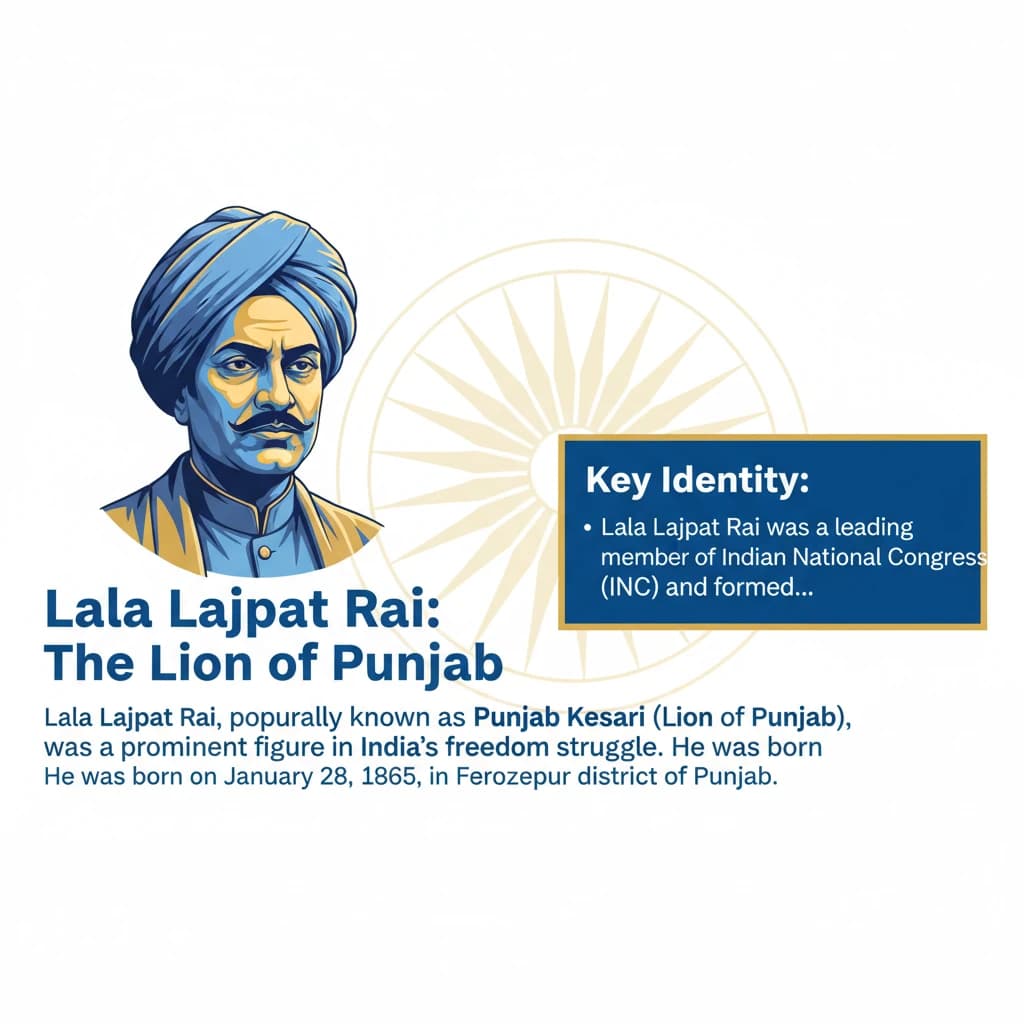
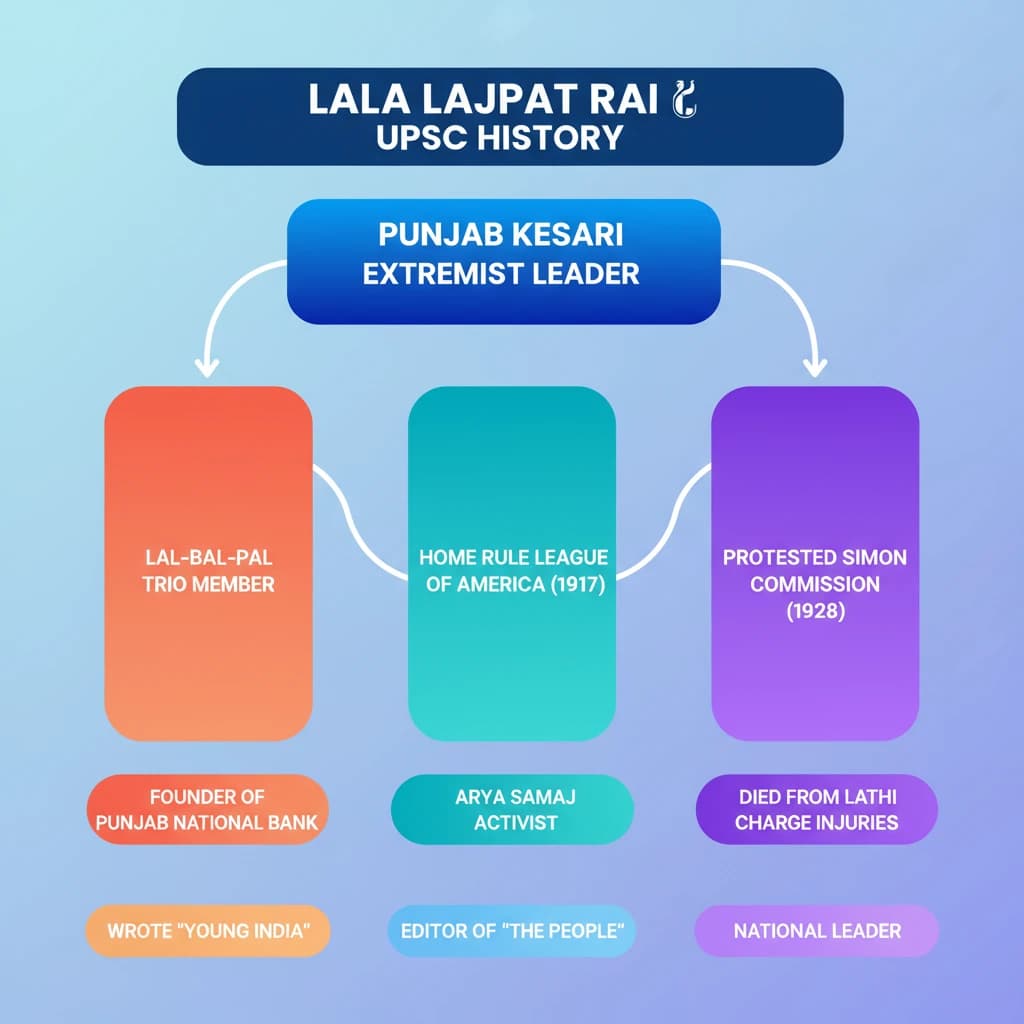
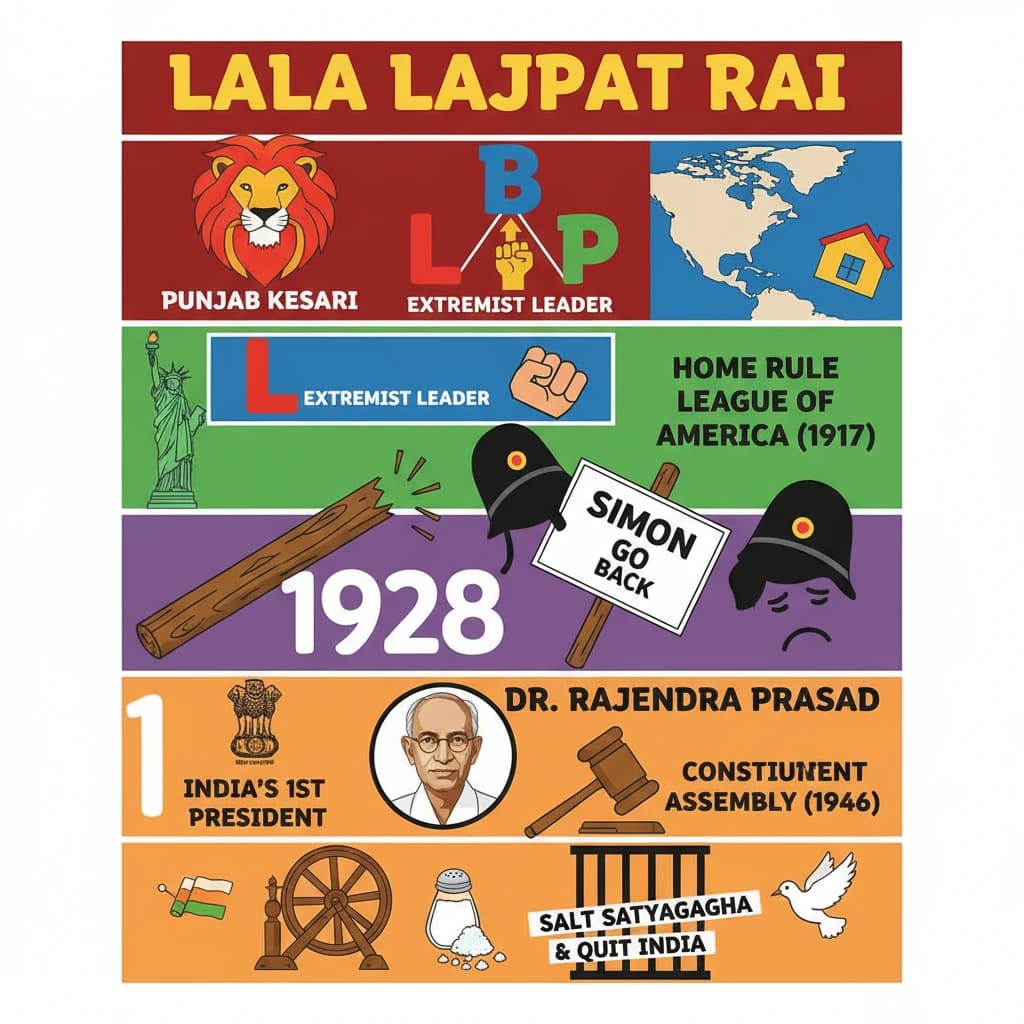
<h4>Lala Lajpat Rai: The Lion of Punjab</h4><p><strong>Lala Lajpat Rai</strong>, popularly known as <strong>Punjab Kesari</strong> (Lion of Punjab), was a prominent figure in India's freedom struggle. He was born on <strong>January 28, 1865</strong>, in the <strong>Ferozepur district</strong> of <strong>Punjab</strong>.</p><div class='info-box'><p><strong>Key Identity:</strong> <strong>Lala Lajpat Rai</strong> was a leading member of the <strong>Indian National Congress (INC)</strong> and formed the influential trio <strong>Lal-Bal-Pal</strong> alongside <strong>Bal Gangadhar Tilak</strong> and <strong>Bipin Chandra Pal</strong>.</p></div><h4>Role in Early Nationalist Movements</h4><p>Lala Lajpat Rai actively participated in and led several significant movements during the early 20th century. His nationalist fervor was evident in his strong opposition to the <strong>Partition of Bengal in 1905</strong>.</p><p>He later extended his support to <strong>Mahatma Gandhi's Non-Cooperation Movement</strong> which began in <strong>1920</strong>, advocating for non-violent resistance against British rule.</p><h4>International Advocacy and Protests</h4><p>During his time abroad, Lala Lajpat Rai founded the <strong>Home Rule League of America</strong> in <strong>1917</strong>. This initiative aimed to garner international support for India’s <strong>Home Rule Movement</strong>, which had been initiated by <strong>Bal Gangadhar Tilak</strong> and <strong>Annie Besant</strong> in <strong>1916</strong>.</p><p>Upon his return, he vehemently protested against the repressive <strong>Rowlatt Act</strong> and condemned the brutal <strong>Jallianwala Bagh massacre</strong>, highlighting the injustices of British colonial rule.</p><div class='exam-tip-box'><p><strong>UPSC Insight:</strong> Questions on <strong>Lal-Bal-Pal</strong> often focus on their ideological differences and similarities with the 'Moderates' and their role in shaping the <strong>Extremist phase</strong> of the Indian National Movement. Remember his international efforts for Home Rule.</p></div><h4>Tragic End during Simon Commission Protests</h4><p>In <strong>1928</strong>, Lala Lajpat Rai led a massive opposition movement against the <strong>Simon Commission</strong>, an all-British commission appointed to review constitutional reforms in India. During a peaceful protest in <strong>Lahore</strong>, he sustained severe injuries from a brutal <strong>lathi charge</strong>.</p><p>These injuries proved fatal, and <strong>Lala Lajpat Rai</strong> succumbed to them, becoming a martyr for the cause of Indian independence. His death sparked widespread outrage and further intensified the nationalist movement.</p><div class='key-point-box'><p><strong>Remember:</strong> <strong>Lala Lajpat Rai's</strong> death is a critical event, symbolizing British brutality and fueling revolutionary activities in the late 1920s.</p></div><hr><h4>Dr. Rajendra Prasad: Architect of Modern India</h4><p><strong>Dr. Rajendra Prasad</strong>, India's <strong>first President</strong>, was born on <strong>December 3, 1884</strong>, in <strong>Bihar</strong>. His birth anniversary is observed annually on this date.</p><div class='info-box'><p><strong>Early Life & Influences:</strong> He was deeply influenced by <strong>Mahatma Gandhi's</strong> views, particularly on issues of <strong>caste</strong> and <strong>untouchability</strong>, which led him to adopt a simple and principled life.</p></div><h4>Role in the Freedom Struggle</h4><p>Dr. Rajendra Prasad made a significant sacrifice by giving up his successful <strong>legal career</strong> in <strong>1920</strong> to fully dedicate himself to the <strong>Independence movement</strong>. His commitment led to multiple imprisonments.</p><ul><li>He was imprisoned during the <strong>Salt Satyagraha</strong> in <strong>1931</strong>.</li><li>He was also jailed during the pivotal <strong>Quit India Movement</strong> in <strong>1942</strong>.</li></ul><p>His leadership within the <strong>Indian National Congress</strong> was undeniable. He presided over the <strong>Bombay session of the INC</strong> in <strong>1934</strong>. Later, he became the <strong>Congress President</strong> after <strong>Subhash Chandra Bose's</strong> resignation in <strong>1939</strong>.</p><h4>Contribution to Constitutional Making</h4><p>A pivotal moment in his career was his appointment as the <strong>President of the Constituent Assembly</strong> in <strong>1946</strong>. In this role, he guided the framing of the <strong>Indian Constitution</strong>.</p><p>He also led several crucial committees within the Constituent Assembly, including those on the <strong>National Flag</strong>, <strong>Rules of Procedure</strong>, and <strong>Finance and Staff</strong>, ensuring the smooth functioning of the assembly.</p><h4>Literary Contributions</h4><p>Dr. Rajendra Prasad was also a prolific writer, documenting his experiences and thoughts. His notable literary works include:</p><ul><li><strong>Atmakatha (in Champaran)</strong> (<strong>1922</strong>)</li><li><strong>India Divided</strong> (<strong>1946</strong>)</li><li><strong>Mahatma</strong> (<strong>1946</strong>)</li><li><strong>Bapu ke Kadmon Mein</strong> (<strong>1954</strong>)</li></ul><h4>Presidency and Enduring Legacy</h4><p>He was elected as <strong>India's first President</strong> in <strong>1950</strong>, serving for over <strong>12 years</strong>. He holds the unique distinction of being the <strong>only President to be reelected unopposedly</strong> in both <strong>1952</strong> and <strong>1957</strong>.</p><p>In recognition of his immense contributions to the nation, <strong>Dr. Rajendra Prasad</strong> was awarded the <strong>Bharat Ratna</strong>, India's highest civilian honor, in <strong>1962</strong>.</p><div class='exam-tip-box'><p><strong>UPSC Strategy:</strong> When discussing <strong>Dr. Rajendra Prasad</strong>, emphasize his role as a bridge between the Gandhian era and independent India's constitutional framework. His leadership in the Constituent Assembly is crucial for <strong>GS Paper II (Polity)</strong> and <strong>GS Paper I (Modern History)</strong>.</p></div>