Loading page, please wait…
Vaidra Logo
Vaidra

Top 4 items + smart groups

UPSC GPT
New
Current Affairs
Daily Solutions
Daily Puzzle
Mains Evaluator

Version 2.0.0 • Built with ❤️ for UPSC aspirants

Loading...
Loading...
Loading...
Loading...
Loading...
Loading...
Loading...
Loading...
Loading...
Loading...
Loading...
Loading...
Loading...
80-Pillar Assembly Hall of Kumharr and Mauryan Architecture - UPSC History
Back
All Subjects

Topics

0 topics • 0 completed

Loading topics...
Loading...
Loading...
Loading...
Loading...
Loading...
Overall Progress0%

80-Pillar Assembly Hall of Kumharr and Mauryan Architecture - UPSC History

What is 80-Pillar Assembly Hall of Kumharr and Mauryan Architecture in UPSC History?

80-Pillar Assembly Hall of Kumharr and Mauryan Architecture is a key topic under History for UPSC Civil Services Examination. Key points include: ASI is actively uncovering an 80-pillar assembly hall at Kumhrar, Patna.. Kumhrar is a significant Mauryan archaeological site, likely part of ancient Pataliputra.. The discovery is expected to renew global interest in Mauryan art and architecture.. Understanding this topic is essential for both UPSC Prelims and Mains preparation.

Why is 80-Pillar Assembly Hall of Kumharr and Mauryan Architecture important for UPSC exam?

80-Pillar Assembly Hall of Kumharr and Mauryan Architecture is a Medium-level topic in UPSC History. It is tested in both Prelims (factual MCQs) and Mains (analytical answer writing). Previous year UPSC questions have frequently covered aspects of 80-Pillar Assembly Hall of Kumharr and Mauryan Architecture, making it essential for comprehensive IAS preparation.

How to prepare 80-Pillar Assembly Hall of Kumharr and Mauryan Architecture for UPSC?

To prepare 80-Pillar Assembly Hall of Kumharr and Mauryan Architecture for UPSC: (1) Study the comprehensive notes covering all key concepts on Vaidra. (2) Practice previous year questions on this topic. (3) Connect it with current affairs using daily updates. (4) Revise using key takeaways and mind maps available for History. (5) Write practice answers linking 80-Pillar Assembly Hall of Kumharr and Mauryan Architecture to related GS Paper topics.

Key takeaways of 80-Pillar Assembly Hall of Kumharr and Mauryan Architecture for UPSC

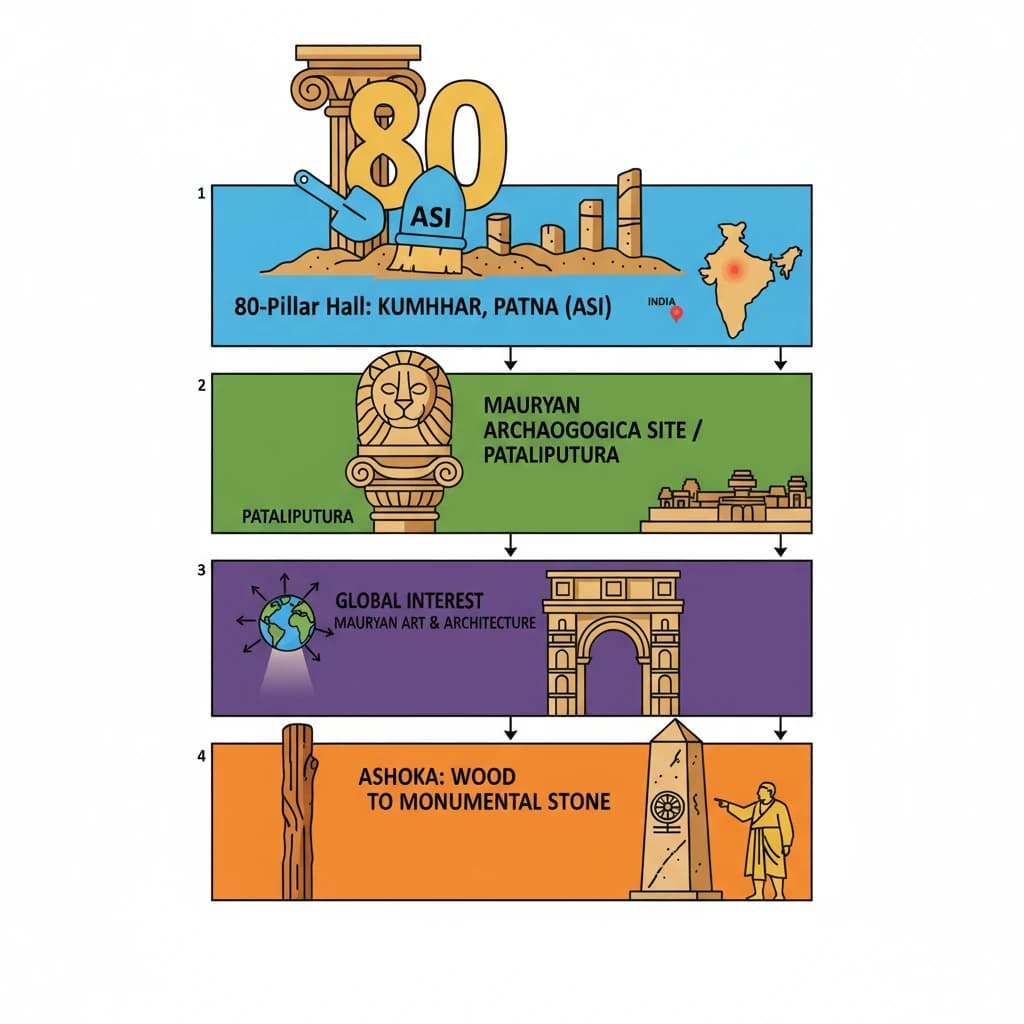
  • ASI is actively uncovering an 80-pillar assembly hall at Kumhrar, Patna.
  • Kumhrar is a significant Mauryan archaeological site, likely part of ancient Pataliputra.
  • The discovery is expected to renew global interest in Mauryan art and architecture.
  • Mauryan architecture, especially under Ashoka, marked a shift to monumental stone structures.
  • Preservation of such sites is vital for cultural tourism, national identity, and historical research.

80-Pillar Assembly Hall of Kumharr and Mauryan Architecture

80-Pillar Assembly Hall of Kumharr and Mauryan Architecture

Medium⏱️ 8 min read✓ 95% Verified
history

📖 Introduction

<h4>Introduction to the Kumhrar Discovery</h4><p>The <strong>Archaeological Survey of India (ASI)</strong> has recently undertaken significant efforts. These initiatives aim to unearth the remains of a notable structure at an ancient site.</p><p>Specifically, the focus is on an <strong>80-pillar assembly hall</strong>. This structure is located within the historically rich <strong>Mauryan archaeological site</strong> of <strong>Kumhrar</strong>, situated in <strong>Patna</strong>.</p><div class='info-box'><p><strong>Key Details:</strong></p><ul><li><strong>Site:</strong> Kumhrar, Patna</li><li><strong>Discovery:</strong> Remnants of an 80-pillar assembly hall</li><li><strong>Initiating Body:</strong> Archaeological Survey of India (ASI)</li><li><strong>Historical Period:</strong> Mauryan Empire</li></ul></div><h4>Significance of the ASI Initiative</h4><p>This archaeological undertaking by the <strong>ASI</strong> holds substantial importance. It is expected to reignite worldwide fascination with the ancient <strong>Mauryan empire</strong>.</p><p>Furthermore, the discovery will highlight the <strong>Mauryan empire's</strong> profound contributions to <strong>art and architecture</strong>. Such findings offer invaluable insights into India's rich historical legacy.</p><div class='key-point-box'><p><strong>Impact of Discovery:</strong></p><ul><li><strong>Rekindles global interest</strong> in the Mauryan empire.</li><li><strong>Showcases Mauryan contributions</strong> to art and architecture.</li></ul></div><div class='exam-tip-box'><p><strong>UPSC Insight:</strong> Questions on <strong>Mauryan art and architecture</strong> are frequent in <strong>GS Paper 1 (Art & Culture)</strong>. Understanding specific sites like <strong>Kumhrar</strong> and the role of bodies like <strong>ASI</strong> is crucial.</p></div>
Concept Diagram

💡 Key Takeaways

  • •ASI is actively uncovering an 80-pillar assembly hall at Kumhrar, Patna.
  • •Kumhrar is a significant Mauryan archaeological site, likely part of ancient Pataliputra.
  • •The discovery is expected to renew global interest in Mauryan art and architecture.
  • •Mauryan architecture, especially under Ashoka, marked a shift to monumental stone structures.
  • •Preservation of such sites is vital for cultural tourism, national identity, and historical research.

🧠 Memory Techniques
Memory Aid
95% Verified Content

📚 Reference Sources

•Archaeological Survey of India (ASI) reports and publications (general knowledge)
•NCERT Textbooks on Ancient Indian History
•UPSC standard reference books on Indian Art and Culture (e.g., Nitin Singhania)

Related Topics

Loading related topics...
Explore:History Topics·All Subjects·Daily Current Affairs·Editorial Analysis·Previous Year Questions·UPSC GPT