Loading page, please wait…
Harappan Economy: Trade, Barter System, and External Commerce - UPSC History
What is Harappan Economy: Trade, Barter System, and External Commerce in UPSC History?
Harappan Economy: Trade, Barter System, and External Commerce is a key topic under History for UPSC Civil Services Examination. Key points include: The Harappan economy was significantly driven by trade, complementing its agricultural base.. Standardized seals, a uniform script, and consistent weights/measures were crucial for efficient trade.. The barter system was the primary mode of exchange; no metal currency existed.. Understanding this topic is essential for both UPSC Prelims and Mains preparation.
Why is Harappan Economy: Trade, Barter System, and External Commerce important for UPSC exam?
Harappan Economy: Trade, Barter System, and External Commerce is a Medium-level topic in UPSC History. It is tested in both Prelims (factual MCQs) and Mains (analytical answer writing). Previous year UPSC questions have frequently covered aspects of Harappan Economy: Trade, Barter System, and External Commerce, making it essential for comprehensive IAS preparation.
How to prepare Harappan Economy: Trade, Barter System, and External Commerce for UPSC?
To prepare Harappan Economy: Trade, Barter System, and External Commerce for UPSC: (1) Study the comprehensive notes covering all key concepts on Vaidra. (2) Practice previous year questions on this topic. (3) Connect it with current affairs using daily updates. (4) Revise using key takeaways and mind maps available for History. (5) Write practice answers linking Harappan Economy: Trade, Barter System, and External Commerce to related GS Paper topics.
Key takeaways of Harappan Economy: Trade, Barter System, and External Commerce for UPSC
- The Harappan economy was significantly driven by trade, complementing its agricultural base.
- Standardized seals, a uniform script, and consistent weights/measures were crucial for efficient trade.
- The barter system was the primary mode of exchange; no metal currency existed.
- Extensive internal and external trade networks connected Harappan sites and reached Mesopotamia and Central Asia.
- Lapis lazuli trade was vital, contributing to the social status and prestige of the ruling class.
- Harappans demonstrated advanced navigational skills along the Arabian Sea coast.
Harappan Economy: Trade, Barter System, and External Commerce
Medium⏱️ 9 min read
history
📖 Introduction
The Foundation of Harappan Economy: Trade
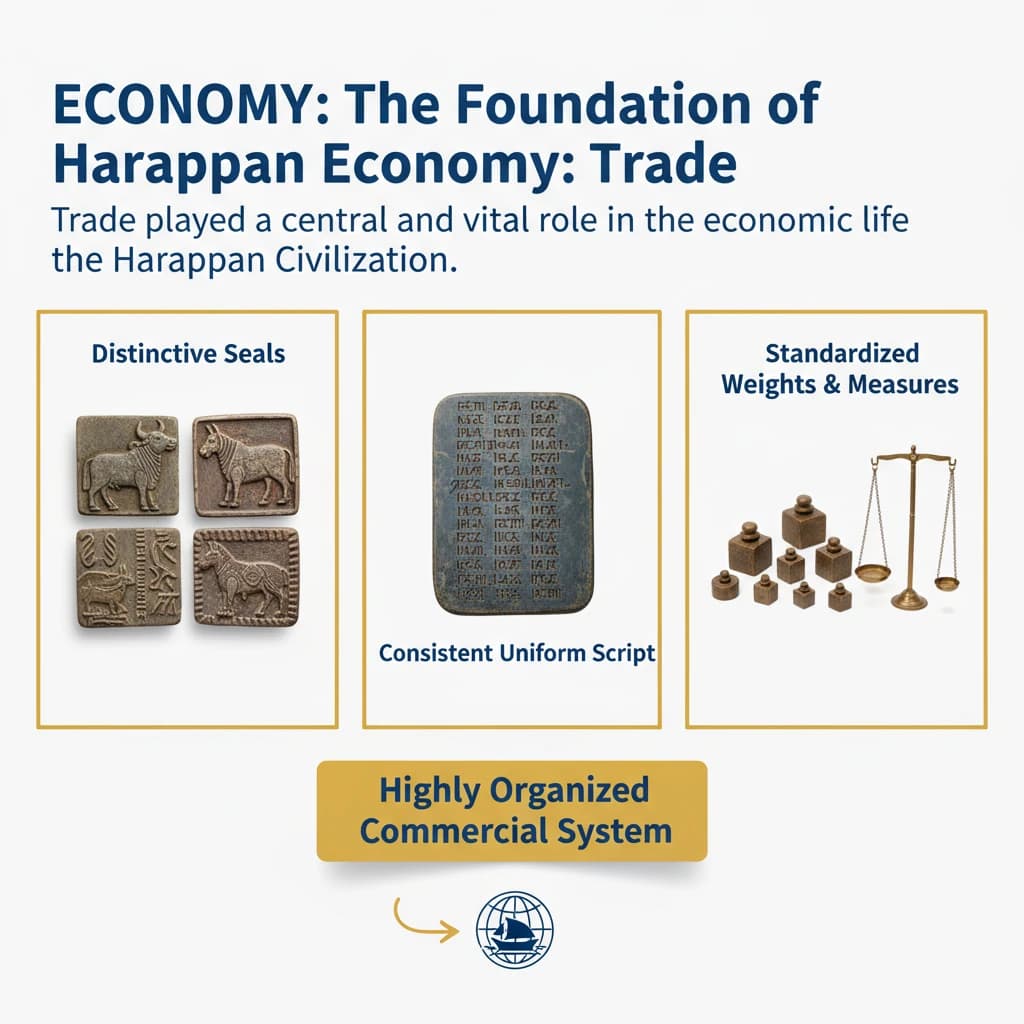
Trade played a central and vital role in the economic life of the Harappan Civilization. This is evident from various archaeological findings across different sites.
The widespread use of distinctive seals, a consistent uniform script, and precisely standardized weights and measures across the civilization all point to a highly organized commercial system.
The presence of these standardized elements suggests a sophisticated administrative and economic control over internal and external trade activities.
Major Trade Commodities and Barter System
The primary items exchanged in Harappan trade included essential raw materials such as stone, various metals, and valuable shell. These were crucial for crafting tools, ornaments, and other goods.
The barter system was the prevalent mode of exchange for goods and services. There is no archaeological evidence to suggest the existence of a formal metal currency during this period.
Barter System: An economic system where goods or services are directly exchanged for other goods or services without the use of money.
Navigational Practices and Trade Routes
The Harappans were adept seafarers, actively practicing navigation along the extensive Arabian Sea coast. This maritime capability facilitated coastal trade and connections with distant regions.
Their long-distance trade routes extended significantly beyond the Indian subcontinent. A crucial trading colony was established in northern Afghanistan.
This Afghan outpost served as a vital hub, facilitating commerce with Central Asia and providing access to valuable resources from that region.
International Trade: Connections with Mesopotamia
The Harappan civilization maintained robust trade relations with Mesopotamia, an ancient civilization situated in the fertile Tigris-Euphrates region (modern-day Iraq).
Archaeological discoveries, such as Harappan seals found in Mesopotamian cities and Mesopotamian artifacts at Indus sites, conclusively confirm this extensive international interaction.
Mesopotamia: An ancient region in the eastern Mediterranean, often referred to as the "cradle of civilization," home to early urban societies like Sumer, Akkad, Assyria, and Babylonia.
Lapis Lazuli: A Symbol of Status
Long-distance trade in lapis lazuli, a beautiful blue semi-precious stone, held particular significance. This valuable commodity was likely imported from regions such as Badakhshan in Afghanistan.
The acquisition and display of lapis lazuli are believed to have played a significant role in enhancing the social status of the ruling class. It served as a powerful symbol of wealth and power.
When discussing the Harappan economy, remember to highlight not just the mechanics of trade but also its socio-political implications, such as the role of lapis lazuli in reinforcing social hierarchies and elite status.
💡 Key Takeaways
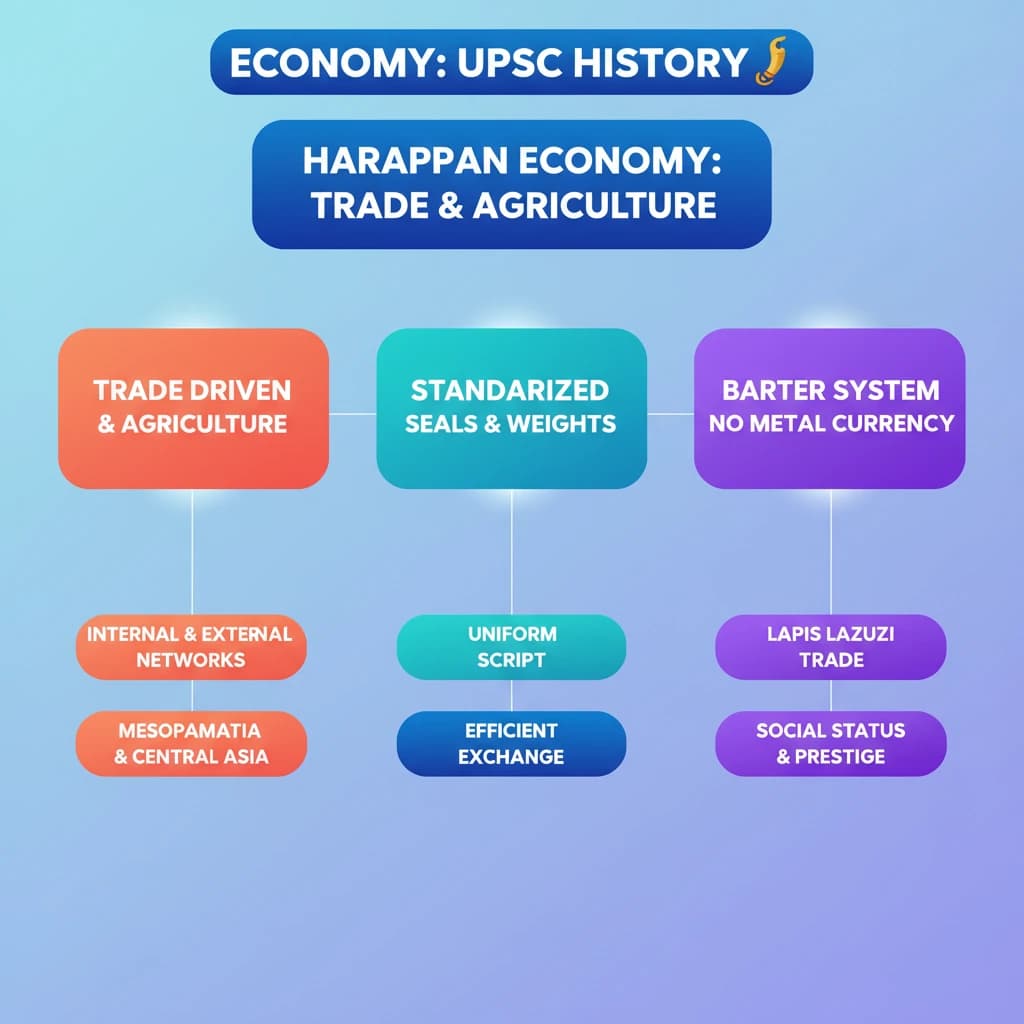
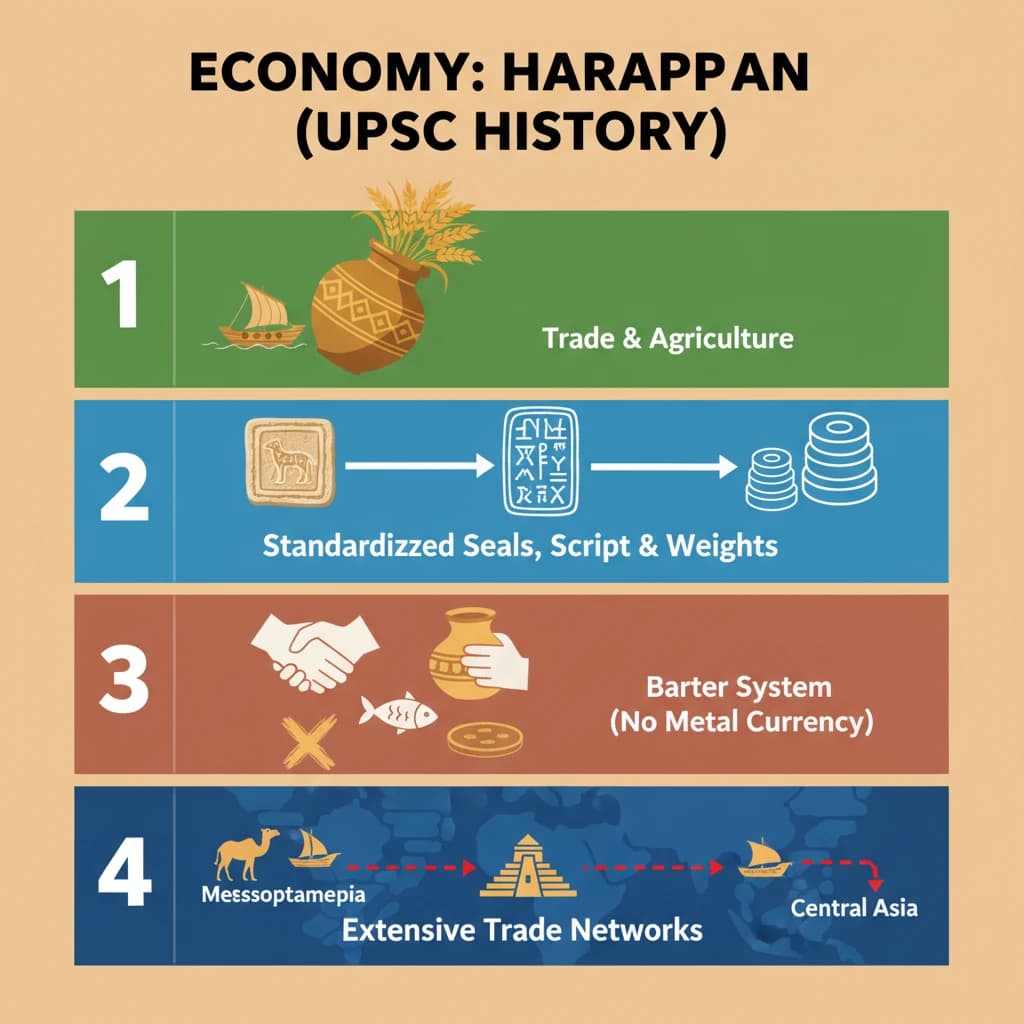
- •The Harappan economy was significantly driven by trade, complementing its agricultural base.
- •Standardized seals, a uniform script, and consistent weights/measures were crucial for efficient trade.
- •The barter system was the primary mode of exchange; no metal currency existed.
- •Extensive internal and external trade networks connected Harappan sites and reached Mesopotamia and Central Asia.
- •Lapis lazuli trade was vital, contributing to the social status and prestige of the ruling class.
- •Harappans demonstrated advanced navigational skills along the Arabian Sea coast.
🧠 Memory Techniques
98% Verified Content
📚 Reference Sources
•NCERT Class 11 History: An Introduction to Indian Art (Chapter 1 - Harappan Art)
•Upinder Singh, A History of Ancient and Early Medieval India: From the Stone Age to the 12th Century (Chapter 3 - The Harappan Civilization)
•Romila Thapar, Early India: From the Origins to AD 1300 (Chapter 2 - The Harappan Civilization)