Loading page, please wait…
Lal Bahadur Shastri - UPSC History
What is Lal Bahadur Shastri in UPSC History?
Lal Bahadur Shastri is a key topic under History for UPSC Civil Services Examination. Key points include: Lal Bahadur Shastri: Second PM, decisive leadership in 1965 war, "Jai Jawan Jai Kisan" slogan, Tashkent Declaration.. Savitribai Phule: Pioneer of women's education (first girls' school 1848), fought female infanticide, authored works, influenced by Jyotiba Phule.. Martyrs' Day (Jan 30): Commemorates Mahatma Gandhi's assassination in 1948, a symbol of sacrifice for national unity.. Understanding this topic is essential for both UPSC Prelims and Mains preparation.
Why is Lal Bahadur Shastri important for UPSC exam?
Lal Bahadur Shastri is a Medium-level topic in UPSC History. It is tested in both Prelims (factual MCQs) and Mains (analytical answer writing). Previous year UPSC questions have frequently covered aspects of Lal Bahadur Shastri, making it essential for comprehensive IAS preparation.
How to prepare Lal Bahadur Shastri for UPSC?
To prepare Lal Bahadur Shastri for UPSC: (1) Study the comprehensive notes covering all key concepts on Vaidra. (2) Practice previous year questions on this topic. (3) Connect it with current affairs using daily updates. (4) Revise using key takeaways and mind maps available for History. (5) Write practice answers linking Lal Bahadur Shastri to related GS Paper topics.
Key takeaways of Lal Bahadur Shastri for UPSC
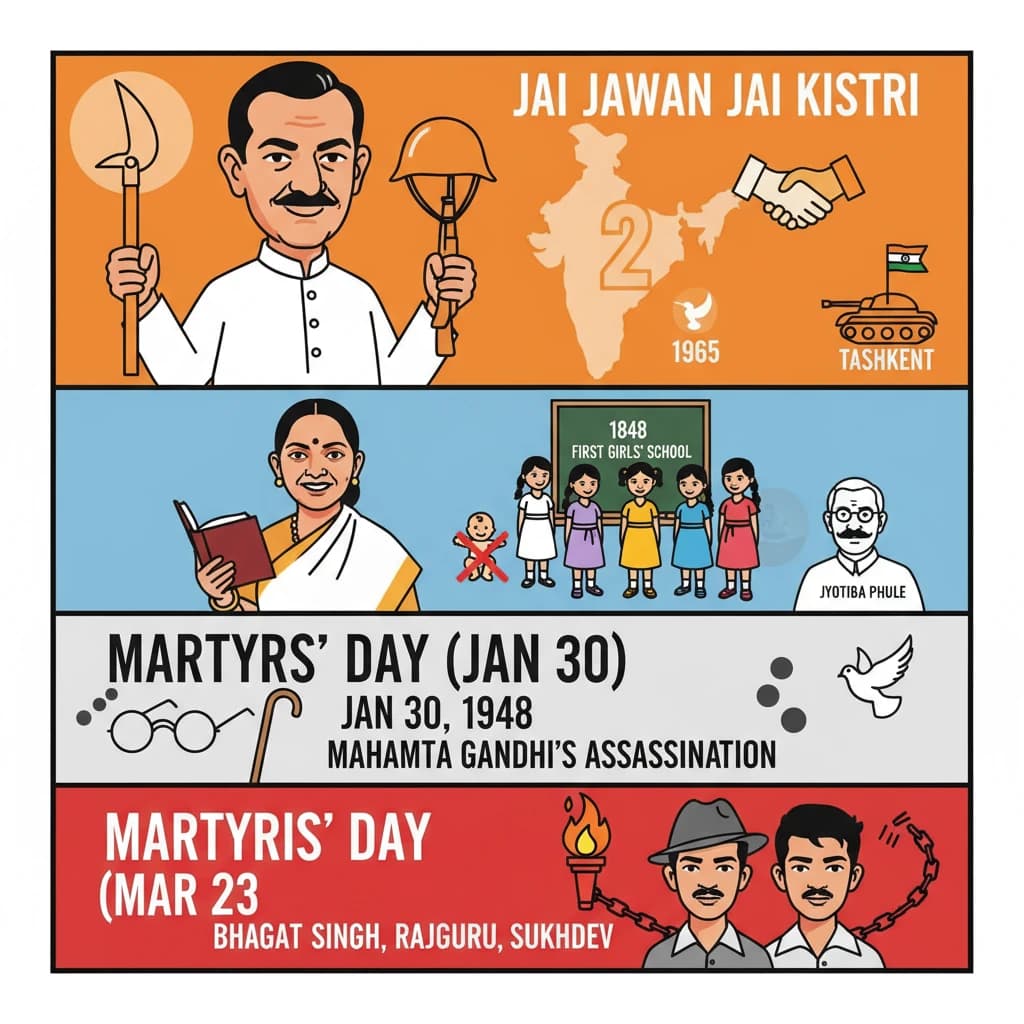
- Lal Bahadur Shastri: Second PM, decisive leadership in 1965 war, "Jai Jawan Jai Kisan" slogan, Tashkent Declaration.
- Savitribai Phule: Pioneer of women's education (first girls' school 1848), fought female infanticide, authored works, influenced by Jyotiba Phule.
- Martyrs' Day (Jan 30): Commemorates Mahatma Gandhi's assassination in 1948, a symbol of sacrifice for national unity.
- Martyrs' Day (Mar 23): Honors Bhagat Singh, Rajguru, Sukhdev.
- These figures embody leadership, social reform, and national sacrifice, crucial for understanding India's evolution.
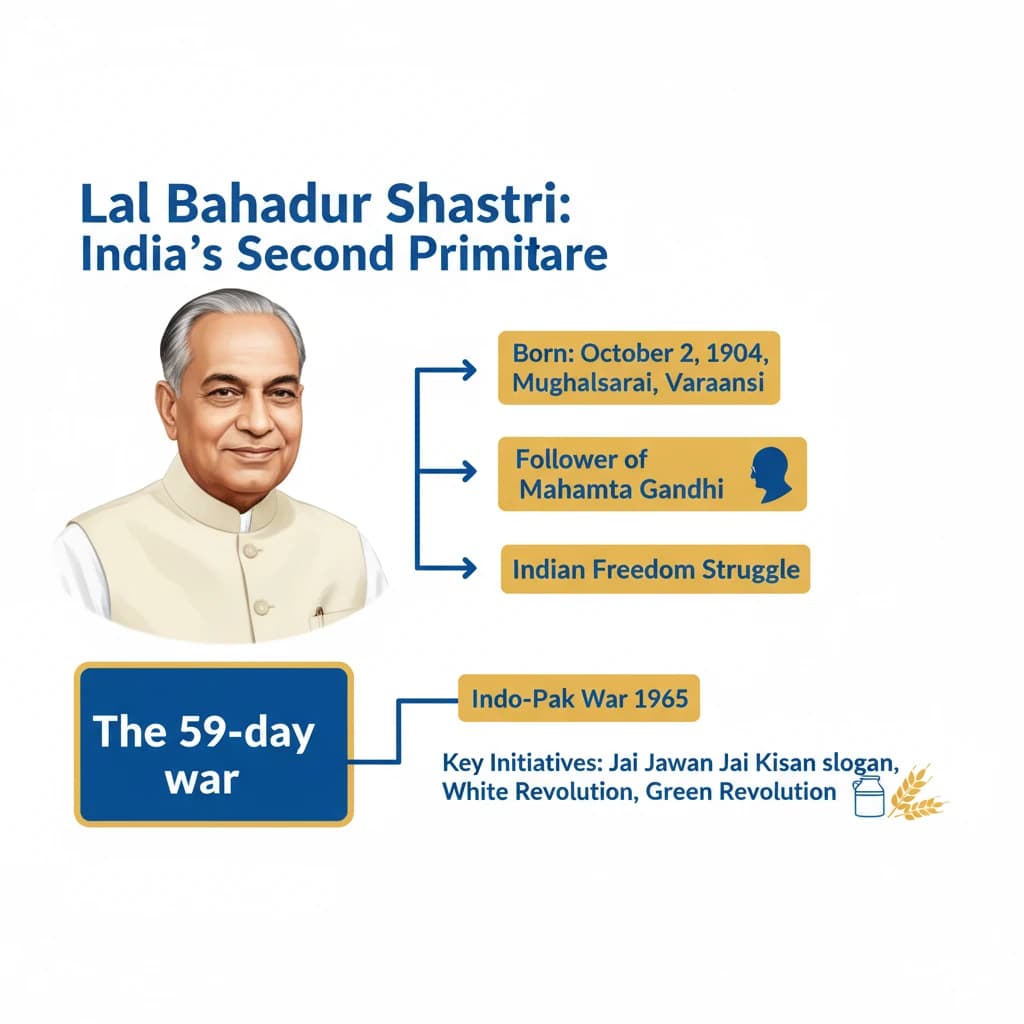
Lal Bahadur Shastri
Medium⏱️ 8 min read
history
📖 Introduction
Lal Bahadur Shastri: India's Second Prime Minister
Lal Bahadur Shastri, India's Second Prime Minister, was born on October 2, 1904, in Mughalsarai, near Varanasi.
His early life and political ideology were profoundly shaped by the principles of Mahatma Gandhi, making him a significant figure in India's freedom struggle.
The 59th death anniversary of Shri Lal Bahadur Shastri was recently observed, marking his lasting legacy.
Ministerial Roles and Prime Ministership
Before assuming the nation's highest office, Shastri held several crucial ministerial portfolios.
- He served as the Home Minister, overseeing internal security and administration.
- He was also the Minister of Railways, a vital infrastructure portfolio.
- Additionally, he held the position of Minister of Commerce and Industry.
As Prime Minister from 1964 to 1966, he demonstrated exemplary and decisive leadership.
His tenure as PM is most notably remembered for his strong leadership during the 1965 Indo-Pak War, where India achieved a significant military and diplomatic stand.
During this challenging period, he famously coined the inspiring slogan, “Jai Jawan Jai Kisan” (Hail the Soldier, Hail the Farmer), which united the nation.
Following the war, Shastri signed the Tashkent Declaration, a peace agreement between India and Pakistan, in January 1966, shortly before his untimely demise.
Savitribai Phule: Pioneer of Women's Education and Social Reform
Savitribai Phule, a towering figure in Indian social reform, was born on January 3, 1831, in Satara, Maharashtra.
She belonged to a marginalised Mali community, which further highlighted her struggle and achievements in a caste-ridden society.
Her 193rd birth anniversary was observed on January 3, 2025, celebrating her enduring contributions.
Savitribai was married to Jyotiba Phule, a renowned social reformer, who took charge of her education and became her lifelong partner in social work.
Groundbreaking Contributions to Education and Social Justice
Together with Jyotiba Phule, Savitribai made monumental contributions to education and the upliftment of the oppressed.
- In 1848, they established India's first school for girls in Pune, a revolutionary step at the time.
- The couple collectively started and successfully ran 18 schools, expanding educational access.
- They founded various educational trusts specifically aimed at uplifting the Dalit community, promoting their social and economic empowerment.
Beyond education, Savitribai and Jyotirao addressed critical social issues.
In 1863, they founded Balhatya Pratibandhak Griha, which was India’s first home dedicated to combating female infanticide.
This initiative also provided support and shelter to pregnant Brahmin widows and rape victims, offering them dignity and care.
Literary Works and Influence
Savitribai Phule was also an accomplished author and poet, using her writing to advocate for social change.
- Her famous works include Kavya Phule (published in 1854) and Bavan Kashi Subodh Ratnakar (published in 1892).
- She also penned the inspiring poem, “Go, Get Education”, urging the marginalized to seek knowledge.
Her husband, Jyotirao Phule, a prominent 19th-century social reformer, further critiqued social oppression in his influential book Gulamgiri.
Jyotirao Phule also founded the Satyashodhak Samaj in 1873, an organization dedicated to promoting education, equality, and abolishing untouchability, principles that Savitribai actively supported.
Mahatma Gandhi and Martyrs' Day
India observes Martyrs’ Day, also known as Shaheed Diwas, annually on January 30.
This day is dedicated to commemorating the immense sacrifices of all those who laid down their lives for the nation’s independence.
The day holds special significance as it marks the assassination of Mahatma Gandhi, often referred to as Mahatma Gandhi Smriti.
On January 30, 1948, Mahatma Gandhi was tragically assassinated by Nathuram Godse during an evening prayer meeting at Birla House in Delhi.
It is important to note that Martyrs’ Day is also commemorated on March 23 to honor the sacrifice of freedom fighters Bhagat Singh, Shivaram Rajguru, and Sukhdev Thapar, who were executed on that day.

💡 Key Takeaways
- •Lal Bahadur Shastri: Second PM, decisive leadership in 1965 war, "Jai Jawan Jai Kisan" slogan, Tashkent Declaration.
- •Savitribai Phule: Pioneer of women's education (first girls' school 1848), fought female infanticide, authored works, influenced by Jyotiba Phule.
- •Martyrs' Day (Jan 30): Commemorates Mahatma Gandhi's assassination in 1948, a symbol of sacrifice for national unity.
- •Martyrs' Day (Mar 23): Honors Bhagat Singh, Rajguru, Sukhdev.
- •These figures embody leadership, social reform, and national sacrifice, crucial for understanding India's evolution.
🧠 Memory Techniques
95% Verified Content