Loading page, please wait…
Maratha Administration: Central & Revenue Systems (Chauth & Sardeshmukhi) - UPSC History
What is Maratha Administration: Central & Revenue Systems (Chauth & Sardeshmukhi) in UPSC History?
Maratha Administration: Central & Revenue Systems (Chauth & Sardeshmukhi) is a key topic under History for UPSC Civil Services Examination. Key points include: Maratha central administration was headed by the King, assisted by the 'Ashtapradhan' (council of eight ministers).. Key revenue sources were Chauth and Sardeshmukhi, crucial for Maratha military and state finance.. Chauth was 1/4th of the revenue demand, paid by non-Maratha territories for protection against raids.. Understanding this topic is essential for both UPSC Prelims and Mains preparation.
Why is Maratha Administration: Central & Revenue Systems (Chauth & Sardeshmukhi) important for UPSC exam?
Maratha Administration: Central & Revenue Systems (Chauth & Sardeshmukhi) is a Medium-level topic in UPSC History. It is tested in both Prelims (factual MCQs) and Mains (analytical answer writing). Previous year UPSC questions have frequently covered aspects of Maratha Administration: Central & Revenue Systems (Chauth & Sardeshmukhi), making it essential for comprehensive IAS preparation.
How to prepare Maratha Administration: Central & Revenue Systems (Chauth & Sardeshmukhi) for UPSC?
To prepare Maratha Administration: Central & Revenue Systems (Chauth & Sardeshmukhi) for UPSC: (1) Study the comprehensive notes covering all key concepts on Vaidra. (2) Practice previous year questions on this topic. (3) Connect it with current affairs using daily updates. (4) Revise using key takeaways and mind maps available for History. (5) Write practice answers linking Maratha Administration: Central & Revenue Systems (Chauth & Sardeshmukhi) to related GS Paper topics.
Key takeaways of Maratha Administration: Central & Revenue Systems (Chauth & Sardeshmukhi) for UPSC
- Maratha central administration was headed by the King, assisted by the 'Ashtapradhan' (council of eight ministers).
- Key revenue sources were Chauth and Sardeshmukhi, crucial for Maratha military and state finance.
- Chauth was 1/4th of the revenue demand, paid by non-Maratha territories for protection against raids.
- Sardeshmukhi was an additional 10% levy on lands where Marathas claimed hereditary rights.
- Shivaji Maharaj established the foundation of this robust administrative and revenue system.
- The system balanced central authority with delegated ministerial responsibilities.
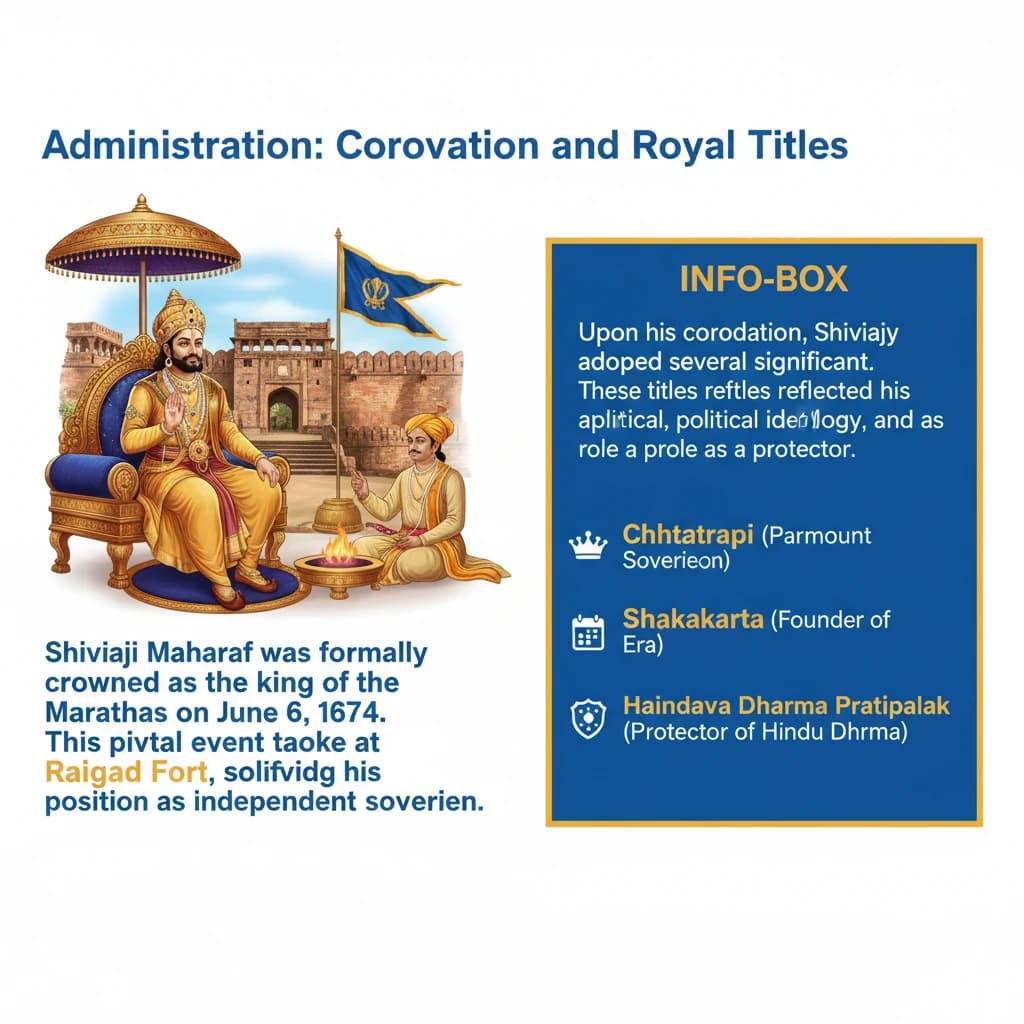
Maratha Administration: Central & Revenue Systems (Chauth & Sardeshmukhi)
Medium⏱️ 7 min read
history
📖 Introduction
Maratha Administration: Core Components
The Maratha administration, particularly under Chhatrapati Shivaji Maharaj, was a well-structured system designed for efficient governance and resource mobilization. It played a crucial role in the expansion and consolidation of the Maratha Empire.
Understanding Maratha administration is vital for grasping the dynamics of state formation and revenue systems in medieval India.
Central Administration: The King and His Council
At the apex of the Maratha state was the King, who served as the supreme head. His authority was absolute, encompassing all legislative, executive, and judicial functions.
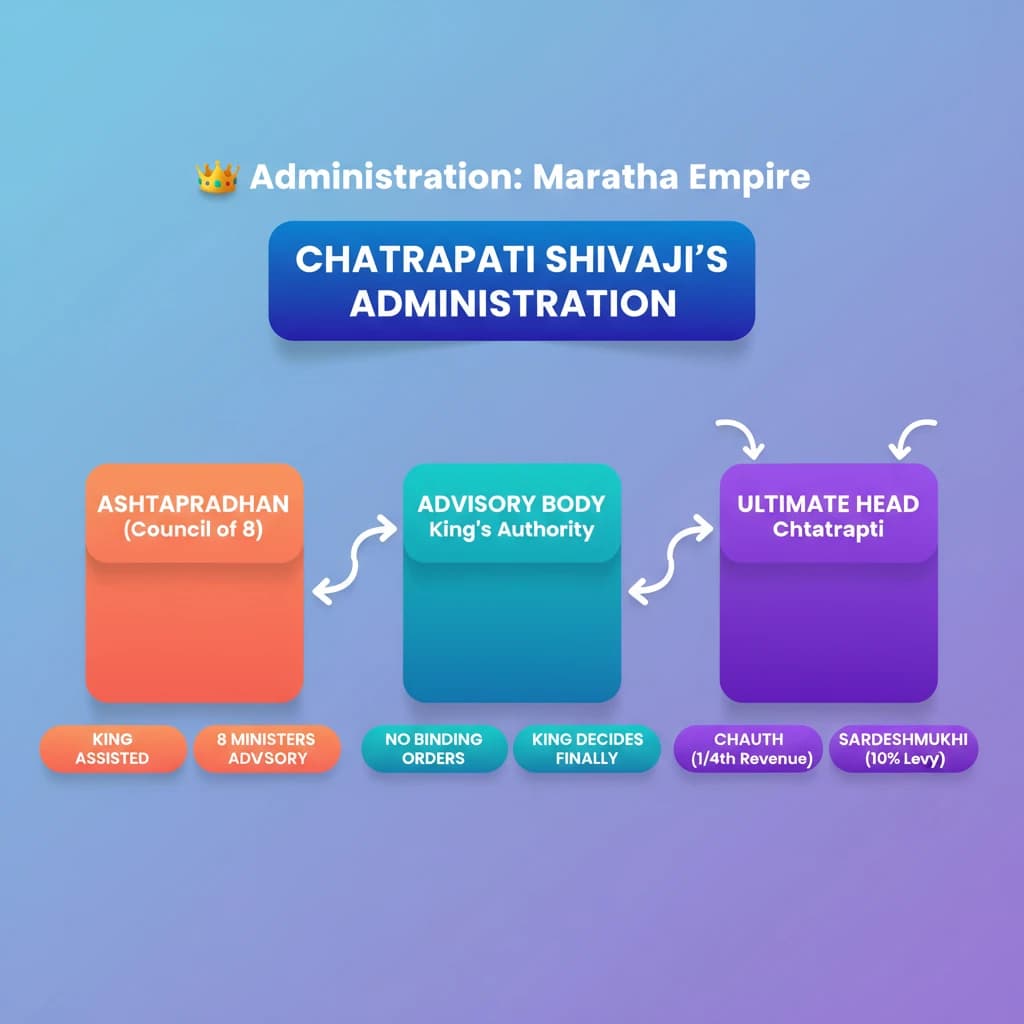
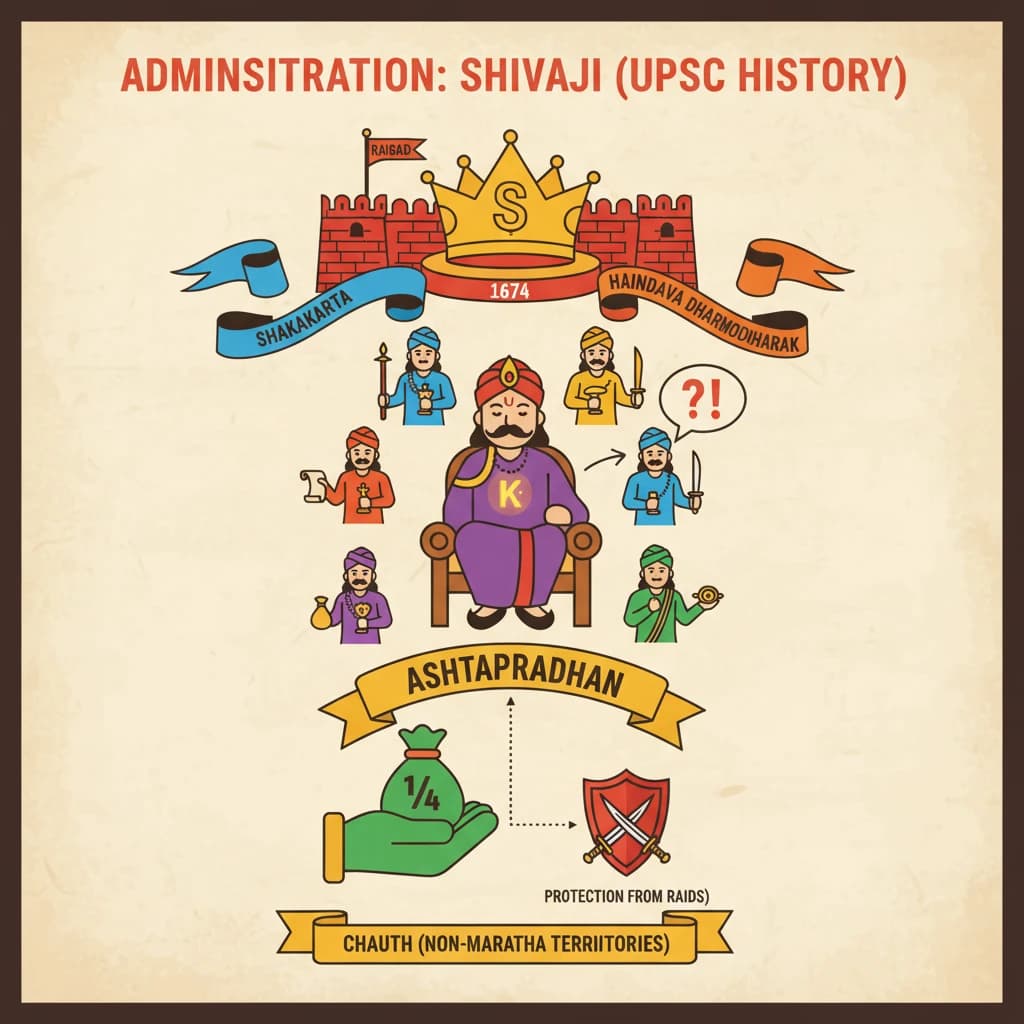
To assist the King in the complex affairs of governance, a council of eight ministers was established. This council was famously known as the 'Ashtapradhan'.
The Ashtapradhan Mandal comprised eight key ministers, each responsible for a specific department. This system aimed at distributing administrative responsibilities efficiently.
Revenue Administration: Pillars of Maratha Economy
The financial backbone of the Maratha Empire was its robust revenue administration. Key sources of income included land revenue and special levies imposed on both Maratha and non-Maratha territories.
Among the most significant revenue demands were Chauth and Sardeshmukhi. These levies were instrumental in financing the extensive military campaigns and maintaining the state apparatus.
Chauth: The Protection Tax
Chauth was a distinctive revenue demand collected by the Marathas. It constituted a significant portion of the total revenue generated from territories that were not directly under Maratha rule.
Definition of Chauth: It amounted to 1/4th (one-fourth) of the total revenue demand from a territory. This payment was made by non-Maratha regions to the Marathas.
The primary purpose of paying Chauth was to safeguard these non-Maratha territories. It acted as a protection money against potential raids and plunder by Shivaji's forces or other Maratha contingents.
Sardeshmukhi: The Hereditary Claim Levy
In addition to Chauth, the Marathas also imposed another important levy known as Sardeshmukhi. This tax was based on a claim of hereditary rights over certain lands.
Definition of Sardeshmukhi: It was an additional levy of 10% (one-tenth) imposed on lands over which the Marathas claimed to be the hereditary head (Sardeshmukh).
The collection of Sardeshmukhi reinforced the Maratha's assertion of paramountcy and their traditional rights over these territories, even if they were not directly administered by them.
For UPSC, distinguish clearly between Chauth and Sardeshmukhi in terms of their purpose, amount, and the basis of their imposition. This is a frequent point of confusion in Prelims and can be a comparative point in Mains answers.
💡 Key Takeaways
- •Maratha central administration was headed by the King, assisted by the 'Ashtapradhan' (council of eight ministers).
- •Key revenue sources were Chauth and Sardeshmukhi, crucial for Maratha military and state finance.
- •Chauth was 1/4th of the revenue demand, paid by non-Maratha territories for protection against raids.
- •Sardeshmukhi was an additional 10% levy on lands where Marathas claimed hereditary rights.
- •Shivaji Maharaj established the foundation of this robust administrative and revenue system.
- •The system balanced central authority with delegated ministerial responsibilities.
🧠 Memory Techniques
95% Verified Content
📚 Reference Sources
•Satish Chandra, 'History of Medieval India'
•Jadunath Sarkar, 'Shivaji and His Times'
•NCERT History Textbooks (Class XI & XII)