Loading page, please wait…
Maratha Administration under Shivaji: Central & Revenue Systems - UPSC History
What is Maratha Administration under Shivaji: Central & Revenue Systems in UPSC History?
Maratha Administration under Shivaji: Central & Revenue Systems is a key topic under History for UPSC Civil Services Examination. Key points include: Shivaji was crowned Chhatrapati in 1674 at Raigad, adopting titles like Shakakarta and Haindava Dharmoddharak.. Central administration was led by the King, assisted by the 'Ashtapradhan' (council of eight ministers).. Ashtapradhan was an advisory body, with the King holding ultimate authority.. Understanding this topic is essential for both UPSC Prelims and Mains preparation.
Why is Maratha Administration under Shivaji: Central & Revenue Systems important for UPSC exam?
Maratha Administration under Shivaji: Central & Revenue Systems is a Medium-level topic in UPSC History. It is tested in both Prelims (factual MCQs) and Mains (analytical answer writing). Previous year UPSC questions have frequently covered aspects of Maratha Administration under Shivaji: Central & Revenue Systems, making it essential for comprehensive IAS preparation.
How to prepare Maratha Administration under Shivaji: Central & Revenue Systems for UPSC?
To prepare Maratha Administration under Shivaji: Central & Revenue Systems for UPSC: (1) Study the comprehensive notes covering all key concepts on Vaidra. (2) Practice previous year questions on this topic. (3) Connect it with current affairs using daily updates. (4) Revise using key takeaways and mind maps available for History. (5) Write practice answers linking Maratha Administration under Shivaji: Central & Revenue Systems to related GS Paper topics.
Key takeaways of Maratha Administration under Shivaji: Central & Revenue Systems for UPSC
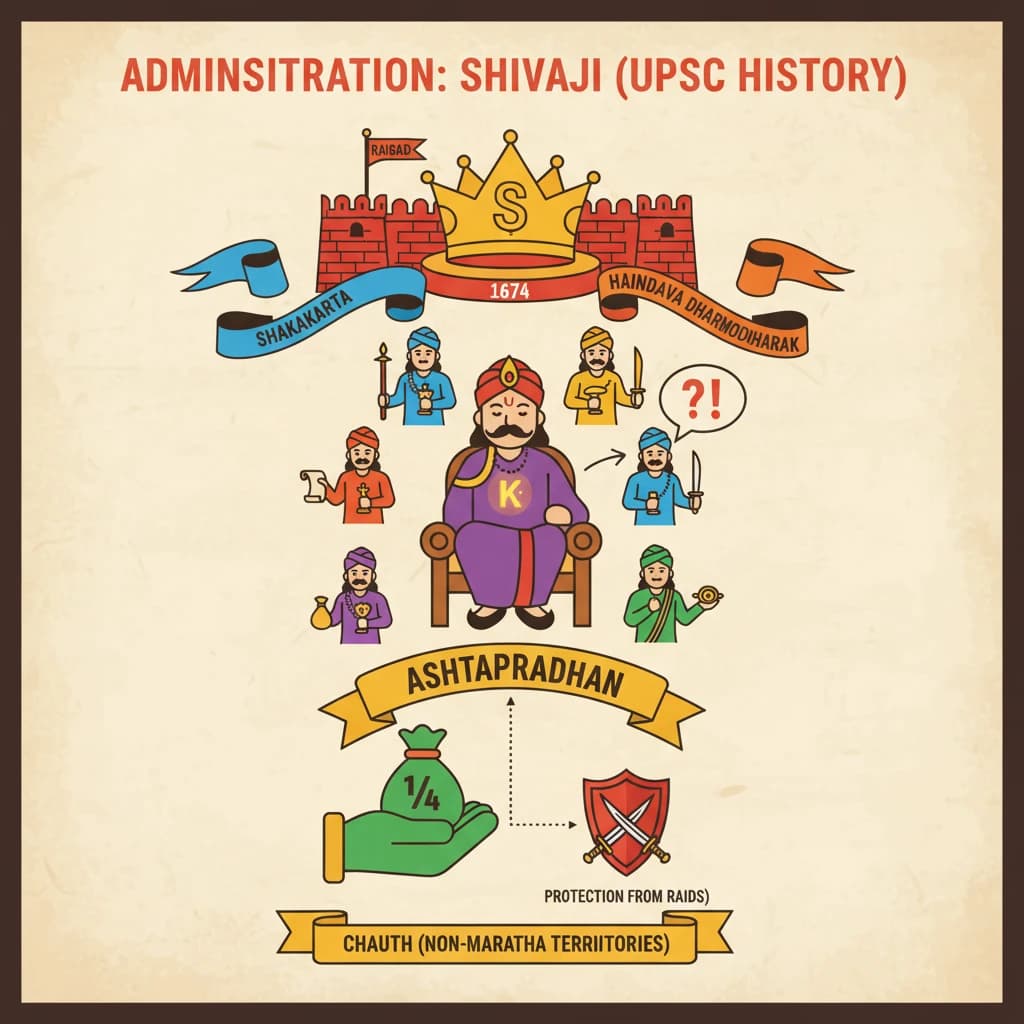
- Shivaji was crowned Chhatrapati in 1674 at Raigad, adopting titles like Shakakarta and Haindava Dharmoddharak.
- Central administration was led by the King, assisted by the 'Ashtapradhan' (council of eight ministers).
- Ashtapradhan was an advisory body, with the King holding ultimate authority.
- Key revenue sources were Chauth (1/4th of revenue for protection from raids in non-Maratha territories).
- Sardeshmukhi was an additional 10% levy on lands where Marathas claimed hereditary rights.
- Shivaji's administration was crucial for consolidating Maratha power and funding state operations.
Maratha Administration under Shivaji: Central & Revenue Systems
Medium⏱️ 8 min read
history
📖 Introduction
Coronation and Royal Titles
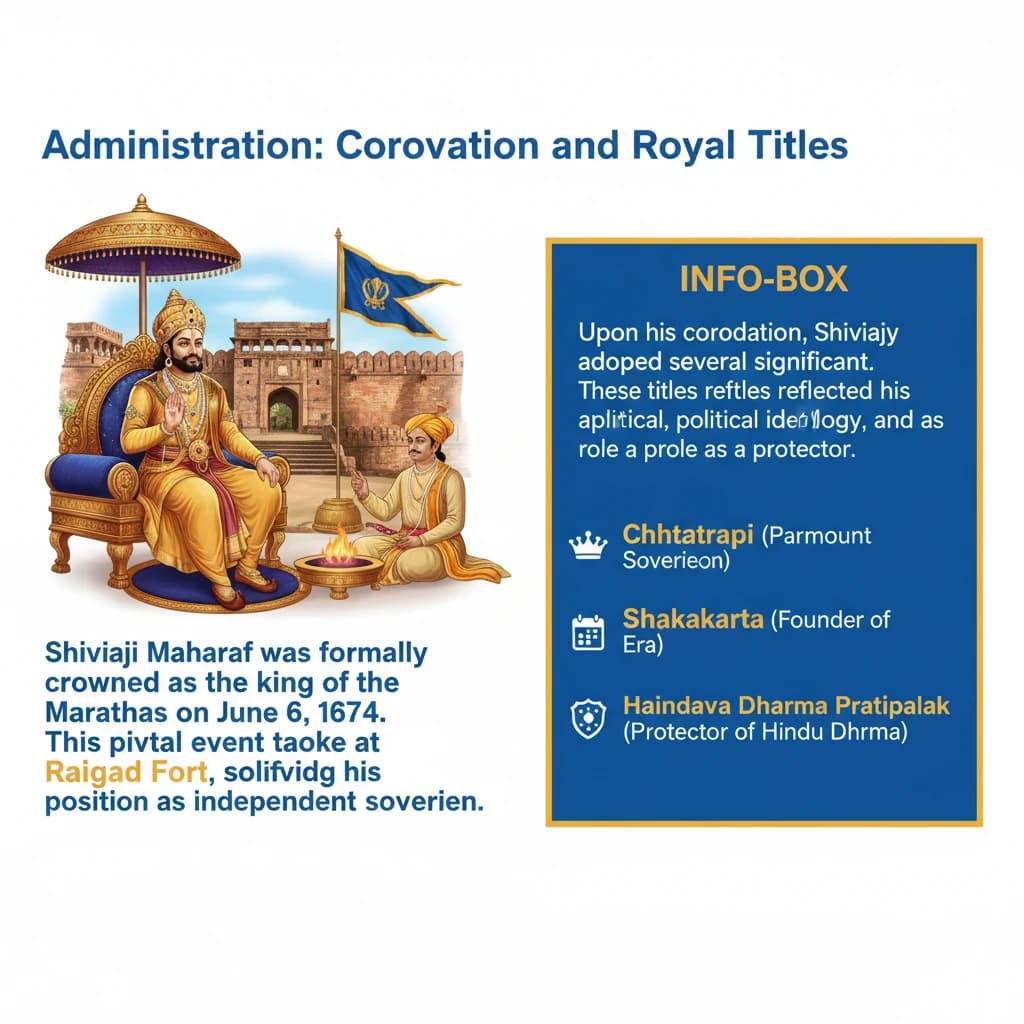
Shivaji Maharaj was formally crowned as the king of the Marathas on June 6, 1674. This pivotal event took place at Raigad Fort, solidifying his position as an independent sovereign.
Upon his coronation, Shivaji adopted several significant titles. These titles reflected his aspirations, political ideology, and role as a protector of his people and dharma.
He assumed the titles of Chhatrapati (Paramount Sovereign), Shakakarta (Founder of an Era), Kshatriya Kulavantas (Head of the Kshatriya Race), and Haindava Dharmoddharak (Protector of the Hindu Dharma).
Central Administration: The Ashtapradhan
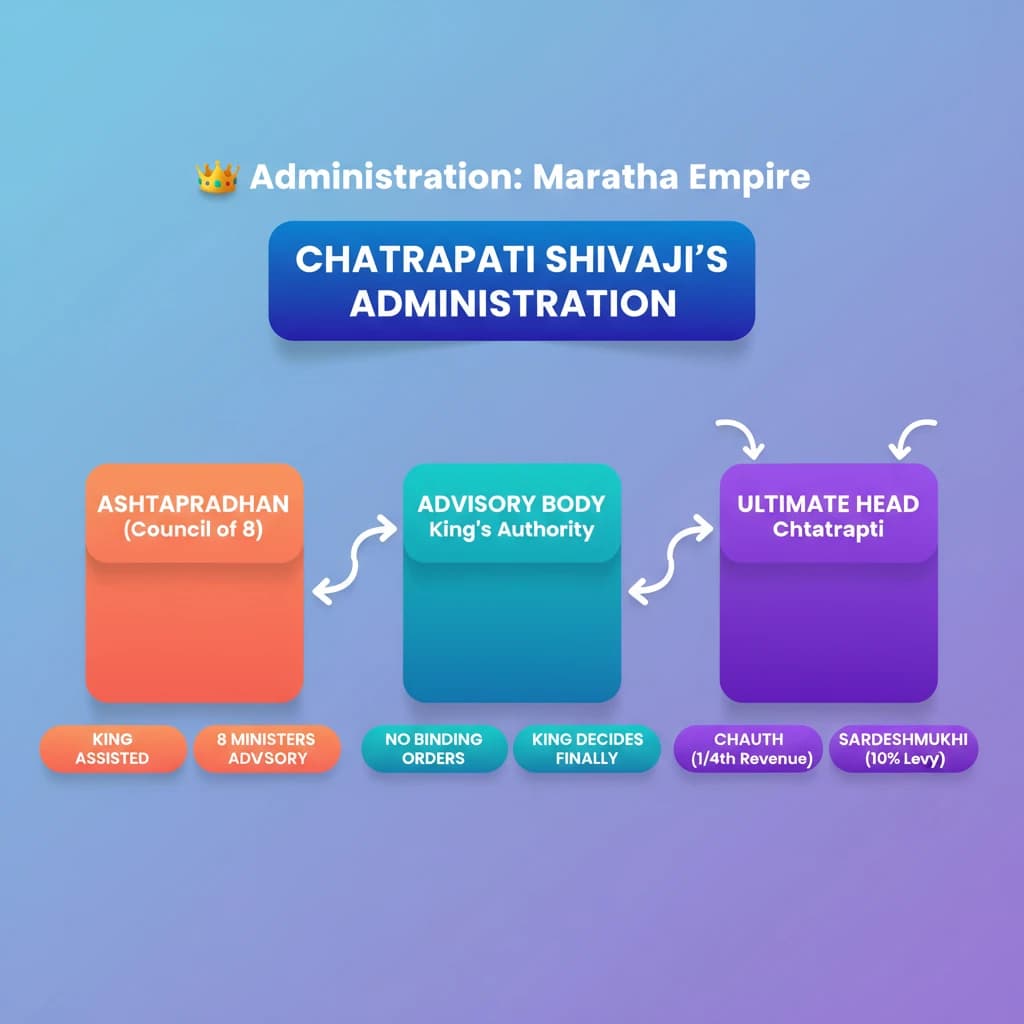
The King, Chhatrapati Shivaji, was the supreme head of the state. He exercised ultimate authority in all administrative, military, and judicial matters.
To assist him in the complex task of governance, Shivaji established a council of eight ministers. This council was famously known as the 'Ashtapradhan Mandal'.
The Ashtapradhan was not a cabinet in the modern sense, where decisions are taken by majority vote. Instead, it was an advisory council, and the final decision rested with the Chhatrapati.
Understanding the Ashtapradhan is crucial for UPSC Mains GS Paper 1 (History) and GS Paper 2 (Polity - comparison with modern cabinet systems). Note its advisory nature.
Revenue Administration: Key Sources of Income
Shivaji's administration developed an effective revenue system to fund his military campaigns and state machinery. Two primary sources of income were Chauth and Sardeshmukhi.
These levies were crucial for maintaining the Maratha army and asserting their dominance over neighboring territories, without necessarily occupying them directly.
Understanding Chauth
Chauth was a significant revenue demand that amounted to one-fourth (1/4th) of the total revenue of a territory. It was primarily collected from non-Maratha territories.
The payment of Chauth served as a safeguard. In return for this payment, Shivaji's forces guaranteed protection against raids and plunder in those specific regions.
Chauth is often asked in UPSC Prelims as a direct definition. Remember it's 1/4th and a protection levy.
Understanding Sardeshmukhi
Sardeshmukhi was another important levy, representing an additional tax of 10% (or 1/10th) of the revenue. It was imposed on lands where the Marathas claimed hereditary rights.
The claim of hereditary rights was based on Shivaji's position as the Sardeshmukh (chief headman) of the entire Maratha land, justifying this extra collection.
Distinguish clearly between Chauth (protection from raids, 1/4th) and Sardeshmukhi (hereditary claim, 1/10th) for both Prelims and Mains answers.
💡 Key Takeaways
- •Shivaji was crowned Chhatrapati in 1674 at Raigad, adopting titles like Shakakarta and Haindava Dharmoddharak.
- •Central administration was led by the King, assisted by the 'Ashtapradhan' (council of eight ministers).
- •Ashtapradhan was an advisory body, with the King holding ultimate authority.
- •Key revenue sources were Chauth (1/4th of revenue for protection from raids in non-Maratha territories).
- •Sardeshmukhi was an additional 10% levy on lands where Marathas claimed hereditary rights.
- •Shivaji's administration was crucial for consolidating Maratha power and funding state operations.
🧠 Memory Techniques
95% Verified Content
📚 Reference Sources
•NCERT History Textbooks (Class XI/XII)
•Standard Reference Books on Indian History (e.g., Satish Chandra, Bipin Chandra)