Loading page, please wait…
Mauryan Dynasty - UPSC History
What is Mauryan Dynasty in UPSC History?
Mauryan Dynasty is a key topic under History for UPSC Civil Services Examination. Key points include: Chandragupta Maurya founded the empire (321 BCE), overthrew Nandas, expanded to Hindu Kush, and made a treaty with Seleucus Nicator.. Chanakya (Kautilya) was the prime minister, crucial for empire's success, known for the Arthashastra.. Bindusara expanded the empire to the Deccan and was called 'Amitraghata'.. Understanding this topic is essential for both UPSC Prelims and Mains preparation.
Why is Mauryan Dynasty important for UPSC exam?
Mauryan Dynasty is a Medium-level topic in UPSC History. It is tested in both Prelims (factual MCQs) and Mains (analytical answer writing). Previous year UPSC questions have frequently covered aspects of Mauryan Dynasty, making it essential for comprehensive IAS preparation.
How to prepare Mauryan Dynasty for UPSC?
To prepare Mauryan Dynasty for UPSC: (1) Study the comprehensive notes covering all key concepts on Vaidra. (2) Practice previous year questions on this topic. (3) Connect it with current affairs using daily updates. (4) Revise using key takeaways and mind maps available for History. (5) Write practice answers linking Mauryan Dynasty to related GS Paper topics.
Key takeaways of Mauryan Dynasty for UPSC
- Chandragupta Maurya founded the empire (321 BCE), overthrew Nandas, expanded to Hindu Kush, and made a treaty with Seleucus Nicator.
- Chanakya (Kautilya) was the prime minister, crucial for empire's success, known for the Arthashastra.
- Bindusara expanded the empire to the Deccan and was called 'Amitraghata'.
- Ashoka transformed after the Kalinga War, embraced Buddhism, propagated Dhamma, and organized the 3rd Buddhist Council.
- Later Mauryan rulers like Dasharatha, Samprati, Shalishuka, and Devavarman oversaw the empire's gradual decline.
- The Mauryan Dynasty established the first large, unified empire in ancient India, known for its centralized administration and significant cultural shifts.
Mauryan Dynasty
Medium⏱️ 10 min read
history
📖 Introduction
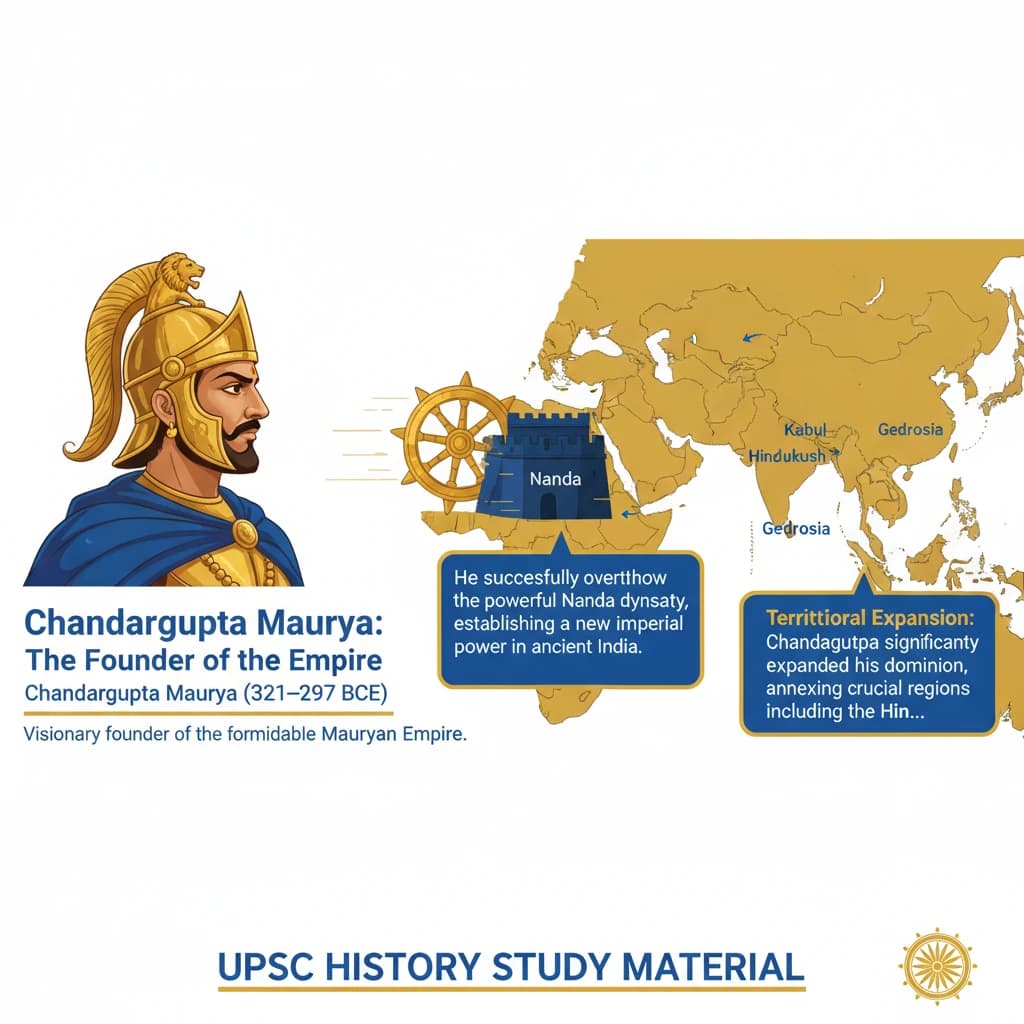
Chandragupta Maurya: The Founder of the Empire
Chandragupta Maurya (321–297 BCE) was the visionary founder of the formidable Mauryan Empire.
He successfully overthrew the powerful Nanda dynasty, establishing a new imperial power in ancient India.
Territorial Expansion: Chandragupta significantly expanded his dominion, annexing crucial regions including the Hindu Kush mountains.
In 305 BCE, he engaged in a conflict with Seleucus Nicator, the Greek Seleucid king.
This conflict concluded with a significant treaty, granting Chandragupta additional territories and solidifying his western borders.
Towards the later part of his life, Chandragupta embraced Jainism, becoming a devoted disciple of the faith.
Chanakya: The Architect of Mauryan Statecraft
Chanakya, also known as Kautilya or Vishnugupta, served as the influential prime minister.
He was a key advisor during the reigns of Chandragupta Maurya (322 BCE - 297 BCE) and his successor, Bindusara.
Chanakya's strategic acumen and political theories, famously codified in the Arthashastra, were instrumental in the empire’s success and efficient administration.
Bindusara: The Expander to the Deccan
Bindusara (298–272 BCE) succeeded his father, Chandragupta, and continued the empire's expansionist policies.
He is credited with extending the Mauryan Empire further into the Deccan region of India.
Title: Bindusara was known by the epithet “Amitraghata,” which translates to “slayer of enemies,” reflecting his military prowess.
He showed an inclination towards the Ajivika sect, a prominent heterodox philosophical school of ancient India.
The Greek ambassador Deimachus was present at Bindusara's royal court, indicating active diplomatic relations with Hellenistic kingdoms.
Ashoka: The Great Transformer and Dhamma Propagator
Ashoka (272-232 BCE) is arguably the most celebrated ruler of the Mauryan Dynasty, known for his profound personal and political transformation.
His early reign was marked by the brutal Kalinga War, which led to massive casualties and widespread devastation.
The immense suffering caused by the Kalinga War deeply impacted Ashoka, leading him to renounce warfare and embrace Buddhism.
Following his conversion, Ashoka dedicated his efforts to promoting peace and moral governance through his unique policy of Dhamma (moral laws).
He played a crucial role in organizing the 3rd Buddhist Council, which aimed to purify and propagate Buddhist teachings.
Global Spread of Buddhism: Ashoka was instrumental in spreading Buddhism globally, sending emissaries to various countries and constructing numerous stupas and viharas.
Later Mauryan Rulers: Decline and Succession
After Ashoka, the vast Mauryan Empire gradually entered a phase of decline, marked by territorial losses and internal instability.
Dasharatha (232–224 BCE): He was the last Mauryan ruler to issue imperial inscriptions, but faced significant territorial losses during his reign.
Samprati (224–215 BCE): He attempted to re-establish Mauryan control over disintegrated territories and was a known patron of Jainism.
Shalishuka (215–202 BCE): This ruler is known in historical accounts for his negative reputation as a quarrelsome ruler.
Devavarman (202–195 BCE): He had a brief reign and is primarily mentioned in the ancient Hindu texts known as the Puranas.
Understanding the contributions and challenges of later Mauryan rulers helps in analyzing the factors contributing to the decline of great empires, a recurring theme in UPSC history questions.
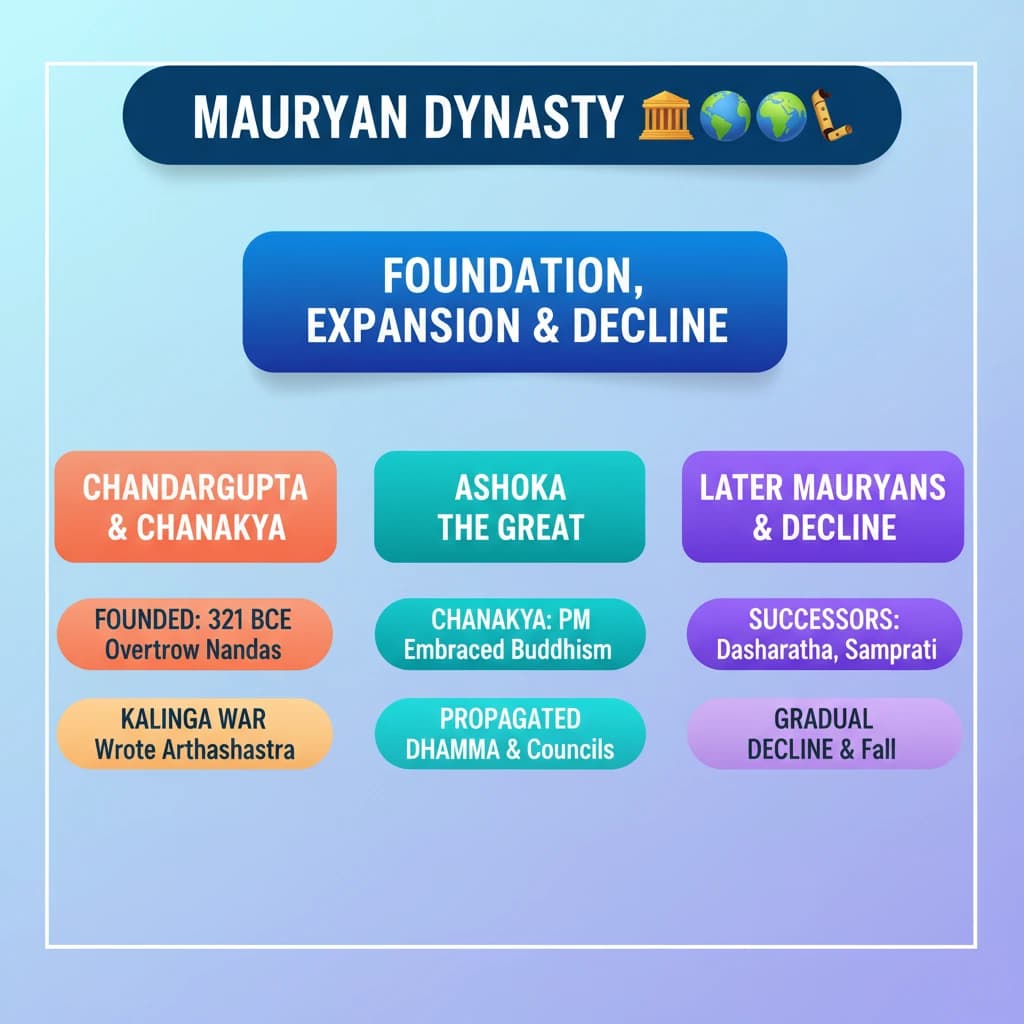
💡 Key Takeaways
- •Chandragupta Maurya founded the empire (321 BCE), overthrew Nandas, expanded to Hindu Kush, and made a treaty with Seleucus Nicator.
- •Chanakya (Kautilya) was the prime minister, crucial for empire's success, known for the Arthashastra.
- •Bindusara expanded the empire to the Deccan and was called 'Amitraghata'.
- •Ashoka transformed after the Kalinga War, embraced Buddhism, propagated Dhamma, and organized the 3rd Buddhist Council.
- •Later Mauryan rulers like Dasharatha, Samprati, Shalishuka, and Devavarman oversaw the empire's gradual decline.
- •The Mauryan Dynasty established the first large, unified empire in ancient India, known for its centralized administration and significant cultural shifts.
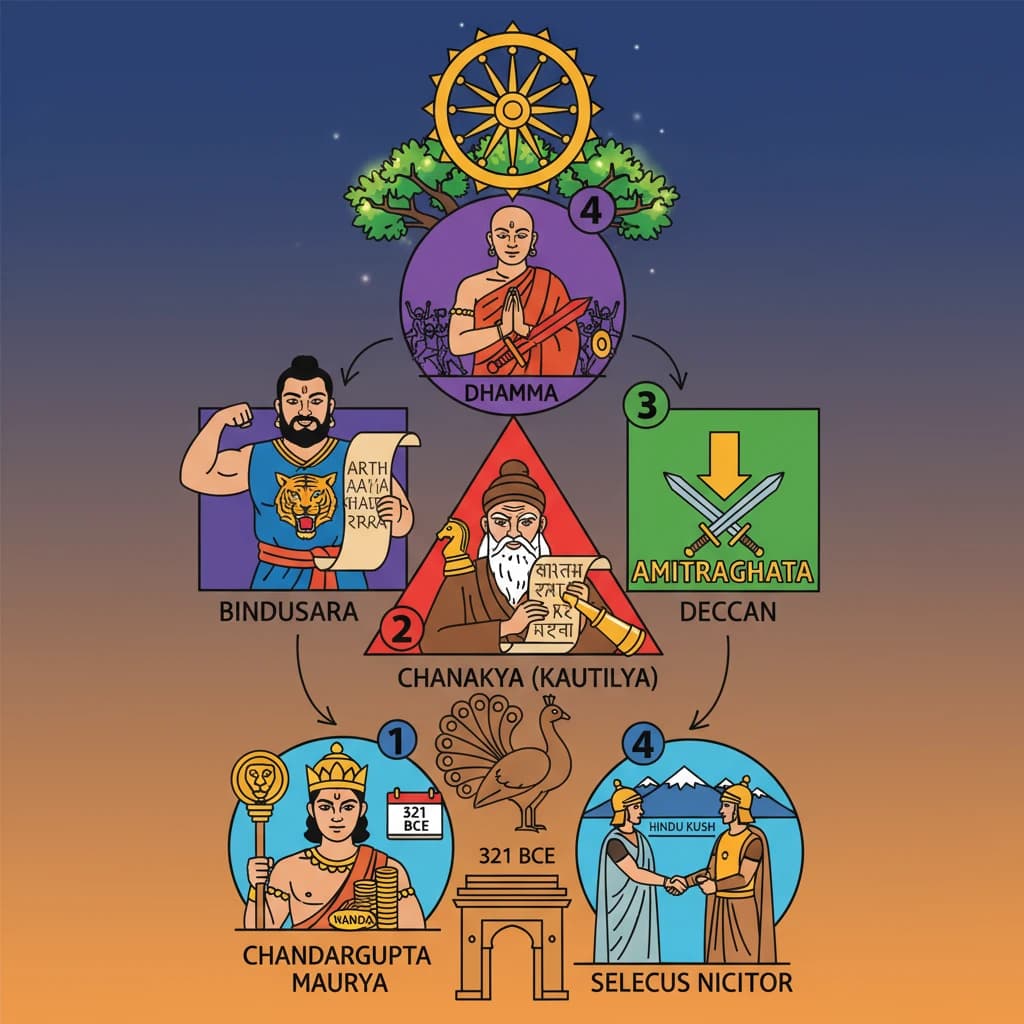
🧠 Memory Techniques
95% Verified Content
📚 Reference Sources
•NCERT History Textbooks (Class XI & XII)
•Upinder Singh, 'A History of Ancient and Early Medieval India'
•Romila Thapar, 'Ashoka and the Decline of the Mauryas'