Loading page, please wait…
NCERT Chapter on Veer Abdul Hameed - UPSC History
What is NCERT Chapter on Veer Abdul Hameed in UPSC History?
NCERT Chapter on Veer Abdul Hameed is a key topic under History for UPSC Civil Services Examination. Key points include: Veer Abdul Hameed was a 1965 Indo-Pak War hero, posthumously awarded Param Veer Chakra for destroying Pakistani Patton tanks at the Battle of Asal Uttar.. His story, along with a poem on the National War Memorial, is now included in Class VI NCERT to inspire patriotism and devotion to duty.. These curriculum changes align with NEP 2020 and NCF 2023, emphasizing holistic education, ethical values, and responsible citizenship.. Understanding this topic is essential for both UPSC Prelims and Mains preparation.
Why is NCERT Chapter on Veer Abdul Hameed important for UPSC exam?
NCERT Chapter on Veer Abdul Hameed is a Medium-level topic in UPSC History. It is tested in both Prelims (factual MCQs) and Mains (analytical answer writing). Previous year UPSC questions have frequently covered aspects of NCERT Chapter on Veer Abdul Hameed, making it essential for comprehensive IAS preparation.
How to prepare NCERT Chapter on Veer Abdul Hameed for UPSC?
To prepare NCERT Chapter on Veer Abdul Hameed for UPSC: (1) Study the comprehensive notes covering all key concepts on Vaidra. (2) Practice previous year questions on this topic. (3) Connect it with current affairs using daily updates. (4) Revise using key takeaways and mind maps available for History. (5) Write practice answers linking NCERT Chapter on Veer Abdul Hameed to related GS Paper topics.
Key takeaways of NCERT Chapter on Veer Abdul Hameed for UPSC
- Veer Abdul Hameed was a 1965 Indo-Pak War hero, posthumously awarded Param Veer Chakra for destroying Pakistani Patton tanks at the Battle of Asal Uttar.
- His story, along with a poem on the National War Memorial, is now included in Class VI NCERT to inspire patriotism and devotion to duty.
- These curriculum changes align with NEP 2020 and NCF 2023, emphasizing holistic education, ethical values, and responsible citizenship.
- The Battle of Asal Uttar was a crucial tank battle of the 1965 War, where India's valor, despite initial setbacks, turned the tide.
- Sardar Patel's integration of 562 princely states and establishment of All India Services were foundational to modern India's unity and administrative strength.
NCERT Chapter on Veer Abdul Hameed
Medium⏱️ 8 min read
history
📖 Introduction
Introduction to the NCERT Chapter
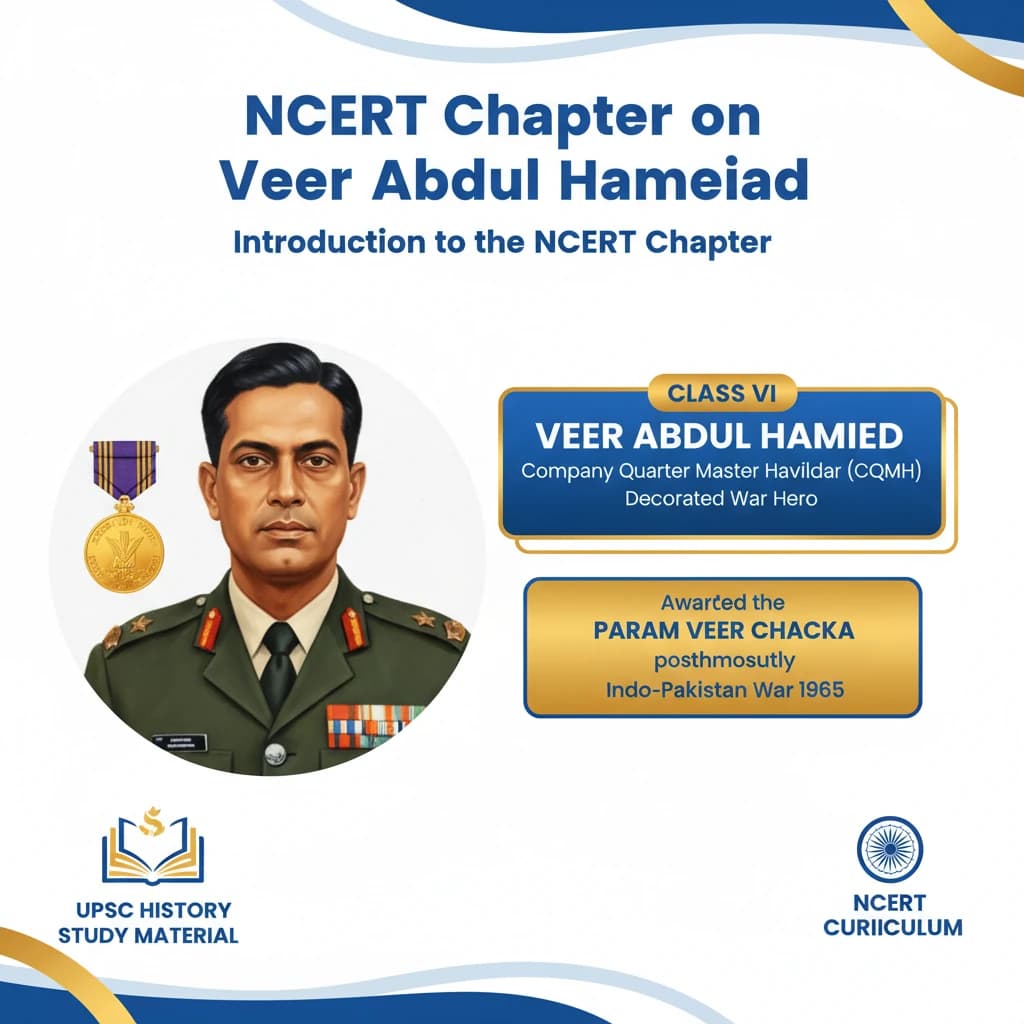
The NCERT curriculum for Class VI now includes a chapter titled ‘Veer Abdul Hameed’. This inclusion aims to honor Company Quarter Master Havildar (CQMH) Abdul Hameed, a decorated war hero.
He was awarded the Param Veer Chakra posthumously for his gallantry during the Indo-Pakistan War 1965.
The chapter's primary purpose is to inspire students with real-life examples of patriotism and unwavering devotion to duty.
Poem on National War Memorial
Alongside the chapter, a poem titled ‘National War Memorial’ has also been incorporated into the curriculum.
This poem seeks to instill a deep sense of respect for soldiers who made the ultimate sacrifice for the nation.
It also promotes a spirit of national pride and remembrance for their bravery.
- The National War Memorial stands as a testament to sacrifices made by soldiers during various conflicts, United Nations Operations, and Humanitarian Assistance and Disaster Response Operations since Independence.
- It was inaugurated on 25th February 2019 at the India Gate complex, New Delhi.
Educational Reforms and Vision
These changes in the NCERT textbook are fully aligned with the vision of the National Education Policy (NEP) 2020.
They also conform to the principles outlined in the National Curriculum Framework (NCF) 2023.
Both NEP 2020 and NCF 2023 emphasize holistic education that fosters ethical values, patriotism, and the development of responsible citizens.
Understanding this alignment is crucial for UPSC Mains GS-II (Education) and GS-IV (Ethics) answers, demonstrating a grasp of contemporary educational philosophy.
Profile of Veer Abdul Hameed
Abdul Hameed served with distinction in the 4th Grenadiers Battalion of the Indian Army.
He was a vital part of India's defense force during the pivotal Battle of Asal Uttar in the India-Pakistan War of 1965.
His unit was equipped with Recoilless Guns, specifically designed to target and neutralize enemy tanks.
The Battle of Asal Uttar: A Turning Point
The Battle of Asal Uttar took place in early September 1965, near the India-Pakistan border in Punjab, close to the town of Khem Karan.
Pakistan's objective was to invade India, capture Khem Karan, and advance towards the Beas River bridge to isolate strategic areas like Amritsar.
- Pakistan launched its offensive with a significant number of superior Patton tanks, initially surprising and forcing Indian forces to retreat.
- This engagement is recognized as one of the largest tank battles of the entire 1965 India-Pakistan War.
Abdul Hameed's Valour at Cheema Village
Abdul Hameed was strategically positioned near Cheema village, located on the Amritsar-Khem Karan road.
He commanded a detachment equipped with Recoilless Guns, tasked with engaging enemy tanks.
On 10th September 1965, he encountered four advancing Pakistani Patton tanks.
With incredible bravery, he successfully destroyed three of these tanks and damaged a fourth. Tragically, he was subsequently killed by fire from another enemy tank.
Posthumous Recognition and Memorial
The site of Abdul Hameed's death has been transformed into a significant war memorial.
A captured Pakistani Patton tank, with its turret lowered in submission, stands guard at the memorial's entrance.
This serves as a powerful tribute to the Indian soldiers who fought and sacrificed their lives in the Battle of Asal Uttar.
Sardar Patel's Post-Independence Contributions
While the chapter focuses on Veer Abdul Hameed, other figures like Sardar Vallabhbhai Patel are also crucial to understanding India's post-independence journey, often covered in NCERTs.
Sardar Patel played an instrumental role in the integration of 562 princely states into the Indian Union.
This monumental effort secured stability and democracy for millions following the Indian Independence Act of 1947.
The Indian Independence Act of 1947 allowed princely states to decide on their independence or accession to India or Pakistan.
Reinforcing India's Civil Services
Patel was also pivotal in establishing the modern All India Services, which significantly strengthened the country's administrative framework.
He is affectionately remembered as the “patron saint of India’s civil servants” for his dedication to reinforcing the bureaucratic system.
National Civil Service Day is observed annually on 21st April.
This day honors Sardar Patel’s 1947 speech, where he famously referred to civil servants as “the steel frame of India”, emphasizing their dedication to public service.
Leadership in the Constituent Assembly
Furthermore, Sardar Patel led the Advisory Committee on Fundamental Rights, Minorities, and Tribal and Excluded Areas within the Constituent Assembly.
Knowledge of Sardar Patel's contributions is essential for UPSC Mains GS-I (Post-Independence Consolidation) and GS-II (Polity and Governance) answers.
💡 Key Takeaways
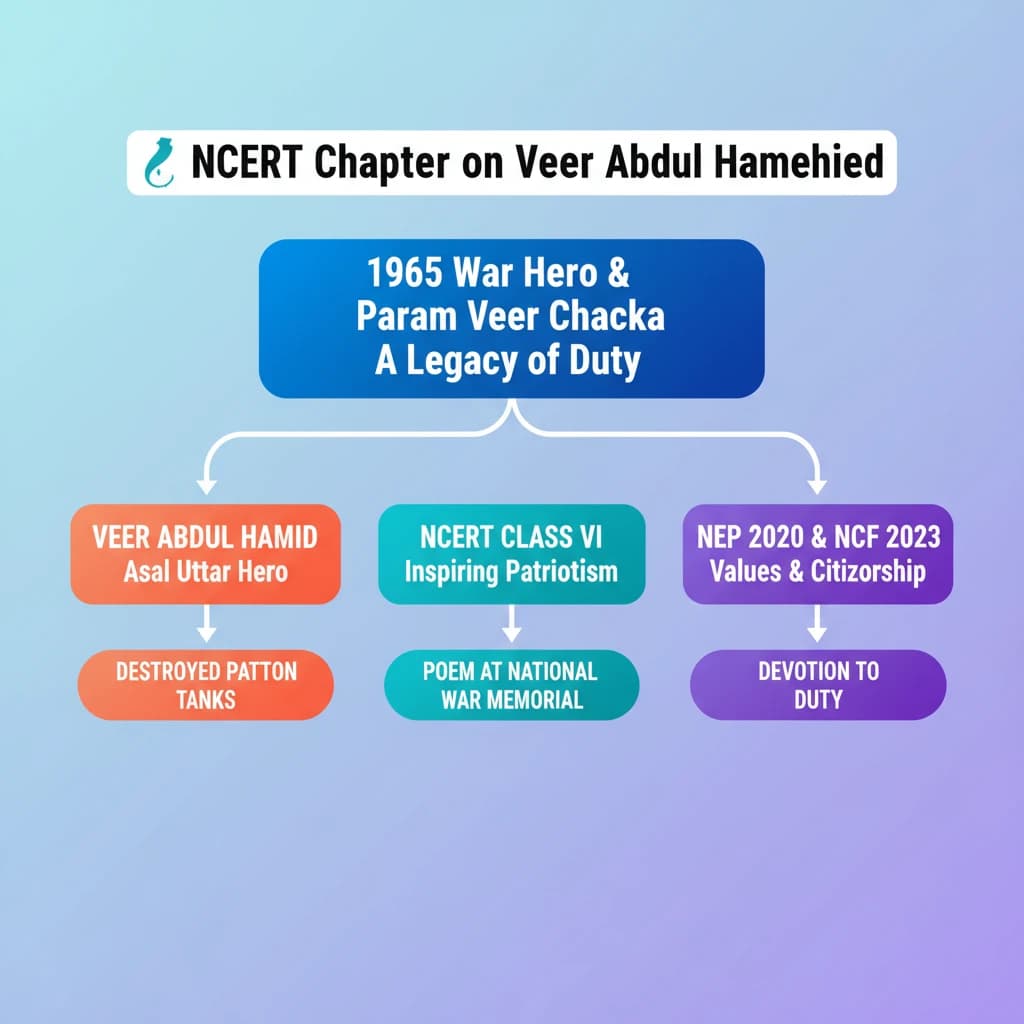
- •Veer Abdul Hameed was a 1965 Indo-Pak War hero, posthumously awarded Param Veer Chakra for destroying Pakistani Patton tanks at the Battle of Asal Uttar.
- •His story, along with a poem on the National War Memorial, is now included in Class VI NCERT to inspire patriotism and devotion to duty.
- •These curriculum changes align with NEP 2020 and NCF 2023, emphasizing holistic education, ethical values, and responsible citizenship.
- •The Battle of Asal Uttar was a crucial tank battle of the 1965 War, where India's valor, despite initial setbacks, turned the tide.
- •Sardar Patel's integration of 562 princely states and establishment of All India Services were foundational to modern India's unity and administrative strength.
🧠 Memory Techniques
95% Verified Content
📚 Reference Sources
•NCERT Class VI Curriculum (implied content)
•Government of India official communications (National War Memorial inauguration details)