Loading page, please wait…
Pingali Venkayya, the Man Behind Tricolour - UPSC History
What is Pingali Venkayya, the Man Behind Tricolour in UPSC History?
Pingali Venkayya, the Man Behind Tricolour is a key topic under History for UPSC Civil Services Examination. Key points include: Pingali Venkayya designed the flag on which the Indian National Flag is based.. He was a freedom fighter and Gandhian, born on August 2nd.. The 'Har Ghar Tiranga' movement encourages unfurling the Tricolour between August 9-15, 2024.. Understanding this topic is essential for both UPSC Prelims and Mains preparation.
Why is Pingali Venkayya, the Man Behind Tricolour important for UPSC exam?
Pingali Venkayya, the Man Behind Tricolour is a Medium-level topic in UPSC History. It is tested in both Prelims (factual MCQs) and Mains (analytical answer writing). Previous year UPSC questions have frequently covered aspects of Pingali Venkayya, the Man Behind Tricolour, making it essential for comprehensive IAS preparation.
How to prepare Pingali Venkayya, the Man Behind Tricolour for UPSC?
To prepare Pingali Venkayya, the Man Behind Tricolour for UPSC: (1) Study the comprehensive notes covering all key concepts on Vaidra. (2) Practice previous year questions on this topic. (3) Connect it with current affairs using daily updates. (4) Revise using key takeaways and mind maps available for History. (5) Write practice answers linking Pingali Venkayya, the Man Behind Tricolour to related GS Paper topics.
Key takeaways of Pingali Venkayya, the Man Behind Tricolour for UPSC
- Pingali Venkayya designed the flag on which the Indian National Flag is based.
- He was a freedom fighter and Gandhian, born on August 2nd.
- The 'Har Ghar Tiranga' movement encourages unfurling the Tricolour between August 9-15, 2024.
- The Indian National Flag evolved through several designs, with Venkayya's 1921 design being pivotal.
- The Ashoka Chakra replaced the Charkha in the final 1947 flag, symbolizing dharma and progress.
- The flag represents India's sovereignty, unity, and constitutional values.
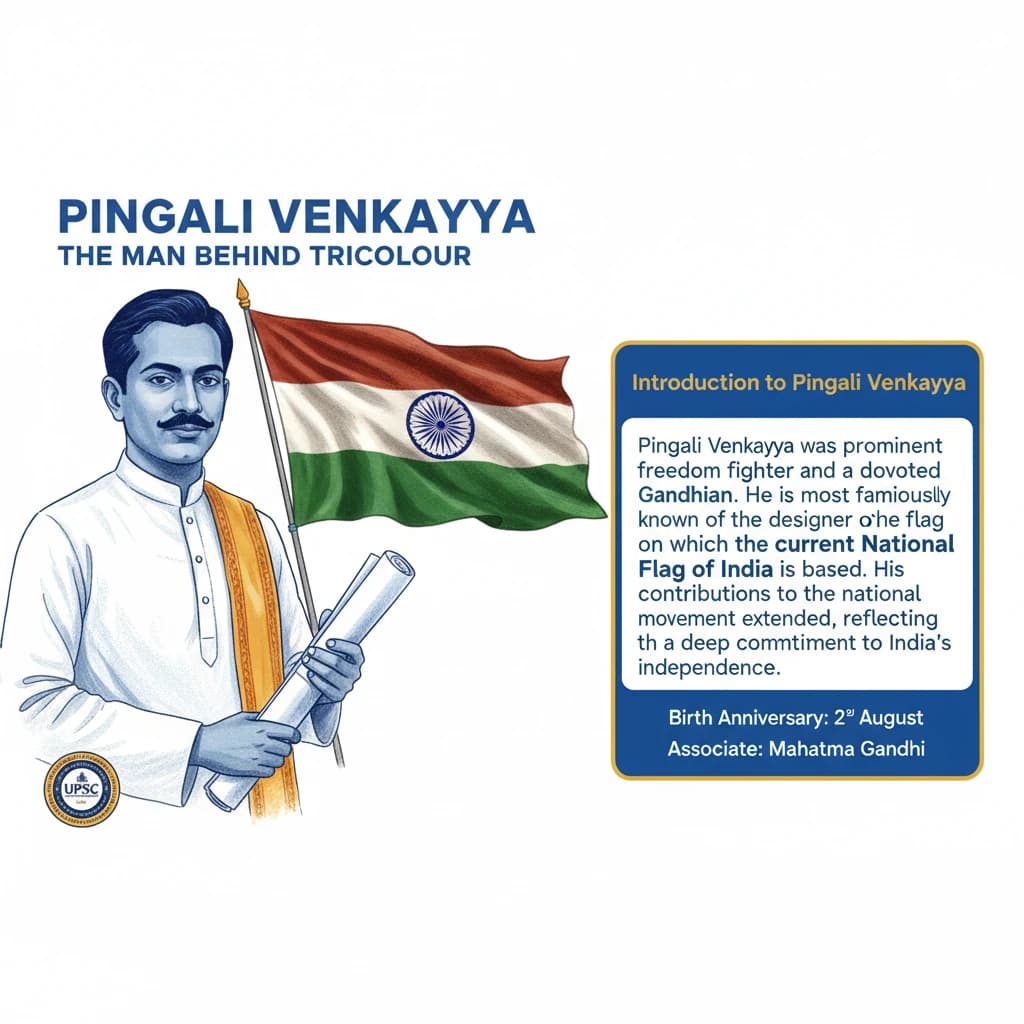
Pingali Venkayya, the Man Behind Tricolour
Medium⏱️ 6 min read
history
📖 Introduction
Introduction to Pingali Venkayya
Pingali Venkayya was a prominent freedom fighter and a devoted Gandhian. He is most famously known as the designer of the flag on which the current National Flag of India is based. His contributions to the national movement extended beyond flag design, reflecting a deep commitment to India's independence.
Birth Anniversary: 2nd August
Associated Movement: Indian Freedom Struggle
Key Contribution: Designing the prototype of the Indian National Flag
PM's Tribute and 'Har Ghar Tiranga' Movement
On 2nd August, the birth anniversary of Pingali Venkayya, the Prime Minister of India paid heartfelt tributes to him. This gesture highlights the nation's remembrance and respect for his pivotal role in India's history.
The Prime Minister also launched and urged citizens to participate in the 'Har Ghar Tiranga' movement. This initiative encourages every household to unfurl the Tricolour, the Indian National Flag, between 9th and 15th August, 2024, as part of Independence Day celebrations.
UPSC Relevance: Questions on national symbols, freedom fighters, and their contributions are common in GS Paper I (History) and can also be linked to GS Paper II (Polity) for discussions on national identity and constitutional values.
Evolution of the Indian National Flag
The journey of the Indian National Flag is a testament to India's struggle for independence. Various designs were proposed and used before the final version was adopted. Pingali Venkayya's design was a significant milestone in this evolution.
- 1906: First unofficial flag, Calcutta Flag (Red, Yellow, Green stripes).
- 1907: Madame Bhikaji Cama's flag at Stuttgart.
- 1917: Home Rule Movement flag by Annie Besant and Lokmanya Tilak.
- 1921: Pingali Venkayya presented a flag with two red and green bands representing Hindus and Muslims, with a spinning wheel. Gandhi suggested adding a white band for other communities and the nation's progress.
- 1931: The Congress Committee adopted a flag with three bands (saffron, white, green) and a spinning wheel in the centre. This was a crucial step towards the current design.
- 1947: The Constituent Assembly adopted the Tricolour with the Ashoka Chakra replacing the spinning wheel as the National Flag of independent India.
The Ashoka Chakra represents the 'wheel of dharma' and symbolizes progress and continuous movement, replacing the spinning wheel which symbolized self-reliance and Swadeshi.
💡 Key Takeaways
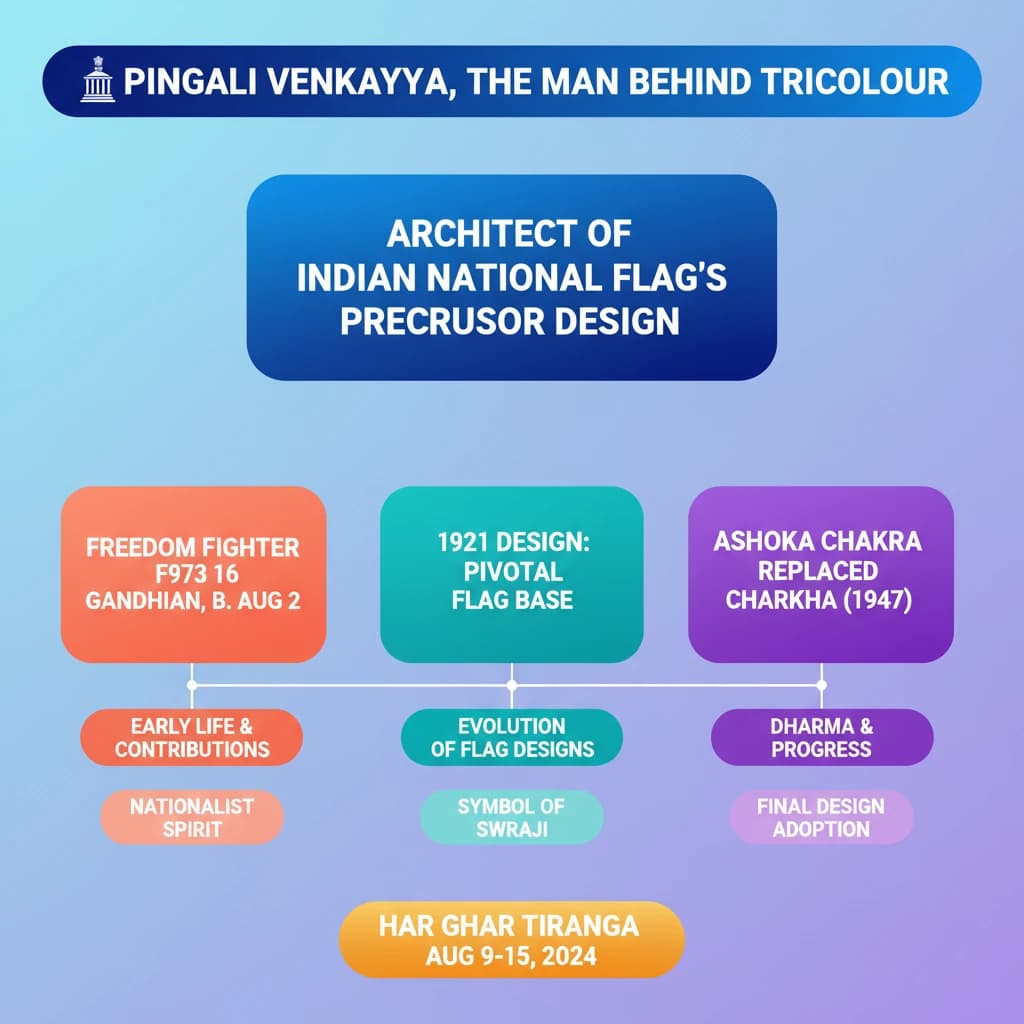
- •Pingali Venkayya designed the flag on which the Indian National Flag is based.
- •He was a freedom fighter and Gandhian, born on August 2nd.
- •The 'Har Ghar Tiranga' movement encourages unfurling the Tricolour between August 9-15, 2024.
- •The Indian National Flag evolved through several designs, with Venkayya's 1921 design being pivotal.
- •The Ashoka Chakra replaced the Charkha in the final 1947 flag, symbolizing dharma and progress.
- •The flag represents India's sovereignty, unity, and constitutional values.
🧠 Memory Techniques
98% Verified Content
📚 Reference Sources
•Ministry of Culture, Government of India (for Har Ghar Tiranga and Flag Code)
•National Portal of India (for National Symbols)
•NCERT History Textbooks (for Freedom Struggle and Flag Evolution)