Loading page, please wait…
Pt. Jawaharlal Nehru - UPSC History
What is Pt. Jawaharlal Nehru in UPSC History?
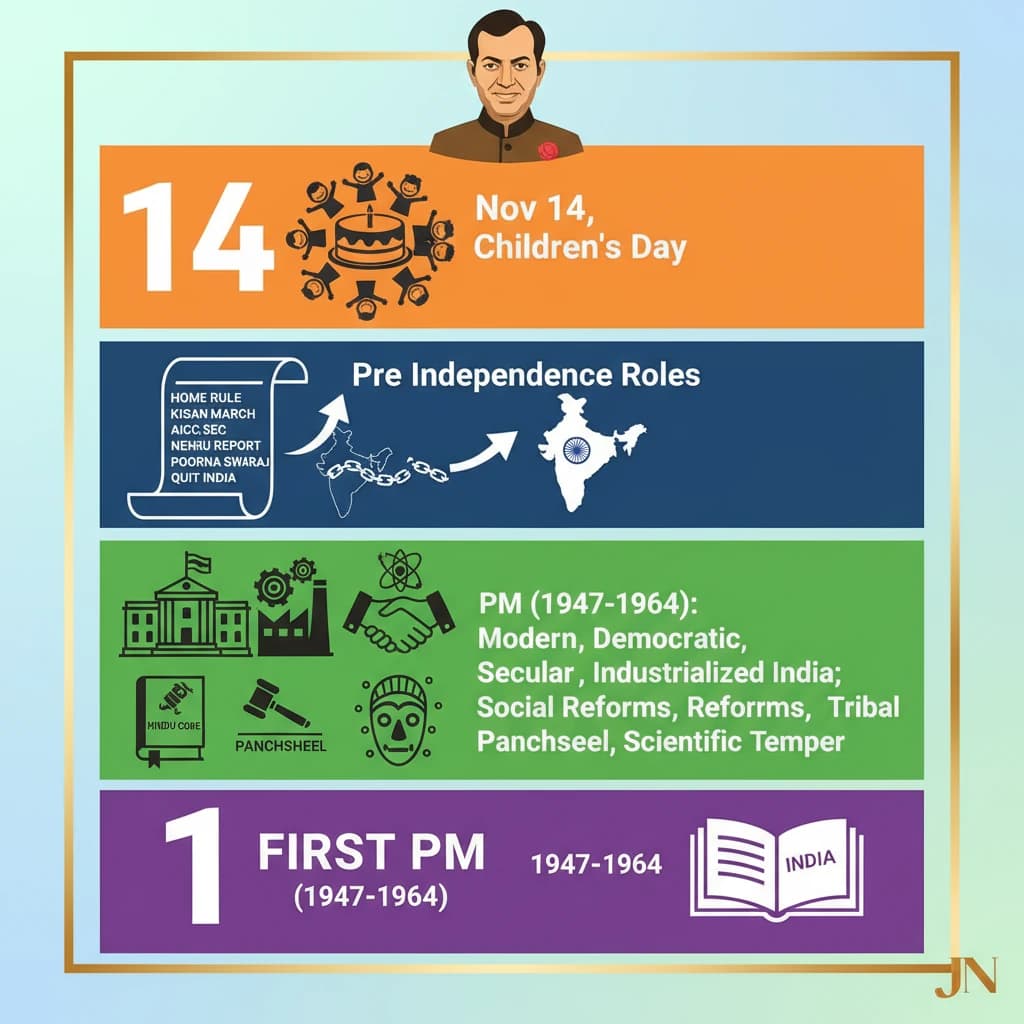
Pt. Jawaharlal Nehru is a key topic under History for UPSC Civil Services Examination. Key points include: Jawaharlal Nehru, India's first PM, born Nov 14, 1889, celebrated as Children's Day.. Key pre-independence roles: Home Rule League, Kisan March, AICC General Secretary, Nehru Report, Purna Swaraj Resolution, Quit India Movement.. As PM (1947-1964), he laid foundations for a modern, democratic, secular, and industrialized India.. Understanding this topic is essential for both UPSC Prelims and Mains preparation.
Why is Pt. Jawaharlal Nehru important for UPSC exam?
Pt. Jawaharlal Nehru is a Medium-level topic in UPSC History. It is tested in both Prelims (factual MCQs) and Mains (analytical answer writing). Previous year UPSC questions have frequently covered aspects of Pt. Jawaharlal Nehru, making it essential for comprehensive IAS preparation.
How to prepare Pt. Jawaharlal Nehru for UPSC?
To prepare Pt. Jawaharlal Nehru for UPSC: (1) Study the comprehensive notes covering all key concepts on Vaidra. (2) Practice previous year questions on this topic. (3) Connect it with current affairs using daily updates. (4) Revise using key takeaways and mind maps available for History. (5) Write practice answers linking Pt. Jawaharlal Nehru to related GS Paper topics.
Key takeaways of Pt. Jawaharlal Nehru for UPSC
- Jawaharlal Nehru, India's first PM, born Nov 14, 1889, celebrated as Children's Day.
- Key pre-independence roles: Home Rule League, Kisan March, AICC General Secretary, Nehru Report, Purna Swaraj Resolution, Quit India Movement.
- As PM (1947-1964), he laid foundations for a modern, democratic, secular, and industrialized India.
- Introduced social reforms like the Hindu Code Bill, championed Tribal Panchsheel, and promoted scientific temper.
- Architect of India's foreign policy: Non-Aligned Movement (NAM) and Panchsheel Principles.
- Established premier institutions like IITs, IIMs, and paved the way for ISRO.
Pt. Jawaharlal Nehru
Medium⏱️ 8 min read
history
📖 Introduction
Introduction to Pt. Jawaharlal Nehru
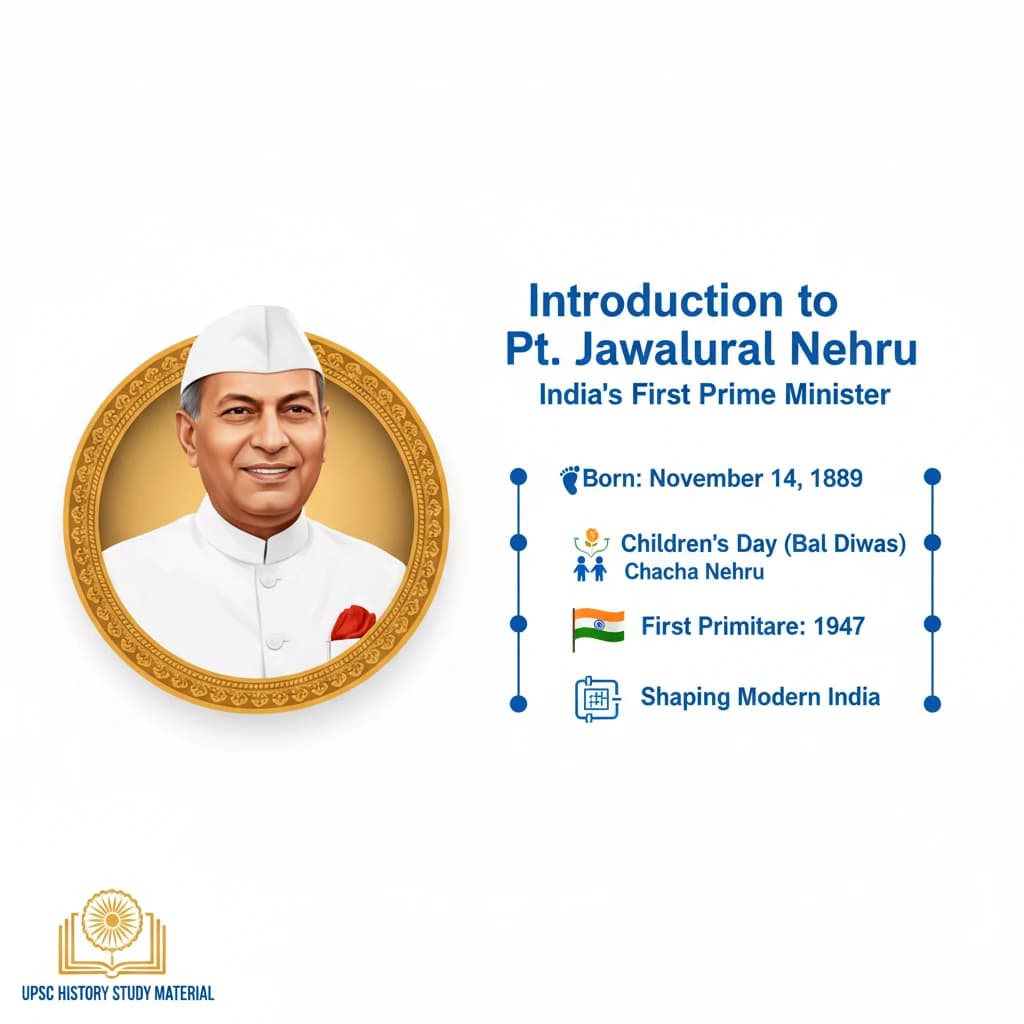
Pt. Jawaharlal Nehru, born on November 14, 1889, was India's first Prime Minister. His birth anniversary is celebrated annually as Children's Day (Bal Diwas), reflecting his deep affection for children, who lovingly called him Chacha Nehru.
Nehru's life was marked by significant contributions both during India's struggle for independence and in shaping the newly independent nation.
Key Fact: Children's Day is observed on November 14th each year in India to honor Jawaharlal Nehru's birthday and his commitment to child welfare.
Pre-Independence Era Contributions (1889-1947)
Nehru's political journey began early, demonstrating a strong commitment to India's freedom struggle. He actively participated in various movements and held crucial positions within the Indian National Congress.
- 1912: Entered politics as a delegate at the 27th Congress session at Bankipore.
- 1919: Became Home Rule League Secretary, advocating for self-rule.
- 1920: Organized the first Kisan March in Pratapgarh, Uttar Pradesh, highlighting agrarian issues.
- 1920-22: Imprisoned twice during the Non-Cooperation Movement, a testament to his active involvement.
Leadership Role: Nehru quickly rose through the ranks, becoming General Secretary of the All India Congress Committee (AICC) in 1923.
His vision for complete independence was clear and unwavering, pushing the Congress towards more assertive demands.
- 1926: Committed the Congress to the goal of independence at the Madras Congress.
- 1928: Faced a lathi-charge while leading a procession against the Simon Commission in Lucknow, showcasing his defiance against British authority.
- 1928: Played a crucial role in the Nehru Report (drafted by his father, Motilal Nehru), a proposal for constitutional reforms.
- 1928: Established the Independence for India League to advocate for full independence.
- 1929: Elected President of the Lahore Congress, where the Congress officially adopted Purna Swaraj (complete independence) as its goal.
- 1942: Moved the historic Quit India Resolution at the AICC session in Bombay, demanding immediate British withdrawal.
Achievements as India's First Prime Minister (1947-1964)
As the first Prime Minister of India, Jawaharlal Nehru laid the foundational principles for a modern, democratic, and self-reliant nation. His tenure from 1947 to 1964 was pivotal in shaping India's domestic and foreign policies.
Vision for Modern India
Nehru envisioned India as a progressive nation built on democratic values, secularism, and scientific advancement. He tirelessly worked towards establishing a robust framework for its future growth.
Core Vision: Established a modern democratic state, promoted secularism and scientific advancement, and laid the groundwork for industrialization.
Social Reforms: The Hindu Code Bill
A significant aspect of Nehru's reformist agenda was the modernization of personal laws to ensure equality and justice, particularly for women.
- The Hindu Code Bill aimed to replace traditional religious laws with a secular civil code.
- It sought to outlaw polygamy, grant women property and divorce rights, amend inheritance laws, and introduce provisions for inter-caste marriage.
Tribal Panchsheel
Nehru's approach to tribal development was marked by respect for indigenous cultures and a focus on self-determination, encapsulated in the Tribal Panchsheel.
Five Principles: Emphasized self-development, respect for tribal rights, minimal external imposition, local participation in administration, and human-centered outcomes over financial metrics.
Economic Development and Institutions
Nehru understood that robust institutions and planned economic growth were crucial for India's self-sufficiency and progress.
- Established premier institutions like the Indian Institutes of Technology (IITs), the Indian Institute of Management (IIM), and the Indian Space Research Organisation (ISRO).
- Championed industrialization through Five-Year Plans, aiming for self-sufficiency and economic growth.
- Promoted a scientific temperament to combat religious obscurantism and superstition, continuing the legacy of reformers like Raja Ram Mohan Roy.
Institutionalization of Democracy
Nehru's intellectual contributions significantly shaped the philosophical underpinnings of India's Constitution.
His 'Objective Resolution' guided the Constituent Assembly in drafting the constitution, profoundly influencing the Preamble and the overall philosophy of the Constitution of India.
Foreign Policy of Non-Alignment
In a world divided by the Cold War, Nehru carved out a unique path for India through its non-alignment policy, advocating for global peace and cooperation.
- India's non-alignment policy aimed to maintain neutrality during the Cold War.
- He was pivotal in forming the Non-Aligned Movement (NAM), promoting global peace and cooperation.
- Key conferences for NAM were Bandung (1955) and Belgrade (1961).
Panchsheel Principle
The Panchsheel Principles, or Five Principles of Peaceful Coexistence, were partly formulated by India and China in the 1950s, forming the bedrock of India's foreign policy.
The Five Principles include:
- Mutual Respect for Each other’s Territorial Integrity and Sovereignty.
- Mutual Non-Aggression.
- Mutual Non-Interference in each other’s internal affairs.
- Equality and Mutual Benefit.
- Peaceful Coexistence.
UPSC Insight: Nehru's contributions span across Indian History (Modern), Polity (Constitution making, democratic institutions), Economy (Five-Year Plans, institutions), and International Relations (NAM, Panchsheel). A holistic understanding is crucial for Mains answers.
💡 Key Takeaways
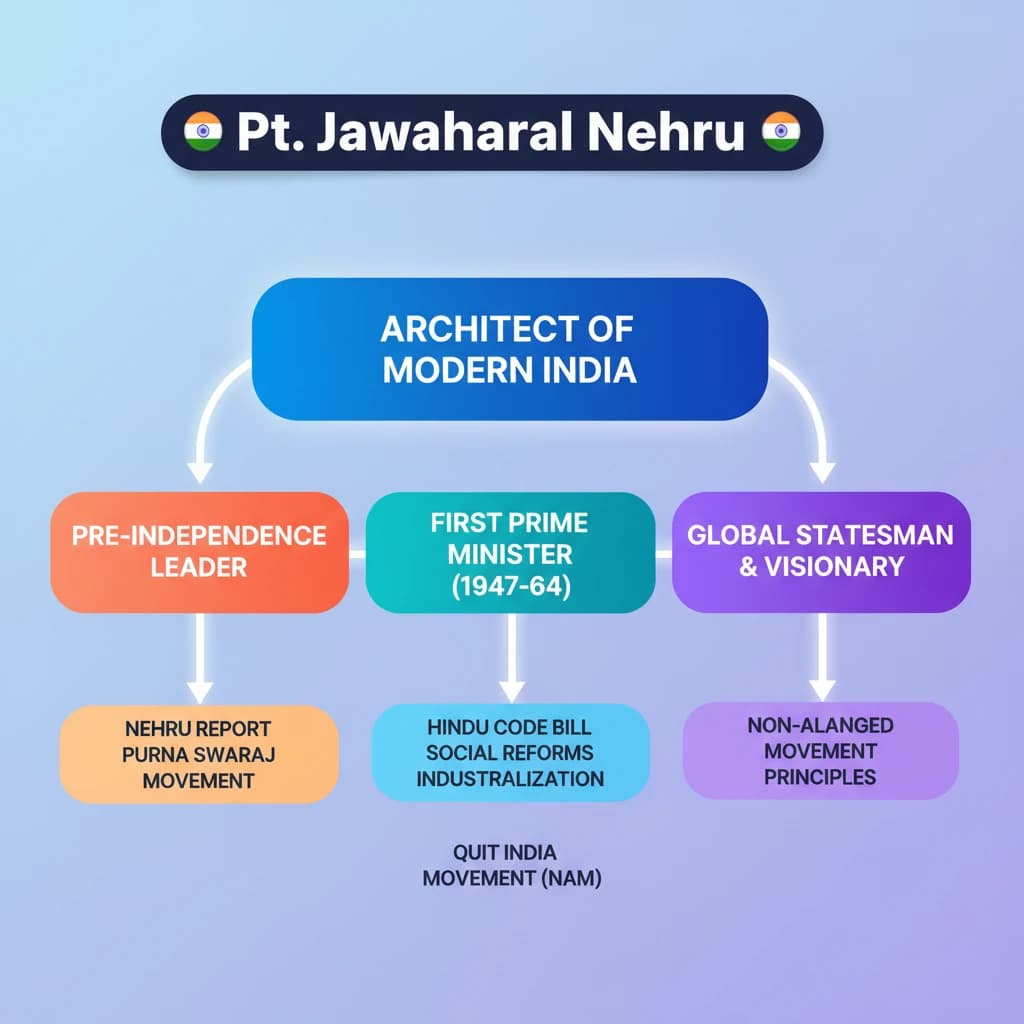
- •Jawaharlal Nehru, India's first PM, born Nov 14, 1889, celebrated as Children's Day.
- •Key pre-independence roles: Home Rule League, Kisan March, AICC General Secretary, Nehru Report, Purna Swaraj Resolution, Quit India Movement.
- •As PM (1947-1964), he laid foundations for a modern, democratic, secular, and industrialized India.
- •Introduced social reforms like the Hindu Code Bill, championed Tribal Panchsheel, and promoted scientific temper.
- •Architect of India's foreign policy: Non-Aligned Movement (NAM) and Panchsheel Principles.
- •Established premier institutions like IITs, IIMs, and paved the way for ISRO.
🧠 Memory Techniques
95% Verified Content
📚 Reference Sources
•NCERT Textbooks (History, Political Science)
•Official government archives (for policy details)