Loading page, please wait…
Reopening of the Assembly Hall - UPSC History
What is Reopening of the Assembly Hall in UPSC History?
Reopening of the Assembly Hall is a key topic under History for UPSC Civil Services Examination. Key points include: ASI is reopening the Mauryan Assembly Hall in Patna due to a receding water table and rising interest in Mauryan heritage.. Initial phase involves exposing 6-7 pillars to study humidity and groundwater impacts with CGWB support.. An expert committee will decide on fully reopening all 80 pillars, balancing preservation with public access.. Understanding this topic is essential for both UPSC Prelims and Mains preparation.
Why is Reopening of the Assembly Hall important for UPSC exam?
Reopening of the Assembly Hall is a Medium-level topic in UPSC History. It is tested in both Prelims (factual MCQs) and Mains (analytical answer writing). Previous year UPSC questions have frequently covered aspects of Reopening of the Assembly Hall, making it essential for comprehensive IAS preparation.
How to prepare Reopening of the Assembly Hall for UPSC?
To prepare Reopening of the Assembly Hall for UPSC: (1) Study the comprehensive notes covering all key concepts on Vaidra. (2) Practice previous year questions on this topic. (3) Connect it with current affairs using daily updates. (4) Revise using key takeaways and mind maps available for History. (5) Write practice answers linking Reopening of the Assembly Hall to related GS Paper topics.
Key takeaways of Reopening of the Assembly Hall for UPSC
- ASI is reopening the Mauryan Assembly Hall in Patna due to a receding water table and rising interest in Mauryan heritage.
- Initial phase involves exposing 6-7 pillars to study humidity and groundwater impacts with CGWB support.
- An expert committee will decide on fully reopening all 80 pillars, balancing preservation with public access.
- The site offers insights into Mauryan architecture and administration at Pataliputra.
- Project highlights the importance of scientific conservation, urban heritage integration, and cultural tourism.
Reopening of the Assembly Hall
Medium⏱️ 6 min read
history
📖 Introduction
Introduction to the Assembly Hall Reopening
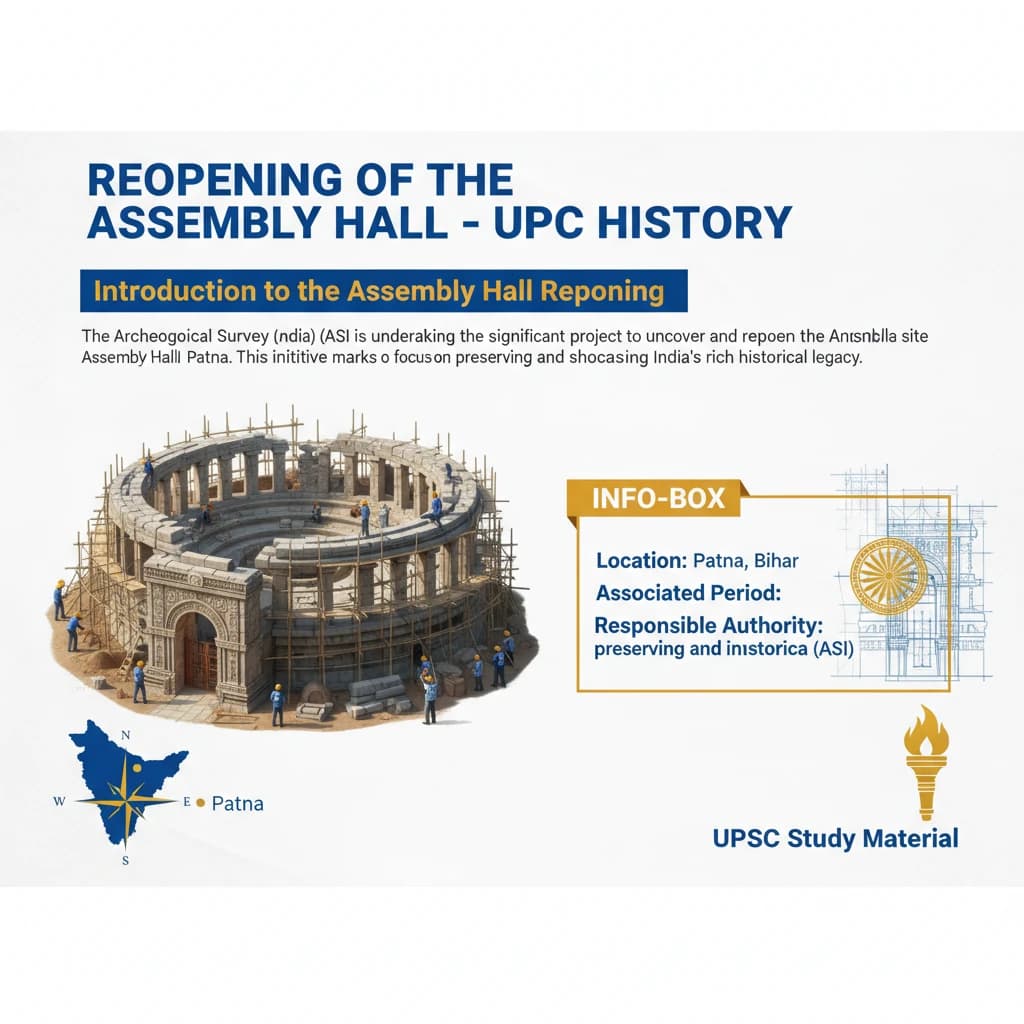
The Archaeological Survey of India (ASI) is undertaking a significant project to uncover and reopen the ancient Assembly Hall site in Patna. This initiative marks a renewed focus on preserving and showcasing India's rich historical legacy.
Location: Patna, Bihar
Associated Period: Mauryan Empire
Responsible Authority: Archaeological Survey of India (ASI)
Reasons for the Reopening Initiative
The decision to reopen the Assembly Hall is driven by two primary factors. Firstly, a noticeable recession of the water table in the Patna region has made the site more accessible for excavation and study. This natural change provides a window of opportunity for archaeological work.
Secondly, there is a growing public and academic interest in Mauryan heritage. Uncovering such sites allows for deeper insights into one of ancient India's most powerful empires, fostering a connection with the past.
Key Drivers:
- Receded water table in Patna
- Rising public and academic interest in Mauryan heritage
Initial Phase of Exposure and Study
The reopening process will commence with a cautious and scientific approach. Initially, only 6-7 pillars of the Assembly Hall will be exposed. This limited exposure is crucial for conducting preliminary studies.
The primary focus during this phase will be to assess the impacts of humidity and groundwater on the ancient structures. This scientific evaluation is vital for planning long-term preservation strategies.
Initial Scope: Exposure of 6-7 pillars
Study Focus: Impact of humidity and groundwater
Collaborating Body: Central Ground Water Board (CGWB)
The Central Ground Water Board (CGWB) will provide essential support for these studies. Their expertise will be instrumental in understanding the hydrological conditions affecting the site and ensuring sustainable preservation.
Future Decisions and Balancing Act
Following the initial studies, an expert committee will be constituted. This committee will play a pivotal role in deciding the future course of action regarding the complete reopening of the site.
The committee's decision will involve a delicate balance between preservation and public access. While making the site accessible to the public is important for education and tourism, ensuring its long-term survival remains the paramount concern.
UPSC Insight: Questions on archaeological conservation often involve balancing development/tourism with preservation. The role of bodies like ASI and expert committees is frequently tested in GS Paper I (History & Culture) and GS Paper III (Environment & Conservation).
The Assembly Hall is believed to have originally featured 80 pillars. The full exposure of all these pillars will depend on the findings of the initial studies and the recommendations of the expert committee, ensuring minimal damage and maximum longevity.
💡 Key Takeaways
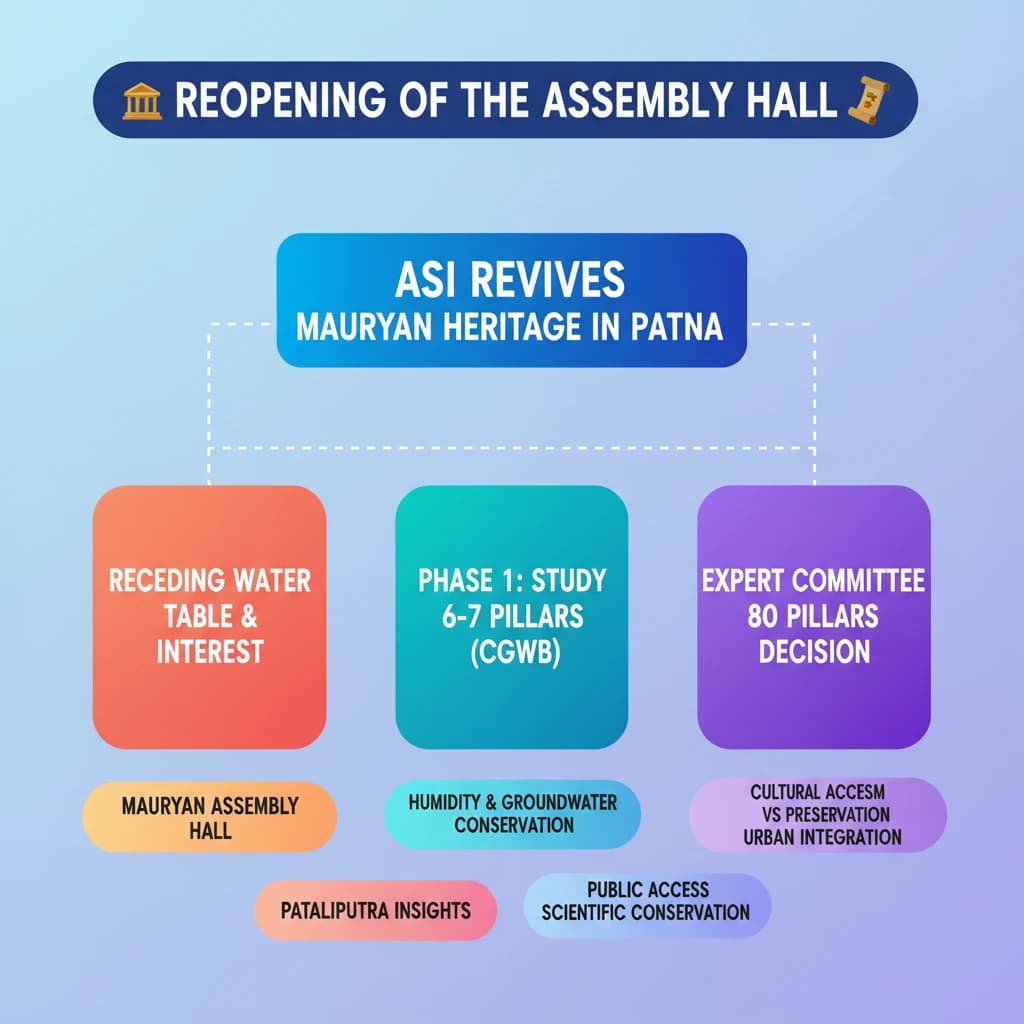
- •ASI is reopening the Mauryan Assembly Hall in Patna due to a receding water table and rising interest in Mauryan heritage.
- •Initial phase involves exposing 6-7 pillars to study humidity and groundwater impacts with CGWB support.
- •An expert committee will decide on fully reopening all 80 pillars, balancing preservation with public access.
- •The site offers insights into Mauryan architecture and administration at Pataliputra.
- •Project highlights the importance of scientific conservation, urban heritage integration, and cultural tourism.
🧠 Memory Techniques
95% Verified Content
📚 Reference Sources
•Archaeological Survey of India (ASI) official reports and publications (General context)
•NCERT Textbooks for Ancient Indian History (Mauryan period context)