Loading page, please wait…
Santhal Tribe: History, Culture, and Socio-Economic Life - UPSC History
What is Santhal Tribe: History, Culture, and Socio-Economic Life in UPSC History?
Santhal Tribe: History, Culture, and Socio-Economic Life is a key topic under History for UPSC Civil Services Examination. Key points include: Santhals are the third largest Scheduled Tribe in India, known for their peaceful nature.. Primarily located in Jharkhand, Odisha, and West Bengal, with diverse livelihoods.. They follow an animistic religion, worshipping nature in sacred groves.. Understanding this topic is essential for both UPSC Prelims and Mains preparation.
Why is Santhal Tribe: History, Culture, and Socio-Economic Life important for UPSC exam?
Santhal Tribe: History, Culture, and Socio-Economic Life is a Medium-level topic in UPSC History. It is tested in both Prelims (factual MCQs) and Mains (analytical answer writing). Previous year UPSC questions have frequently covered aspects of Santhal Tribe: History, Culture, and Socio-Economic Life, making it essential for comprehensive IAS preparation.
How to prepare Santhal Tribe: History, Culture, and Socio-Economic Life for UPSC?
To prepare Santhal Tribe: History, Culture, and Socio-Economic Life for UPSC: (1) Study the comprehensive notes covering all key concepts on Vaidra. (2) Practice previous year questions on this topic. (3) Connect it with current affairs using daily updates. (4) Revise using key takeaways and mind maps available for History. (5) Write practice answers linking Santhal Tribe: History, Culture, and Socio-Economic Life to related GS Paper topics.
Key takeaways of Santhal Tribe: History, Culture, and Socio-Economic Life for UPSC
- Santhals are the third largest Scheduled Tribe in India, known for their peaceful nature.
- Primarily located in Jharkhand, Odisha, and West Bengal, with diverse livelihoods.
- They follow an animistic religion, worshipping nature in sacred groves.
- Their language is Santhali, with a unique script 'Ol Chiki', recognized in the Eighth Schedule.
- The Santhal Rebellion (Hul) of 1855-56 was a significant anti-colonial uprising.
- Their distinct art forms (Phuta Katcha) and attractive Olah houses are cultural hallmarks.
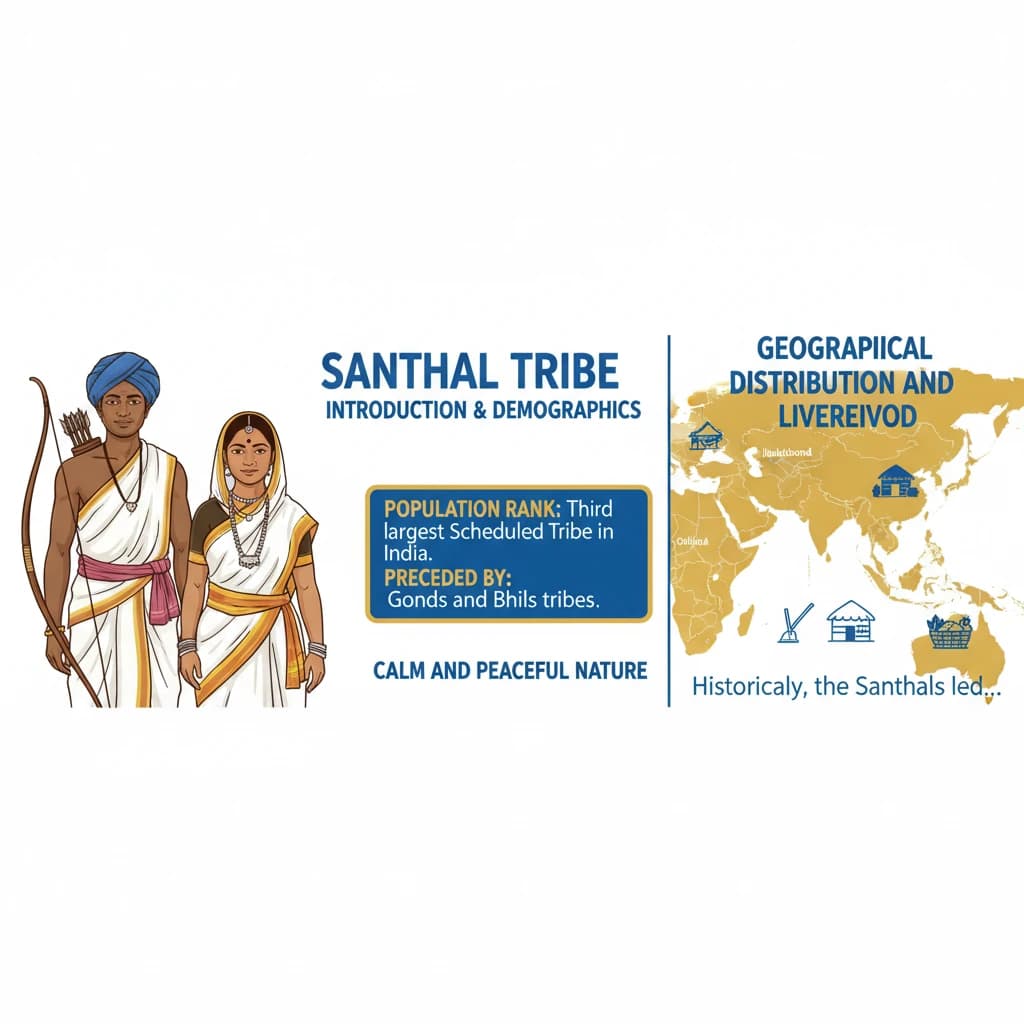
Santhal Tribe: History, Culture, and Socio-Economic Life
Medium⏱️ 8 min read
history
📖 Introduction
Introduction and Demographics
The Santhal tribe holds a significant position as the third largest Scheduled Tribe in India. They are known for their generally calm and peaceful nature.
Population Rank: Third largest Scheduled Tribe in India.
Preceded by: Gonds and Bhils tribes.
Geographical Distribution and Livelihood
Historically, the Santhals led a nomadic life before settling in the Chota Nagpur plateau. Over time, they migrated and established communities in the Santhal Parganas regions of present-day Jharkhand, Bihar, and Odisha.
Today, their primary concentration is found across Jharkhand, Odisha, and West Bengal. Their livelihoods are diverse, encompassing cultivation, industrial labour, mining, and quarrying.
Cultural and Linguistic Aspects
The Santhals adhere to an animistic religious tribal religion. Their spiritual practices involve the worship of nature, typically conducted at sacred groves.
Language: Their native language is Santhali.
Script: They possess their own unique script known as ‘Ol Chiki’.
Constitutional Recognition: The Ol Chiki script and Santhali language are recognised under the Eighth Schedule of the Indian Constitution, signifying its national importance.
Art and Lifestyle
Santhal culture is rich in art forms. Notable among these are their distinctive Phuta Katcha pattern sarees and dresses, which are widely popular.
They observe various festivals and rituals, many of which are intricately linked to agriculture and their traditional worship practices.
Their traditional houses, called Olah, are easily identifiable. They are characterised by their large, neat, and attractive appearance, often adorned with vibrant multi-coloured paintings on their exterior walls.
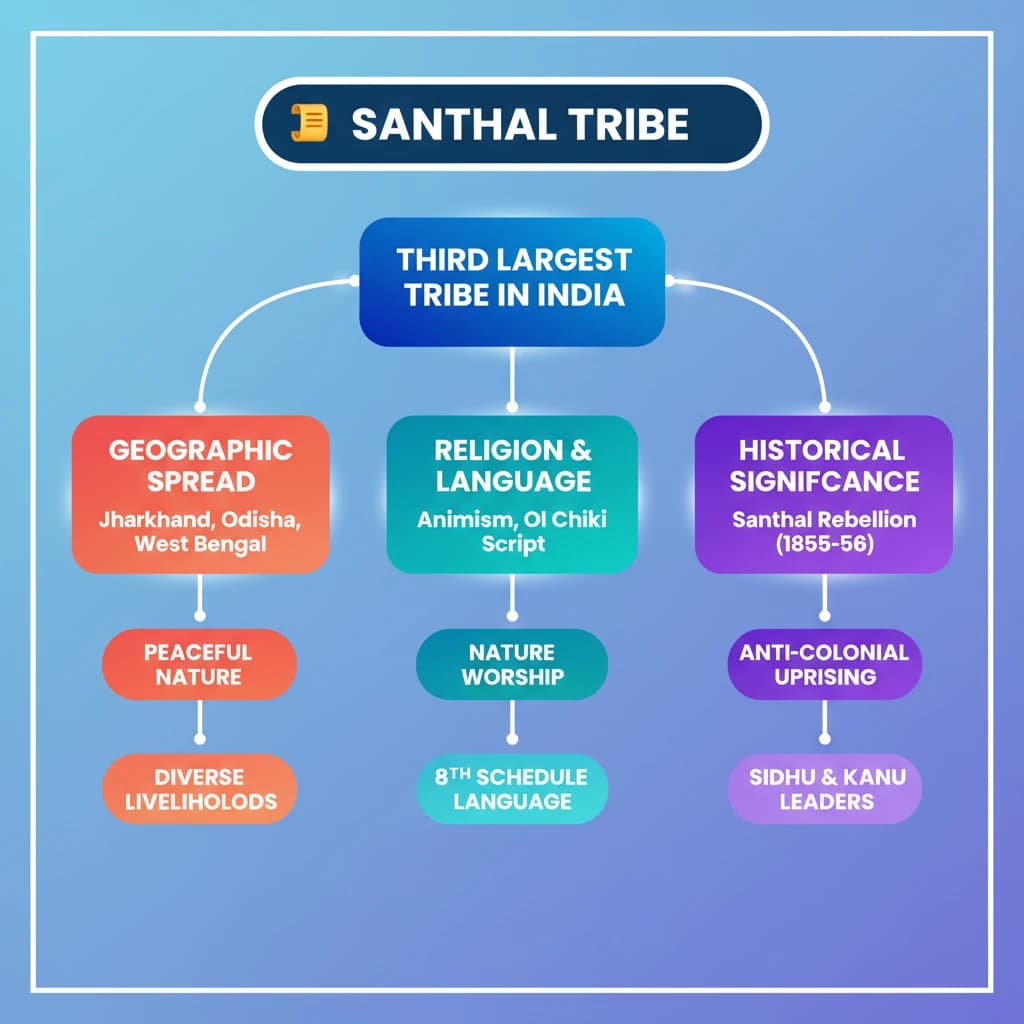
💡 Key Takeaways
- •Santhals are the third largest Scheduled Tribe in India, known for their peaceful nature.
- •Primarily located in Jharkhand, Odisha, and West Bengal, with diverse livelihoods.
- •They follow an animistic religion, worshipping nature in sacred groves.
- •Their language is Santhali, with a unique script 'Ol Chiki', recognized in the Eighth Schedule.
- •The Santhal Rebellion (Hul) of 1855-56 was a significant anti-colonial uprising.
- •Their distinct art forms (Phuta Katcha) and attractive Olah houses are cultural hallmarks.
🧠 Memory Techniques
95% Verified Content
📚 Reference Sources
•NCERT History Textbooks (Class 8, 12)
•Ministry of Tribal Affairs, Government of India reports
•The Constitution of India (Eighth Schedule)
•Academic articles on Tribal Movements in India