Loading page, please wait…
The Nayakas: Military Administration and Feudal System - UPSC History
What is The Nayakas: Military Administration and Feudal System in UPSC History?
The Nayakas: Military Administration and Feudal System is a key topic under History for UPSC Civil Services Examination. Key points include: Nayakas were military commanders granted 'amaram' land by kings, primarily in the Vijayanagara Empire.. They provided troops and financial contributions in exchange for land and local autonomy.. The system was feudal-like, with Nayakas responsible for local administration, tax collection, and defense.. Understanding this topic is essential for both UPSC Prelims and Mains preparation.
Why is The Nayakas: Military Administration and Feudal System important for UPSC exam?
The Nayakas: Military Administration and Feudal System is a Medium-level topic in UPSC History. It is tested in both Prelims (factual MCQs) and Mains (analytical answer writing). Previous year UPSC questions have frequently covered aspects of The Nayakas: Military Administration and Feudal System, making it essential for comprehensive IAS preparation.
How to prepare The Nayakas: Military Administration and Feudal System for UPSC?
To prepare The Nayakas: Military Administration and Feudal System for UPSC: (1) Study the comprehensive notes covering all key concepts on Vaidra. (2) Practice previous year questions on this topic. (3) Connect it with current affairs using daily updates. (4) Revise using key takeaways and mind maps available for History. (5) Write practice answers linking The Nayakas: Military Administration and Feudal System to related GS Paper topics.
Key takeaways of The Nayakas: Military Administration and Feudal System for UPSC
- Nayakas were military commanders granted 'amaram' land by kings, primarily in the Vijayanagara Empire.
- They provided troops and financial contributions in exchange for land and local autonomy.
- The system was feudal-like, with Nayakas responsible for local administration, tax collection, and defense.
- Initially loyal, Nayakas gained power over time, leading to conflicts and contributing to the decline of the central empire.
- Prominent Nayaka states emerged in Madurai, Gingee, and Thanjavur after Vijayanagara's weakening.
The Nayakas: Military Administration and Feudal System
Medium⏱️ 6 min read
history
📖 Introduction
Introduction to Nayakas
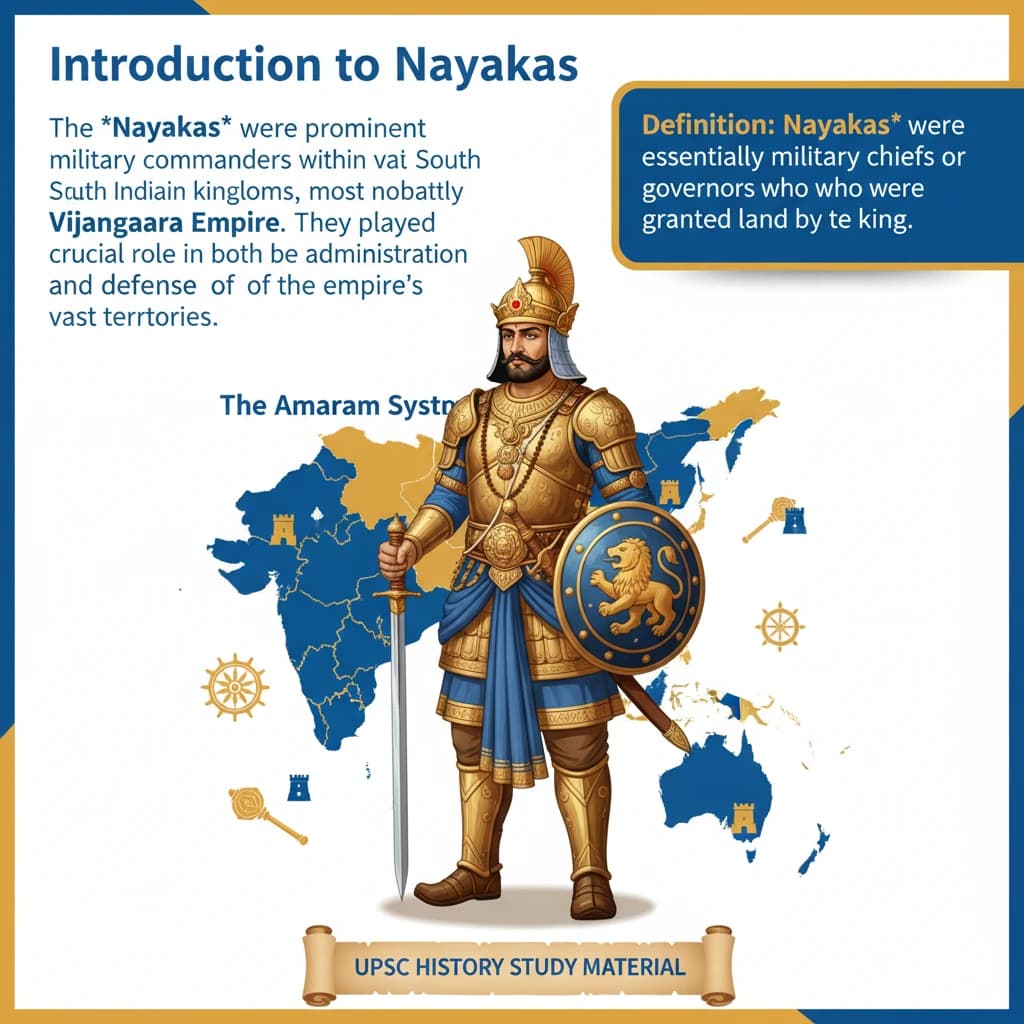
The Nayakas were prominent military commanders within various South Indian kingdoms, most notably the Vijayanagara Empire. They played a crucial role in both the administration and defense of the empire's vast territories.
Definition: Nayakas were essentially military chiefs or governors who were granted land by the king.
The Amaram System
Under the Amaram system, kings granted specific tracts of land, known as amaram, to these military commanders. This grant was not outright ownership but a tenure system.
In return for these land grants, the Nayakas were obligated to maintain a stipulated number of troops and provide financial contributions to the central treasury. This system formed the backbone of the empire's military strength.
Autonomy and Local Governance
The Nayakas enjoyed substantial autonomy within their assigned territories. They were responsible for various aspects of local administration and defense.
Despite their autonomy, Nayakas were expected to remain loyal to the central authority of the king. This balance of power was critical for the empire's stability.
Their responsibilities included land distribution among cultivators and the vital task of tax collection. This created a highly decentralized, yet integrated, administrative structure.
Feudal-like System
The administrative arrangement involving Nayakas and their land grants closely resembled a feudal-like system. Power was distributed, with local lords managing their domains under the overarching authority of the monarch.
UPSC Insight: Understanding the Nayaka system is crucial for analyzing the administrative structure and military organization of the Vijayanagara Empire, often asked in GS Paper I (History).
Evolution and Decline
Over time, particularly as the central power of the Vijayanagara Empire waned, some Nayakas began to accumulate significant power. This led to increased conflicts with the central authority.
The growing independence and eventual secession of powerful Nayaka states, such as those in Madurai and Gingee, were major factors contributing to the ultimate decline and disintegration of the Vijayanagara Empire.
💡 Key Takeaways
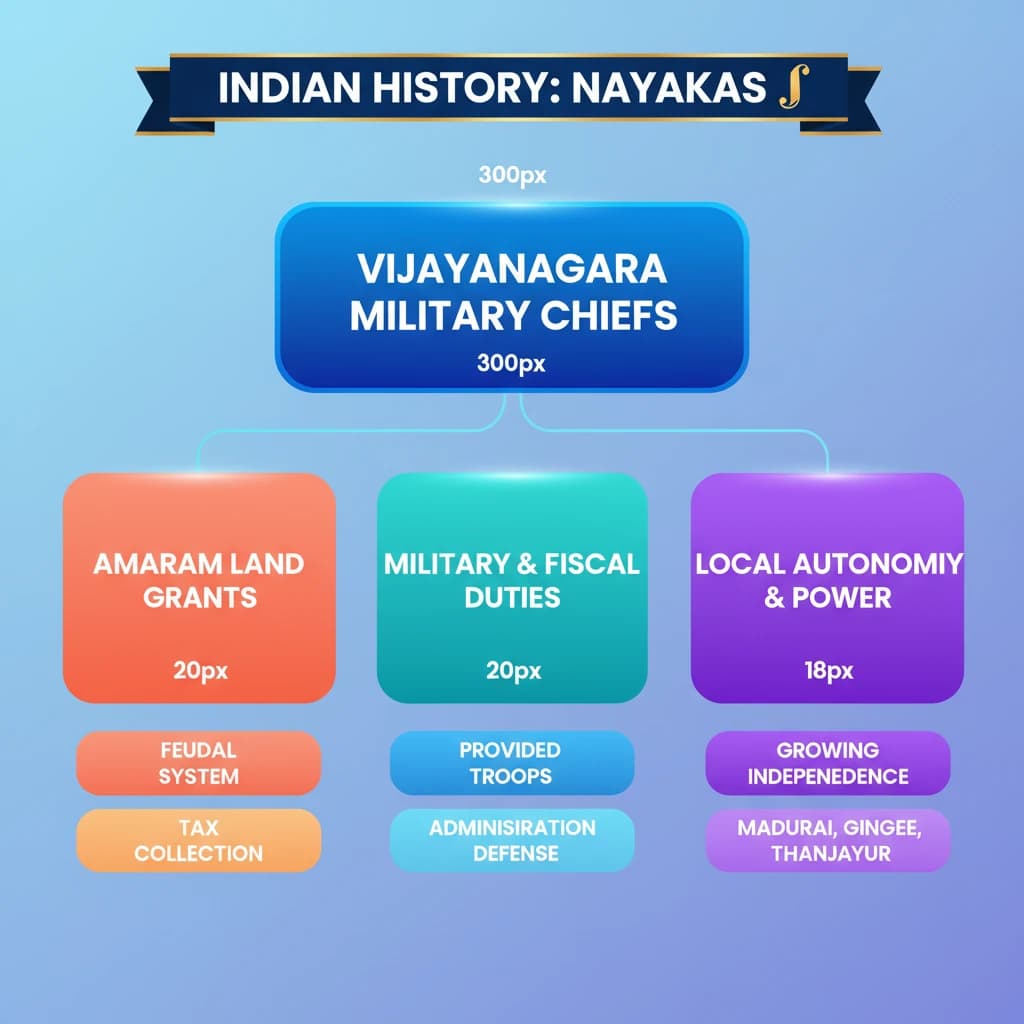
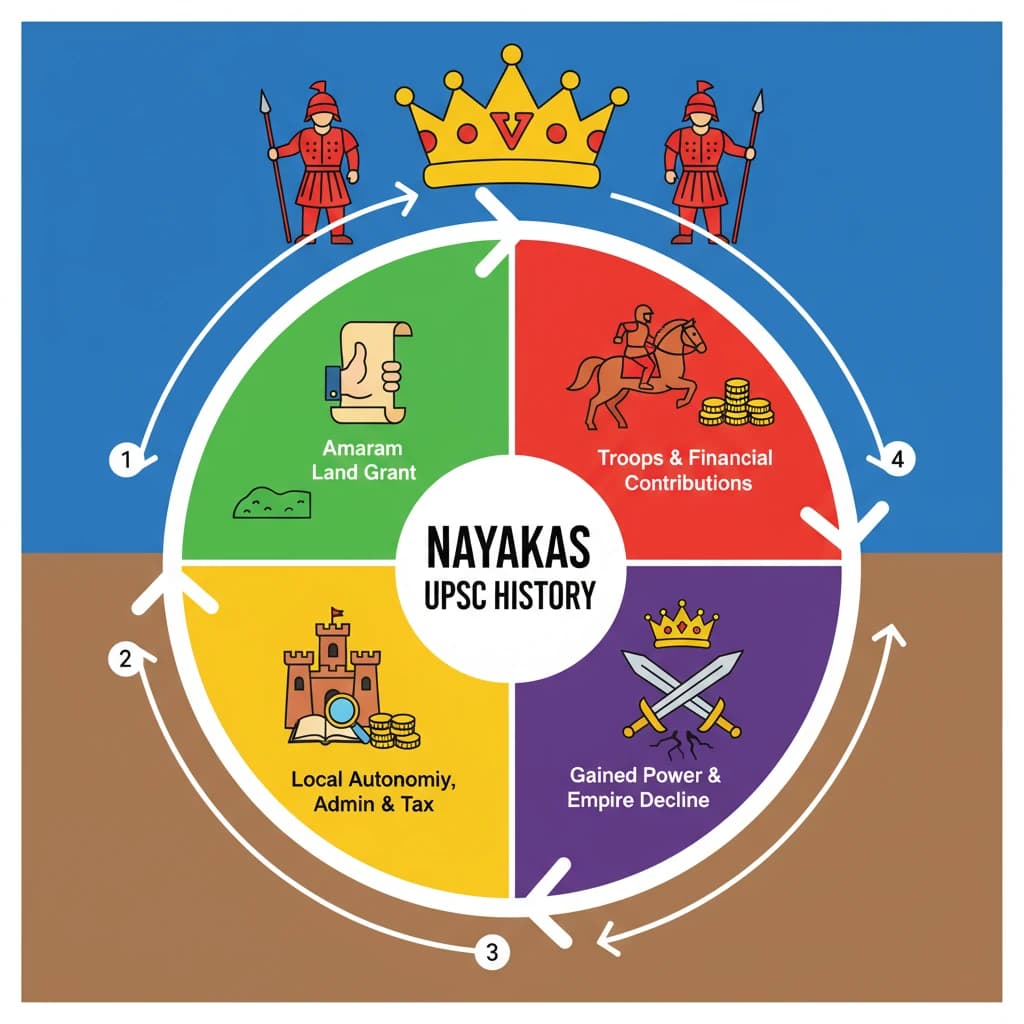
- •Nayakas were military commanders granted 'amaram' land by kings, primarily in the Vijayanagara Empire.
- •They provided troops and financial contributions in exchange for land and local autonomy.
- •The system was feudal-like, with Nayakas responsible for local administration, tax collection, and defense.
- •Initially loyal, Nayakas gained power over time, leading to conflicts and contributing to the decline of the central empire.
- •Prominent Nayaka states emerged in Madurai, Gingee, and Thanjavur after Vijayanagara's weakening.
🧠 Memory Techniques
98% Verified Content
📚 Reference Sources
•NCERT Textbooks (Ancient and Medieval India)
•A History of South India by K.A. Nilakanta Sastri
•The Cambridge Economic History of India, Vol. 1