Loading page, please wait…
Was QIM a Spontaneous Outburst, or an Organized Movement? - UPSC History
What is Was QIM a Spontaneous Outburst, or an Organized Movement? in UPSC History?
Was QIM a Spontaneous Outburst, or an Organized Movement? is a key topic under History for UPSC Civil Services Examination. Key points include: QIM was largely spontaneous due to the immediate arrest of top Congress leaders.. Viceroy Linlithgow called it 'the most serious rebellion since 1857'.. Lack of central command led to decentralized, often violent, local actions.. Understanding this topic is essential for both UPSC Prelims and Mains preparation.
Why is Was QIM a Spontaneous Outburst, or an Organized Movement? important for UPSC exam?
Was QIM a Spontaneous Outburst, or an Organized Movement? is a Medium-level topic in UPSC History. It is tested in both Prelims (factual MCQs) and Mains (analytical answer writing). Previous year UPSC questions have frequently covered aspects of Was QIM a Spontaneous Outburst, or an Organized Movement?, making it essential for comprehensive IAS preparation.
How to prepare Was QIM a Spontaneous Outburst, or an Organized Movement? for UPSC?
To prepare Was QIM a Spontaneous Outburst, or an Organized Movement? for UPSC: (1) Study the comprehensive notes covering all key concepts on Vaidra. (2) Practice previous year questions on this topic. (3) Connect it with current affairs using daily updates. (4) Revise using key takeaways and mind maps available for History. (5) Write practice answers linking Was QIM a Spontaneous Outburst, or an Organized Movement? to related GS Paper topics.
Key takeaways of Was QIM a Spontaneous Outburst, or an Organized Movement? for UPSC
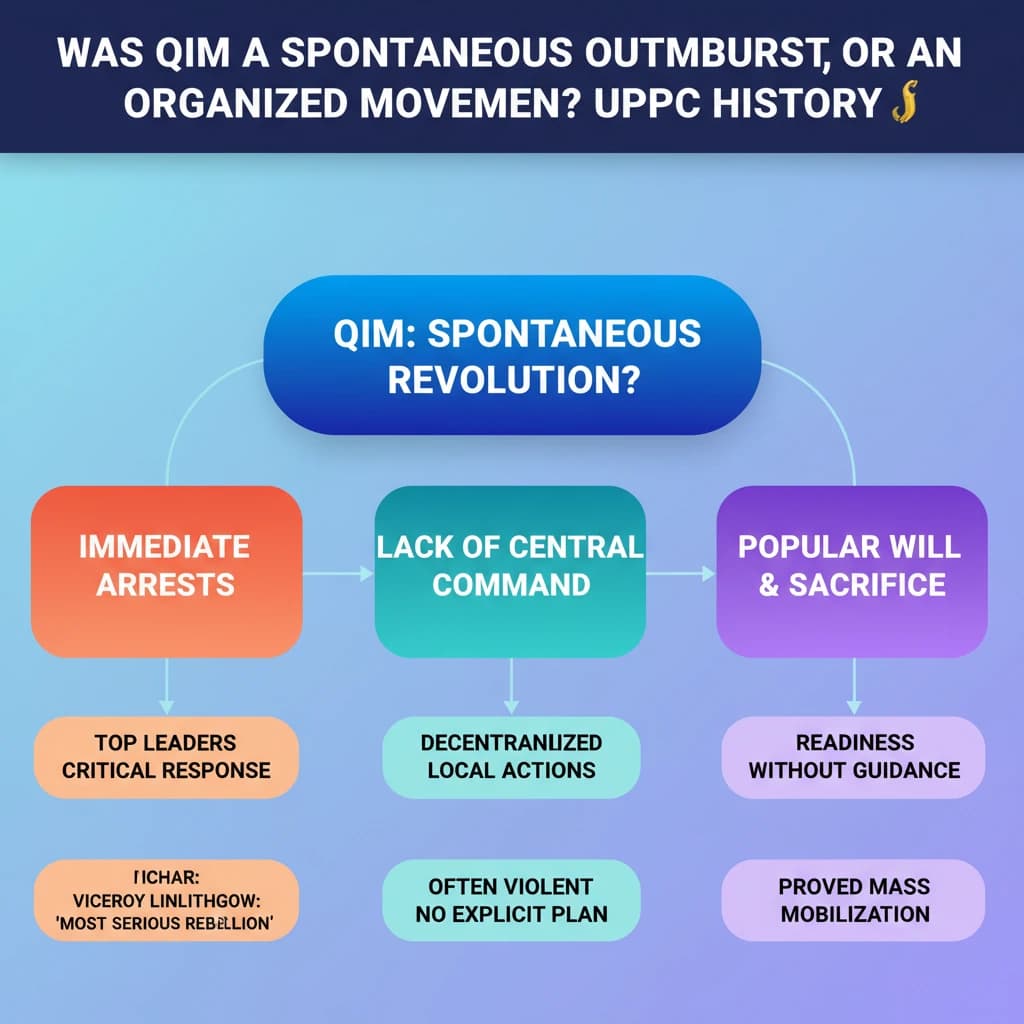
- QIM was largely spontaneous due to the immediate arrest of top Congress leaders.
- Viceroy Linlithgow called it 'the most serious rebellion since 1857'.
- Lack of central command led to decentralized, often violent, local actions.
- Characterized as a 'spontaneous revolution' because no plan could yield such immediate results.
- Demonstrated immense popular will and readiness for sacrifice without explicit guidance.
Was QIM a Spontaneous Outburst, or an Organized Movement?
Medium⏱️ 7 min read
history
📖 Introduction
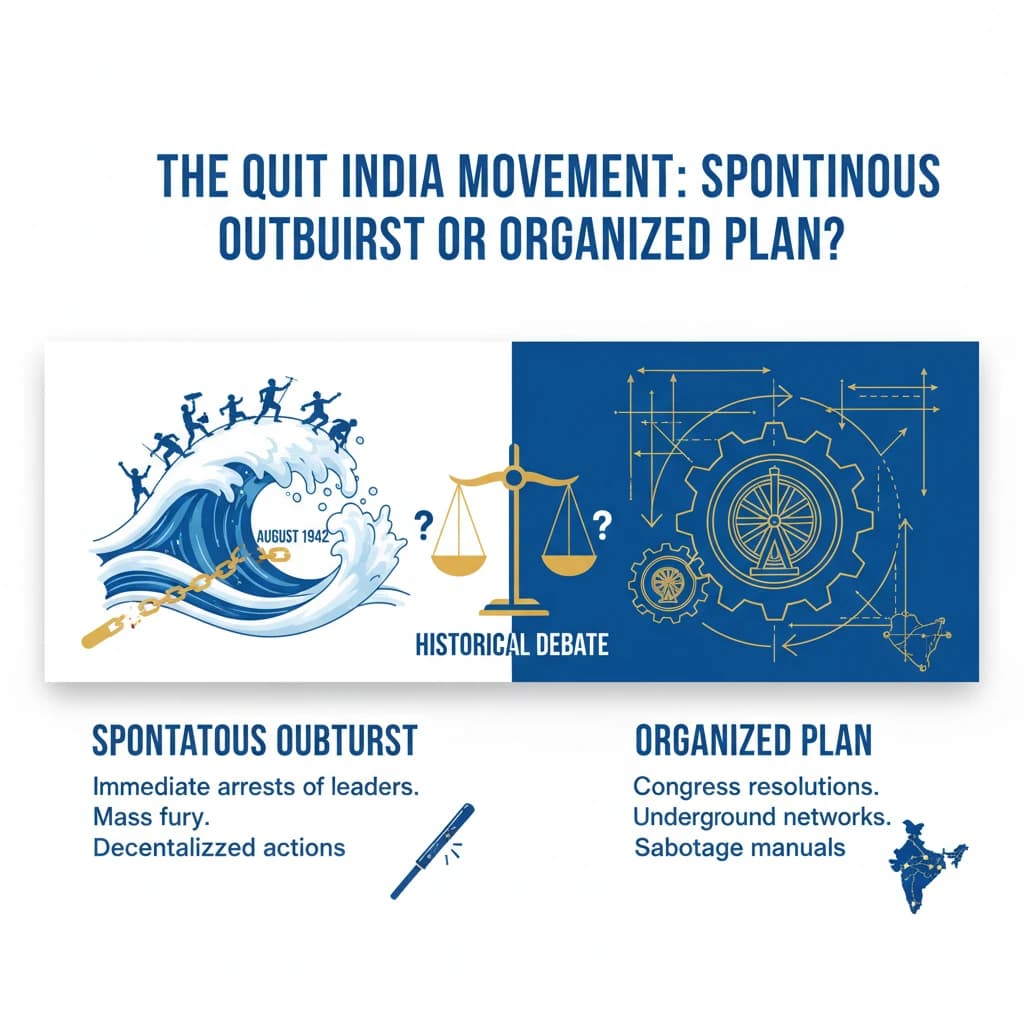
The Quit India Movement: Spontaneous Outburst or Organized Plan?
The nature of the Quit India Movement (QIM), launched in August 1942, has been a subject of historical debate. Historians often ponder whether it was a pre-planned, organized rebellion or a sudden, spontaneous reaction from the masses.
The immediate circumstances surrounding its launch provide strong arguments for its spontaneous character, especially given the rapid arrest of key leaders.
Arguments for a Spontaneous Outburst
One of the primary reasons for characterizing the QIM as a spontaneous outburst was the swift and decisive action taken by the British authorities. The entire upper echelon of the Congress leadership was incarcerated even before the movement could properly commence.
This pre-emptive arrest left the masses without central guidance or a preconceived plan. Consequently, the movement unfolded in a largely uncontrolled and uncoordinated manner across various regions of India.
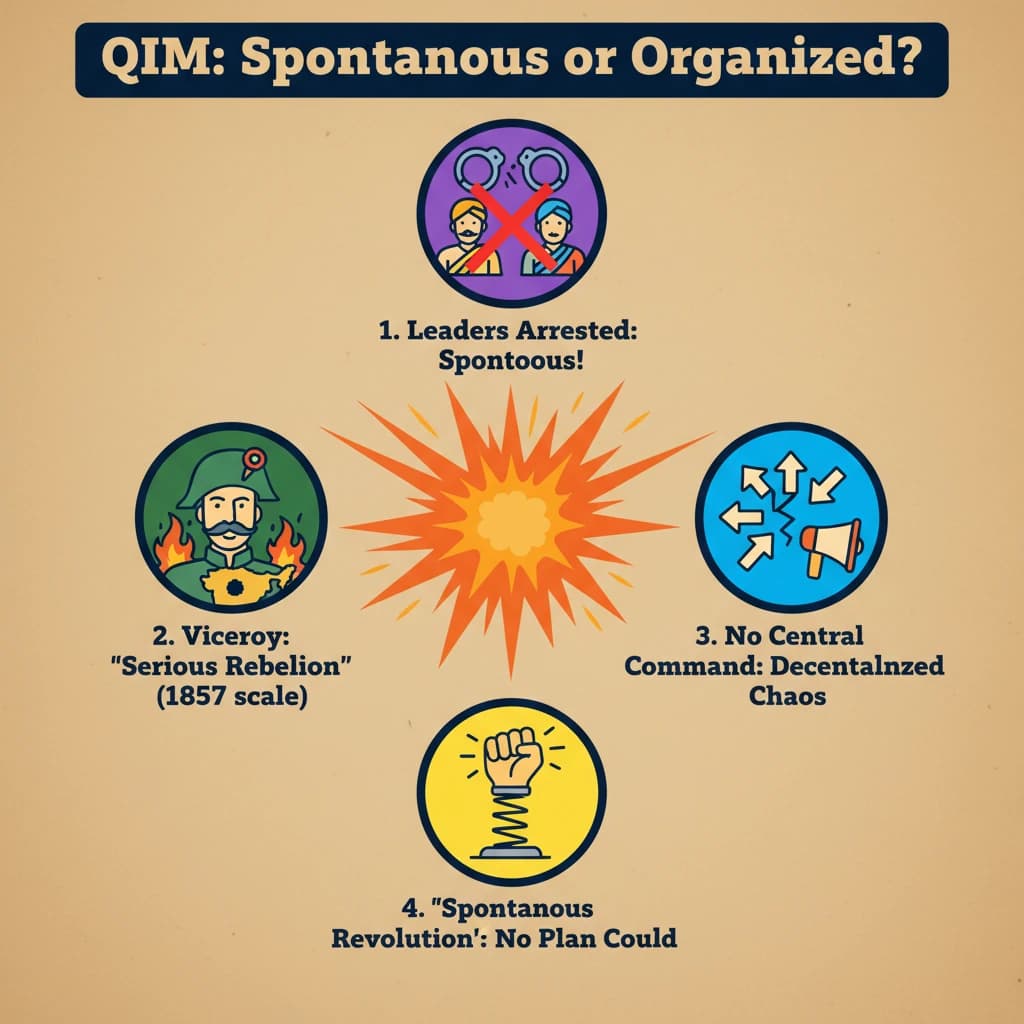
Viceroy Linlithgow's Assessment: The then Viceroy, Lord Linlithgow, famously described the Quit India Movement as 'by far the most serious rebellion since 1857'. This highlights the unprecedented scale and intensity of the uprising.
Characterization as a 'Spontaneous Revolution': Due to the absence of a central command and the immediate, widespread nature of the protests, the Quit India Movement is often termed a 'spontaneous revolution'. It is argued that 'no preconceived plan could have produced such instantaneous and uniform results' across the subcontinent.
When analyzing the QIM for UPSC Mains (GS Paper I), it's crucial to discuss its spontaneous elements. Focus on the immediate triggers and the nature of participation to substantiate its character as a mass uprising.
💡 Key Takeaways
- •QIM was largely spontaneous due to the immediate arrest of top Congress leaders.
- •Viceroy Linlithgow called it 'the most serious rebellion since 1857'.
- •Lack of central command led to decentralized, often violent, local actions.
- •Characterized as a 'spontaneous revolution' because no plan could yield such immediate results.
- •Demonstrated immense popular will and readiness for sacrifice without explicit guidance.
🧠 Memory Techniques
95% Verified Content
📚 Reference Sources
•Bipan Chandra, India's Struggle for Independence
•Spectrum, A Brief History of Modern India