Loading page, please wait…
What are Key Facts about Rash Behari Bose? - UPSC History
What is What are Key Facts about Rash Behari Bose? in UPSC History?
What are Key Facts about Rash Behari Bose? is a key topic under History for UPSC Civil Services Examination. Key points include: Rash Behari Bose, born in Bengal, joined the independence movement at 16, inspired by revolutionary ideals.. He gained prominence for his involvement in the Alipore Bomb Case (1908) and masterminded the 1912 bomb plot against Viceroy Charles Hardinge.. Mentored by Jatin Mukherjee (Bagha Jatin) in 1913, his resolve for India's freedom deepened.. Understanding this topic is essential for both UPSC Prelims and Mains preparation.
Why is What are Key Facts about Rash Behari Bose? important for UPSC exam?
What are Key Facts about Rash Behari Bose? is a Medium-level topic in UPSC History. It is tested in both Prelims (factual MCQs) and Mains (analytical answer writing). Previous year UPSC questions have frequently covered aspects of What are Key Facts about Rash Behari Bose?, making it essential for comprehensive IAS preparation.
How to prepare What are Key Facts about Rash Behari Bose? for UPSC?
To prepare What are Key Facts about Rash Behari Bose? for UPSC: (1) Study the comprehensive notes covering all key concepts on Vaidra. (2) Practice previous year questions on this topic. (3) Connect it with current affairs using daily updates. (4) Revise using key takeaways and mind maps available for History. (5) Write practice answers linking What are Key Facts about Rash Behari Bose? to related GS Paper topics.
Key takeaways of What are Key Facts about Rash Behari Bose? for UPSC
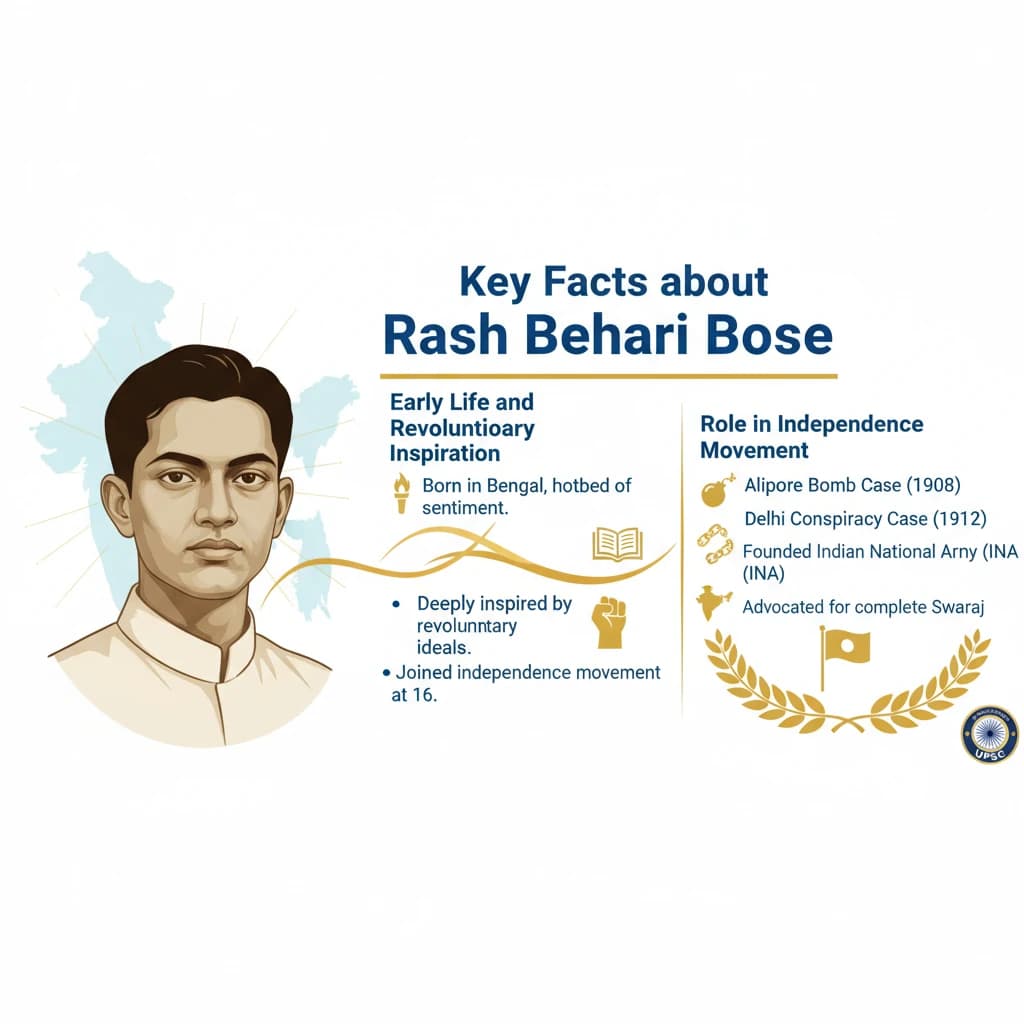
- Rash Behari Bose, born in Bengal, joined the independence movement at 16, inspired by revolutionary ideals.
- He gained prominence for his involvement in the Alipore Bomb Case (1908) and masterminded the 1912 bomb plot against Viceroy Charles Hardinge.
- Mentored by Jatin Mukherjee (Bagha Jatin) in 1913, his resolve for India's freedom deepened.
- He was a key figure in the Ghadar Movement, an international effort by Indian expatriates to overthrow British rule.
- In Japan in 1924, he met Subhas Chandra Bose, a meeting facilitated by Veer Savarkar, linking two major revolutionary figures.
What are Key Facts about Rash Behari Bose?
Medium⏱️ 7 min read
history
📖 Introduction
Early Life and Revolutionary Inspiration
Rash Behari Bose was born in Bengal, a region that was a hotbed of nationalist sentiment. From a very young age, he was deeply inspired by revolutionary ideals. This early exposure shaped his commitment to India's freedom.
He formally joined the independence movement when he was just 16 years old, dedicating his life to the cause of overthrowing British rule.
Prominent Revolutionary Activities
Bose quickly rose to prominence due to his active involvement in significant revolutionary events. One of his early notable involvements was in the Alipore Bomb Case of 1908, which highlighted the growing militancy among Indian nationalists.
A more direct and audacious act was his participation in the bomb plot to assassinate Viceroy Charles Hardinge in 1912. This daring attempt underscored the revolutionaries' resolve to target high-ranking British officials.
Key Event: The Delhi Bomb Plot (1912) targeted Viceroy Charles Hardinge during his state entry into Delhi. Though Hardinge was injured, he survived the attack, making it a significant but ultimately unsuccessful assassination attempt.
Key Associations and Mentorship
In 1913, Rash Behari Bose met Jatin Mukherjee, famously known as Bagha Jatin. This meeting proved to be a pivotal moment in Bose's revolutionary journey.
Under Bagha Jatin's mentorship, Bose's determination to fight for India’s freedom intensified. He gained valuable insights and strategic guidance from the seasoned revolutionary.
Involvement in the Ghadar Movement
Rash Behari Bose became a central figure in the Ghadar Movement. This was a crucial international political movement initiated by Indian expatriates, primarily in North America.
The primary objective of the Ghadar Movement was to organize and mobilize Indians abroad to orchestrate a widespread rebellion to overthrow British rule in India.
The Ghadar Movement was significant for its efforts to unite the Indian diaspora and its focus on armed insurrection, making it a formidable challenge to British authority.
Meeting Subhas Chandra Bose in Japan
Later in his life, Rash Behari Bose moved to Japan, where he continued his efforts for India's independence from abroad. In 1924, he had a significant meeting with another prominent nationalist leader, Subhas Chandra Bose.
This crucial meeting between the two leaders was facilitated by Veer Savarkar, highlighting the network of Indian revolutionaries operating globally.
💡 Key Takeaways
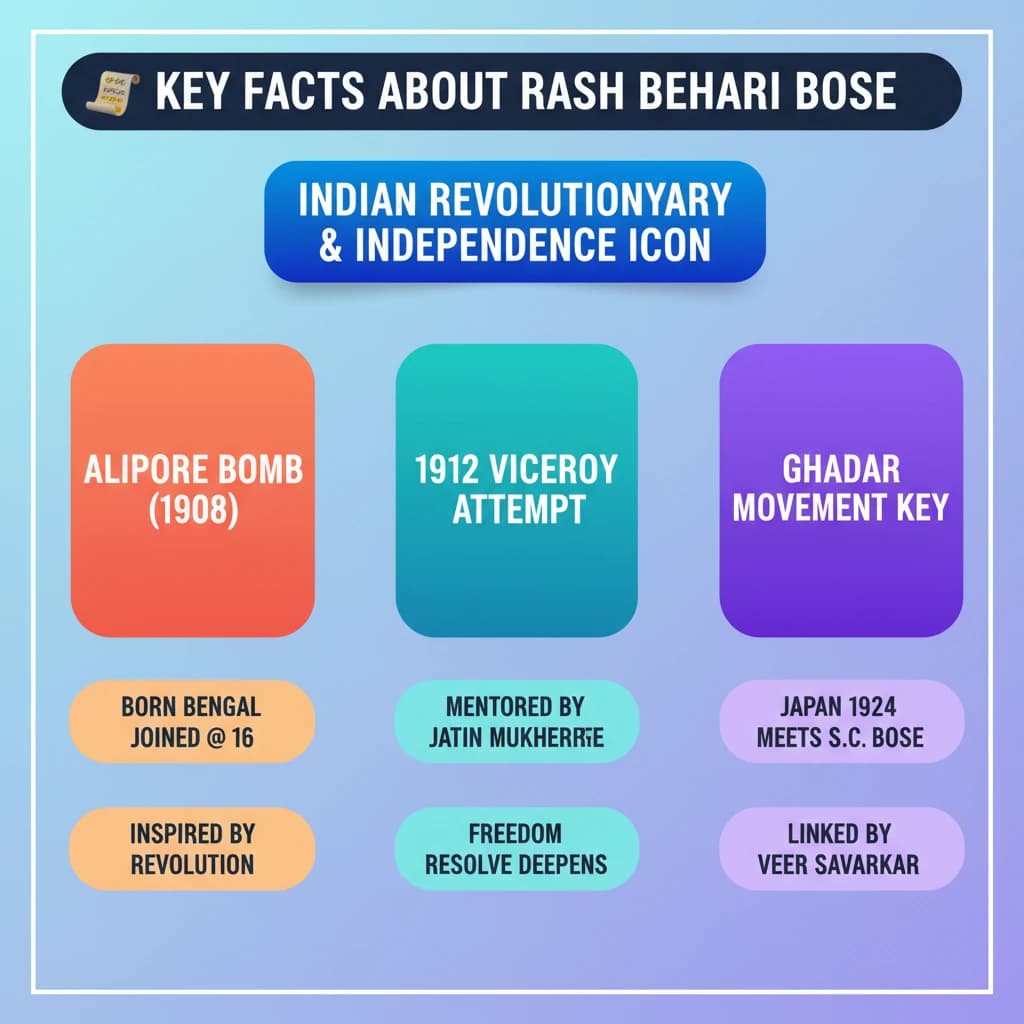
- •Rash Behari Bose, born in Bengal, joined the independence movement at 16, inspired by revolutionary ideals.
- •He gained prominence for his involvement in the Alipore Bomb Case (1908) and masterminded the 1912 bomb plot against Viceroy Charles Hardinge.
- •Mentored by Jatin Mukherjee (Bagha Jatin) in 1913, his resolve for India's freedom deepened.
- •He was a key figure in the Ghadar Movement, an international effort by Indian expatriates to overthrow British rule.
- •In Japan in 1924, he met Subhas Chandra Bose, a meeting facilitated by Veer Savarkar, linking two major revolutionary figures.
🧠 Memory Techniques
98% Verified Content
📚 Reference Sources
•NCERT Textbooks (Class 12: Themes in Indian History Part III)
•Bipan Chandra, India's Struggle for Independence
•Spectrum, A Brief History of Modern India