Loading page, please wait…
What are the Key Facts About the 80-Pillar Assembly Hall of Kumharr? - UPSC History
What is What are the Key Facts About the 80-Pillar Assembly Hall of Kumharr? in UPSC History?
What are the Key Facts About the 80-Pillar Assembly Hall of Kumharr? is a key topic under History for UPSC Civil Services Examination. Key points include: The 80-Pillar Assembly Hall at Kumhrar is a significant Mauryan archaeological site.. It is linked to Emperor Ashoka and the Third Buddhist Council (c. 250 BCE).. The council aimed to unify the Buddhist Sangha and propagate Dhamma.. Understanding this topic is essential for both UPSC Prelims and Mains preparation.
Why is What are the Key Facts About the 80-Pillar Assembly Hall of Kumharr? important for UPSC exam?
What are the Key Facts About the 80-Pillar Assembly Hall of Kumharr? is a Medium-level topic in UPSC History. It is tested in both Prelims (factual MCQs) and Mains (analytical answer writing). Previous year UPSC questions have frequently covered aspects of What are the Key Facts About the 80-Pillar Assembly Hall of Kumharr?, making it essential for comprehensive IAS preparation.
How to prepare What are the Key Facts About the 80-Pillar Assembly Hall of Kumharr? for UPSC?
To prepare What are the Key Facts About the 80-Pillar Assembly Hall of Kumharr? for UPSC: (1) Study the comprehensive notes covering all key concepts on Vaidra. (2) Practice previous year questions on this topic. (3) Connect it with current affairs using daily updates. (4) Revise using key takeaways and mind maps available for History. (5) Write practice answers linking What are the Key Facts About the 80-Pillar Assembly Hall of Kumharr? to related GS Paper topics.
Key takeaways of What are the Key Facts About the 80-Pillar Assembly Hall of Kumharr? for UPSC
- The 80-Pillar Assembly Hall at Kumhrar is a significant Mauryan archaeological site.
- It is linked to Emperor Ashoka and the Third Buddhist Council (c. 250 BCE).
- The council aimed to unify the Buddhist Sangha and propagate Dhamma.
- The hall featured 80 sandstone pillars supporting a wooden roof and floor.
- It underscores Pataliputra's role as a major Mauryan political and cultural center.
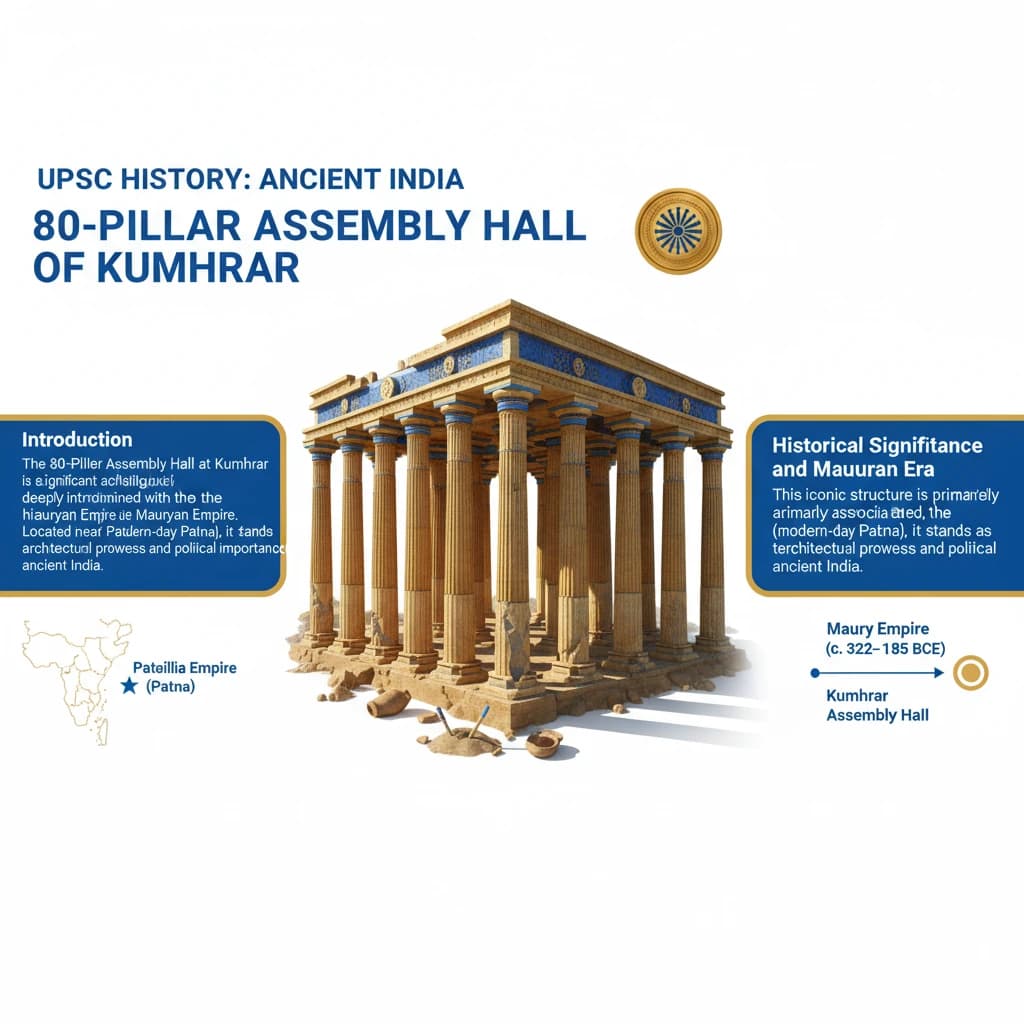
What are the Key Facts About the 80-Pillar Assembly Hall of Kumharr?
Medium⏱️ 5 min read
history
📖 Introduction
Introduction to the 80-Pillar Assembly Hall
The 80-Pillar Assembly Hall at Kumhrar is a significant archaeological site, deeply intertwined with the history of the Mauryan Empire. Located near Pataliputra (modern-day Patna), it stands as a testament to the architectural prowess and political importance of ancient India.
Historical Significance and Mauryan Era
This iconic structure is primarily associated with the Mauryan Empire, one of ancient India's most powerful and extensive dynasties. The Mauryan period spanned from approximately 321 BCE to 185 BCE, marking a pivotal era in Indian history.
Mauryan Empire (321–185 BCE): The first pan-Indian empire, known for its centralized administration and significant cultural developments under rulers like Chandragupta Maurya and Ashoka the Great.
Emperor Ashoka and the Third Buddhist Council
The hall holds immense religious significance, particularly in the context of Buddhism. It is widely believed that Emperor Ashoka (reigned 268–232 BCE) convened the Third Buddhist Council within this very hall.
The primary objective of the Third Buddhist Council was to address the fragmentation within the Buddhist Sangha (monastic community) and to solidify the propagation of Dhamma (Buddhist teachings and universal moral law).
The Third Buddhist Council, held under Ashoka's patronage, was a crucial event that helped shape Buddhism into a global religion, facilitating its spread beyond the Indian subcontinent.
Pataliputra: A Political and Cultural Nexus
The presence of such a grand assembly hall at Kumhrar further underscores Pataliputra's critical role. As the capital of the vast Mauryan Empire, Pataliputra served as both a political and cultural hub.
Its strategic location and imperial patronage fostered intellectual, religious, and administrative activities, making it a focal point of ancient Indian civilization.
Architectural Features of the Hall
The design of the 80-Pillar Assembly Hall showcased advanced engineering for its time. It featured a distinctive architectural style, characteristic of Mauryan imperial structures.
- Pillars: The hall was supported by 80 magnificent sandstone pillars. These pillars were likely polished, a hallmark of Mauryan artistry.
- Roof and Floor: The pillars bore the weight of a substantial wooden roof and a wooden floor, indicating a multi-story or elevated structure.
The use of sandstone for pillars and wood for the superstructure was common in Mauryan architecture, demonstrating a blend of durable stone foundations with lighter, more flexible wooden elements.
For UPSC Prelims, remember the number of pillars (80), the material (sandstone, wood), and its association with Ashoka and the Third Buddhist Council. For Mains, discuss its significance in understanding Mauryan architecture and religious history.
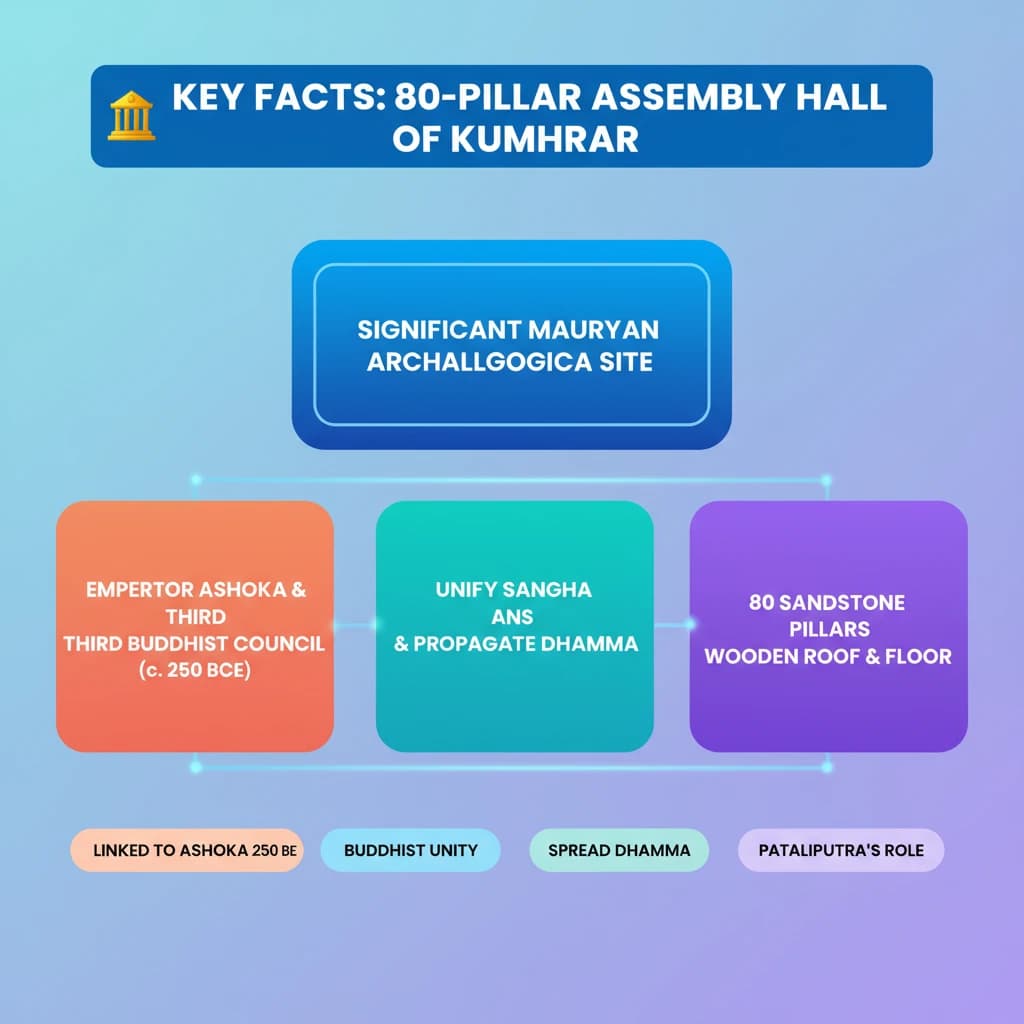
💡 Key Takeaways
- •The 80-Pillar Assembly Hall at Kumhrar is a significant Mauryan archaeological site.
- •It is linked to Emperor Ashoka and the Third Buddhist Council (c. 250 BCE).
- •The council aimed to unify the Buddhist Sangha and propagate Dhamma.
- •The hall featured 80 sandstone pillars supporting a wooden roof and floor.
- •It underscores Pataliputra's role as a major Mauryan political and cultural center.
🧠 Memory Techniques

95% Verified Content
📚 Reference Sources
•NCERT Ancient Indian History Textbooks
•Archaeological Survey of India (ASI) publications on Mauryan sites