Loading page, please wait…
What is Communal Politics? - UPSC History
What is What is Communal Politics? in UPSC History?
What is Communal Politics? is a key topic under History for UPSC Civil Services Examination. Key points include: Communal politics uses religious identity for political gain, often leading to division.. Jinnah's Fourteen Points (1929) articulated key Muslim League demands, solidifying communal political strategy.. British 'Divide and Rule' policy, including Separate Electorates (1909) and Communal Award (1932), fueled communalism.. Understanding this topic is essential for both UPSC Prelims and Mains preparation.
Why is What is Communal Politics? important for UPSC exam?
What is Communal Politics? is a Medium-level topic in UPSC History. It is tested in both Prelims (factual MCQs) and Mains (analytical answer writing). Previous year UPSC questions have frequently covered aspects of What is Communal Politics?, making it essential for comprehensive IAS preparation.
How to prepare What is Communal Politics? for UPSC?
To prepare What is Communal Politics? for UPSC: (1) Study the comprehensive notes covering all key concepts on Vaidra. (2) Practice previous year questions on this topic. (3) Connect it with current affairs using daily updates. (4) Revise using key takeaways and mind maps available for History. (5) Write practice answers linking What is Communal Politics? to related GS Paper topics.
Key takeaways of What is Communal Politics? for UPSC
- Communal politics uses religious identity for political gain, often leading to division.
- Jinnah's Fourteen Points (1929) articulated key Muslim League demands, solidifying communal political strategy.
- British 'Divide and Rule' policy, including Separate Electorates (1909) and Communal Award (1932), fueled communalism.
- Events like Partition of Bengal, Khilafat Movement, and Akali Agitations contributed to communal divisions.
- Post-independence, communal politics gained legitimacy, using violence and social media to challenge secularism.
- It remains a significant threat to India's secular fabric and national integration.
What is Communal Politics?
Medium⏱️ 10 min read
history
📖 Introduction
Understanding Communal Politics
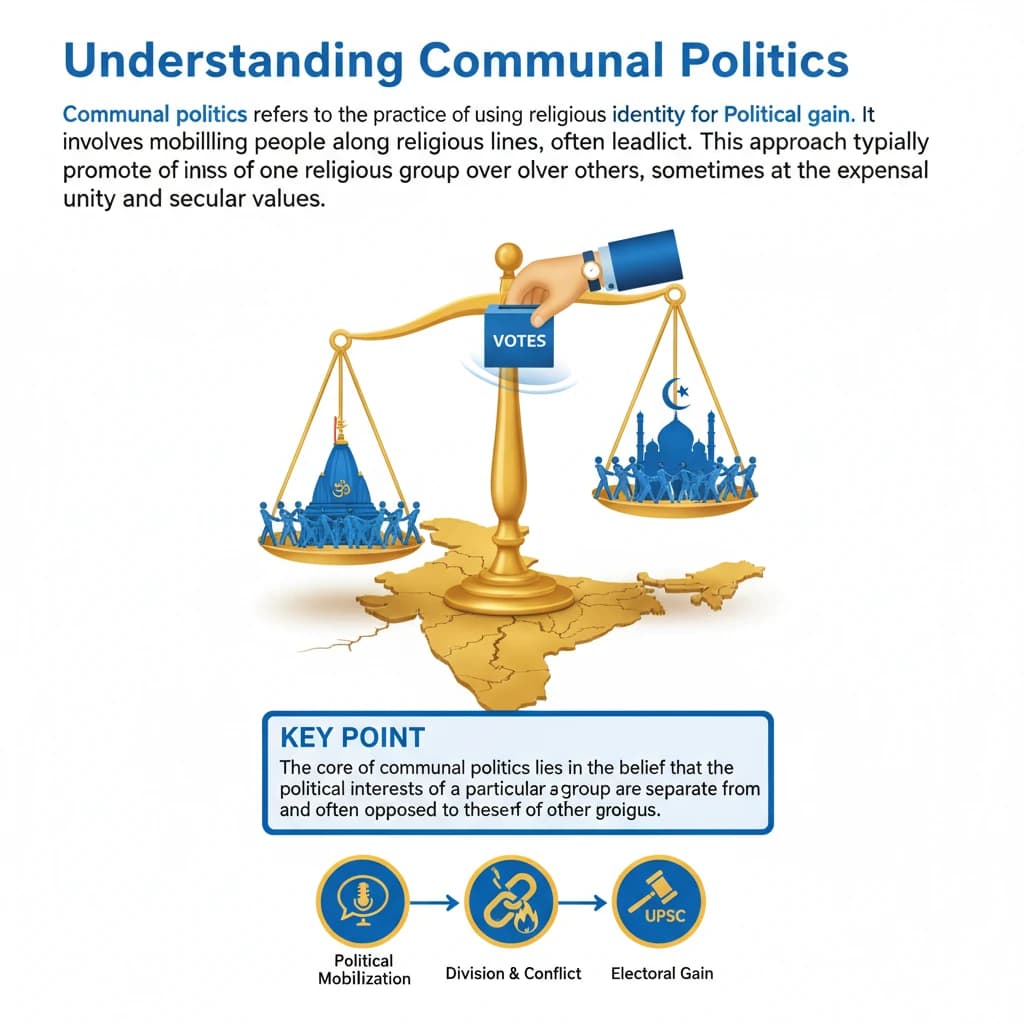
Communal politics refers to the practice of using religious identity for political gain. It involves mobilizing people along religious lines, often leading to division and conflict. This approach typically promotes the interests of one religious group over others, sometimes at the expense of national unity and secular values.
The core of communal politics lies in the belief that the political, economic, and social interests of a particular religious community are distinct from, and often opposed to, those of other communities. This perception is then exploited for electoral and power-related objectives.
Muslim Response and Jinnah's Fourteen Points
Following the Nehru Report, which was criticized by Muslim leaders as being against Muslim interests, Muhammad Ali Jinnah presented a significant political manifesto. In March 1929, during a Muslim League session in Delhi, he unveiled his Fourteen Points.
These points became the League’s manifesto and a cornerstone of its political strategy, articulating the demands and aspirations of a section of the Muslim community in British India.
Jinnah's Fourteen Points:
- Federal Constitution: A federal system with residual powers allocated to provinces.
- Provincial Autonomy: Complete autonomy for provinces.
- Constitutional Amendments: Central amendments to require states’ consent.
- Muslim Representation in Legislatures: Adequate Muslim representation without undermining majorities.
- Representation in Services: Fair representation in government services and self-governing bodies.
- Central Legislature: One-third Muslim representation in the central legislature.
- Cabinet Representation: One-third Muslim representation in central and provincial cabinets.
- Separate Electorates: Continuation of separate electorates.
- Minority Safeguards: Bills opposed by three-fourths of a minority group could not pass.
- Territorial Redistribution: Territorial changes not to harm Muslim-majority areas like Punjab, Bengal, and NWFP.
- Sindh Separation: Separation of Sindh from Bombay.
- Constitutional Reforms: Reforms for North-West Frontier Province (NWFP) and Balochistan to grant Muslims greater political autonomy.
- Religious Freedom: Guaranteed religious freedom for all communities.
- Protection of Muslim Rights: Safeguards for religion, culture, education, and language.
Communal Politics in the Pre-Independence Period
The roots of communal politics in India can be traced back to the British colonial rule. It initially emerged as a tool for bargaining privileges such as jobs, education, and political positions for various communities.
The British actively employed the “Divide and Rule” policy. This strategy fostered divisions between Hindus and Muslims, aiming to weaken the growing nationalist unity and prolong their rule.
British support for communal forces was evident through measures like the Communal Award of 1932. This award strengthened the Muslim League and deepened its ideological differences with the Indian National Congress.
Initial Goals and Religious Mobilization
Early forms of communal politics, championed by leaders like Syed Ahmad Khan, primarily sought upward mobility and improved status for communities, particularly Muslims.
Anti-colonial agitations, while nationalist in intent, sometimes contributed to deepening communal divisions. Examples include the Akali agitations (1919-1926) and the Khilafat Movement (1920-21).
Role of Indian National Congress (INC) and Muslim League
While the Indian National Congress (INC) was committed to Hindu-Muslim unity, its dominance and occasional use of Hindu cultural symbols sometimes alienated sections of the Muslim community, inadvertently fueling communal sentiments.
Communal tensions escalated significantly with pivotal events such as the Partition of Bengal (1905) and the establishment of separate electorates (1909), which institutionalized religious divisions in politics.
The Muslim League actively promoted the Congress as a Hindu-dominated entity. This narrative intensified Muslim fears of marginalization in a unified, independent India.
Rise of Two-Nation Theory
The culmination of these communal ideologies was the emergence of concepts like Hindutva, advocated by figures such as Vinayak Damodar Savarkar, and the Muslim League’s demand for Pakistan. These ideologies ultimately led to the tragic Partition of India.
Communal Politics in the Post-Independence Period
After India's Independence, communal politics gained increasing legitimacy and openness. This trend became particularly pronounced with the rise of religious identity-based ideologies in the 1980s.
This period saw communal politics openly challenging the foundational principles of secularism and pluralism. It began advocating for a nation centered around a majority religious identity, diverging from the constitutional vision.
Use of Violence and Social Media
A disturbing aspect of post-independence communal politics has been the strategic use of violence. Riots and pogroms are often planned and orchestrated to achieve specific electoral and economic objectives, creating fear and division.
In the modern era, social media platforms have become powerful tools for the spread of hate speech and fake news. This digital dissemination often escalates existing communal tensions, making them more widespread and volatile.
💡 Key Takeaways
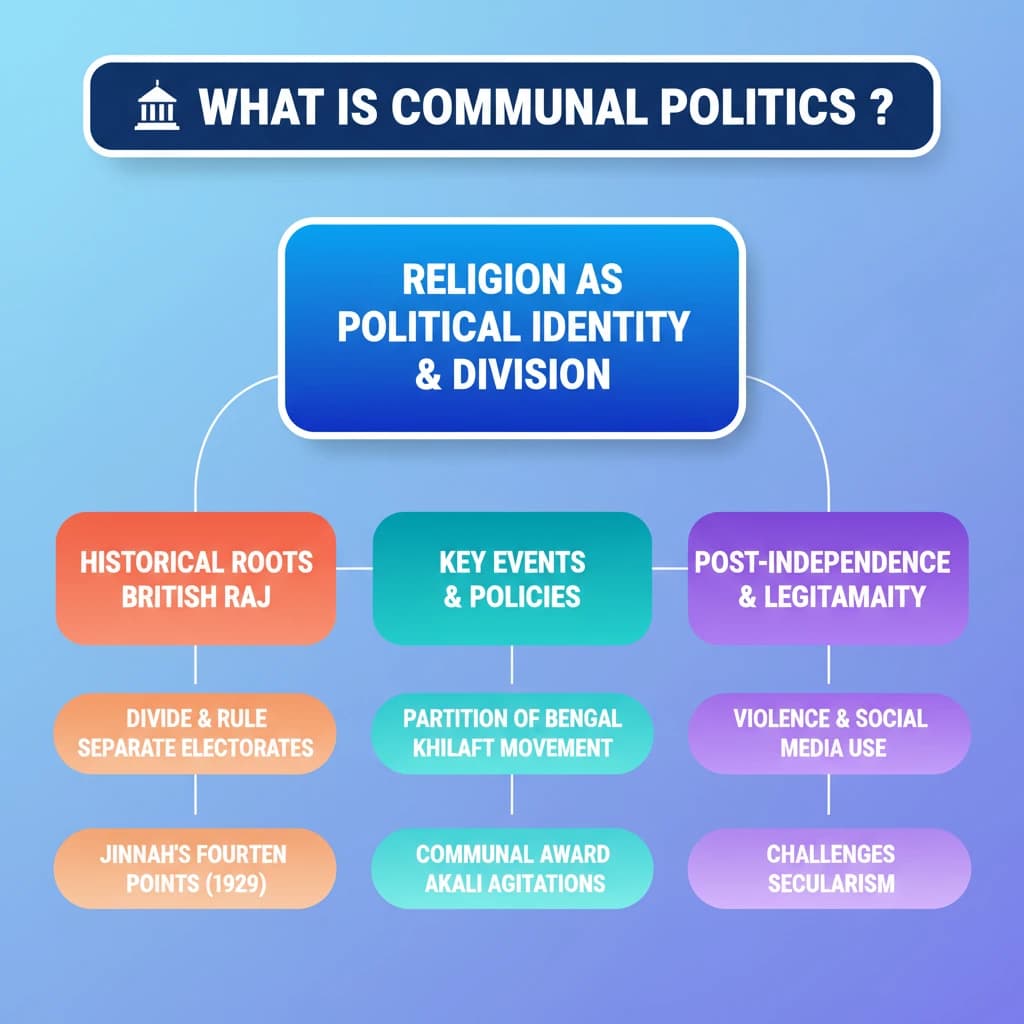
- •Communal politics uses religious identity for political gain, often leading to division.
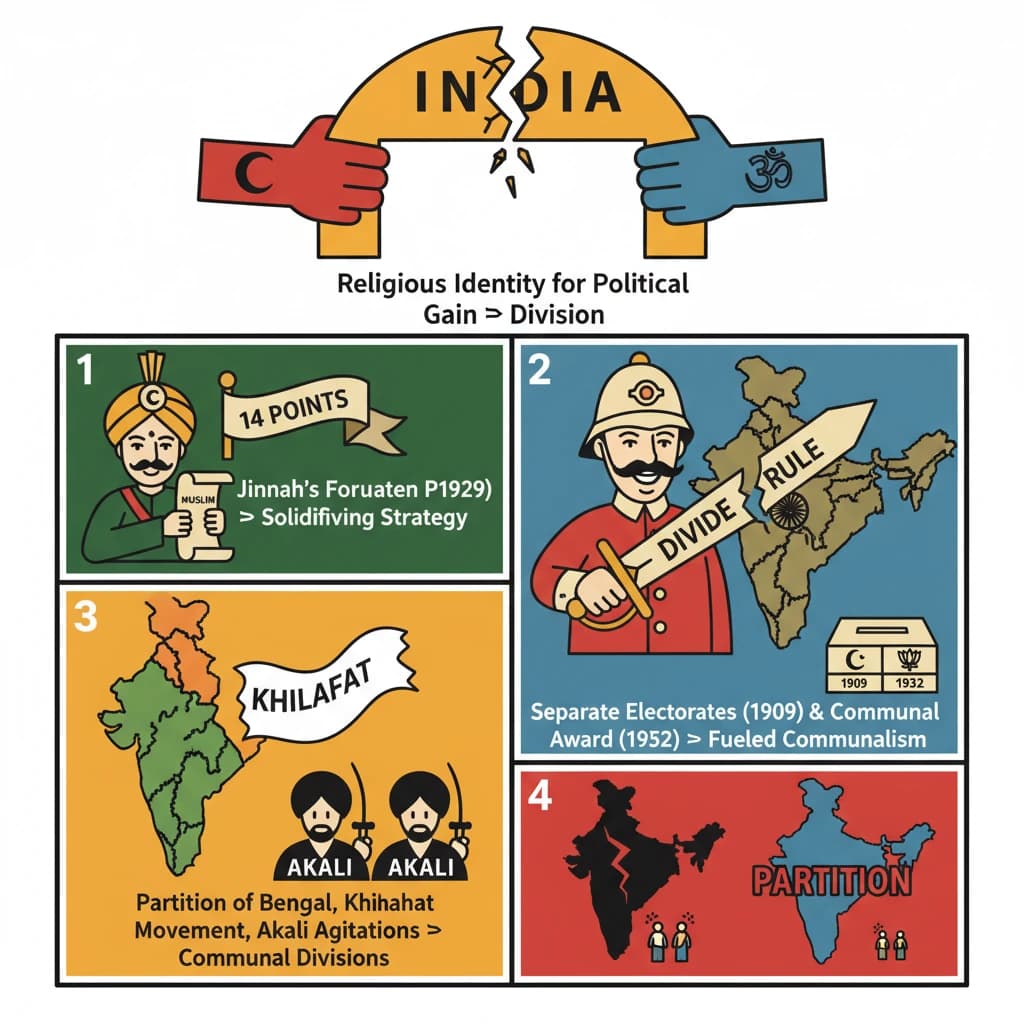
- •Jinnah's Fourteen Points (1929) articulated key Muslim League demands, solidifying communal political strategy.
- •British 'Divide and Rule' policy, including Separate Electorates (1909) and Communal Award (1932), fueled communalism.
- •Events like Partition of Bengal, Khilafat Movement, and Akali Agitations contributed to communal divisions.
- •Post-independence, communal politics gained legitimacy, using violence and social media to challenge secularism.
- •It remains a significant threat to India's secular fabric and national integration.
🧠 Memory Techniques
95% Verified Content