Loading page, please wait…
What is the History and Revival Efforts of Nalanda University? - UPSC History
What is What is the History and Revival Efforts of Nalanda University? in UPSC History?
What is the History and Revival Efforts of Nalanda University? is a key topic under History for UPSC Civil Services Examination. Key points include: Nalanda University founded by Gupta Emperor Kumaragupta I in 427 CE.. Flourished for 600 years, prominent under Harshavardhana and Palas.. Visited by Chinese pilgrims Xuan Zang and I-Tsing, providing key historical accounts.. Understanding this topic is essential for both UPSC Prelims and Mains preparation.
Why is What is the History and Revival Efforts of Nalanda University? important for UPSC exam?
What is the History and Revival Efforts of Nalanda University? is a Medium-level topic in UPSC History. It is tested in both Prelims (factual MCQs) and Mains (analytical answer writing). Previous year UPSC questions have frequently covered aspects of What is the History and Revival Efforts of Nalanda University?, making it essential for comprehensive IAS preparation.
How to prepare What is the History and Revival Efforts of Nalanda University? for UPSC?
To prepare What is the History and Revival Efforts of Nalanda University? for UPSC: (1) Study the comprehensive notes covering all key concepts on Vaidra. (2) Practice previous year questions on this topic. (3) Connect it with current affairs using daily updates. (4) Revise using key takeaways and mind maps available for History. (5) Write practice answers linking What is the History and Revival Efforts of Nalanda University? to related GS Paper topics.
Key takeaways of What is the History and Revival Efforts of Nalanda University? for UPSC
- Nalanda University founded by Gupta Emperor Kumaragupta I in 427 CE.
- Flourished for 600 years, prominent under Harshavardhana and Palas.
- Visited by Chinese pilgrims Xuan Zang and I-Tsing, providing key historical accounts.
- Xuan Zang studied for 5 years and took scriptures to China.
- I-Tsing reported 2,000 students supported by 200 villages in 670 AD.
- Represents a peak of ancient Indian education and international intellectual exchange.
What is the History and Revival Efforts of Nalanda University?
Medium⏱️ 5 min read
history
📖 Introduction
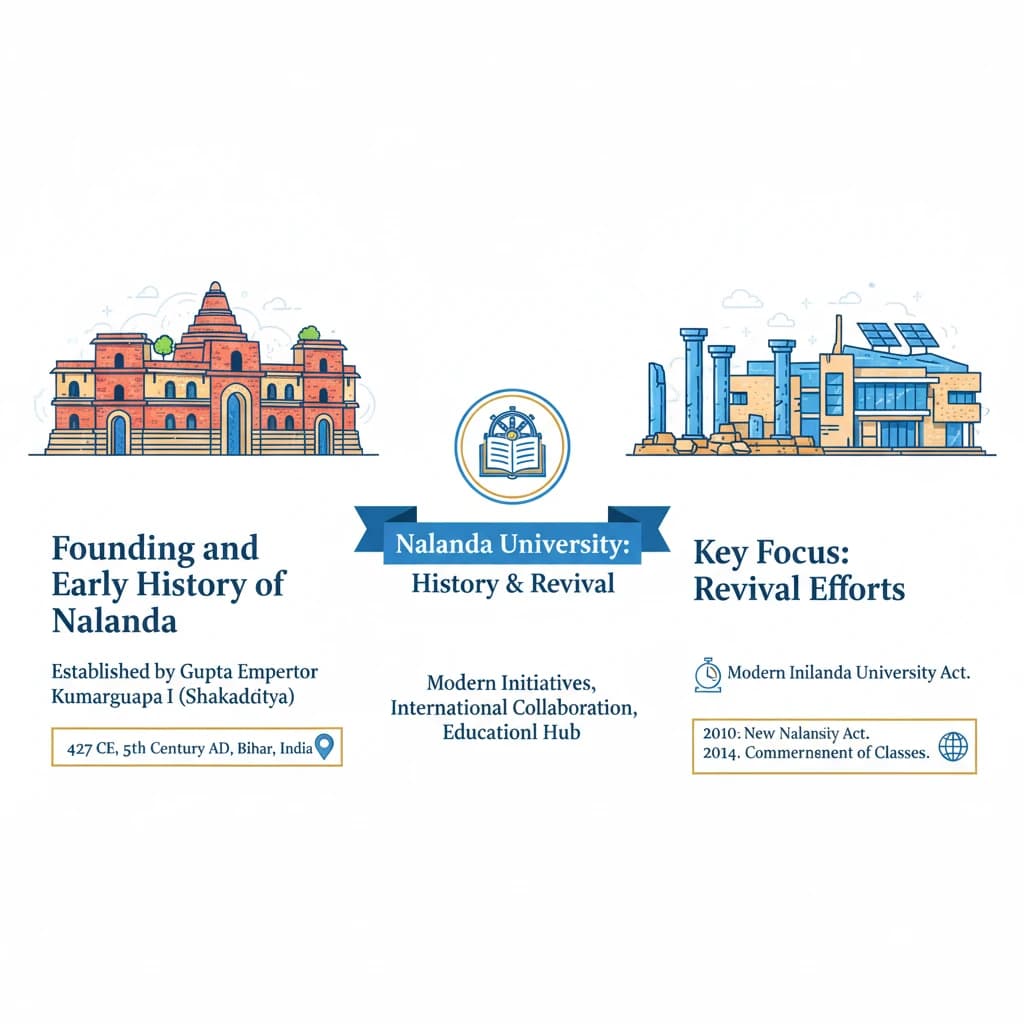
Founding and Early History of Nalanda
The illustrious Nalanda University was established by Gupta Emperor Kumaragupta I, also known as Shakraditya, of the Gupta dynasty.
Its foundation dates back to 427 CE, placing its origins in the early 5th century AD. The university was situated in what is now modern Bihar, India.
Key Founding Details:
- Founder: Emperor Kumaragupta I (Shakraditya)
- Dynasty: Gupta Empire
- Founding Year: 427 CE (early 5th century)
- Location: Present-day Bihar
- Period of Flourishing: Approximately 600 years, lasting until the 12th century.
Golden Age and Royal Patronage
Nalanda's prominence significantly grew during the reigns of powerful monarchs. It achieved widespread popularity and influence under King Harshavardhana and the subsequent Pala monarchs.
These rulers provided substantial patronage, which allowed the university to expand its academic offerings and infrastructure, attracting scholars and students from across Asia.
Visits by Chinese Pilgrims: Xuan Zang (Hiuen Tsang)
During the reign of King Harshavardhana (606-647 AD), a renowned 7th-century Chinese Buddhist monk, scholar, traveller, and translator named Xuan Zang visited Nalanda.
Also known as Hiuen Tsang and Moksadeva, he spent approximately five years studying at the university, immersing himself in its vast repository of knowledge.
Upon his return to China, Xuan Zang carried numerous Buddhist scriptures from Nalanda, which he subsequently dedicated his life to translating into Chinese, significantly enriching Chinese Buddhism.
Xuan Zang's Contribution:
- Visit Period: During Harshavardhana's reign (606-647 AD)
- Duration of Study: Approximately 5 years at Nalanda
- Legacy: Carried back and translated numerous Buddhist scriptures into Chinese
Visits by Chinese Pilgrims: I-Tsing
Another significant Chinese pilgrim, I-Tsing, visited Nalanda in 670 AD. His accounts provide valuable insights into the university's scale and functioning during his time.
I-Tsing documented that Nalanda was a massive educational complex, housing around 2,000 students. Its operations were financially supported by revenues from 200 villages, highlighting its extensive patronage and economic base.
I-Tsing's Observations (670 AD):
- Student Population: Approximately 2,000 students
- Financial Support: Endowed with resources from 200 villages
💡 Key Takeaways
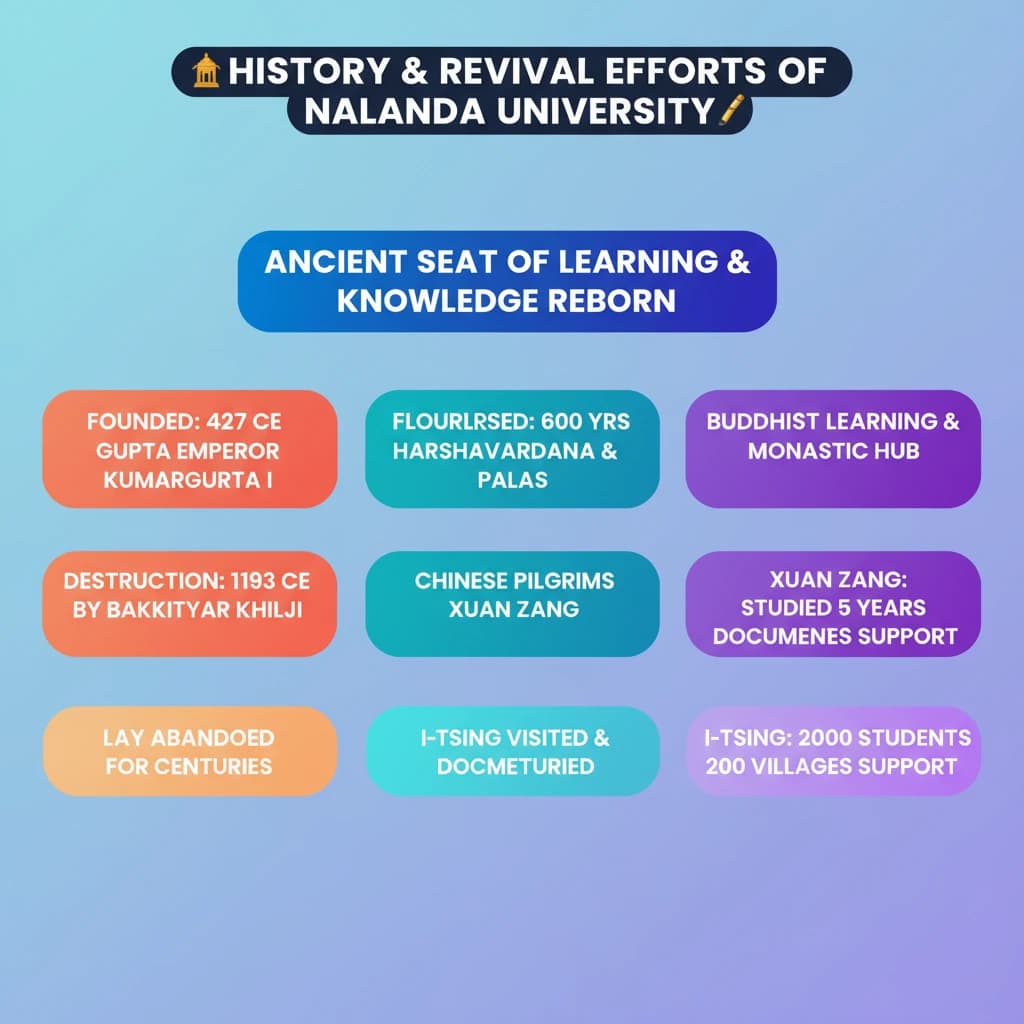
- •Nalanda University founded by Gupta Emperor Kumaragupta I in 427 CE.
- •Flourished for 600 years, prominent under Harshavardhana and Palas.
- •Visited by Chinese pilgrims Xuan Zang and I-Tsing, providing key historical accounts.
- •Xuan Zang studied for 5 years and took scriptures to China.
- •I-Tsing reported 2,000 students supported by 200 villages in 670 AD.
- •Represents a peak of ancient Indian education and international intellectual exchange.
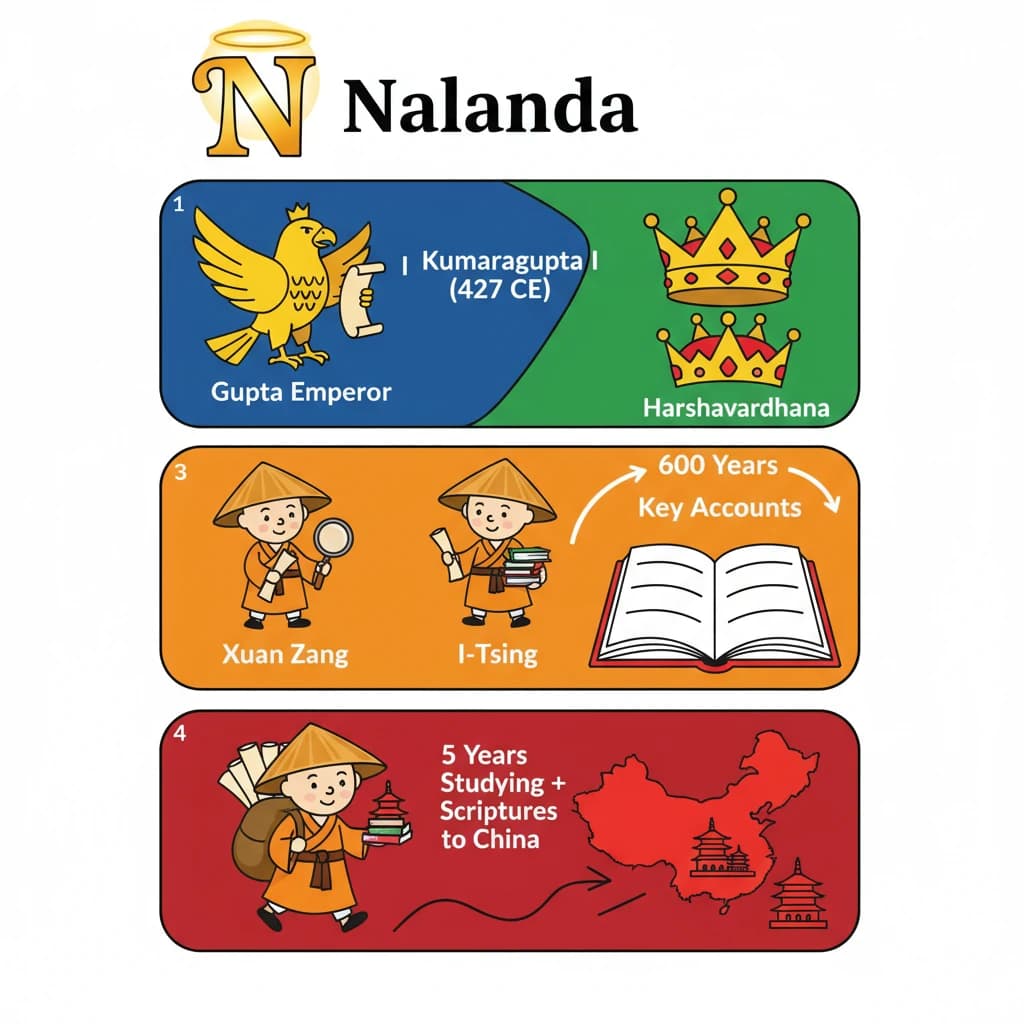
🧠 Memory Techniques
95% Verified Content