Loading page, please wait…
What is the History and Revival Efforts of Nalanda University? - UPSC History
What is What is the History and Revival Efforts of Nalanda University? in UPSC History?
What is the History and Revival Efforts of Nalanda University? is a key topic under History for UPSC Civil Services Examination. Key points include: Ancient Nalanda was founded by Emperor Kumaragupta in 427 CE and flourished for 600 years as a global learning hub.. It attracted scholars like Xuan Zang and I-Tsing, offering diverse subjects and fostering international intellectual exchange.. Nalanda faced multiple attacks (Hunas, Gaudas) but was repeatedly restored by rulers like Skanda Gupta and Harshavardhana before its final destruction by Bakhtiyar Khilji in 1193 AD.. Understanding this topic is essential for both UPSC Prelims and Mains preparation.
Why is What is the History and Revival Efforts of Nalanda University? important for UPSC exam?
What is the History and Revival Efforts of Nalanda University? is a Medium-level topic in UPSC History. It is tested in both Prelims (factual MCQs) and Mains (analytical answer writing). Previous year UPSC questions have frequently covered aspects of What is the History and Revival Efforts of Nalanda University?, making it essential for comprehensive IAS preparation.
How to prepare What is the History and Revival Efforts of Nalanda University? for UPSC?
To prepare What is the History and Revival Efforts of Nalanda University? for UPSC: (1) Study the comprehensive notes covering all key concepts on Vaidra. (2) Practice previous year questions on this topic. (3) Connect it with current affairs using daily updates. (4) Revise using key takeaways and mind maps available for History. (5) Write practice answers linking What is the History and Revival Efforts of Nalanda University? to related GS Paper topics.
Key takeaways of What is the History and Revival Efforts of Nalanda University? for UPSC
- Ancient Nalanda was founded by Emperor Kumaragupta in 427 CE and flourished for 600 years as a global learning hub.
- It attracted scholars like Xuan Zang and I-Tsing, offering diverse subjects and fostering international intellectual exchange.
- Nalanda faced multiple attacks (Hunas, Gaudas) but was repeatedly restored by rulers like Skanda Gupta and Harshavardhana before its final destruction by Bakhtiyar Khilji in 1193 AD.
- The modern Nalanda University, revived in the 21st century under the 2010 Act, aims to restore its ancient glory as a center for regional knowledge exchange.
- The new campus is a 'Net Zero' Green Campus, emphasizing sustainability, and the ancient ruins are a UNESCO World Heritage Site since 2016.
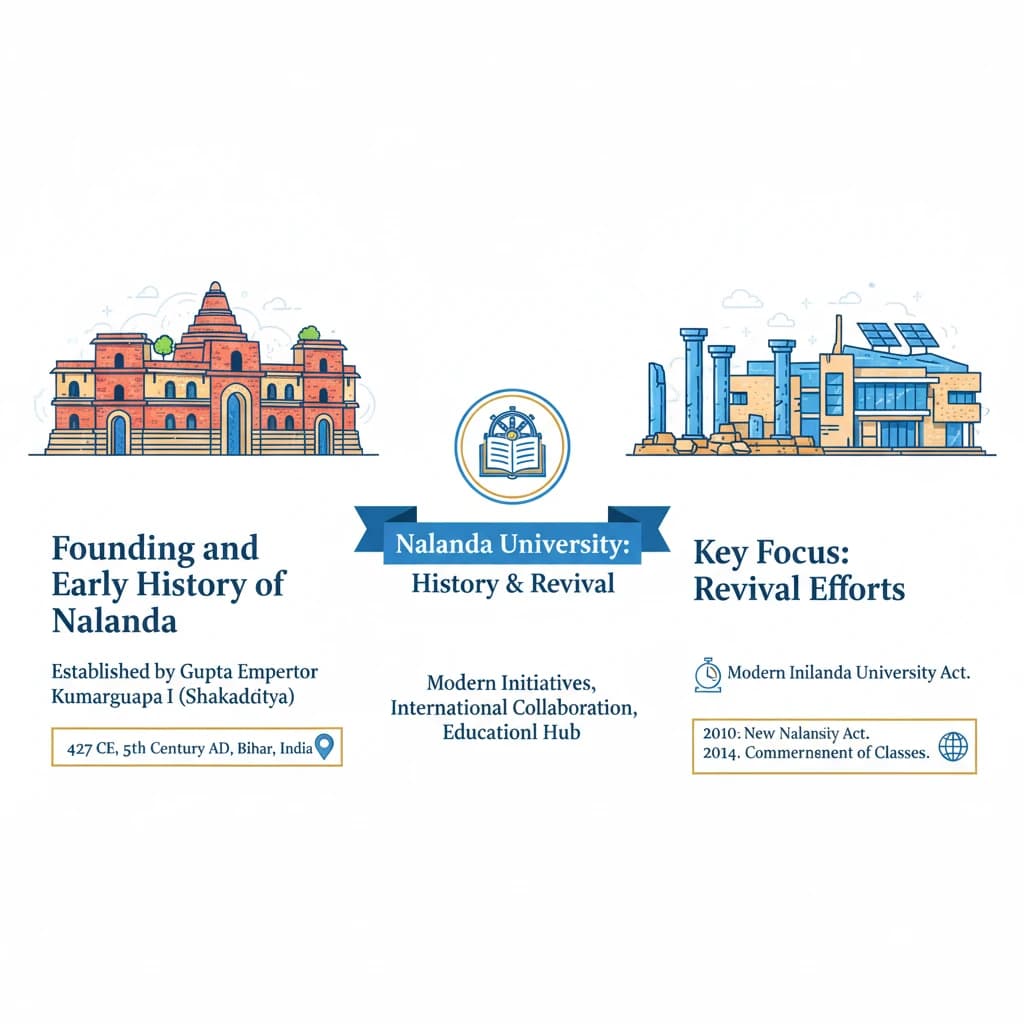
What is the History and Revival Efforts of Nalanda University?
Medium⏱️ 10 min read
history
📖 Introduction
The Genesis and Golden Age of Ancient Nalanda
The illustrious Nalanda University was founded in 427 CE by Emperor Kumaragupta I in the early 5th century. Located in modern-day Bihar, it flourished for over 600 years.
Key Fact: Nalanda's golden era spanned from the 5th century to the 12th century, becoming a beacon of learning and intellectual discourse.
Its prominence significantly increased during the reigns of Emperor Harshavardhana and the Pala monarchs, attracting scholars and students from across Asia.
Global Outreach and Scholarly Contributions
The university was a global hub for learning, drawing students from countries like China, Mongolia, Tibet, Korea, and other Asian nations.
During King Harshavardhana's reign (606-647 AD), the renowned Chinese scholar Xuan Zang (also known as Hiuen Tsang or Moksadeva) visited Nalanda. He studied there for approximately five years.
Xuan Zang's Legacy: He carried back numerous scriptures from Nalanda, which were later translated into Chinese, significantly influencing East Asian Buddhism.
Another Chinese pilgrim, I-Tsing, visited in 670 AD, reporting that Nalanda housed 2,000 students and was sustained by revenue from 200 villages.
Archaeological findings suggest connections with the Indonesian Shailendra dynasty, with one of their kings funding a monastery within the complex.
The region's spiritual vibrancy was further enhanced as both Lord Buddha and Lord Mahavira were believed to have meditated here.
Great masters such as Nagarjuna, Aryabhatta, and Dharmakirti made profound contributions to Nalanda's rich scholarly traditions in diverse fields like philosophy, astronomy, and logic.
Attacks and Resilience: A History of Destruction and Revival
Nalanda faced multiple attacks throughout its history, demonstrating its resilience and the efforts to restore it.
First Attack (455-470 AD): Occurred during Emperor Samudragupta's reign of the Gupta Empire. The attackers were the Hunas, a Central Asian tribal group, primarily seeking to loot valuable resources.
Restoration by Skanda Gupta: Emperor Skanda Gupta later re-established the university. It was during his rule that the famous Abhayadatta library was founded.
Second Attack (Early 7th Century): Orchestrated by the Gaudas emperors of Bengal, driven by political tensions with Emperor Harshavardhana of Kannauj.
Harshavardhana's Restoration: Despite significant destruction, Harshavardhana ensured the university's restoration, allowing Nalanda to continue its mission of global knowledge dissemination.
The Final Destruction and Rediscovery
The university was ultimately destroyed in 1193 AD by Bakhtiyar Khilji, a general of the Turkish ruler Qutbuddin Aibak, marking the end of its ancient era.
Rediscovery Timeline:
- 1812: Rediscovered by Scottish surveyor Francis Buchanan-Hamilton.
- 1861: Identified as the ancient university by Sir Alexander Cunningham.
Modern Revival Efforts and the New Nalanda University
The idea for Nalanda's revival gained momentum in the early 2000s, championed by figures like former President A.P.J. Abdul Kalam and the Singapore government.
Leaders of the East Asia Summit (EAS) countries also advocated for the university's return, envisioning it as a symbol of regional knowledge exchange.
Legal Framework: The Indian Parliament passed the Nalanda University Act in 2010, establishing the legal basis for the new institution.
The Bihar government provided a 455-acre site near the ancient ruins for the new campus.
Designed by architect B.V. Doshi, the campus is eco-friendly, blending modern amenities with the spirit of the ancient institution.
Academic Offerings: The university offers postgraduate programs in diverse fields including Buddhist Studies, Historical Studies, Ecology and Environmental Studies, and International Relations.
The campus operates as a 'Net Zero' Green Campus, featuring a solar plant, water treatment and recycling facilities, and extensive water bodies, promoting self-sustainability.
UPSC Insight: The ruins of Nalanda University were declared a UNESCO World Heritage Site in 2016. This highlights its global cultural significance and India's commitment to heritage preservation (GS Paper I - Culture, GS Paper III - Environment).
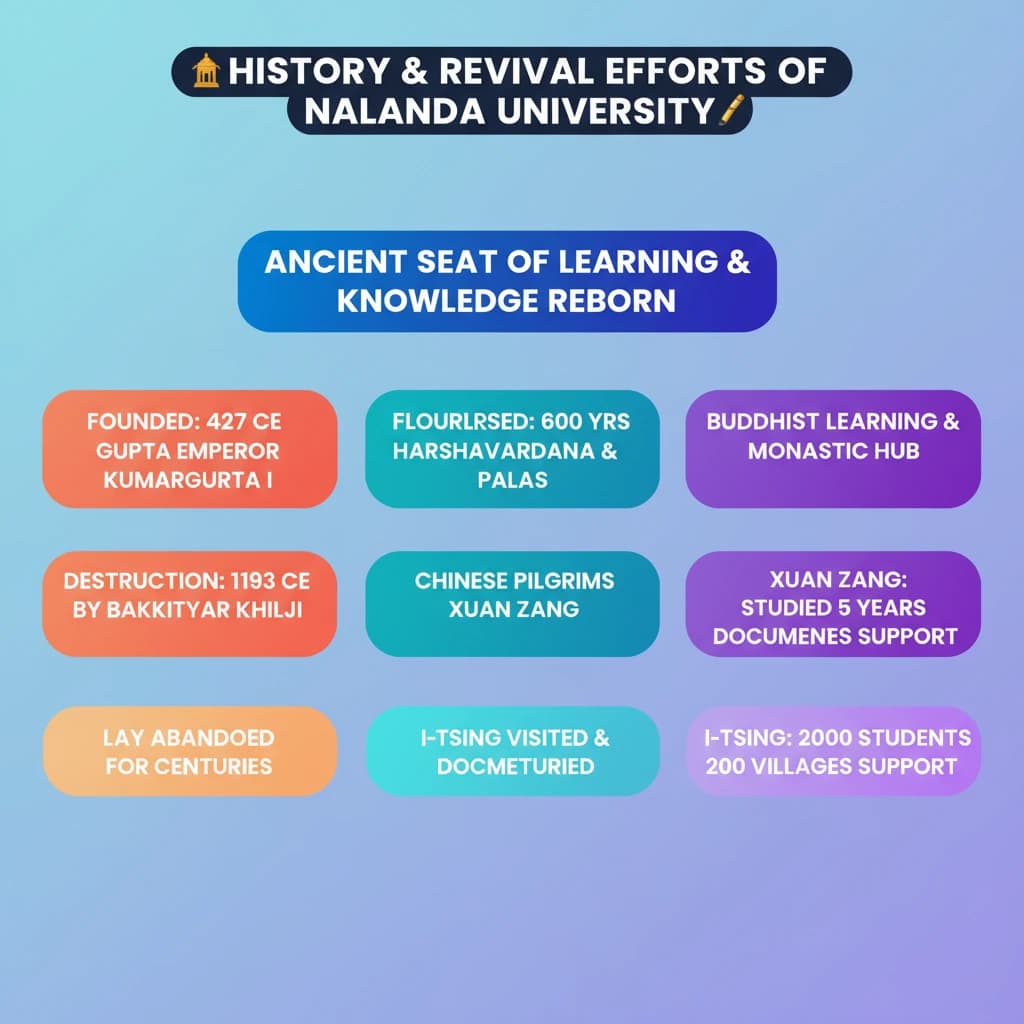
💡 Key Takeaways
- •Ancient Nalanda was founded by Emperor Kumaragupta in 427 CE and flourished for 600 years as a global learning hub.
- •It attracted scholars like Xuan Zang and I-Tsing, offering diverse subjects and fostering international intellectual exchange.
- •Nalanda faced multiple attacks (Hunas, Gaudas) but was repeatedly restored by rulers like Skanda Gupta and Harshavardhana before its final destruction by Bakhtiyar Khilji in 1193 AD.
- •The modern Nalanda University, revived in the 21st century under the 2010 Act, aims to restore its ancient glory as a center for regional knowledge exchange.
- •The new campus is a 'Net Zero' Green Campus, emphasizing sustainability, and the ancient ruins are a UNESCO World Heritage Site since 2016.
🧠 Memory Techniques

95% Verified Content