Loading page, please wait…
What was SC Bose Role in India’s Freedom Movement? - UPSC History
What is What was SC Bose Role in India’s Freedom Movement? in UPSC History?
What was SC Bose Role in India’s Freedom Movement? is a key topic under History for UPSC Civil Services Examination. Key points include: SC Bose pursued independence through international alliances and armed struggle, a departure from Gandhi's non-violence.. His escape in 1941 and formation of the INA were pivotal in challenging British rule.. The INA, including the Rani of Jhansi Regiment, demonstrated a diverse and inclusive approach to warfare.. Understanding this topic is essential for both UPSC Prelims and Mains preparation.
Why is What was SC Bose Role in India’s Freedom Movement? important for UPSC exam?
What was SC Bose Role in India’s Freedom Movement? is a Medium-level topic in UPSC History. It is tested in both Prelims (factual MCQs) and Mains (analytical answer writing). Previous year UPSC questions have frequently covered aspects of What was SC Bose Role in India’s Freedom Movement?, making it essential for comprehensive IAS preparation.
How to prepare What was SC Bose Role in India’s Freedom Movement? for UPSC?
To prepare What was SC Bose Role in India’s Freedom Movement? for UPSC: (1) Study the comprehensive notes covering all key concepts on Vaidra. (2) Practice previous year questions on this topic. (3) Connect it with current affairs using daily updates. (4) Revise using key takeaways and mind maps available for History. (5) Write practice answers linking What was SC Bose Role in India’s Freedom Movement? to related GS Paper topics.
Key takeaways of What was SC Bose Role in India’s Freedom Movement? for UPSC
- SC Bose pursued independence through international alliances and armed struggle, a departure from Gandhi's non-violence.
- His escape in 1941 and formation of the INA were pivotal in challenging British rule.
- The INA, including the Rani of Jhansi Regiment, demonstrated a diverse and inclusive approach to warfare.
- The INA Trials significantly boosted nationalist sentiment across India.
- Bose's legacy is honored through the Subhas Chandra Bose Aapda Prabandhan Puraskar for disaster management.
What was SC Bose Role in India’s Freedom Movement?
Medium⏱️ 8 min read
history
📖 Introduction
Dramatic Escape and Early Actions
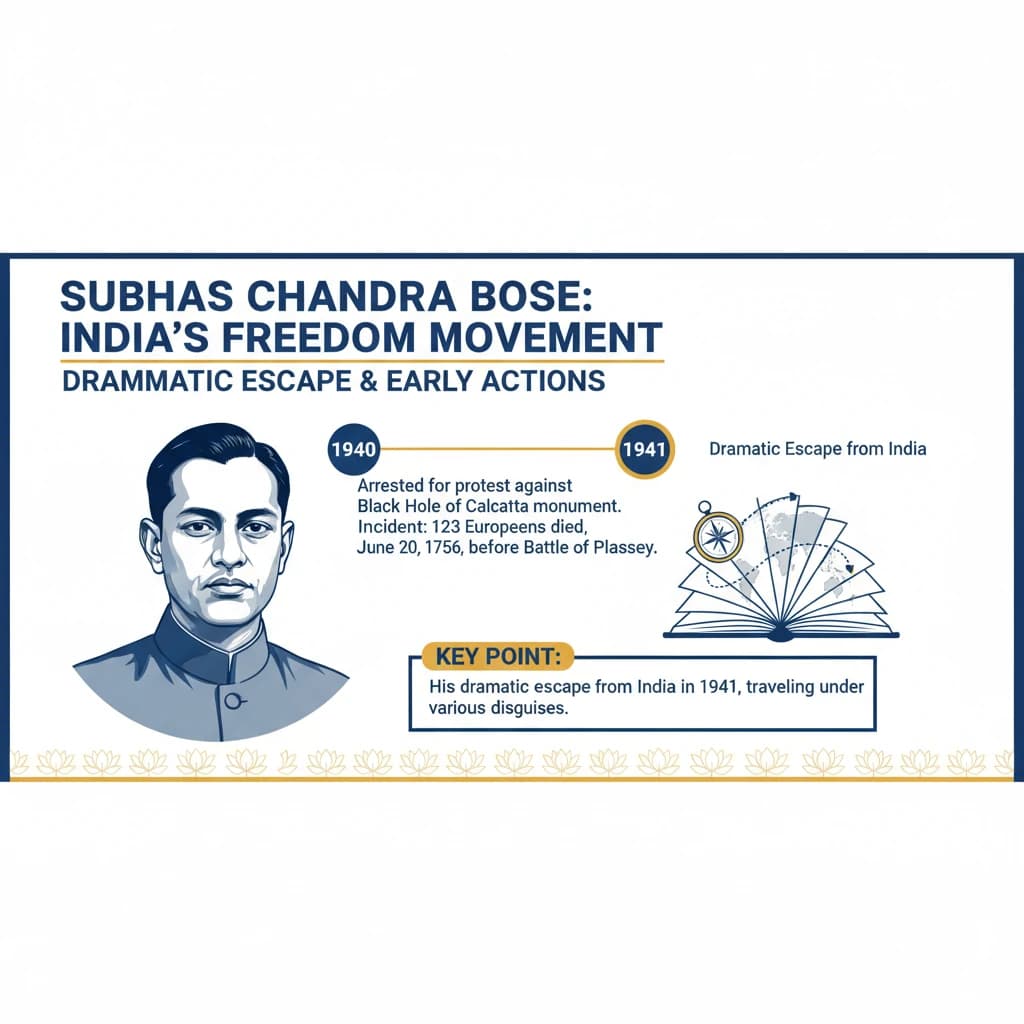
Subhas Chandra Bose was arrested in 1940 before he could campaign against the monument dedicated to the Black Hole tragedy of Calcutta. This incident, where 123 Europeans died on June 20, 1756, occurred a year before the Battle of Plassey.
His dramatic escape from India in 1941, traveling under various disguises, showcased his relentless pursuit of independence. This act demonstrated his resolve even in the face of stringent British surveillance.
International Alliances During World War II
After reaching Europe, Bose strategically sought support from powers interested in defeating Britain during World War II. He approached Nazi Germany, the Soviet Union, and later Imperial Japan in Asia.
These alliances allowed Bose to establish the Azad Hind Radio. He was also provided with several thousand Indian prisoners of war (POWs) captured by the Axis powers during the war.
Perilous Journey to Southeast Asia
In February 1943, Bose and his aide, Abid Hasan, embarked on an arduous journey. They traveled from Germany in a submarine, crossing the Atlantic Ocean, the Cape of Good Hope, and the Indian Ocean.
The journey culminated with them reaching Tokyo by air, completing a 90-day, perilous voyage. This demonstrated his commitment to securing international backing for India's freedom.
Formation of the Indian National Army (INA)
The Indian National Army (INA) was formed in 1942. It comprised thousands of Indian prisoners of war who had been captured by the Japanese, receiving support from Japanese troops.
Initially, Captain Mohan Singh was appointed as the commander of the INA. Later, Subhas Chandra Bose took over its leadership, galvanizing its forces for the independence struggle.
The 'Chalo Delhi' Campaign
Under SC Bose's leadership, the INA launched the 'Chalo Delhi' campaign. In March 1944, they crossed the Indo-Burma border and marched towards Imphal and Kohima.
However, the campaign ultimately ended in Imphal with the defeat of Japan in World War II, significantly impacting the INA's advance.
The Provisional Government of Azad Hind
In October 1943, Bose established the Provisional Government of Azad Hind in Singapore. This government was a symbolic assertion of India's independence from British rule.
The headquarters of the Azad Hind Government were subsequently moved to Rangoon in January 1944, further consolidating its operational base in Southeast Asia.
The Mysterious Demise of SC Bose
Subhas Chandra Bose's fate remains a subject of historical debate. He allegedly boarded a Japanese plane headed towards China, which reportedly crashed.
According to some accounts, SC Bose was badly burned but still alive after the alleged crash. The exact circumstances of his death continue to be a mystery.
Legacy of Subhas Chandra Bose
Bose’s leadership, his strong ideology, and his unwavering call for complete independence made him one of the most influential figures in India’s freedom struggle. His radical approach inspired many.
His slogan, 'Give me blood, and I shall give you freedom!', continues to resonate as a powerful symbol of his revolutionary spirit and dedication to the nation.
Rani of Jhansi Regiment
A testament to his progressive vision, Bose also created the Rani of Jhansi Regiment. This was a unique military unit composed entirely of women.
These women fought alongside men in the struggle for independence, marking a significant and pioneering step for women's participation in armed resistance.
The INA Trials (Red Fort Trials)
The INA Trials were a series of military tribunals held by the British colonial government in 1945-46. They were conducted to try INA officers and soldiers for treason.
The trials of prominent officers like Shah Nawaz Khan, Prem Kumar Sehgal, and Gurbaksh Singh Dhillon ignited a powerful wave of nationalist sentiment. This led to widespread violent confrontations against the British Raj.
The INA Trials are crucial for UPSC Mains (GS Paper I - Modern History). They represent a pivotal moment where public sympathy for the INA significantly weakened British authority and bolstered the independence movement.
Subhas Chandra Bose Aapda Prabandhan Puraskar
The Subhas Chandra Bose Aapda Prabandhan Puraskar was instituted in 2018. This annual award recognizes and honors the invaluable contribution and selfless service rendered in the field of disaster management in India.
The award is announced every year on January 23rd, Bose's birth anniversary. It carries a cash prize of Rs 51 lakh and a certificate for an institution, and Rs 5 lakh and a certificate for an individual.
💡 Key Takeaways
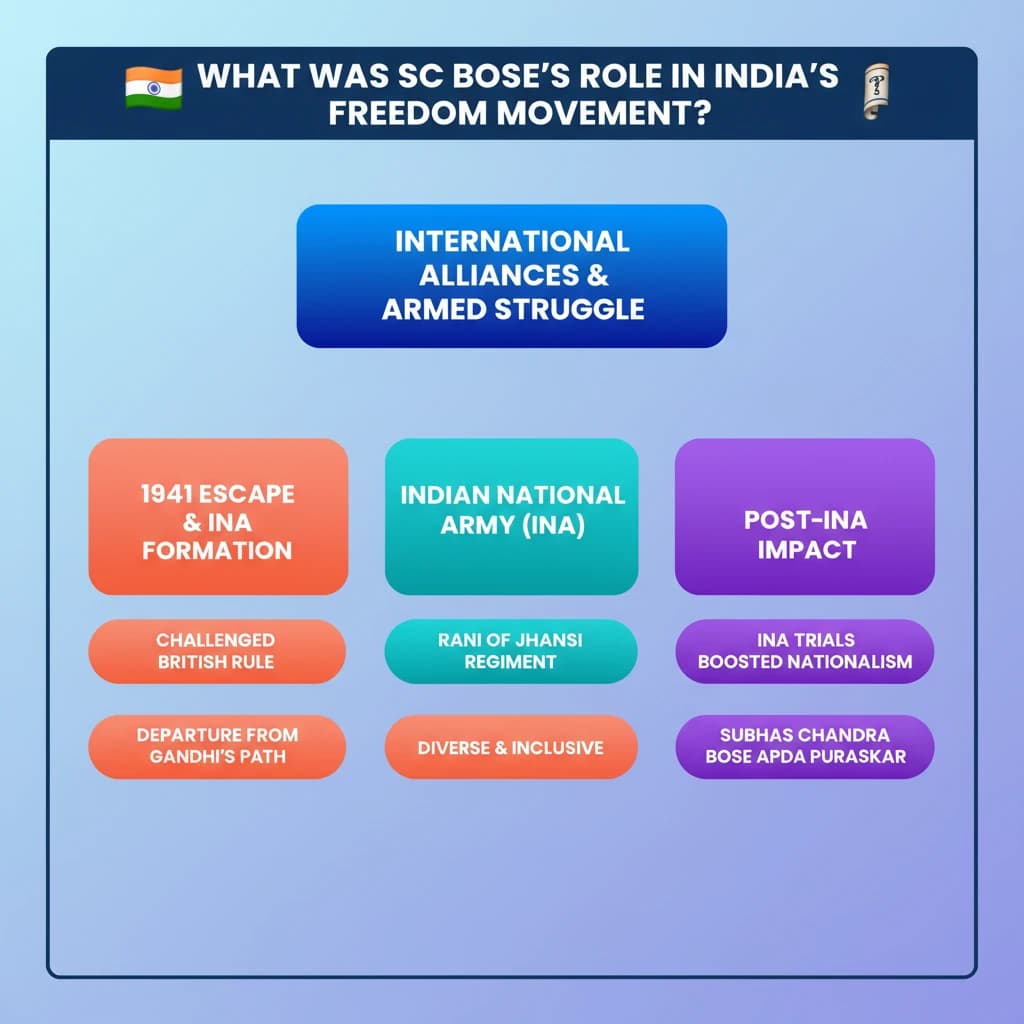
- •SC Bose pursued independence through international alliances and armed struggle, a departure from Gandhi's non-violence.
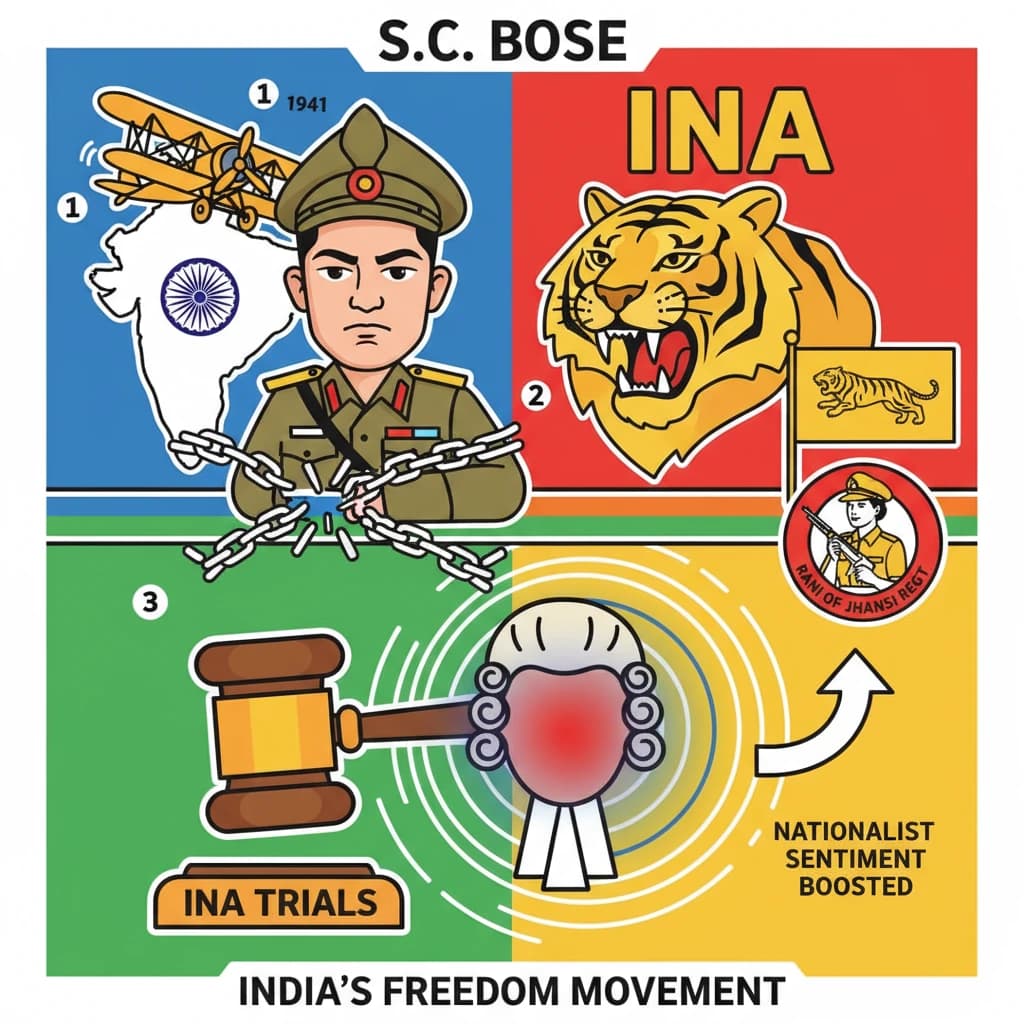
- •His escape in 1941 and formation of the INA were pivotal in challenging British rule.
- •The INA, including the Rani of Jhansi Regiment, demonstrated a diverse and inclusive approach to warfare.
- •The INA Trials significantly boosted nationalist sentiment across India.
- •Bose's legacy is honored through the Subhas Chandra Bose Aapda Prabandhan Puraskar for disaster management.
🧠 Memory Techniques
95% Verified Content
📚 Reference Sources
•NCERT History Textbooks (Class XII)
•Spectrum's 'A Brief History of Modern India'