Loading page, please wait…
What was the 1971 Bangladesh Liberation War? - UPSC History
What is What was the 1971 Bangladesh Liberation War? in UPSC History?
What was the 1971 Bangladesh Liberation War? is a key topic under History for UPSC Civil Services Examination. Key points include: The 1971 Bangladesh Liberation War led to Bangladesh's independence from Pakistan.. Its roots lie in the 1947 Partition of India and the creation of a bifurcated Pakistan.. Key causes included social exploitation, linguistic marginalisation (Urdu vs. Bengali), and political discrimination.. Understanding this topic is essential for both UPSC Prelims and Mains preparation.
Why is What was the 1971 Bangladesh Liberation War? important for UPSC exam?
What was the 1971 Bangladesh Liberation War? is a Medium-level topic in UPSC History. It is tested in both Prelims (factual MCQs) and Mains (analytical answer writing). Previous year UPSC questions have frequently covered aspects of What was the 1971 Bangladesh Liberation War?, making it essential for comprehensive IAS preparation.
How to prepare What was the 1971 Bangladesh Liberation War? for UPSC?
To prepare What was the 1971 Bangladesh Liberation War? for UPSC: (1) Study the comprehensive notes covering all key concepts on Vaidra. (2) Practice previous year questions on this topic. (3) Connect it with current affairs using daily updates. (4) Revise using key takeaways and mind maps available for History. (5) Write practice answers linking What was the 1971 Bangladesh Liberation War? to related GS Paper topics.
Key takeaways of What was the 1971 Bangladesh Liberation War? for UPSC
- The 1971 Bangladesh Liberation War led to Bangladesh's independence from Pakistan.
- Its roots lie in the 1947 Partition of India and the creation of a bifurcated Pakistan.
- Key causes included social exploitation, linguistic marginalisation (Urdu vs. Bengali), and political discrimination.
- West Pakistan's refusal to transfer power after the Awami League's 1970 election victory was a major catalyst.
- The war highlighted the triumph of linguistic-cultural nationalism over religious nationalism in East Pakistan.
- India played a crucial role in supporting Bangladesh's liberation.
What was the 1971 Bangladesh Liberation War?
Medium⏱️ 7 min read
history
📖 Introduction
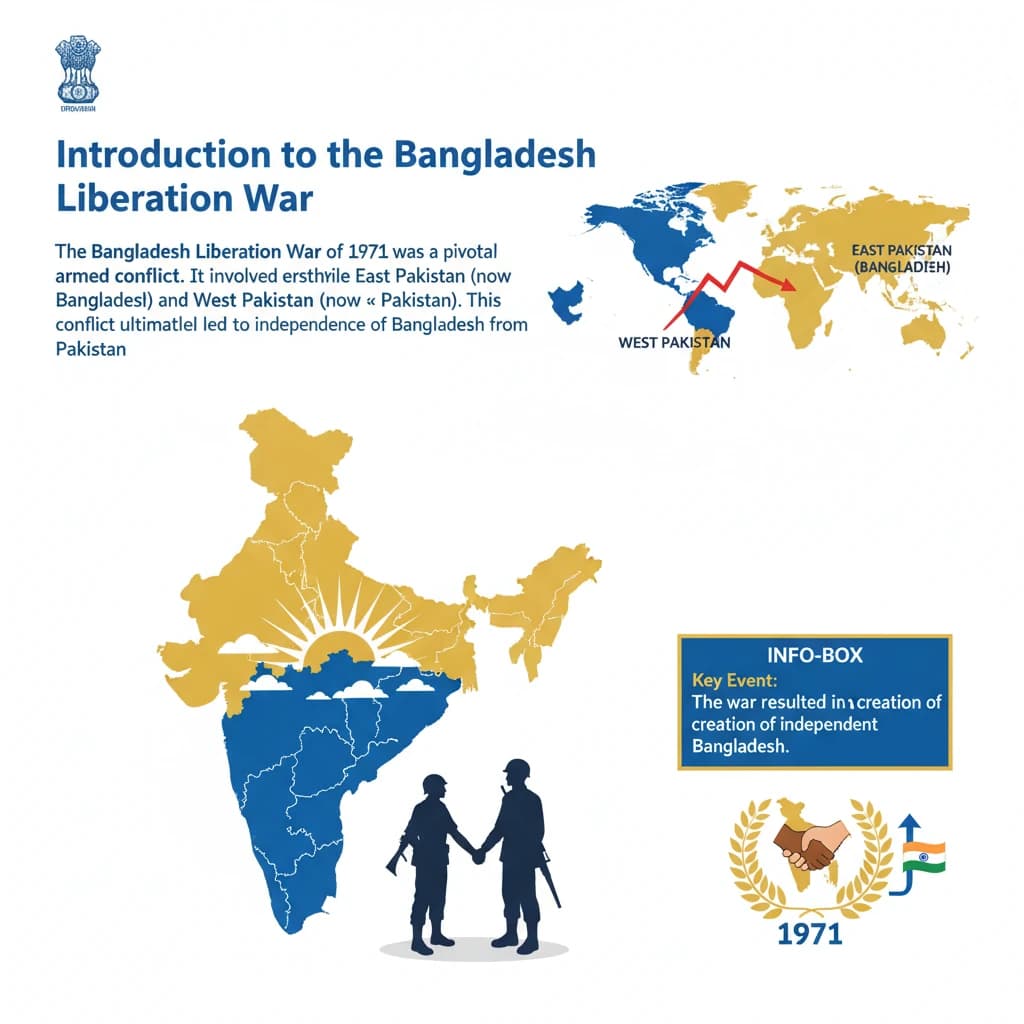
Introduction to the Bangladesh Liberation War
The Bangladesh Liberation War of 1971 was a pivotal armed conflict. It involved erstwhile East Pakistan (now Bangladesh) and West Pakistan (now Pakistan). This conflict ultimately led to the independence of Bangladesh from Pakistan.
Key Event: The war resulted in the creation of an independent nation, Bangladesh, marking a significant geopolitical shift in South Asia.
Roots of the Conflict
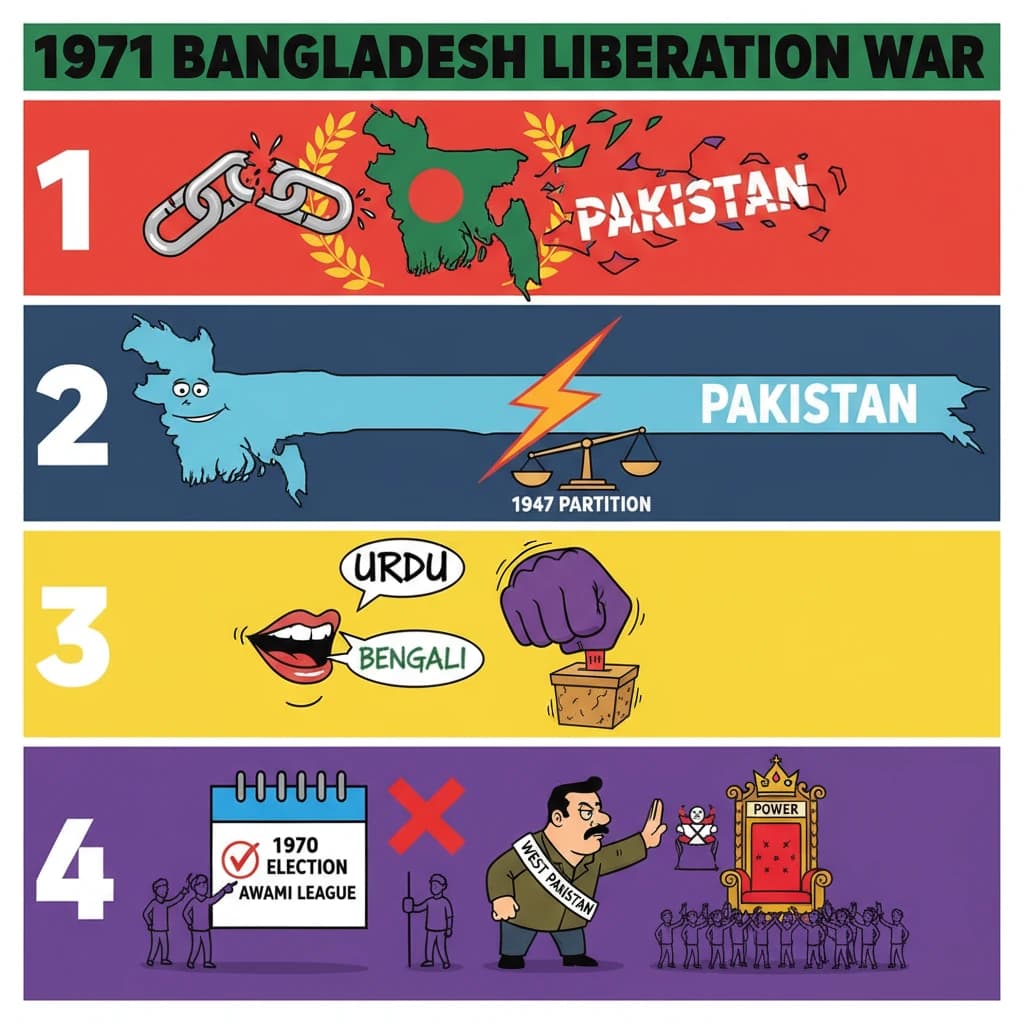
The origins of the 1971 Bangladesh Liberation War are deeply embedded in the 1947 Partition of India. This historical event divided the subcontinent primarily along religious lines.
Pakistan was established as a Muslim-majority state, fulfilling the demand of Muhammad Ali Jinnah. However, this new nation comprised two geographically separate wings: East Pakistan and West Pakistan.
Despite being united by religion, profound geographical, cultural, and linguistic differences existed between East Pakistan and West Pakistan. These disparities gradually sowed seeds of discord and alienation among the populace.
Key Causes of the 1971 War
Several underlying factors contributed to the outbreak of the war, stemming from systematic discrimination against East Pakistan by the West Pakistani establishment.
Social Exploitation and Cultural Inferiority
Post-independence, West Pakistan often perceived East Pakistan as culturally inferior. This perception was largely due to East Pakistan's historical ties with the Hindu-dominated elite before the Partition.
This view fueled systematic discrimination against the Bengali population, impacting their social and cultural development.
Linguistic Marginalisation
A major point of contention was the imposition of Urdu as Pakistan’s national language. This policy completely disregarded Bengali, which was the predominant language spoken by the majority population in East Pakistan.
This linguistic marginalisation led to widespread unrest and significant protests, most notably the Bengali Language Movement.
Important Concept: The Bengali Language Movement (early 1950s) was a crucial precursor, highlighting the strong cultural identity of East Pakistan and their resistance to West Pakistani dominance.
Political Discrimination
West Pakistan maintained a dominant position in the central government, with political power largely concentrated among the Punjabi elite. This meant that decision-making was heavily skewed.
Despite having a larger population, East Pakistan received minimal representation and influence in national policy and governance, leading to deep political grievances.
The 1970 general elections became a flashpoint. The Awami League, led by Sheikh Mujibur Rahman, won a decisive victory, securing a majority in the National Assembly. However, the West Pakistani establishment refused to transfer power, escalating tensions dramatically.
UPSC Insight: Understanding the multi-faceted causes – social, linguistic, and political – is crucial for essay questions on nation-building, regional conflicts, and India's role in South Asian geopolitics. Focus on the 1947 Partition as the foundational event.
💡 Key Takeaways
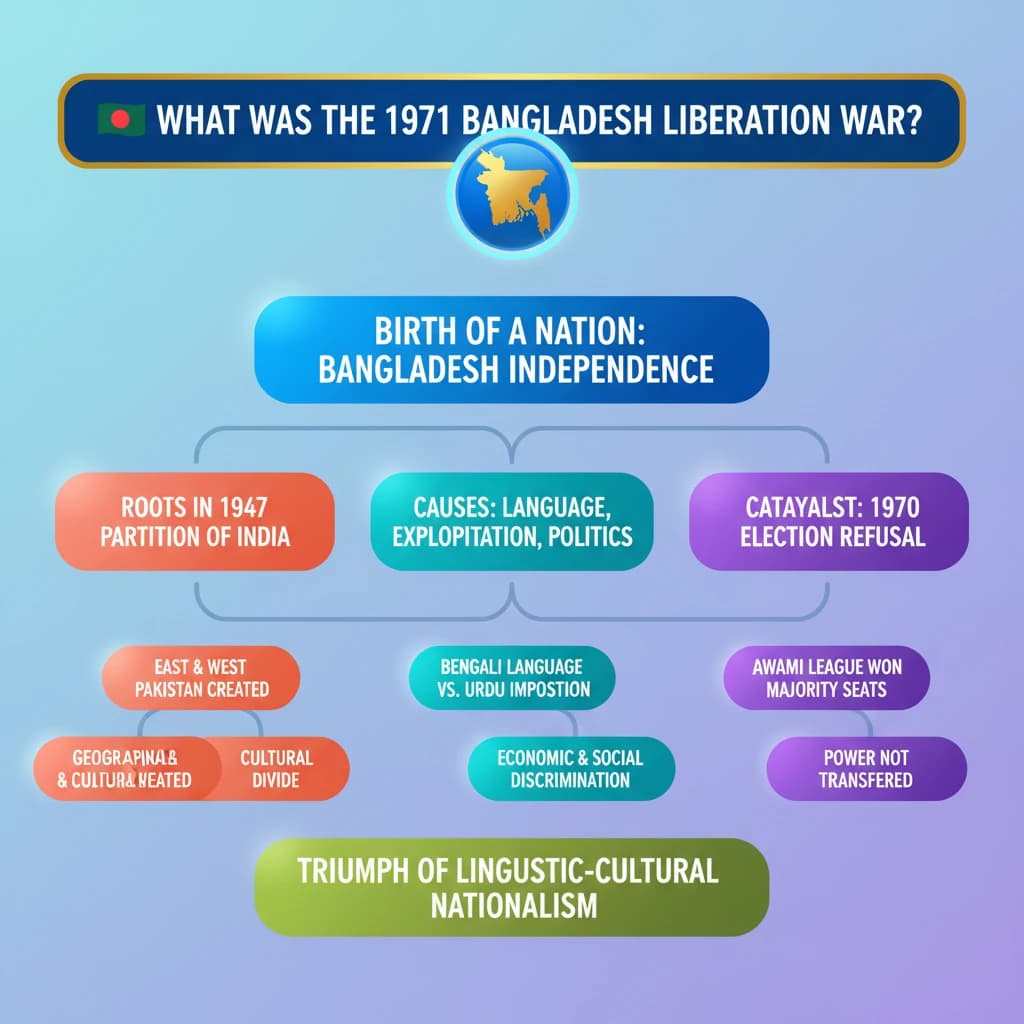
- •The 1971 Bangladesh Liberation War led to Bangladesh's independence from Pakistan.
- •Its roots lie in the 1947 Partition of India and the creation of a bifurcated Pakistan.
- •Key causes included social exploitation, linguistic marginalisation (Urdu vs. Bengali), and political discrimination.
- •West Pakistan's refusal to transfer power after the Awami League's 1970 election victory was a major catalyst.
- •The war highlighted the triumph of linguistic-cultural nationalism over religious nationalism in East Pakistan.
- •India played a crucial role in supporting Bangladesh's liberation.
🧠 Memory Techniques
95% Verified Content
📚 Reference Sources
•Academic texts on the Partition of India and creation of Bangladesh
•Historical accounts of the Bengali Language Movement and 1970 elections