Loading page, please wait…
Vaidra Logo
Vaidra

Top 4 items + smart groups

UPSC GPT
New
Current Affairs
Daily Solutions
Daily Puzzle
Mains Evaluator

Version 2.0.0 • Built with ❤️ for UPSC aspirants

Loading...
Loading...
Loading...
Loading...
Loading...
Loading...
Loading...
Loading...
Loading...
Loading...
Loading...
Loading...
Loading...
Back
All Subjects

Topics

0 topics • 0 completed

Loading topics...
Loading...
Loading...
Loading...
Loading...
Loading...
Overall Progress0%

How are the New Members Elected to the UNSC? - UPSC International Relations

What is How are the New Members Elected to the UNSC? in UPSC International Relations?

How are the New Members Elected to the UNSC? is a key topic under International Relations for UPSC Civil Services Examination. Key points include: UNSC non-permanent members are elected by the UN General Assembly for a two-year term.. The election process is guided by four regional groupings to ensure equitable geographical distribution.. Newly elected members for the 2025-2026 term include Somalia, Pakistan, Panama, Denmark, and Greece.. Understanding this topic is essential for both UPSC Prelims and Mains preparation.

Why is How are the New Members Elected to the UNSC? important for UPSC exam?

How are the New Members Elected to the UNSC? is a Medium-level topic in UPSC International Relations. It is tested in both Prelims (factual MCQs) and Mains (analytical answer writing). Previous year UPSC questions have frequently covered aspects of How are the New Members Elected to the UNSC?, making it essential for comprehensive IAS preparation.

How to prepare How are the New Members Elected to the UNSC? for UPSC?

To prepare How are the New Members Elected to the UNSC? for UPSC: (1) Study the comprehensive notes covering all key concepts on Vaidra. (2) Practice previous year questions on this topic. (3) Connect it with current affairs using daily updates. (4) Revise using key takeaways and mind maps available for International Relations. (5) Write practice answers linking How are the New Members Elected to the UNSC? to related GS Paper topics.

Key takeaways of How are the New Members Elected to the UNSC? for UPSC

  • UNSC non-permanent members are elected by the UN General Assembly for a two-year term.
  • The election process is guided by four regional groupings to ensure equitable geographical distribution.
  • Newly elected members for the 2025-2026 term include Somalia, Pakistan, Panama, Denmark, and Greece.
  • These new members replace outgoing countries like Mozambique, Japan, Ecuador, Malta, and Switzerland.
  • The UNSC's effectiveness is often challenged by the veto power of its five permanent members.
  • The election process underscores the ongoing debate and need for UN Security Council reforms.
How are the New Members Elected to the UNSC?

How are the New Members Elected to the UNSC?

Medium⏱️ 6 min read✓ 98% Verified
international relations

📖 Introduction

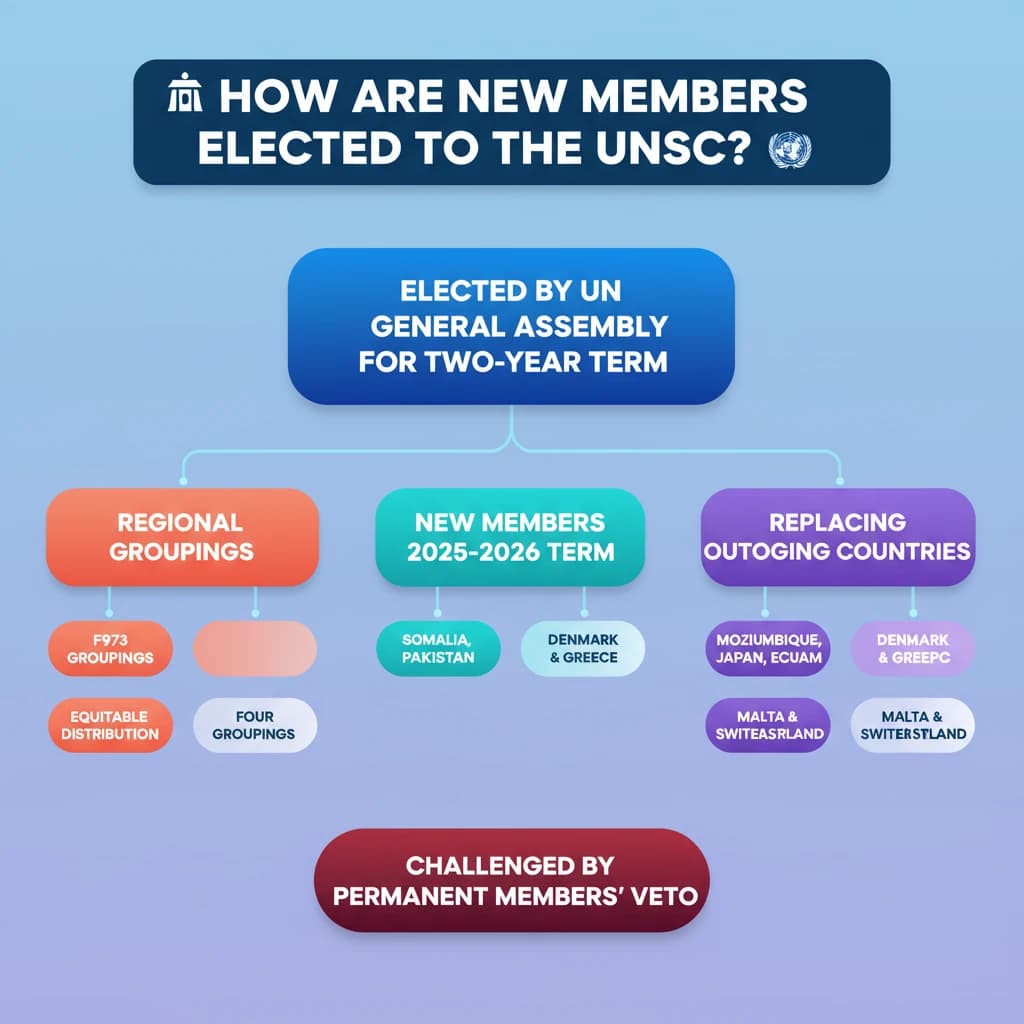
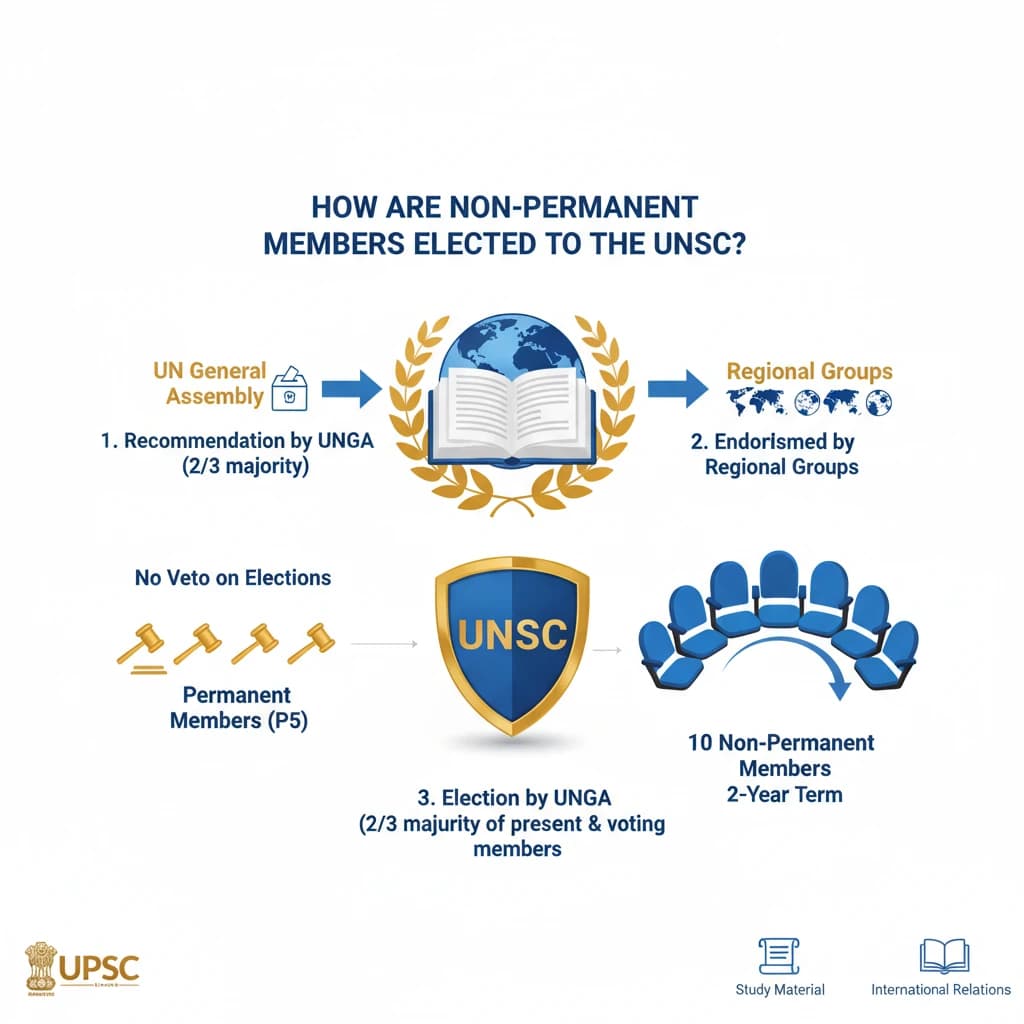
<h4>The UN Security Council: An Overview</h4><p>The <strong>United Nations Security Council (UNSC)</strong> holds a critical mandate in maintaining <strong>international peace and security</strong>. It is one of the six principal organs of the United Nations, tasked with addressing global threats and conflicts.</p><div class='key-point-box'><p>The <strong>UNSC</strong> is the only UN body with the authority to issue legally binding resolutions on member states, making its composition and election process highly significant.</p></div><h4>The Election Process for Non-Permanent Members</h4><p>The election of <strong>non-permanent members</strong> to the <strong>UNSC</strong> is a structured process involving <strong>regional groupings</strong>. These groups play a crucial role in nominating candidates for the available seats.</p><p>There are <strong>four main regional groups</strong> through which member states are nominated. This system ensures a degree of geographical representation within the Council.</p><h4>Regional Groupings and Recent Elections</h4><p>Each regional group typically agrees upon candidates to present to the <strong>UN General Assembly</strong>. These candidates are then elected for a <strong>two-year term</strong>, ensuring a rotation of representation.</p><div class='info-box'><p><strong>Newly Elected Non-Permanent Members (2025-2026 Term):</strong></p><ul><li><strong>African Group:</strong> <strong>Somalia</strong></li><li><strong>Asia-Pacific Group:</strong> <strong>Pakistan</strong></li><li><strong>Latin America and Caribbean Group:</strong> <strong>Panama</strong></li><li><strong>Western European and Others Group:</strong> <strong>Denmark</strong> and <strong>Greece</strong></li></ul></div><p>These newly elected members are set to replace countries whose terms are concluding. This rotation is fundamental to the Council's structure and function.</p><div class='info-box'><p><strong>Outgoing Non-Permanent Members:</strong></p><ul><li><strong>Mozambique</strong></li><li><strong>Japan</strong></li><li><strong>Ecuador</strong></li><li><strong>Malta</strong></li><li><strong>Switzerland</strong></li></ul></div><h4>Ensuring Regional Representation and Global Diversity</h4><p>The election process is specifically designed to ensure <strong>regional representation</strong> within the <strong>Security Council</strong>. This reflects the global geopolitical diversity and the varied interests of member states.</p><p>By having members from different regions, the UNSC aims to gather a broader perspective on international issues, potentially leading to more balanced and effective resolutions.</p><h4>Challenges to UNSC Effectiveness</h4><p>Despite its critical role, the effectiveness of the <strong>UN Security Council</strong> can be significantly hindered. A primary challenge is the <strong>veto power</strong> held by its <strong>five permanent members</strong>.</p><div class='exam-tip-box'><p>Understanding the <strong>veto power</strong> and its impact on UNSC decision-making is crucial for UPSC exams, particularly for questions on UN reforms and international relations dynamics.</p></div>
Concept Diagram

💡 Key Takeaways

  • •UNSC non-permanent members are elected by the UN General Assembly for a two-year term.
  • •The election process is guided by four regional groupings to ensure equitable geographical distribution.
  • •Newly elected members for the 2025-2026 term include Somalia, Pakistan, Panama, Denmark, and Greece.
  • •These new members replace outgoing countries like Mozambique, Japan, Ecuador, Malta, and Switzerland.
  • •The UNSC's effectiveness is often challenged by the veto power of its five permanent members.
  • •The election process underscores the ongoing debate and need for UN Security Council reforms.

🧠 Memory Techniques
Memory Aid
98% Verified Content

📚 Reference Sources

•United Nations Official Website (for UNSC structure and election process)

Related Topics

Loading related topics...
Explore:International Relations Topics·All Subjects·Daily Current Affairs·Editorial Analysis·Previous Year Questions·UPSC GPT
How are the New Members Elected to the UNSC? - UPSC International Relations