📖 Introduction
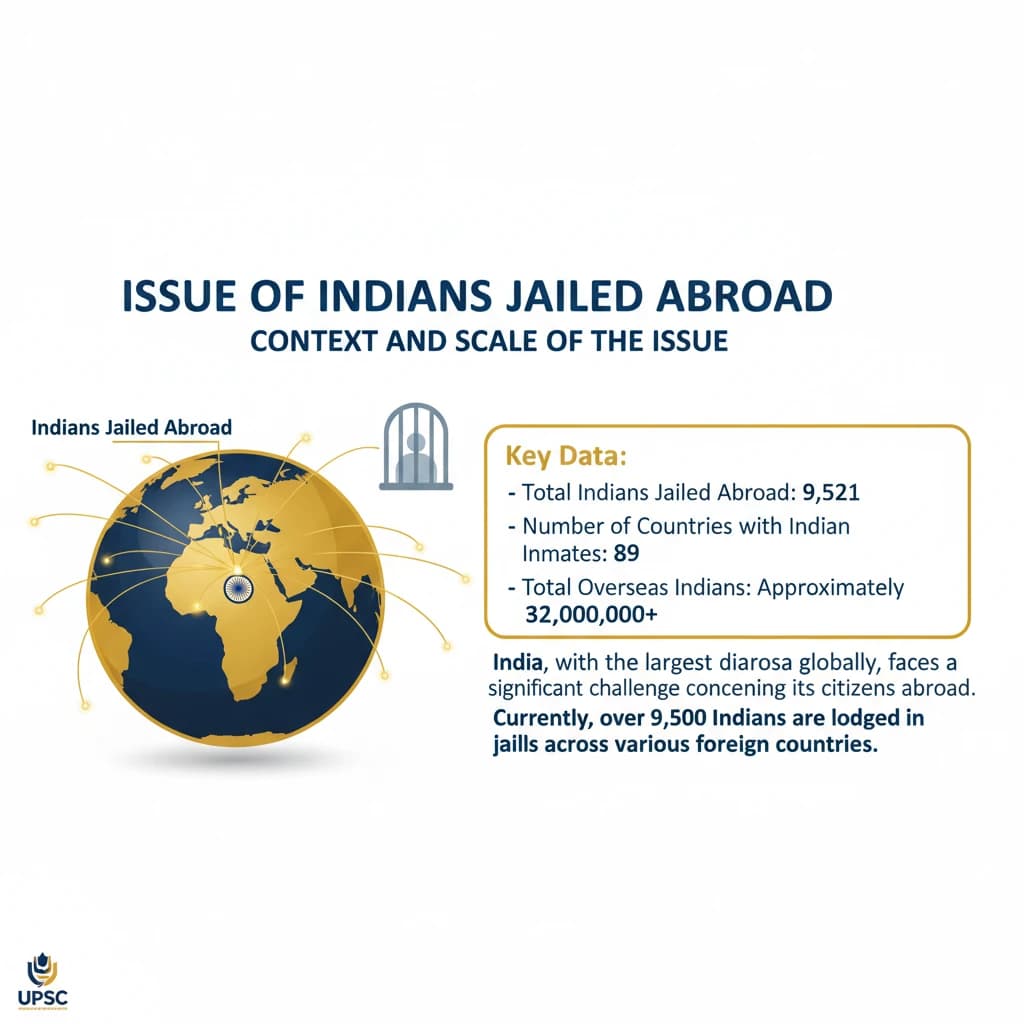
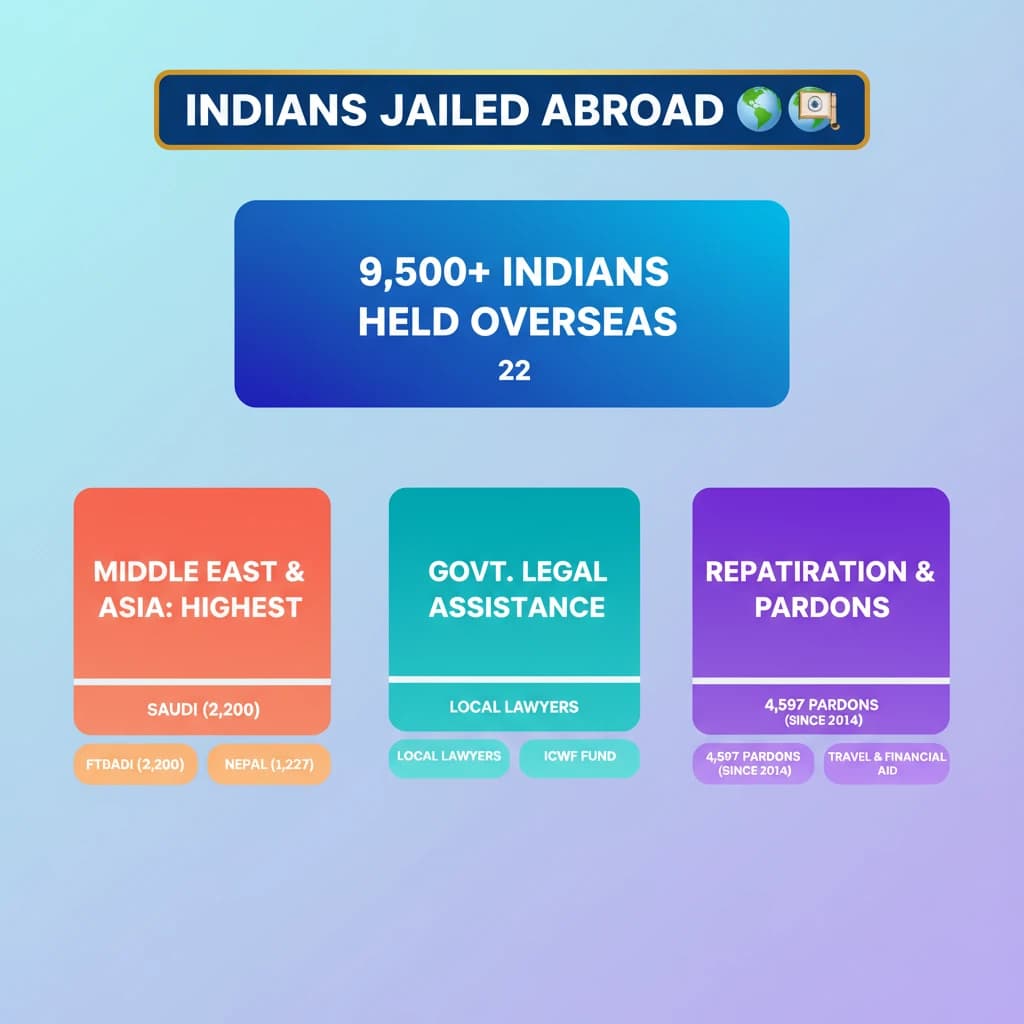
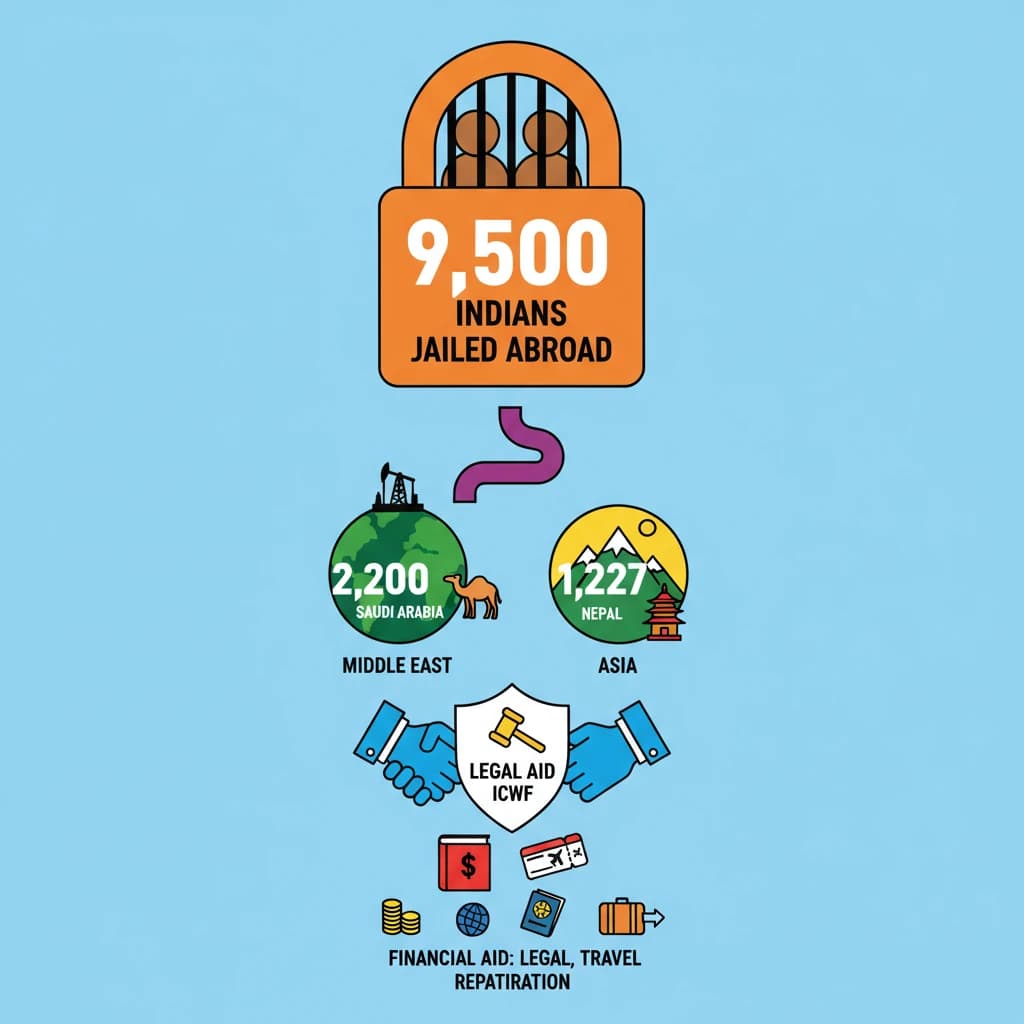
<h4>Context and Scale of the Issue</h4><p>India, with the <strong>largest diaspora globally</strong>, faces a significant challenge concerning its citizens abroad. Currently, over <strong>9,500 Indians</strong> are lodged in jails across various foreign countries.</p><div class='info-box'><p><strong>Key Data:</strong></p><ul><li>Total Indians Jailed Abroad: <strong>9,521</strong></li><li>Number of Countries with Indian Inmates: <strong>89</strong></li><li>Total Overseas Indians: Approximately <strong>3.2 crore</strong> across <strong>210 countries</strong> (MEA data).</li></ul></div><h4>Geographical Distribution of Indian Prisoners</h4><p>The majority of Indian prisoners are concentrated in specific regions, primarily the <strong>Middle East</strong> and <strong>Asia</strong>, reflecting major destinations for Indian migrant workers and expatriates.</p><h5>Middle East Concentration</h5><p>More than <strong>62%</strong> of all Indian prisoners abroad are held in the <strong>Middle East</strong>. This region has the highest number of Indian inmates, indicating strong economic ties and labor migration.</p><div class='info-box'><p><strong>Top Countries in Middle East:</strong></p><ul><li><strong>Saudi Arabia: 2,200</strong> prisoners (highest globally)</li><li><strong>United Arab Emirates (UAE):</strong> Significant numbers</li><li><strong>Qatar: 752</strong> prisoners (third-largest population in the region)</li><li>Other notable countries: <strong>Kuwait, Bahrain, Oman</strong></li></ul></div><h5>Asian Countries with Indian Prisoners</h5><p>Following the Middle East, <strong>Asia</strong> accounts for a substantial portion of Indian prisoners, representing over <strong>23%</strong> of the total. These numbers often reflect proximity and regional migration patterns.</p><div class='info-box'><p><strong>Top Countries in Asia:</strong></p><ul><li><strong>Nepal: 1,227</strong> prisoners (highest in Asia)</li><li>Other notable countries: <strong>Malaysia, Pakistan, China, Singapore, Bhutan, Bangladesh</strong></li></ul></div><h5>European and Other Regions</h5><p>While smaller in comparison, European countries also house a notable number of Indian prisoners. The reasons can vary from immigration issues to criminal offenses.</p><div class='info-box'><p><strong>Top Countries in Europe:</strong></p><ul><li><strong>United Kingdom (UK): 278</strong> prisoners (highest in Europe)</li><li>Other notable countries: <strong>Italy, Germany, France, Spain</strong></li></ul></div><h4>Government Steps for Assistance to Prisoners Abroad</h4><p>The <strong>Government of India</strong>, primarily through the <strong>Ministry of External Affairs (MEA)</strong> and its missions, implements various measures to provide legal, financial, and diplomatic assistance to Indian nationals in foreign prisons.</p><h5>Legal Assistance Mechanisms</h5><p>Indian Missions and Posts abroad play a crucial role in ensuring legal support for distressed citizens. They maintain a network of legal professionals to assist inmates.</p><ul><li><strong>Local Panel of Lawyers:</strong> Missions maintain a panel of lawyers in countries with significant Indian populations.</li><li><strong>No Fee Charged:</strong> Legal facilities extended by the Embassy are provided free of charge to the prisoners.</li></ul><div class='key-point-box'><p><strong>Indian Community Welfare Fund (ICWF):</strong></p><p>The <strong>ICWF</strong> is a vital fund established at Missions and Posts abroad. It provides financial assistance to overseas Indian nationals facing distress, including those in prisons.</p><ul><li><strong>Financial Aid:</strong> Covers legal aid expenses.</li><li><strong>Repatriation Support:</strong> Provides funds for travel documents and air tickets for repatriation.</li></ul></div><h5>Repatriation Efforts</h5><p>The government actively pursues the release and repatriation of Indian nationals. This involves diplomatic engagements and consular consultations with host countries.</p><ul><li><strong>Diplomatic Follow-up:</strong> The issue is regularly raised during consular and bilateral consultations.</li></ul><h5>Pardon and Sentence Reduction</h5><p>Efforts are also made to secure pardons or reductions in sentences for Indian prisoners through diplomatic channels. This often depends on the laws and policies of the foreign government.</p><div class='info-box'><p><strong>Impact of Government Efforts:</strong></p><ul><li>Since <strong>2014</strong>, <strong>4,597 Indian nationals</strong> have received pardons or sentence reductions due to the Indian Government's interventions.</li></ul></div><h4>Agreement(s) on Transfer of Sentenced Persons (TSP)</h4><p>The <strong>Transfer of Sentenced Persons (TSP) Agreements</strong> are crucial bilateral and multilateral instruments that allow Indian prisoners to serve the remainder of their sentences in India, and vice-versa for foreign nationals.</p><div class='key-point-box'><p><strong>Purpose of TSP Agreements:</strong></p><p>These agreements facilitate the transfer of prisoners, enabling them to be closer to their families and cultural environment, and often aiding in their rehabilitation.</p></div><p>India has signed TSP agreements with a significant number of countries, reflecting a global commitment to humanitarian considerations for prisoners.</p><div class='info-box'><p><strong>Countries with Bilateral TSP Agreements (31):</strong></p><ul><li><strong>Australia, Bahrain, Bangladesh, Bosnia & Herzegovina, Brazil, Bulgaria, Cambodia, Egypt, Estonia, France, Hong Kong, Iran, Israel, Italy, Kazakhstan, Korea, Kuwait, Maldives, Mauritius, Mongolia, Qatar, Russia, Saudi Arabia, Somalia, Spain, Sri Lanka, Thailand, Turkey, United Arab Emirates (UAE), United Kingdom, Vietnam.</strong></li></ul></div><p>Beyond bilateral agreements, India is also a signatory to multilateral conventions that facilitate the transfer of sentenced persons, broadening the scope of such humanitarian efforts.</p><div class='info-box'><p><strong>Multilateral Conventions:</strong></p><ul><li><strong>Inter-American Convention on Serving Criminal Sentences Abroad</strong></li><li><strong>Council of Europe Convention on the Transfer of Sentenced Persons</strong></li></ul></div><div class='exam-tip-box'><p><strong>UPSC Insight:</strong> Understanding the mechanisms like <strong>ICWF</strong> and <strong>TSP Agreements</strong> is crucial for Mains GS-2. Questions can focus on India's diaspora policy, human rights, and consular diplomacy. Be prepared to discuss both the challenges and the government's proactive steps.</p></div>