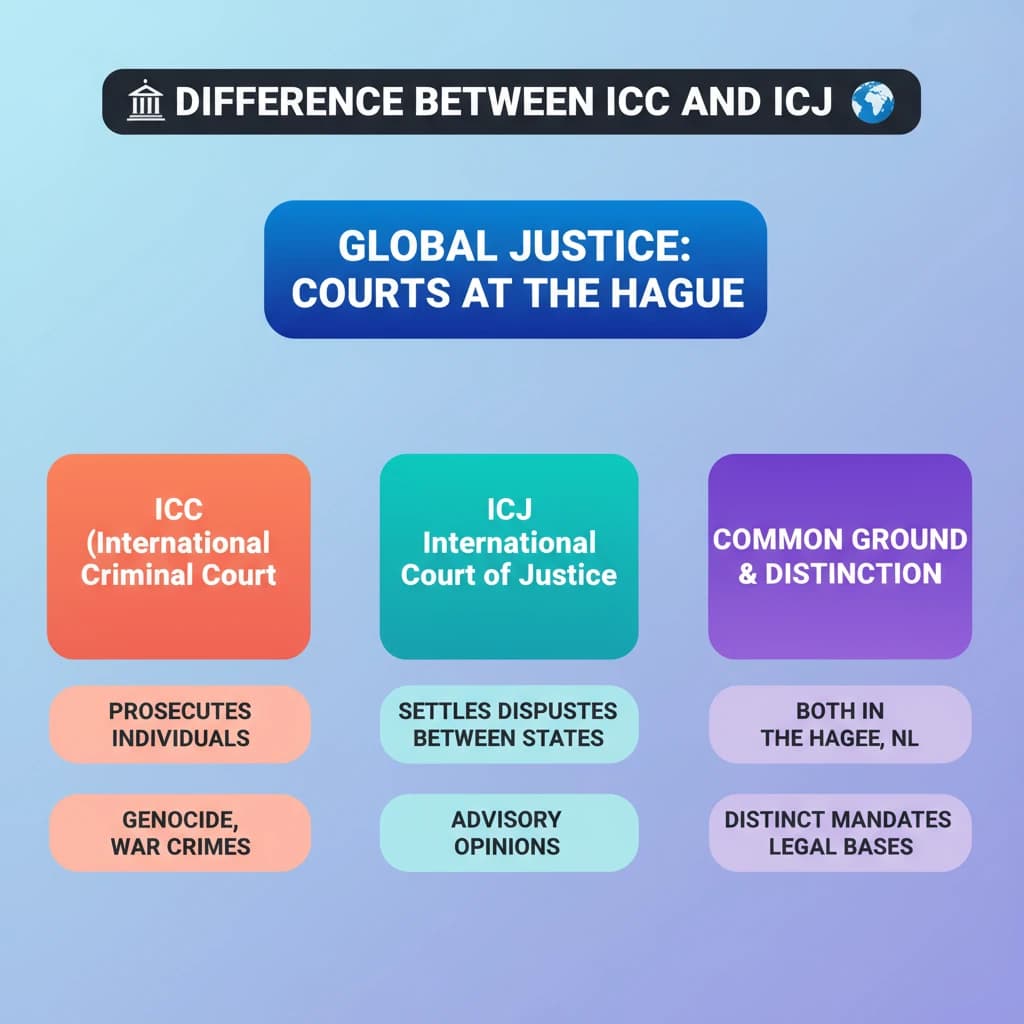
Loading page, please wait…
Vaidra Logo
Vaidra

Top 4 items + smart groups

UPSC GPT
New
Current Affairs
Daily Solutions
Daily Puzzle
Mains Evaluator

Version 2.0.0 • Built with ❤️ for UPSC aspirants

Loading...
Loading...
Loading...
Loading...
Loading...
Loading...
Loading...
Loading...
Loading...
Loading...
Loading...
Loading...
Loading...
Back
All Subjects

Topics

0 topics • 0 completed

Loading topics...
Loading...
Loading...
Loading...
Loading...
Loading...
Overall Progress0%
Difference between ICC and ICJ - UPSC International Relations

Difference between ICC and ICJ - UPSC International Relations

What is Difference between ICC and ICJ in UPSC International Relations?

Difference between ICC and ICJ is a key topic under International Relations for UPSC Civil Services Examination. Key points include: ICJ resolves disputes between states; ICC prosecutes individuals for grave international crimes.. ICJ is a UN organ (established 1945); ICC is independent, established by the Rome Statute (entered into force 2002).. Both courts are located in The Hague, the Netherlands.. Understanding this topic is essential for both UPSC Prelims and Mains preparation.

Why is Difference between ICC and ICJ important for UPSC exam?

Difference between ICC and ICJ is a Medium-level topic in UPSC International Relations. It is tested in both Prelims (factual MCQs) and Mains (analytical answer writing). Previous year UPSC questions have frequently covered aspects of Difference between ICC and ICJ, making it essential for comprehensive IAS preparation.

How to prepare Difference between ICC and ICJ for UPSC?

To prepare Difference between ICC and ICJ for UPSC: (1) Study the comprehensive notes covering all key concepts on Vaidra. (2) Practice previous year questions on this topic. (3) Connect it with current affairs using daily updates. (4) Revise using key takeaways and mind maps available for International Relations. (5) Write practice answers linking Difference between ICC and ICJ to related GS Paper topics.

Key takeaways of Difference between ICC and ICJ for UPSC

  • ICJ resolves disputes between states; ICC prosecutes individuals for grave international crimes.
  • ICJ is a UN organ (established 1945); ICC is independent, established by the Rome Statute (entered into force 2002).
  • Both courts are located in The Hague, the Netherlands.
  • ICJ judgments are final with no appeal; ICC decisions can be appealed within its own structure.
  • Enforcement for both courts relies on external cooperation (UN Security Council for ICJ, member states for ICC).
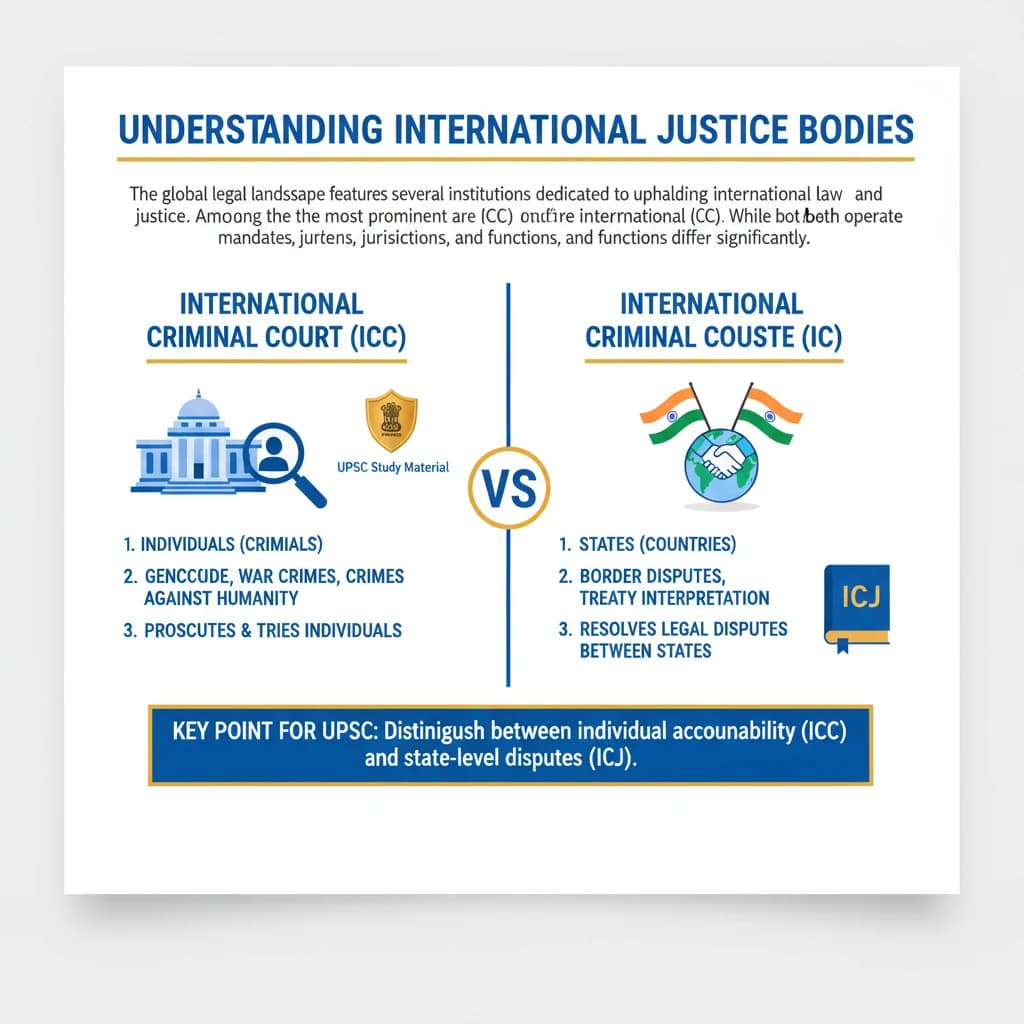
Difference between ICC and ICJ

Difference between ICC and ICJ

Medium⏱️ 8 min read✓ 98% Verified
international relations

📖 Introduction

<h4>Introduction to International Courts</h4><p>The global legal landscape features two prominent international judicial bodies: the <strong>International Court of Justice (ICJ)</strong> and the <strong>International Criminal Court (ICC)</strong>. While both are located in <strong>The Hague, the Netherlands</strong>, and deal with international law, their mandates, jurisdictions, and relationships with the <strong>United Nations</strong> are fundamentally distinct.</p><p>Understanding these differences is crucial for comprehending the architecture of international justice and accountability.</p><h4>International Court of Justice (ICJ)</h4><div class='info-box'><strong>Established:</strong> <strong>1945</strong><br><strong>UN Relationship:</strong> <strong>Highest judicial organ of the United Nations</strong><br><strong>Location:</strong> <strong>The Hague, the Netherlands</strong></div><p>The <strong>ICJ</strong> primarily resolves <strong>legal disputes between states</strong>. It also provides <strong>advisory opinions</strong> on legal questions referred to it by authorized <strong>UN</strong> organs and specialized agencies, clarifying complex international legal issues.</p><p>Its <strong>jurisdiction</strong> is limited to <strong>UN member-states</strong> that have consented to its authority. The <strong>ICJ</strong> does not prosecute individuals; its focus is solely on state-to-state matters.</p><div class='key-point-box'><strong>Enforcement:</strong> The <strong>ICJ</strong> possesses <strong>no direct enforcement power</strong>. It relies on the <strong>UN Security Council</strong> to uphold its judgments, where <strong>permanent members hold veto power</strong>, potentially hindering enforcement.</div><p>There is <strong>no appeal mechanism</strong> for <strong>ICJ</strong> judgments, making its decisions final and binding for the parties involved in a particular case.</p><h4>International Criminal Court (ICC)</h4><div class='info-box'><strong>Established:</strong> <strong>2002</strong><br><strong>UN Relationship:</strong> <strong>Not part of the United Nations system</strong><br><strong>Location:</strong> <strong>The Hague, the Netherlands</strong></div><p>The <strong>ICC</strong> was established by the <strong>Rome Statute</strong> to prosecute <strong>individuals</strong> for the most serious international crimes. These include <strong>genocide, crimes against humanity, war crimes, and the crime of aggression</strong>.</p><p>Its <strong>jurisdiction</strong> extends to individuals from states that are parties to the <strong>Rome Statute</strong>, or when a situation is referred by the <strong>UN Security Council</strong>, ensuring individual accountability.</p><div class='key-point-box'><strong>Enforcement:</strong> The <strong>ICC</strong> also lacks its own enforcement capabilities. It depends on the <strong>cooperation of member states</strong> to arrest suspects, gather evidence, and enforce sentences, which can be a significant challenge.</div><p>Unlike the <strong>ICJ</strong>, decisions of the <strong>ICC</strong> can be <strong>appealed</strong> within its own judicial structure, providing a mechanism for review of its judgments.</p><h4>Key Differentiators: A Comparative Overview</h4><table class='info-table'><tr><th>Feature</th><th>International Court of Justice (ICJ)</th><th>International Criminal Court (ICC)</th></tr><tr><td><strong>Established</strong></td><td><strong>1945</strong></td><td><strong>2002</strong></td></tr><tr><td><strong>UN Relationship</strong></td><td>Highest court of the <strong>UN</strong></td><td><strong>Not part of the UN</strong></td></tr><tr><td><strong>Jurisdiction</strong></td><td><strong>UN member-states</strong></td><td><strong>Individuals</strong></td></tr><tr><td><strong>Types of Cases</strong></td><td>Legal disputes between <strong>states</strong>, advisory opinions</td><td>Prosecutes <strong>individuals</strong> for serious international crimes (<strong>Rome Statute</strong>)</td></tr><tr><td><strong>Appeals</strong></td><td><strong>No</strong></td><td><strong>Yes</strong></td></tr><tr><td><strong>Enforcement</strong></td><td>Relies on <strong>UN Security Council</strong> (<strong>veto power</strong>)</td><td>Relies on <strong>member state cooperation</strong></td></tr></table><div class='exam-tip-box'>Understanding these distinctions is crucial for <strong>UPSC Mains GS-II International Relations</strong>. Questions often test the nuanced roles and limitations of international judicial bodies, requiring precise knowledge of their mandates.</div>
Concept Diagram

💡 Key Takeaways

  • •ICJ resolves disputes between states; ICC prosecutes individuals for grave international crimes.
  • •ICJ is a UN organ (established 1945); ICC is independent, established by the Rome Statute (entered into force 2002).
  • •Both courts are located in The Hague, the Netherlands.
  • •ICJ judgments are final with no appeal; ICC decisions can be appealed within its own structure.
  • •Enforcement for both courts relies on external cooperation (UN Security Council for ICJ, member states for ICC).

🧠 Memory Techniques
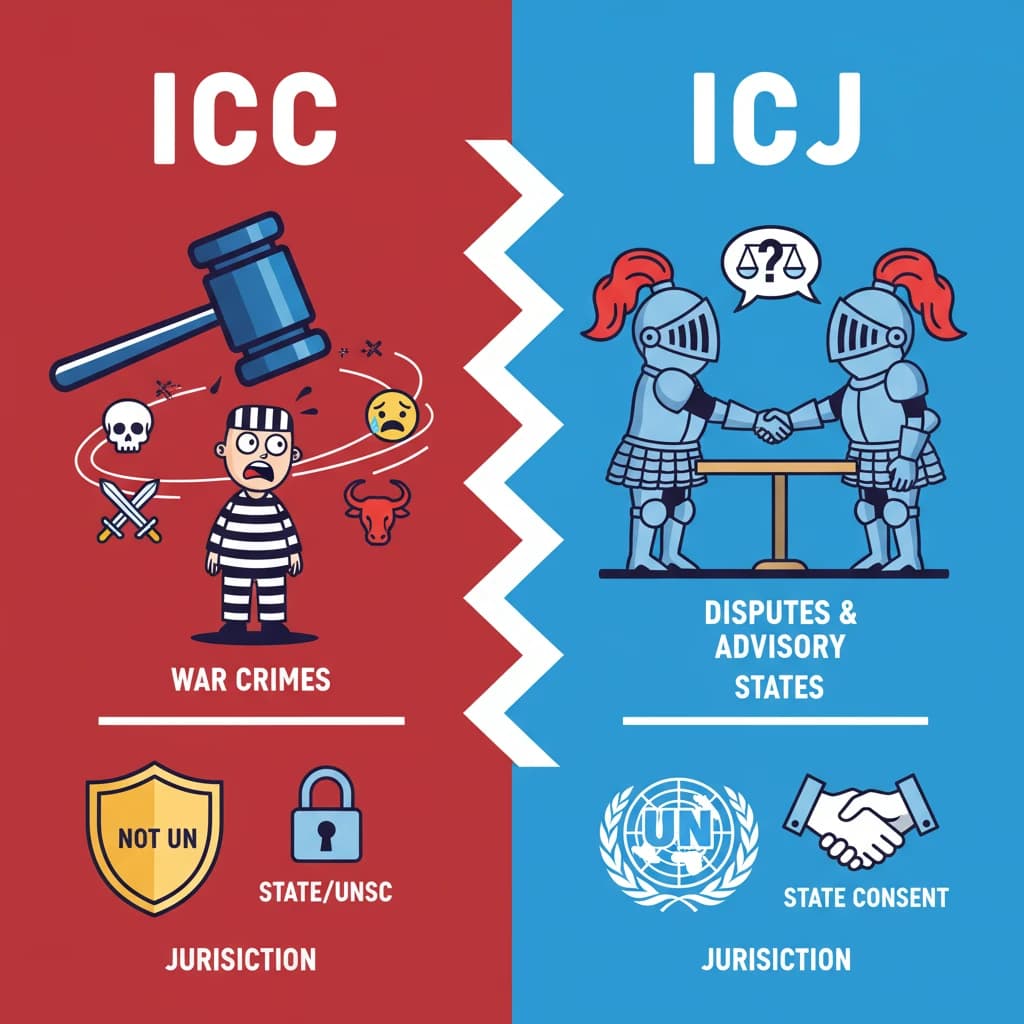
Memory Aid
98% Verified Content

Related Topics

Loading related topics...
Explore:International Relations Topics·All Subjects·Daily Current Affairs·Editorial Analysis·Previous Year Questions·UPSC GPT