Loading page, please wait…
16th BRICS Summit & India-China Border Agreement - UPSC International Relations
What is 16th BRICS Summit & India-China Border Agreement in UPSC International Relations?
16th BRICS Summit & India-China Border Agreement is a key topic under International Relations for UPSC Civil Services Examination. Key points include: The 16th BRICS Summit in Kazan, Russia, saw significant diplomatic activity, including India-China border talks.. India and China agreed on 'complete disengagement and resolution' of 2020 border issues, marking a crucial step towards de-escalation.. India and Maldives expanded cooperation across infrastructure (Thilafushi port), trade (FTA talks), digital (UPI, RuPay), energy (OSOWOG), and health (Jan Aushadhi Kendras).. Understanding this topic is essential for both UPSC Prelims and Mains preparation.
Why is 16th BRICS Summit & India-China Border Agreement important for UPSC exam?
16th BRICS Summit & India-China Border Agreement is a Medium-level topic in UPSC International Relations. It is tested in both Prelims (factual MCQs) and Mains (analytical answer writing). Previous year UPSC questions have frequently covered aspects of 16th BRICS Summit & India-China Border Agreement, making it essential for comprehensive IAS preparation.
How to prepare 16th BRICS Summit & India-China Border Agreement for UPSC?
To prepare 16th BRICS Summit & India-China Border Agreement for UPSC: (1) Study the comprehensive notes covering all key concepts on Vaidra. (2) Practice previous year questions on this topic. (3) Connect it with current affairs using daily updates. (4) Revise using key takeaways and mind maps available for International Relations. (5) Write practice answers linking 16th BRICS Summit & India-China Border Agreement to related GS Paper topics.
Key takeaways of 16th BRICS Summit & India-China Border Agreement for UPSC
- The 16th BRICS Summit in Kazan, Russia, saw significant diplomatic activity, including India-China border talks.
- India and China agreed on 'complete disengagement and resolution' of 2020 border issues, marking a crucial step towards de-escalation.
- India and Maldives expanded cooperation across infrastructure (Thilafushi port), trade (FTA talks), digital (UPI, RuPay), energy (OSOWOG), and health (Jan Aushadhi Kendras).
- India is actively exporting its Digital Public Infrastructure (DPI) model and promoting renewable energy initiatives like One Sun One World One Grid (OSOWOG).
- These developments underscore India's 'Neighbourhood First' policy, its growing role in multilateral forums, and its commitment to regional stability and sustainable development.
16th BRICS Summit & India-China Border Agreement
Medium⏱️ 8 min read
international relations
📖 Introduction
Context of the 16th BRICS Summit
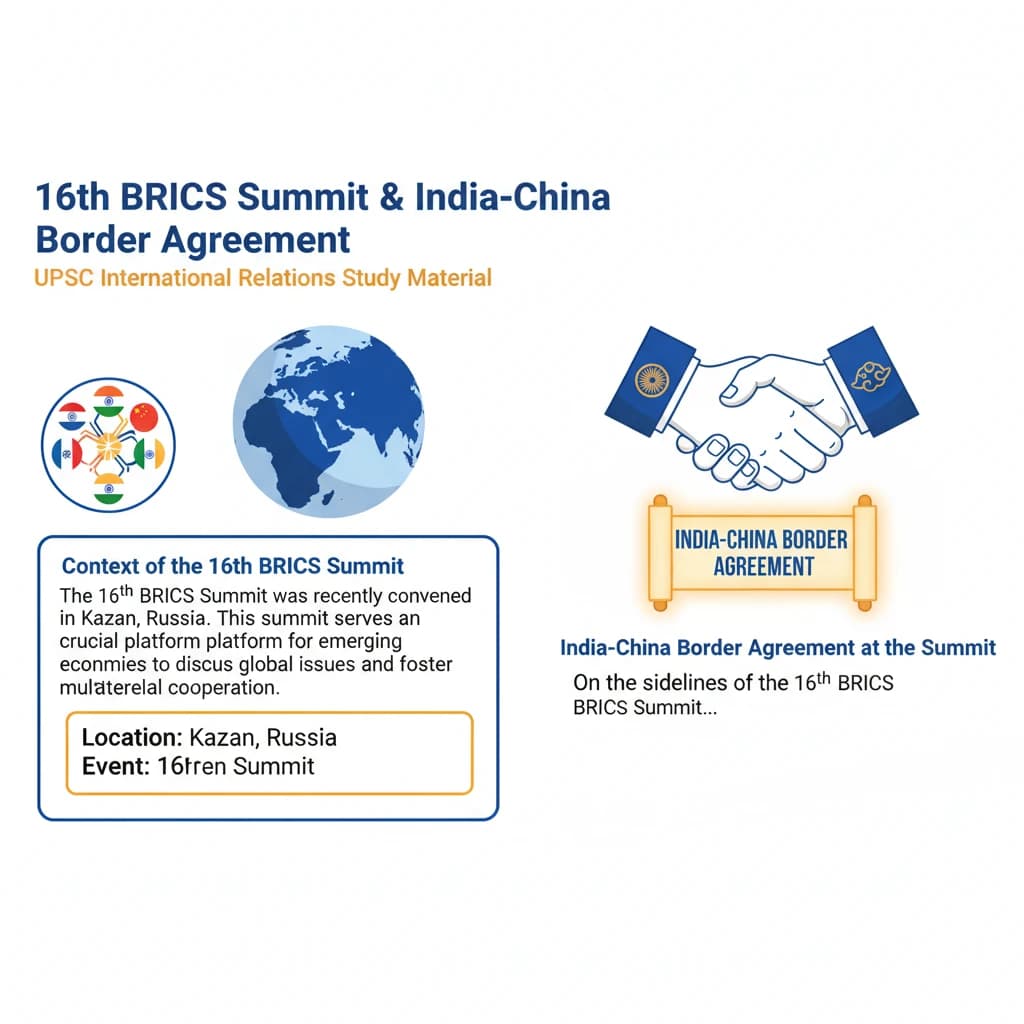
The 16th BRICS Summit was recently convened in Kazan, Russia. This summit serves as a crucial platform for emerging economies to discuss global issues and foster multilateral cooperation.
Location: Kazan, Russia
Event: 16th BRICS Summit
India-China Border Agreement at the Summit
On the sidelines of the 16th BRICS Summit, the Prime Minister of India held a bilateral meeting with China. This marked their first such interaction since 2020.
During this meeting, India welcomed a significant agreement with China. This agreement pertains to the “complete disengagement and resolution” of the outstanding border issues that arose in 2020.
The agreement signifies a step towards de-escalation and aims to normalize relations along the India-China border, addressing long-standing friction points.
India-Maldives Enhanced Cooperation Initiatives
India and Maldives have agreed to expand their bilateral cooperation across multiple vital sectors, strengthening their strategic partnership in the Indian Ocean region.
Infrastructure and Connectivity Development
Both nations are set to collaborate on significant infrastructure projects aimed at boosting connectivity and economic activity in the Maldives.
- Development of a commercial port at Thilafushi to enhance maritime trade.
- Expansion of transshipment and bunkering services, critical for regional shipping.
- Maximizing the potential of key airports such as Hanimaadhoo and Gan to improve air connectivity and tourism.
Trade and Economic Partnership
Discussions are underway to deepen economic ties, focusing on sustainable growth and diversification.
- Initiation of discussions on a bilateral free trade agreement (FTA) to boost trade volumes.
- Exploration of local currency trade settlement to reduce reliance on third-party currencies.
- Promotion of investment in key sectors within the Maldives.
- Efforts towards economic diversification to build a resilient Maldivian economy.
- Strategies to significantly boost tourism, a cornerstone of the Maldivian economy.
Digital and Financial Integration
India is extending its expertise in digital public infrastructure to the Maldives, fostering e-governance and ease of transactions.
- Cooperation in Digital Public Infrastructure (DPI), leveraging India’s successful models.
- Launch of India’s Unified Payments Interface (UPI) in Maldives for seamless digital payments.
- Implementation of Unique Digital Identity and integration with India’s Gati Shakti Scheme.
- Introduction of other digital services to enhance e-governance and efficient service delivery.
The RuPay Card has been launched in Maldives to facilitate easier payments for Indian tourists, promoting financial integration.
Energy and Climate Collaboration
Both countries are committed to addressing climate change and promoting sustainable energy solutions.
- Collaboration on renewable energy projects to support Maldives’ climate goals.
- Focus on energy efficiency initiatives to reduce energy consumption.
- India will assist Maldives in participating in the One Sun One World One Grid (OSOWOG) initiative, a global solar energy project.
Health Sector Strengthening
Joint efforts are being made to improve healthcare access and services in the Maldives.
- Establishment of Jan Aushadhi Kendras across Maldives to provide affordable generic medicines from India.
- Collaboration on enhancing mental health services and support.
- Joint initiatives for drug de-addiction programs.
- Capacity-building efforts for emergency medical evacuation services.
Understanding the multi-faceted cooperation between India and its neighbors, particularly in the Indian Ocean Region, is crucial for UPSC Mains GS Paper 2 (International Relations) and GS Paper 3 (Economy, Environment). Note how India's initiatives like DPI and OSOWOG are being extended globally.
💡 Key Takeaways
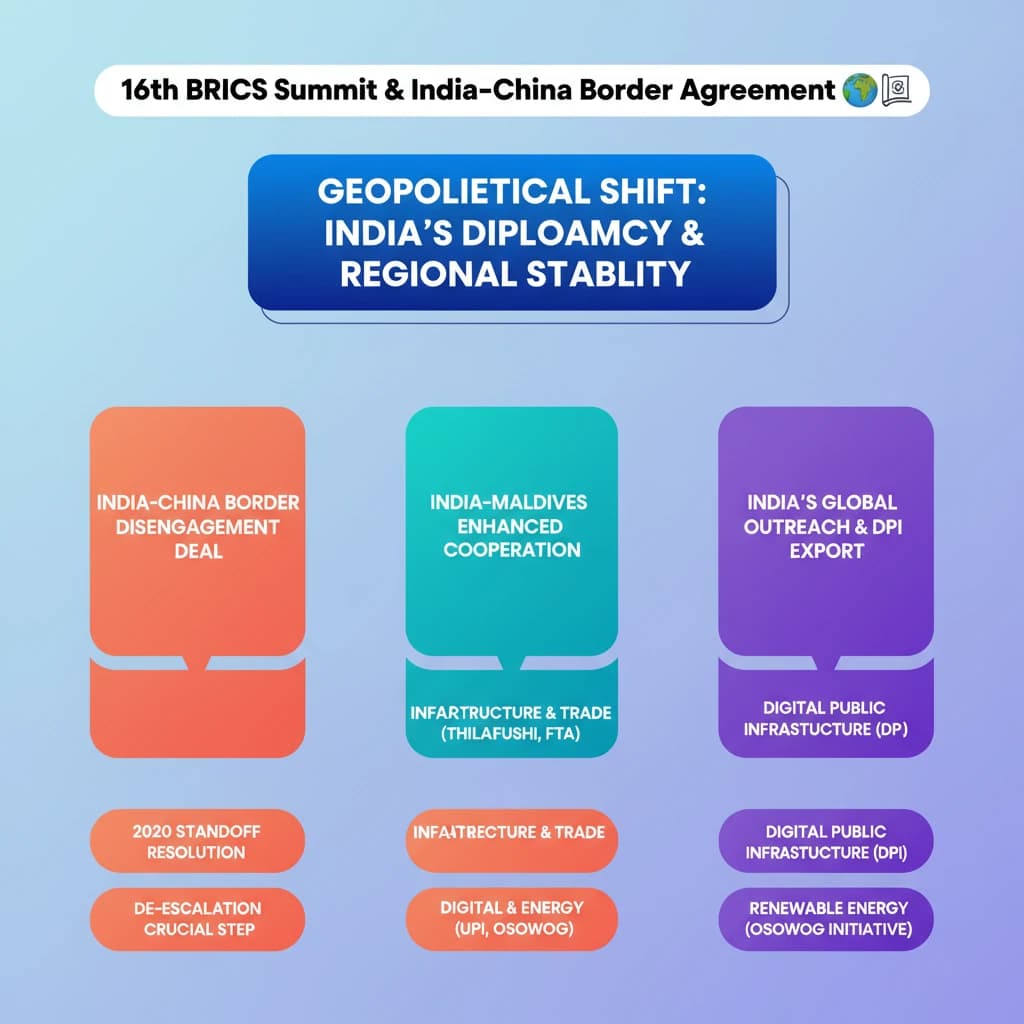
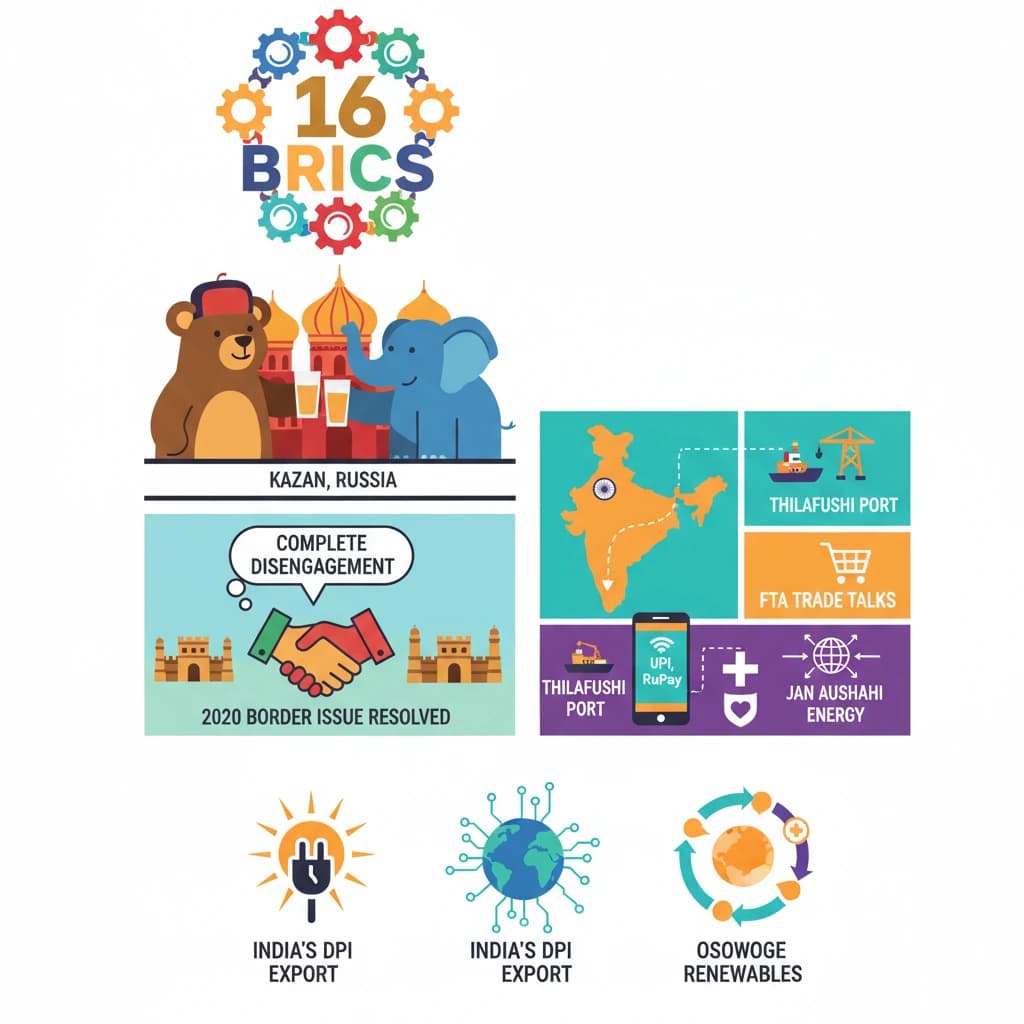
- •The 16th BRICS Summit in Kazan, Russia, saw significant diplomatic activity, including India-China border talks.
- •India and China agreed on 'complete disengagement and resolution' of 2020 border issues, marking a crucial step towards de-escalation.
- •India and Maldives expanded cooperation across infrastructure (Thilafushi port), trade (FTA talks), digital (UPI, RuPay), energy (OSOWOG), and health (Jan Aushadhi Kendras).
- •India is actively exporting its Digital Public Infrastructure (DPI) model and promoting renewable energy initiatives like One Sun One World One Grid (OSOWOG).
- •These developments underscore India's 'Neighbourhood First' policy, its growing role in multilateral forums, and its commitment to regional stability and sustainable development.
🧠 Memory Techniques
95% Verified Content
📚 Reference Sources
•Official statements regarding 16th BRICS Summit
•News reports on India-China border talks and India-Maldives cooperation