Loading page, please wait…
19th NAM Summit and India-Uganda Relations - UPSC International Relations
What is 19th NAM Summit and India-Uganda Relations in UPSC International Relations?
19th NAM Summit and India-Uganda Relations is a key topic under International Relations for UPSC Civil Services Examination. Key points include: 19th NAM Summit hosted in Kampala, Uganda.. Ugandan President Museveni regretted Idi Amin's 1972 expulsion of Indians.. Museveni praised Indian diaspora's achievements and India's Global South leadership.. Understanding this topic is essential for both UPSC Prelims and Mains preparation.
Why is 19th NAM Summit and India-Uganda Relations important for UPSC exam?
19th NAM Summit and India-Uganda Relations is a Medium-level topic in UPSC International Relations. It is tested in both Prelims (factual MCQs) and Mains (analytical answer writing). Previous year UPSC questions have frequently covered aspects of 19th NAM Summit and India-Uganda Relations, making it essential for comprehensive IAS preparation.
How to prepare 19th NAM Summit and India-Uganda Relations for UPSC?
To prepare 19th NAM Summit and India-Uganda Relations for UPSC: (1) Study the comprehensive notes covering all key concepts on Vaidra. (2) Practice previous year questions on this topic. (3) Connect it with current affairs using daily updates. (4) Revise using key takeaways and mind maps available for International Relations. (5) Write practice answers linking 19th NAM Summit and India-Uganda Relations to related GS Paper topics.
Key takeaways of 19th NAM Summit and India-Uganda Relations for UPSC
- 19th NAM Summit hosted in Kampala, Uganda.
- Ugandan President Museveni regretted Idi Amin's 1972 expulsion of Indians.
- Museveni praised Indian diaspora's achievements and India's Global South leadership.
- Idi Amin's expulsion devastated Uganda's economy and led to mass exodus of Asians.
- The event signifies diplomatic reconciliation and strengthened India-Uganda ties.
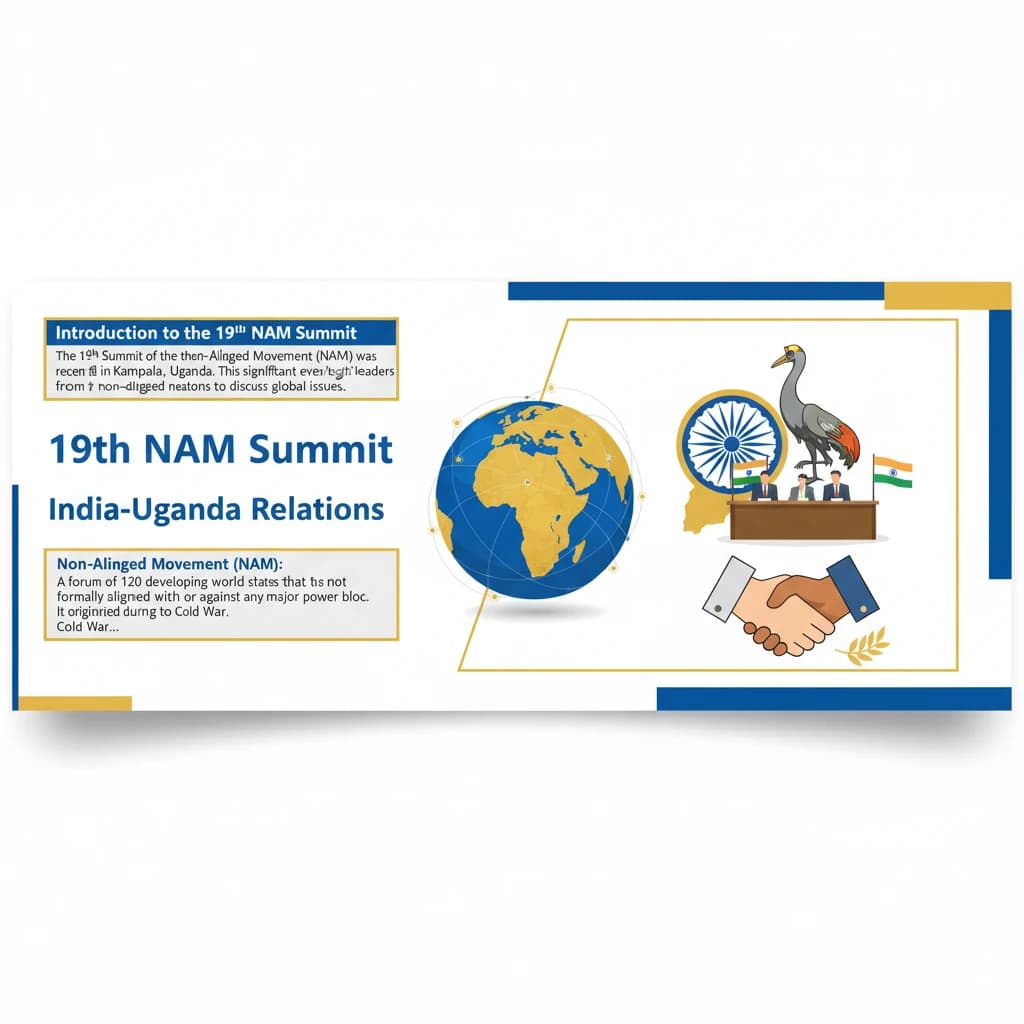
19th NAM Summit and India-Uganda Relations
Medium⏱️ 4 min read
international relations
📖 Introduction
Introduction to the 19th NAM Summit
The 19th Summit of the Non-Aligned Movement (NAM) was recently hosted in Kampala, Uganda. This significant event brought together leaders from various non-aligned nations to discuss global issues.
Non-Aligned Movement (NAM): A forum of 120 developing world states that are not formally aligned with or against any major power bloc. It originated during the Cold War.
Ugandan President's Diplomatic Gesture
During the summit, Ugandan President Yoweri Museveni expressed profound regret over the expulsion of Indians by former dictator Idi Amin in the 1970s. This statement marked a significant moment in India-Uganda bilateral relations.
President Museveni also commended the remarkable achievements of the Indian diaspora in Uganda. He further lauded India's pivotal role in supporting and leading the Global South on various international platforms.
Significance of Museveni's Statement: It represents a diplomatic gesture of reconciliation and acknowledges the historical injustice faced by the Indian community, paving the way for stronger bilateral ties.
Historical Context: Idi Amin's Expulsion Order
In August 1972, Idi Amin, the then-dictator of Uganda, issued a decree ordering the expulsion of all Indians and other Asians residing and working in the country. This drastic measure led to a mass exodus.
The expulsion had a devastating and immediate impact on the Ugandan economy. The departing Asian community, largely comprising business owners and professionals, left a significant void in the country's commercial and administrative sectors.
Understanding such historical events is crucial for UPSC Mains GS Paper 2 (International Relations), especially when discussing diaspora's role, diplomatic relations, and post-colonial challenges.

💡 Key Takeaways
- •19th NAM Summit hosted in Kampala, Uganda.
- •Ugandan President Museveni regretted Idi Amin's 1972 expulsion of Indians.
- •Museveni praised Indian diaspora's achievements and India's Global South leadership.
- •Idi Amin's expulsion devastated Uganda's economy and led to mass exodus of Asians.
- •The event signifies diplomatic reconciliation and strengthened India-Uganda ties.
🧠 Memory Techniques

98% Verified Content
📚 Reference Sources
•General knowledge of Non-Aligned Movement (NAM)
•Historical accounts of Idi Amin's regime and the expulsion of Asians from Uganda