Loading page, please wait…
Vaidra Logo
Vaidra

Top 4 items + smart groups

UPSC GPT
New
Current Affairs
Daily Solutions
Daily Puzzle
Mains Evaluator

Version 2.0.0 • Built with ❤️ for UPSC aspirants

Loading...
Loading...
Loading...
Loading...
Loading...
Loading...
Loading...
Loading...
Loading...
Loading...
Loading...
Loading...
Loading...
Back
All Subjects

Topics

0 topics • 0 completed

Loading topics...
Loading...
Loading...
Loading...
Loading...
Loading...
Overall Progress0%

2nd Retreat of the Foreign Ministers of the BIMSTEC - UPSC International Relations

What is 2nd Retreat of the Foreign Ministers of the BIMSTEC in UPSC International Relations?

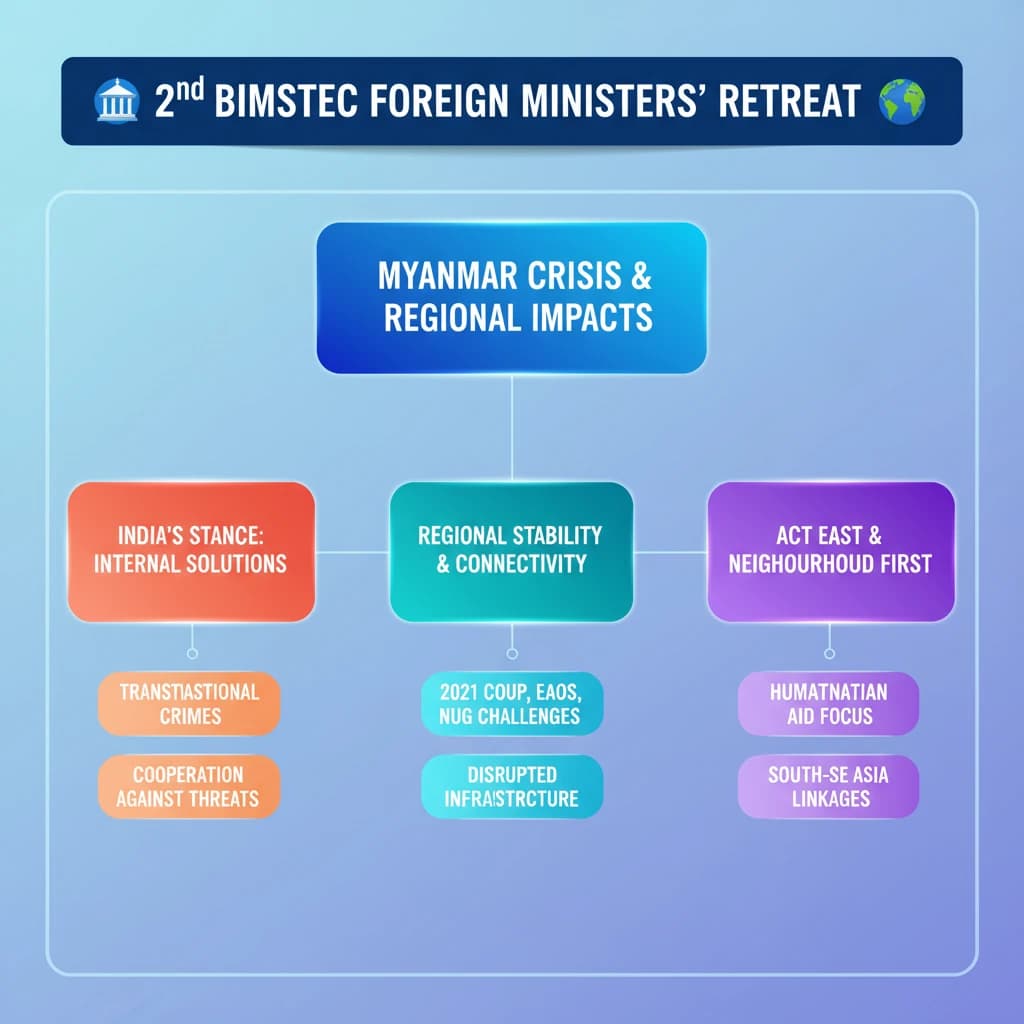
2nd Retreat of the Foreign Ministers of the BIMSTEC is a key topic under International Relations for UPSC Civil Services Examination. Key points include: The 2nd BIMSTEC Foreign Ministers' Retreat focused heavily on the Myanmar crisis and its regional impacts.. India emphasized internal regional solutions for challenges and continued cooperation against transnational crimes.. The Myanmar crisis (2021 coup, EAOs, NUG) severely affects regional stability and connectivity projects.. Understanding this topic is essential for both UPSC Prelims and Mains preparation.

Why is 2nd Retreat of the Foreign Ministers of the BIMSTEC important for UPSC exam?

2nd Retreat of the Foreign Ministers of the BIMSTEC is a Medium-level topic in UPSC International Relations. It is tested in both Prelims (factual MCQs) and Mains (analytical answer writing). Previous year UPSC questions have frequently covered aspects of 2nd Retreat of the Foreign Ministers of the BIMSTEC, making it essential for comprehensive IAS preparation.

How to prepare 2nd Retreat of the Foreign Ministers of the BIMSTEC for UPSC?

To prepare 2nd Retreat of the Foreign Ministers of the BIMSTEC for UPSC: (1) Study the comprehensive notes covering all key concepts on Vaidra. (2) Practice previous year questions on this topic. (3) Connect it with current affairs using daily updates. (4) Revise using key takeaways and mind maps available for International Relations. (5) Write practice answers linking 2nd Retreat of the Foreign Ministers of the BIMSTEC to related GS Paper topics.

Key takeaways of 2nd Retreat of the Foreign Ministers of the BIMSTEC for UPSC

  • The 2nd BIMSTEC Foreign Ministers' Retreat focused heavily on the Myanmar crisis and its regional impacts.
  • India emphasized internal regional solutions for challenges and continued cooperation against transnational crimes.
  • The Myanmar crisis (2021 coup, EAOs, NUG) severely affects regional stability and connectivity projects.
  • BIMSTEC is crucial for India's Act East and Neighbourhood First policies, linking South and Southeast Asia.
  • Humanitarian aid and addressing transnational crimes are key areas of focus for BIMSTEC amidst regional instability.
2nd Retreat of the Foreign Ministers of the BIMSTEC

2nd Retreat of the Foreign Ministers of the BIMSTEC

Medium⏱️ 10 min read✓ 95% Verified
international relations

📖 Introduction

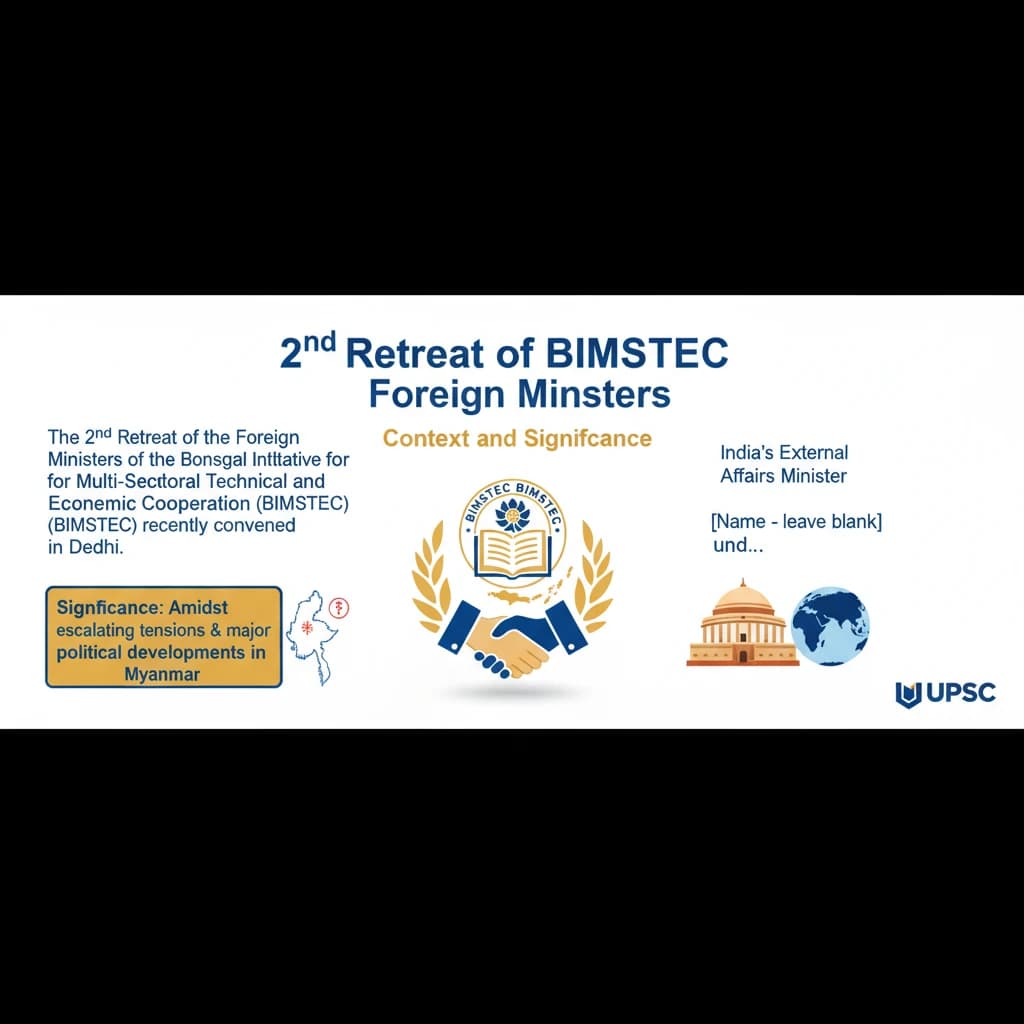
<h4>2nd Retreat of BIMSTEC Foreign Ministers: Context and Significance</h4><p>The <strong>2nd Retreat of the Foreign Ministers</strong> of the <strong>Bay of Bengal Initiative for Multi-Sectoral Technical and Economic Cooperation (BIMSTEC)</strong> recently convened in <strong>New Delhi</strong>. This meeting gained significant importance amidst escalating tensions and major political developments occurring in <strong>Myanmar</strong>.</p><p>India's <strong>External Affairs Minister</strong> underscored the critical need for <strong>BIMSTEC</strong> to address its regional challenges internally. This emphasis was particularly strong given the recent setbacks faced by <strong>Myanmar’s military junta</strong> against various <strong>Ethnic Armed Organisations (EAOs)</strong>.</p><h4>Key Highlights of the Retreat</h4><div class='key-point-box'><p>The meeting's discussions focused on several crucial areas, reflecting the current regional and global landscape.</p></div><ul><li><strong>Global and Regional Developments:</strong> The ministers stressed the urgency of employing established tools like <strong>capacity building</strong> and <strong>economic cooperation</strong>. This is vital for navigating contemporary global and regional challenges effectively.</li><li><strong>Myanmar Crisis Impact:</strong> A central topic was the profound impact of the <strong>Myanmar crisis</strong> on overall <strong>regional stability</strong> and various <strong>development projects</strong>. The instability directly affects connectivity and developmental initiatives linking <strong>Nepal, Bhutan, India, Bangladesh, Myanmar, and Thailand</strong>.</li><li><strong>Humanitarian Assistance:</strong> Conversations included exploring potential avenues for <strong>humanitarian aid</strong>. Currently, India's assistance has been primarily directed towards displaced populations and military personnel seeking refuge in <strong>Mizoram</strong>.</li><li><strong>India's Stance on Myanmar:</strong> India maintains a cautious approach, especially as <strong>Ethnic Armed Organizations (EAOs)</strong> have gained control over crucial <strong>trade routes</strong> and territories near international borders. India continues to collaborate on countering <strong>transnational crimes</strong> such as <strong>cybercrime, narcotics, and illegal arms</strong>.</li></ul><h4>Understanding the Myanmar Crisis</h4><p>The <strong>Myanmar crisis</strong> began in <strong>February 2021</strong> when <strong>Myanmar’s military (the Tatmadaw) junta</strong> overthrew the democratically elected government. This coup triggered widespread protests and a robust <strong>civil disobedience movement</strong> demanding the restoration of democracy.</p><p>In response to the junta's crackdown, various opposition groups, including <strong>Ethnic Armed Organizations (EAOs)</strong>, formed the <strong>People’s Defence Forces (PDFs)</strong>. These forces are resisting military rule and are aligned with the <strong>National Unity Government (NUG)</strong>, which was established by ousted lawmakers.</p><p>Since <strong>October 2023</strong>, fighting between the military and armed opposition groups has intensified significantly. This has led to widespread displacement and a severe <strong>humanitarian crisis</strong> across the country.</p><div class='info-box'><p><strong>Humanitarian Impact:</strong> Approximately <strong>2.6 million people</strong> have fled their homes. An estimated <strong>18.6 million people</strong>, roughly one-third of the total population, are in urgent need of humanitarian assistance. Rising <strong>inflation</strong> and ongoing conflict have drastically increased the prices of food and basic necessities, contributing to hunger and potential illness for a quarter of the population.</p></div><h4>Broader Regional Security Context: India-China Border Agreements</h4><p>While not directly related to BIMSTEC, the source material mentions two significant agreements concerning regional security, specifically in the context of India-China border management. These frameworks highlight broader efforts to maintain peace in sensitive border areas.</p><h5>The Agreement on the Maintenance of Peace and Tranquility (1993)</h5><p>This pivotal agreement was signed in <strong>1993</strong> between <strong>India and China</strong>. It called for a mutual renunciation of the use of force and explicit recognition of the <strong>Line of Actual Control (LAC)</strong>. The agreement also mandated the resolution of border issues through bilateral negotiations.</p><div class='info-box'><p><strong>Significance:</strong> The <strong>1993 Agreement</strong> laid crucial groundwork for stability and security in the border areas. Although tensions have persisted, it remains a foundational document. China accepted this agreement, but its effectiveness has varied over time due to changing geopolitical dynamics and occasional border incidents.</p></div><h5>The Border Defence Cooperation Agreement (BDCA) (2013)</h5><p>The <strong>Border Defence Cooperation Agreement (BDCA)</strong> was signed in <strong>2013</strong> following the significant <strong>Depsang Valley incident</strong>. Its primary objective was to prevent similar face-offs and enhance mutual understanding between border forces.</p><div class='info-box'><p><strong>Current Status:</strong> Despite the <strong>BDCA</strong>, tensions along the <strong>India-China border</strong> have continued, and incidents still occur. Nevertheless, the agreement serves as an important framework for managing border-related issues and striving to maintain peace in the region.</p></div>
Concept Diagram

💡 Key Takeaways

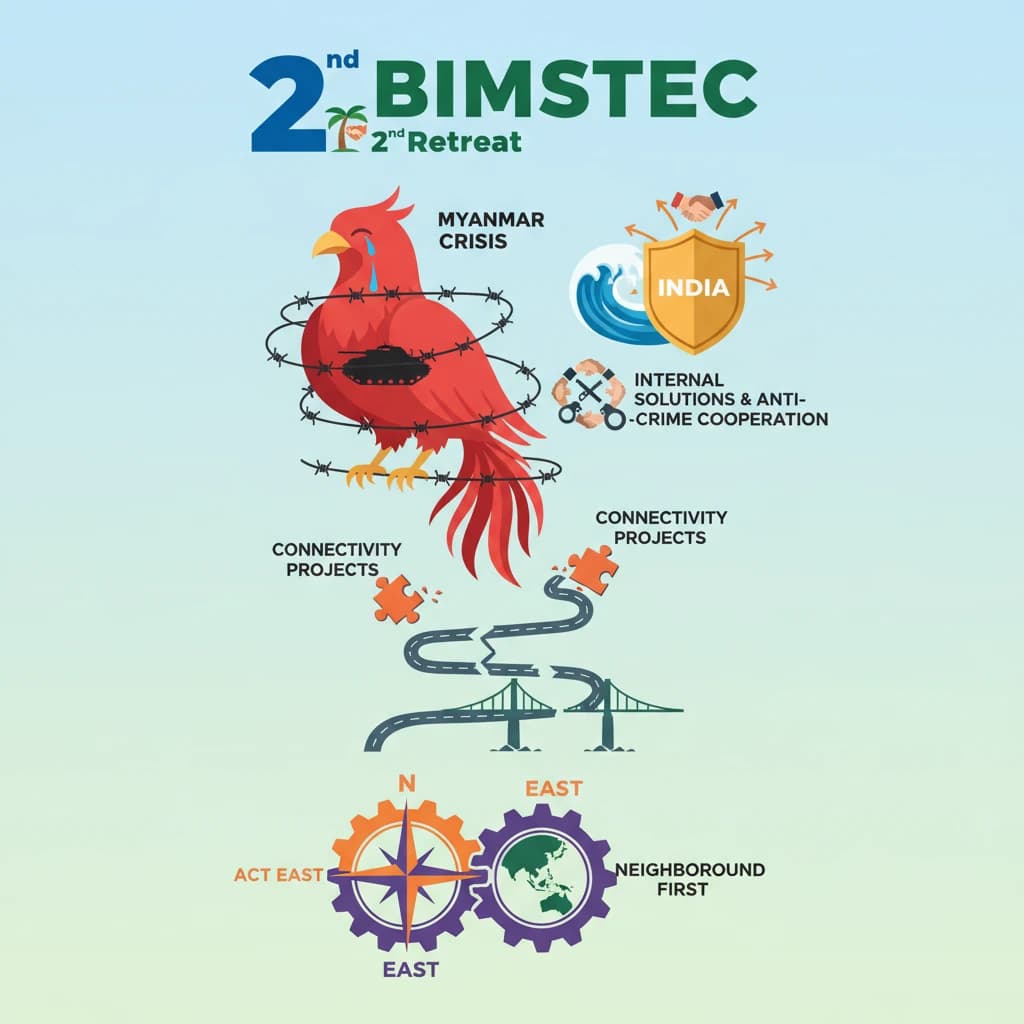
  • •The 2nd BIMSTEC Foreign Ministers' Retreat focused heavily on the Myanmar crisis and its regional impacts.
  • •India emphasized internal regional solutions for challenges and continued cooperation against transnational crimes.
  • •The Myanmar crisis (2021 coup, EAOs, NUG) severely affects regional stability and connectivity projects.
  • •BIMSTEC is crucial for India's Act East and Neighbourhood First policies, linking South and Southeast Asia.
  • •Humanitarian aid and addressing transnational crimes are key areas of focus for BIMSTEC amidst regional instability.

🧠 Memory Techniques
Memory Aid
95% Verified Content

📚 Reference Sources

•Ministry of External Affairs (MEA), Government of India official press releases
•BIMSTEC official website (bimstec.org)
•UNHCR reports on Myanmar humanitarian crisis

Related Topics

Loading related topics...
Explore:International Relations Topics·All Subjects·Daily Current Affairs·Editorial Analysis·Previous Year Questions·UPSC GPT
2nd Retreat of the Foreign Ministers of the BIMSTEC - UPSC International Relations