Loading page, please wait…
Vaidra Logo
Vaidra

Top 4 items + smart groups

UPSC GPT
New
Current Affairs
Daily Solutions
Daily Puzzle
Mains Evaluator

Version 2.0.0 • Built with ❤️ for UPSC aspirants

Loading...
Loading...
Loading...
Loading...
Loading...
Loading...
Loading...
Loading...
Loading...
Loading...
Loading...
Loading...
Loading...
Back
All Subjects

Topics

0 topics • 0 completed

Loading topics...
Loading...
Loading...
Loading...
Loading...
Loading...
Overall Progress0%

India’s Nuclear Program - UPSC International Relations

What is India’s Nuclear Program in UPSC International Relations?

India’s Nuclear Program is a key topic under International Relations for UPSC Civil Services Examination. Key points include: India tested its first nuclear device in May 1974 and maintains a 'no-first-use' nuclear doctrine.. India is not a signatory to the NPT or CTBT but has facility-specific safeguards with the IAEA.. India seeks NSG membership for civilian nuclear commerce and has joined MTCR (2016), Wassenaar Arrangement (2017), and Australia Group (2018).. Understanding this topic is essential for both UPSC Prelims and Mains preparation.

Why is India’s Nuclear Program important for UPSC exam?

India’s Nuclear Program is a Medium-level topic in UPSC International Relations. It is tested in both Prelims (factual MCQs) and Mains (analytical answer writing). Previous year UPSC questions have frequently covered aspects of India’s Nuclear Program, making it essential for comprehensive IAS preparation.

How to prepare India’s Nuclear Program for UPSC?

To prepare India’s Nuclear Program for UPSC: (1) Study the comprehensive notes covering all key concepts on Vaidra. (2) Practice previous year questions on this topic. (3) Connect it with current affairs using daily updates. (4) Revise using key takeaways and mind maps available for International Relations. (5) Write practice answers linking India’s Nuclear Program to related GS Paper topics.

Key takeaways of India’s Nuclear Program for UPSC

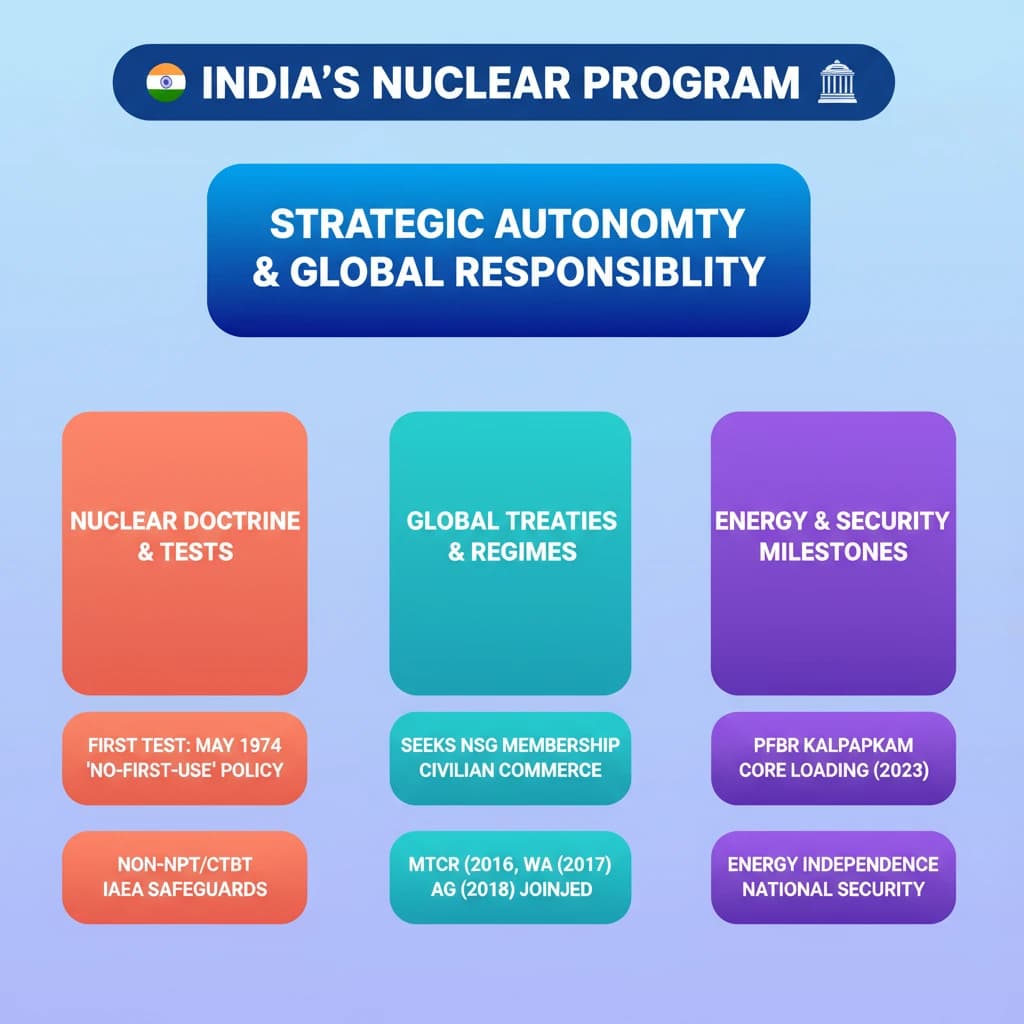
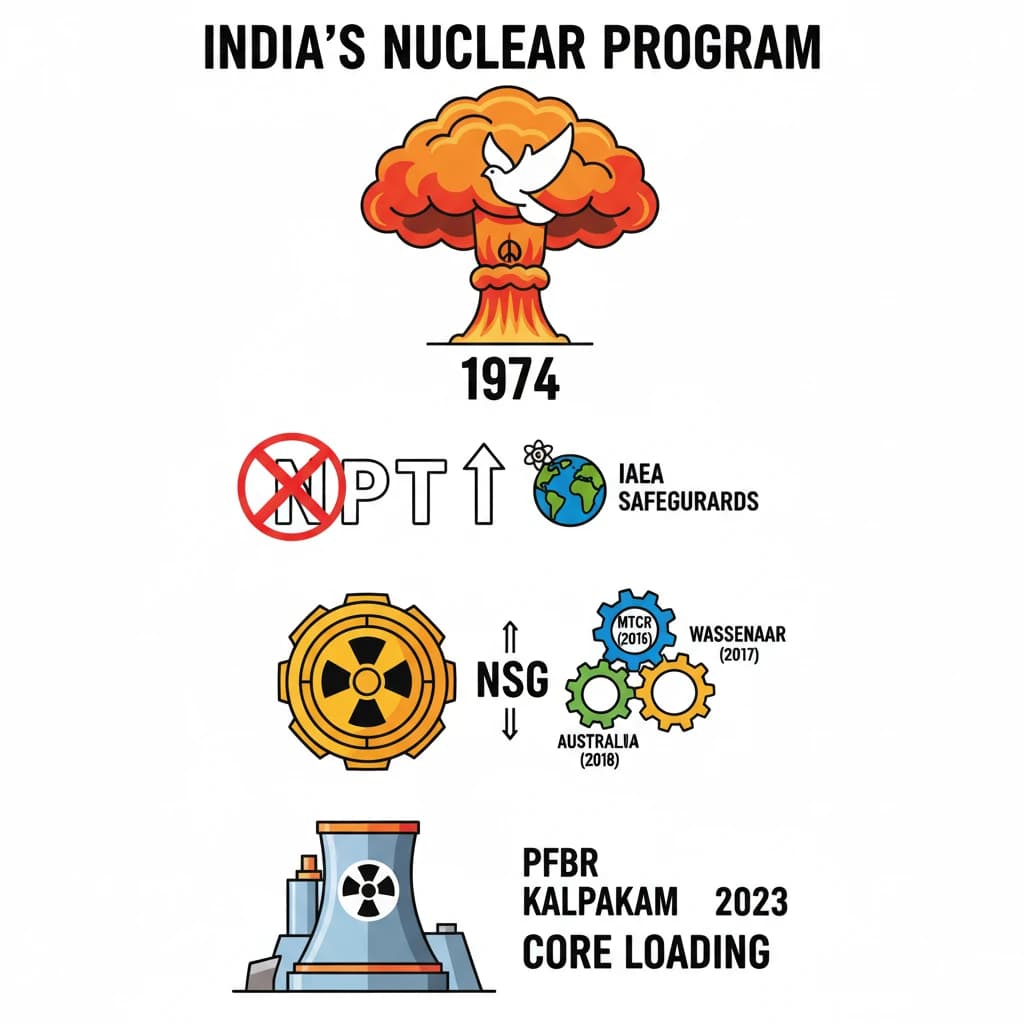
  • India tested its first nuclear device in May 1974 and maintains a 'no-first-use' nuclear doctrine.
  • India is not a signatory to the NPT or CTBT but has facility-specific safeguards with the IAEA.
  • India seeks NSG membership for civilian nuclear commerce and has joined MTCR (2016), Wassenaar Arrangement (2017), and Australia Group (2018).
  • Core loading of the Prototype Fast Breeder Reactor (PFBR) at Kalpakkam in 2023 is a major step in India's nuclear energy program.
  • India's nuclear program balances strategic autonomy, national security, and energy independence with responsible global conduct.
India’s Nuclear Program

India’s Nuclear Program

Medium⏱️ 8 min read✓ 98% Verified
international relations

📖 Introduction

<h4>Overview of India's Nuclear Status</h4><p>India's journey as a nuclear power began with its first nuclear test in <strong>May 1974</strong>. This event marked its entry into the exclusive club of nuclear-armed states.</p><p>Despite its nuclear capabilities, India has consciously chosen to remain outside major international non-proliferation treaties. It is not a signatory to either the <strong>Treaty on the Non-Proliferation of Nuclear Weapons (NPT)</strong> or the <strong>Comprehensive Nuclear Test Ban Treaty (CTBT)</strong>.</p><div class='info-box'><p><strong>Key Fact:</strong> India conducted its first nuclear test in <strong>May 1974</strong>, codenamed <strong>Smiling Buddha</strong>, asserting its technological prowess.</p></div><h4>Engagement with International Nuclear Regimes</h4><p>While not part of the NPT or CTBT, India maintains a strong commitment to nuclear safety and non-proliferation. It has a <strong>facility-specific safeguards agreement</strong> with the <strong>International Atomic Energy Agency (IAEA)</strong>.</p><p>India actively seeks to participate in global civilian nuclear technology commerce. For this, it aims for an exemption from the <strong>Nuclear Suppliers Group (NSG)</strong>, which would allow it to engage in nuclear trade despite its non-NPT status.</p><div class='key-point-box'><p>India's approach is characterized by a commitment to <strong>responsible nuclear stewardship</strong> while maintaining its strategic autonomy.</p></div><h4>Membership in Export Control Regimes</h4><p>India has steadily gained entry into various multilateral export control regimes, signifying its growing integration into the global non-proliferation architecture. These memberships acknowledge India's robust export control systems.</p><ul><li>In <strong>2016</strong>, India was admitted as a member of the <strong>Missile Technology Control Regime (MTCR)</strong>.</li><li>In <strong>2017</strong>, it joined the <strong>Wassenaar Arrangement</strong>.</li><li>In <strong>2018</strong>, India became a member of the <strong>Australia Group</strong>.</li></ul><div class='exam-tip-box'><p>Understanding India's position on <strong>NPT</strong>, <strong>CTBT</strong>, and its membership in regimes like <strong>MTCR</strong>, <strong>Wassenaar</strong>, and <strong>Australia Group</strong> is crucial for UPSC Mains <strong>GS-II</strong> and <strong>GS-III</strong> questions on International Relations and National Security.</p></div><h4>Recent Milestones in India's Nuclear Program</h4><p>India's nuclear program continues to advance, focusing on indigenous development and energy security. A significant recent development highlights its progress in advanced nuclear technology.</p><p>In <strong>2023</strong>, India initiated the <strong>core loading</strong> of its <strong>Prototype Fast Breeder Reactor (PFBR)</strong> at <strong>Kalpakkam, Tamil Nadu</strong>. This marks a critical step towards achieving a closed nuclear fuel cycle and enhancing energy independence.</p><div class='info-box'><p>The <strong>PFBR</strong> at <strong>Kalpakkam</strong> is a key component of India's three-stage nuclear power program, designed to utilize thorium, of which India has vast reserves.</p></div><h4>India's Nuclear Doctrine</h4><p>India maintains a clear and consistent nuclear doctrine. Its official commitment is to a policy of <strong>no-first-use of nuclear weapons</strong>.</p><p>This doctrine underscores India's defensive posture and its commitment to using nuclear weapons solely for deterrence and retaliation, not for initiating conflict.</p>
Concept Diagram

💡 Key Takeaways

  • •India tested its first nuclear device in May 1974 and maintains a 'no-first-use' nuclear doctrine.
  • •India is not a signatory to the NPT or CTBT but has facility-specific safeguards with the IAEA.
  • •India seeks NSG membership for civilian nuclear commerce and has joined MTCR (2016), Wassenaar Arrangement (2017), and Australia Group (2018).
  • •Core loading of the Prototype Fast Breeder Reactor (PFBR) at Kalpakkam in 2023 is a major step in India's nuclear energy program.
  • •India's nuclear program balances strategic autonomy, national security, and energy independence with responsible global conduct.

🧠 Memory Techniques
Memory Aid
98% Verified Content

📚 Reference Sources

•Ministry of External Affairs (MEA) documents on India's nuclear doctrine
•International Atomic Energy Agency (IAEA) reports on safeguards
•Press Information Bureau (PIB) releases on PFBR

Related Topics

Loading related topics...
Explore:International Relations Topics·All Subjects·Daily Current Affairs·Editorial Analysis·Previous Year Questions·UPSC GPT
India’s Nuclear Program - UPSC International Relations