Loading page, please wait…
Vaidra Logo
Vaidra

Top 4 items + smart groups

UPSC GPT
New
Current Affairs
Daily Solutions
Daily Puzzle
Mains Evaluator

Version 2.0.0 • Built with ❤️ for UPSC aspirants

Loading...
Loading...
Loading...
Loading...
Loading...
Loading...
Loading...
Loading...
Loading...
Loading...
Loading...
Loading...
Loading...
Back
All Subjects

Topics

0 topics • 0 completed

Loading topics...
Loading...
Loading...
Loading...
Loading...
Loading...
Overall Progress0%

India-Nepal-Bangladesh Tripartite Agreement - UPSC International Relations

What is India-Nepal-Bangladesh Tripartite Agreement in UPSC International Relations?

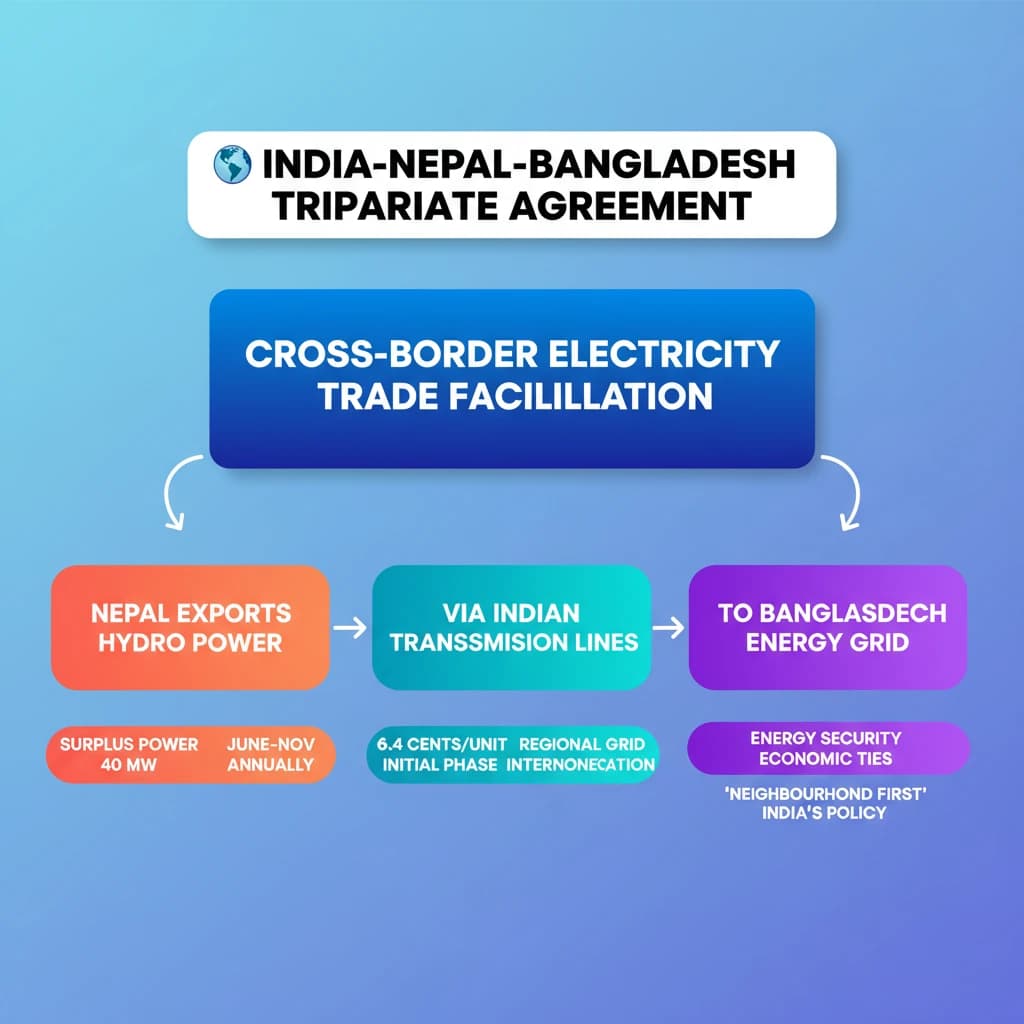
India-Nepal-Bangladesh Tripartite Agreement is a key topic under International Relations for UPSC Civil Services Examination. Key points include: India-Nepal-Bangladesh Tripartite Agreement facilitates cross-border electricity trade.. Nepal exports surplus hydroelectric power to Bangladesh via Indian transmission lines.. Initial phase: 40 MW at 6.4 cents/unit, from June 15 to Nov 15 annually.. Understanding this topic is essential for both UPSC Prelims and Mains preparation.

Why is India-Nepal-Bangladesh Tripartite Agreement important for UPSC exam?

India-Nepal-Bangladesh Tripartite Agreement is a Medium-level topic in UPSC International Relations. It is tested in both Prelims (factual MCQs) and Mains (analytical answer writing). Previous year UPSC questions have frequently covered aspects of India-Nepal-Bangladesh Tripartite Agreement, making it essential for comprehensive IAS preparation.

How to prepare India-Nepal-Bangladesh Tripartite Agreement for UPSC?

To prepare India-Nepal-Bangladesh Tripartite Agreement for UPSC: (1) Study the comprehensive notes covering all key concepts on Vaidra. (2) Practice previous year questions on this topic. (3) Connect it with current affairs using daily updates. (4) Revise using key takeaways and mind maps available for International Relations. (5) Write practice answers linking India-Nepal-Bangladesh Tripartite Agreement to related GS Paper topics.

Key takeaways of India-Nepal-Bangladesh Tripartite Agreement for UPSC

  • India-Nepal-Bangladesh Tripartite Agreement facilitates cross-border electricity trade.
  • Nepal exports surplus hydroelectric power to Bangladesh via Indian transmission lines.
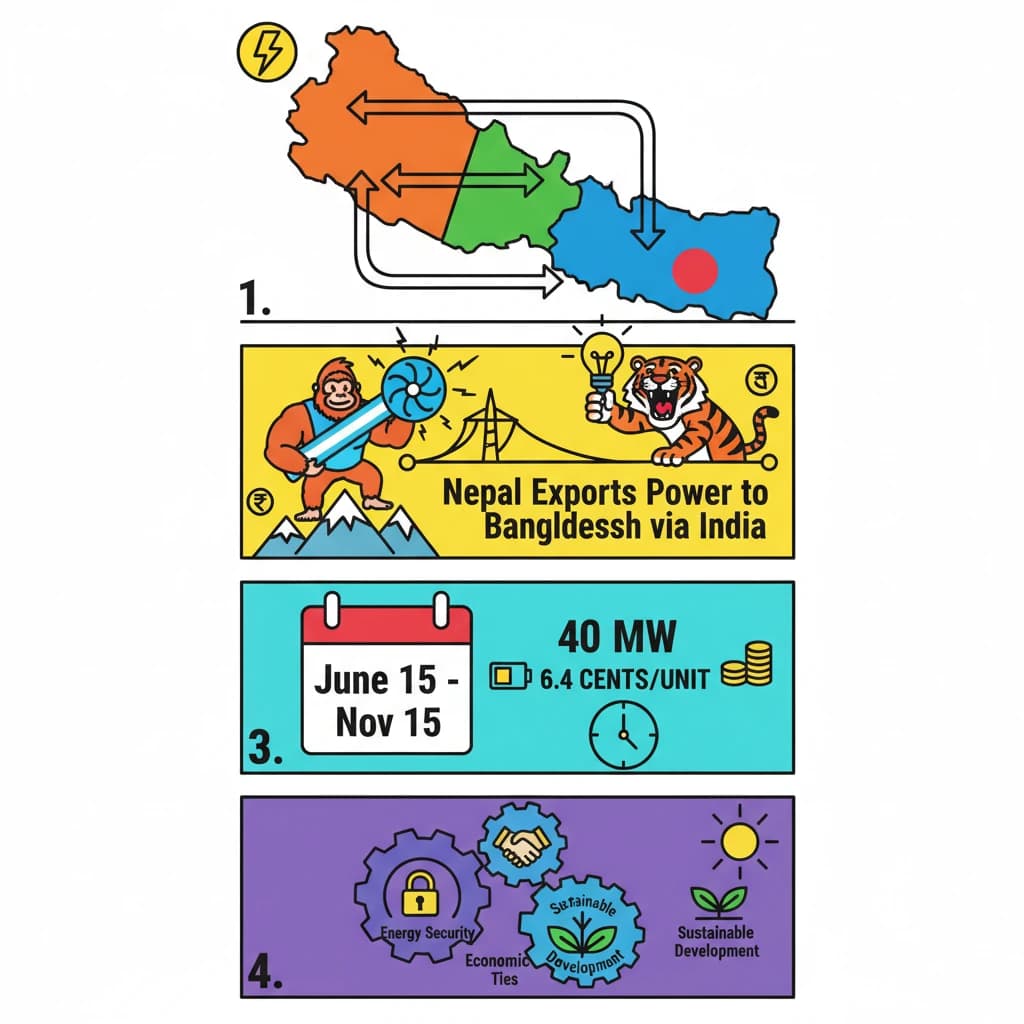
  • Initial phase: 40 MW at 6.4 cents/unit, from June 15 to Nov 15 annually.
  • Strengthens regional energy security, economic ties, and sustainable development.
  • Illustrates India's 'Neighbourhood First' policy and role as a regional facilitator.
  • Reflects cooperation within SAARC, BIMSTEC, and BBIN frameworks.
India-Nepal-Bangladesh Tripartite Agreement

India-Nepal-Bangladesh Tripartite Agreement

Medium⏱️ 6 min read✓ 95% Verified
international relations

📖 Introduction

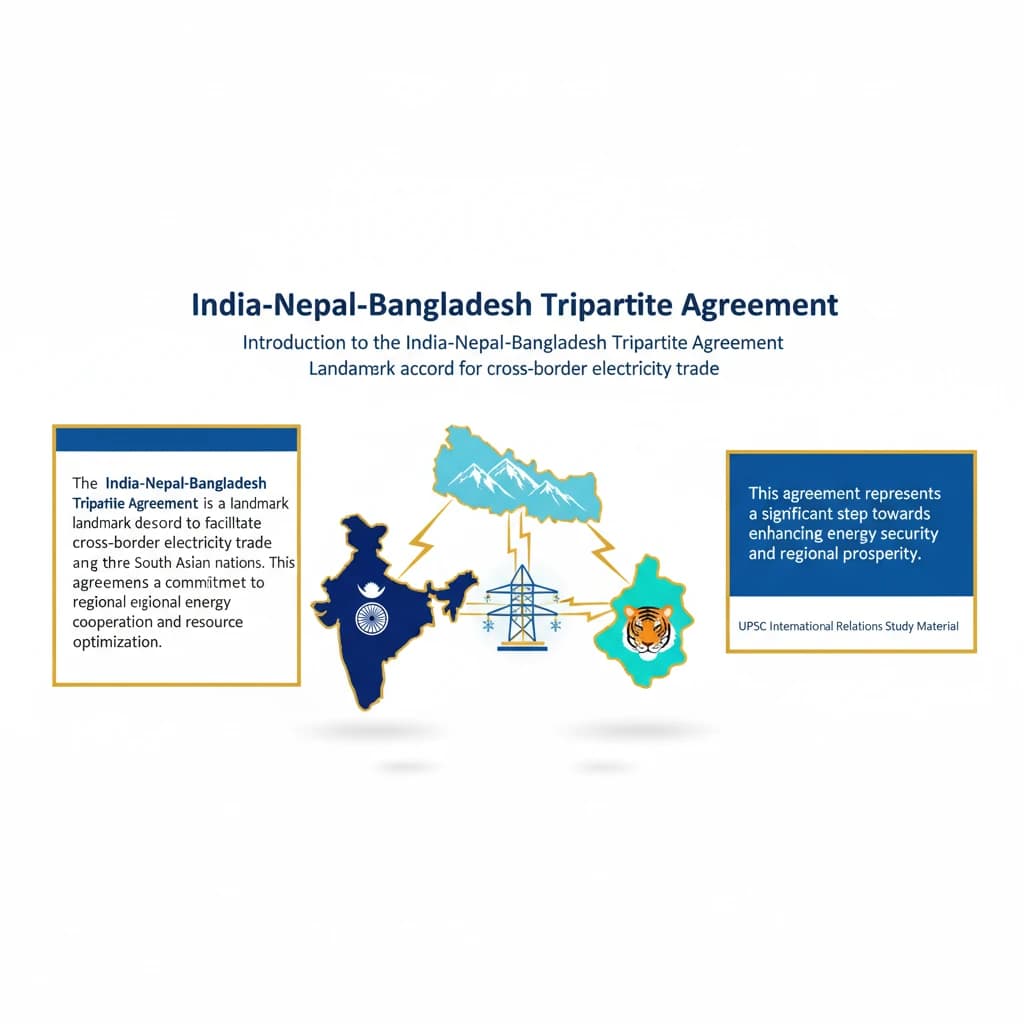
<h4>Introduction to the India-Nepal-Bangladesh Tripartite Agreement</h4><p>The <strong>India-Nepal-Bangladesh Tripartite Agreement</strong> is a landmark accord designed to facilitate <strong>cross-border electricity trade</strong> among the three South Asian nations. This agreement underscores a commitment to regional energy cooperation and resource optimization.</p><div class='key-point-box'><p>This agreement represents a significant step towards enhancing <strong>energy security</strong> and fostering <strong>regional integration</strong> in South Asia by leveraging Nepal's hydroelectric potential.</p></div><h4>Key Provisions of the Agreement</h4><p>Under this tripartite arrangement, <strong>Nepal</strong> is poised to export its surplus hydroelectric power to <strong>Bangladesh</strong>. This mechanism aims to utilize Nepal's abundant renewable energy resources efficiently.</p><p><strong>India</strong> plays a crucial role as a facilitator, providing the necessary transmission infrastructure. It ensures the smooth and reliable flow of electricity from Nepal to Bangladesh through its territory.</p><h4>Operational Details and First Phase</h4><p>The agreement specifies a seasonal export window for Nepal's electricity. Exports will occur annually from <strong>15th June to 15th November</strong>, aligning with Nepal's peak hydroelectric generation period.</p><div class='info-box'><p>In its initial phase, <strong>Nepal</strong> is slated to export <strong>40 MW</strong> of hydroelectric power to <strong>Bangladesh</strong>. The agreed rate for this transaction is <strong>6.4 cents per unit</strong>, ensuring a mutually beneficial economic arrangement.</p></div><h4>Broader Regional Context and Groupings</h4><p>The participation of <strong>India</strong>, <strong>Nepal</strong>, and <strong>Bangladesh</strong> in this agreement is reflective of their broader engagement in various regional and international forums. These platforms often promote cooperation across multiple sectors, including energy.</p><ul><li><strong>South Asian Association for Regional Cooperation (SAARC)</strong>: A regional intergovernmental organization promoting economic and regional integration.</li><li><strong>Bay of Bengal Initiative for Multi-Sectoral Technical and Economic Cooperation (BIMSTEC)</strong>: A regional organization comprising seven member states lying in the littoral and adjacent areas of the Bay of Bengal, focusing on technical and economic cooperation.</li><li><strong>Bangladesh, Bhutan, India, and Nepal (BBIN)</strong>: A sub-regional initiative that focuses on connectivity and cooperation in areas like water resources, power, and transport.</li><li><strong>Non-Aligned Movement</strong>: A forum of 120 developing world states that are not formally aligned with or against any major power bloc.</li></ul><div class='exam-tip-box'><p>For UPSC, understanding such agreements helps in analyzing India's <strong>'Neighbourhood First' policy</strong> and its role in fostering <strong>regional energy grids</strong>. Questions on <strong>regional economic integration</strong> (GS-2, GS-3) are common.</p></div>
Concept Diagram

💡 Key Takeaways

  • •India-Nepal-Bangladesh Tripartite Agreement facilitates cross-border electricity trade.
  • •Nepal exports surplus hydroelectric power to Bangladesh via Indian transmission lines.
  • •Initial phase: 40 MW at 6.4 cents/unit, from June 15 to Nov 15 annually.
  • •Strengthens regional energy security, economic ties, and sustainable development.
  • •Illustrates India's 'Neighbourhood First' policy and role as a regional facilitator.
  • •Reflects cooperation within SAARC, BIMSTEC, and BBIN frameworks.

🧠 Memory Techniques
Memory Aid
95% Verified Content

📚 Reference Sources

•Ministry of External Affairs, Government of India (for policy context)
•Ministry of Power, Government of India (for energy sector details)
•News reports from reputable Indian and international media outlets on the agreement

Related Topics

Loading related topics...
Explore:International Relations Topics·All Subjects·Daily Current Affairs·Editorial Analysis·Previous Year Questions·UPSC GPT
India-Nepal-Bangladesh Tripartite Agreement - UPSC International Relations