Loading page, please wait…
Vaidra Logo
Vaidra

Top 4 items + smart groups

UPSC GPT
New
Current Affairs
Daily Solutions
Daily Puzzle
Mains Evaluator

Version 2.0.0 • Built with ❤️ for UPSC aspirants

Loading...
Loading...
Loading...
Loading...
Loading...
Loading...
Loading...
Loading...
Loading...
Loading...
Loading...
Loading...
Loading...
Back
All Subjects

Topics

0 topics • 0 completed

Loading topics...
Loading...
Loading...
Loading...
Loading...
Loading...
Overall Progress0%

However, it has faced criticism for being discriminatory, creating a divide between nuclear- armed and non-nuclear states. - UPSC International Relations

What is However, it has faced criticism for being discriminatory, creating a divide between nuclear- armed and non-nuclear states. in UPSC International Relations?

However, it has faced criticism for being discriminatory, creating a divide between nuclear- armed and non-nuclear states. is a key topic under International Relations for UPSC Civil Services Examination. Key points include: Nuclear disarmament treaties face criticism for being discriminatory, creating a divide between nuclear-armed and non-nuclear states.. The NPT is the cornerstone of non-proliferation but is criticized for its two-tiered system.. The CTBT aims to ban all nuclear explosions but is not yet fully in force due to non-ratification by key states.. Understanding this topic is essential for both UPSC Prelims and Mains preparation.

Why is However, it has faced criticism for being discriminatory, creating a divide between nuclear- armed and non-nuclear states. important for UPSC exam?

However, it has faced criticism for being discriminatory, creating a divide between nuclear- armed and non-nuclear states. is a Medium-level topic in UPSC International Relations. It is tested in both Prelims (factual MCQs) and Mains (analytical answer writing). Previous year UPSC questions have frequently covered aspects of However, it has faced criticism for being discriminatory, creating a divide between nuclear- armed and non-nuclear states., making it essential for comprehensive IAS preparation.

How to prepare However, it has faced criticism for being discriminatory, creating a divide between nuclear- armed and non-nuclear states. for UPSC?

To prepare However, it has faced criticism for being discriminatory, creating a divide between nuclear- armed and non-nuclear states. for UPSC: (1) Study the comprehensive notes covering all key concepts on Vaidra. (2) Practice previous year questions on this topic. (3) Connect it with current affairs using daily updates. (4) Revise using key takeaways and mind maps available for International Relations. (5) Write practice answers linking However, it has faced criticism for being discriminatory, creating a divide between nuclear- armed and non-nuclear states. to related GS Paper topics.

Key takeaways of However, it has faced criticism for being discriminatory, creating a divide between nuclear- armed and non-nuclear states. for UPSC

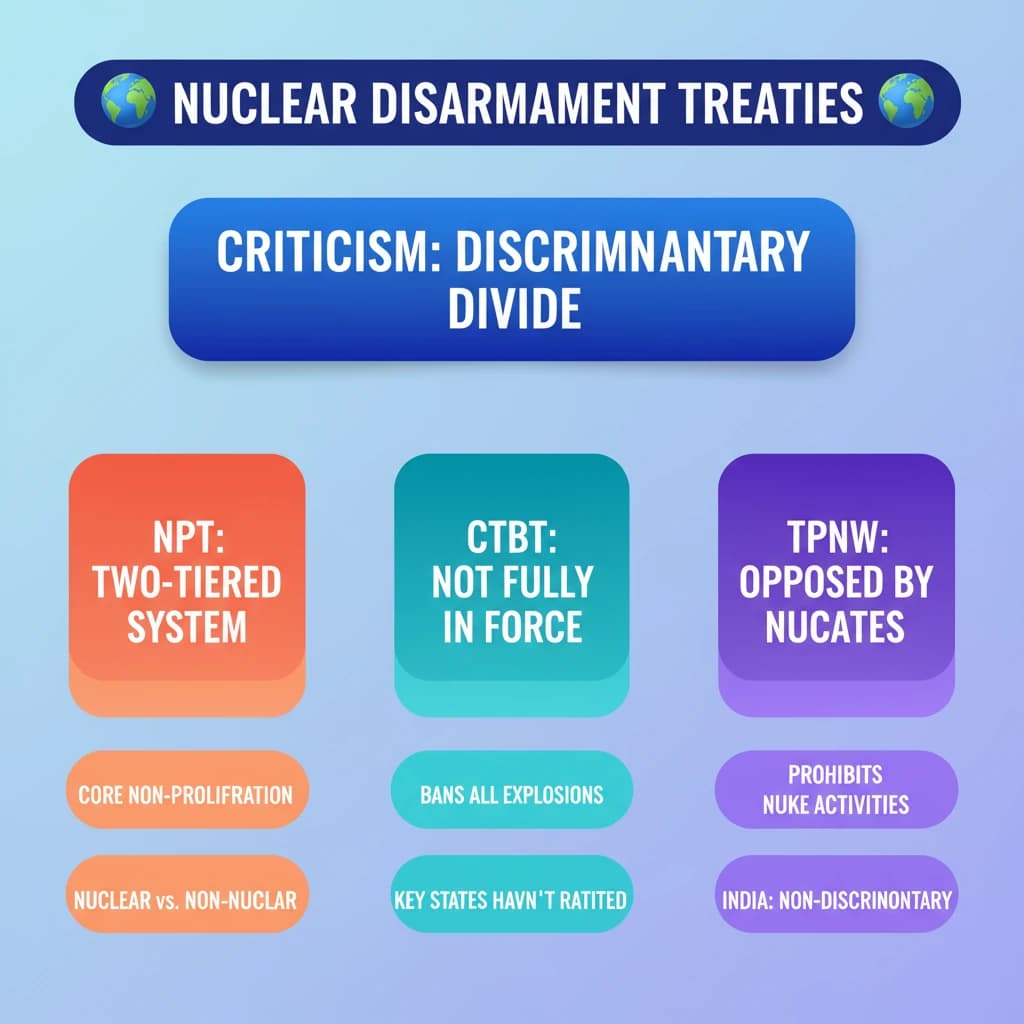
  • Nuclear disarmament treaties face criticism for being discriminatory, creating a divide between nuclear-armed and non-nuclear states.
  • The NPT is the cornerstone of non-proliferation but is criticized for its two-tiered system.
  • The CTBT aims to ban all nuclear explosions but is not yet fully in force due to non-ratification by key states.
  • The TPNW comprehensively prohibits nuclear weapons activities, but is opposed by nuclear-weapon states.
  • India advocates for universal, non-discriminatory, and verifiable nuclear disarmament, not signing NPT or CTBT.
However, it has faced criticism for being discriminatory, creating a divide between nuclear- armed and non-nuclear states.

However, it has faced criticism for being discriminatory, creating a divide between nuclear- armed and non-nuclear states.

Medium⏱️ 8 min read✓ 95% Verified
international relations

📖 Introduction

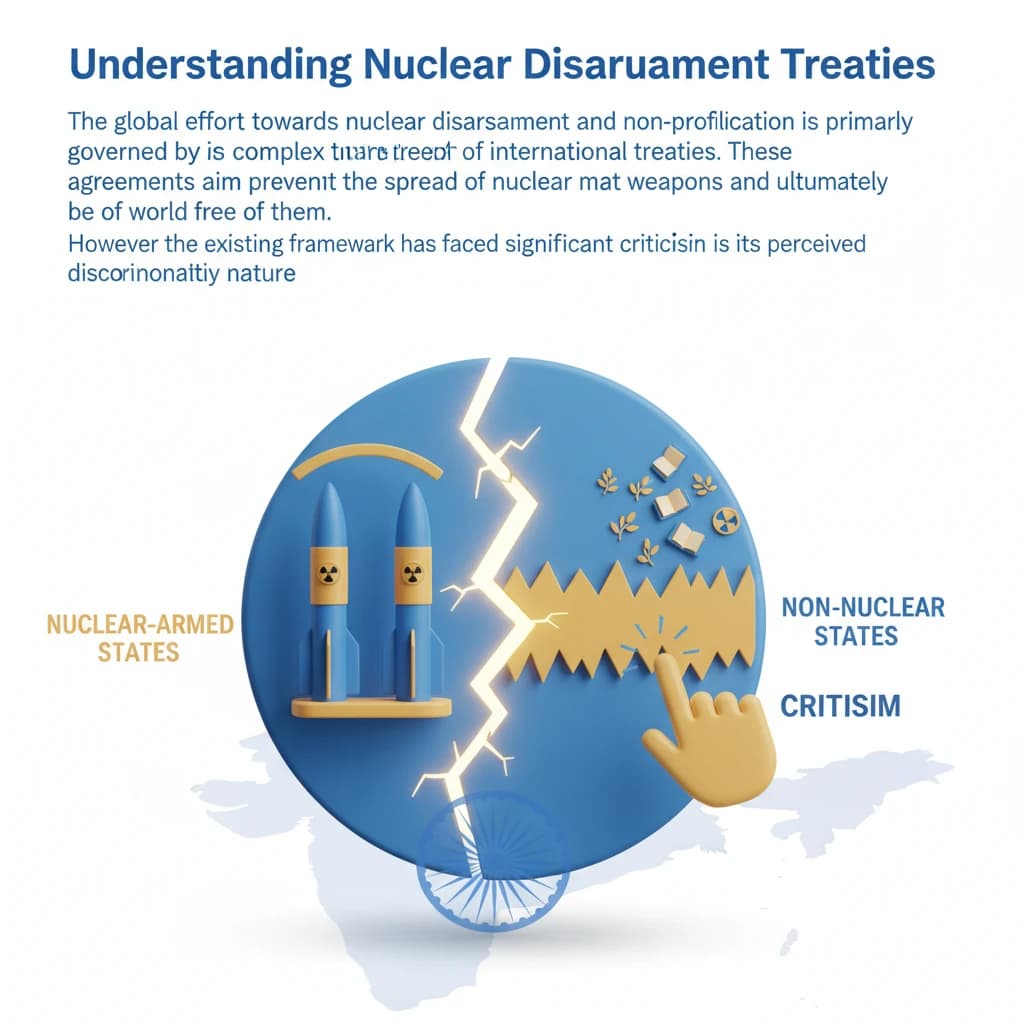
<h4>Understanding Nuclear Disarmament Treaties</h4><p>The global effort towards <strong>nuclear disarmament</strong> and <strong>non-proliferation</strong> is primarily governed by a complex web of international treaties. These agreements aim to prevent the spread of nuclear weapons and ultimately achieve a world free of them.</p><p>However, the existing framework has faced significant <strong>criticism</strong>. A central point of contention is its perceived <strong>discriminatory nature</strong>, which creates a stark divide between <strong>nuclear-armed states</strong> and <strong>non-nuclear states</strong>.</p><div class='key-point-box'><p>This criticism is most often directed at the <strong>Treaty on the Non-Proliferation of Nuclear Weapons (NPT)</strong>, which recognizes five states as legitimate nuclear weapon states while prohibiting others from acquiring them.</p></div><h4>Comprehensive Nuclear-Test-Ban Treaty (CTBT)</h4><p>The <strong>Comprehensive Nuclear-Test-Ban Treaty (CTBT)</strong> is a multilateral treaty that bans all <strong>nuclear explosions</strong>, whether for military or peaceful purposes, in any environment. Its primary objective is to curb the development of new nuclear weapons and the qualitative improvement of existing ones.</p><div class='info-box'><p><strong>CTBT Status:</strong> The treaty was adopted by the United Nations General Assembly in <strong>1996</strong>. However, it is <strong>not yet fully in force</strong> because it requires ratification by 44 specific states, eight of which (including <strong>India</strong>, <strong>Pakistan</strong>, <strong>China</strong>, <strong>Egypt</strong>, <strong>Iran</strong>, <strong>Israel</strong>, <strong>North Korea</strong>, and the <strong>United States</strong>) have not yet ratified it.</p></div><div class='exam-tip-box'><p><strong>UPSC Insight:</strong> Understanding the difference between 'signed' and 'ratified' is crucial for treaties like CTBT. India's stance on CTBT is important for IR questions.</p></div><h4>Treaty on the Prohibition of Nuclear Weapons (TPNW)</h4><p>The <strong>Treaty on the Prohibition of Nuclear Weapons (TPNW)</strong>, often referred to as the <strong>Nuclear Ban Treaty</strong>, represents a more radical approach to nuclear disarmament. It includes a comprehensive set of prohibitions on participating in any <strong>nuclear weapon activities</strong>.</p><div class='info-box'><p><strong>TPNW Prohibitions:</strong> The treaty undertakes for states parties not to:</p><ul><li><strong>Develop</strong>, <strong>test</strong>, <strong>produce</strong>, <strong>acquire</strong>, <strong>possess</strong>, or <strong>stockpile nuclear weapons</strong>.</li><li><strong>Use</strong> or <strong>threaten to use nuclear weapons</strong>.</li><li>Allow any nuclear weapons on their territory.</li><li>Assist, encourage, or induce anyone to engage in prohibited activities.</li></ul></div><p>The TPNW entered into force on <strong>January 22, 2021</strong>. It is supported by a large number of non-nuclear weapon states and civil society organizations, but it is opposed by all nuclear weapon states and their allies, who argue it is not an effective path to disarmament.</p>
Concept Diagram

💡 Key Takeaways

  • •Nuclear disarmament treaties face criticism for being discriminatory, creating a divide between nuclear-armed and non-nuclear states.
  • •The NPT is the cornerstone of non-proliferation but is criticized for its two-tiered system.
  • •The CTBT aims to ban all nuclear explosions but is not yet fully in force due to non-ratification by key states.
  • •The TPNW comprehensively prohibits nuclear weapons activities, but is opposed by nuclear-weapon states.
  • •India advocates for universal, non-discriminatory, and verifiable nuclear disarmament, not signing NPT or CTBT.
  • •Modernization of nuclear arsenals and regional proliferation risks remain significant challenges.

🧠 Memory Techniques

Memory Aid
95% Verified Content

📚 Reference Sources

•International Atomic Energy Agency (IAEA) - Safeguards and Treaties
•Treaty on the Non-Proliferation of Nuclear Weapons (NPT) text
•Comprehensive Nuclear-Test-Ban Treaty (CTBT) text
•Treaty on the Prohibition of Nuclear Weapons (TPNW) text
•Council on Foreign Relations (CFR) - Nuclear Arms Control
•Stockholm International Peace Research Institute (SIPRI) - Nuclear Weapons

Related Topics

Loading related topics...
Explore:International Relations Topics·All Subjects·Daily Current Affairs·Editorial Analysis·Previous Year Questions·UPSC GPT
However, it has faced criticism for being discriminatory, creating a divide between nuclear- armed and non-nuclear states. - UPSC International Relations
  • Modernization of nuclear arsenals and regional proliferation risks remain significant challenges.