Loading page, please wait…
Vaidra Logo
Vaidra

Top 4 items + smart groups

UPSC GPT
New
Current Affairs
Daily Solutions
Daily Puzzle
Mains Evaluator

Version 2.0.0 • Built with ❤️ for UPSC aspirants

Loading...
Loading...
Loading...
Loading...
Loading...
Loading...
Loading...
Loading...
Loading...
Loading...
Loading...
Loading...
Loading...

India Stance on Myanmar Crisis - UPSC International Relations

What is India Stance on Myanmar Crisis in UPSC International Relations?

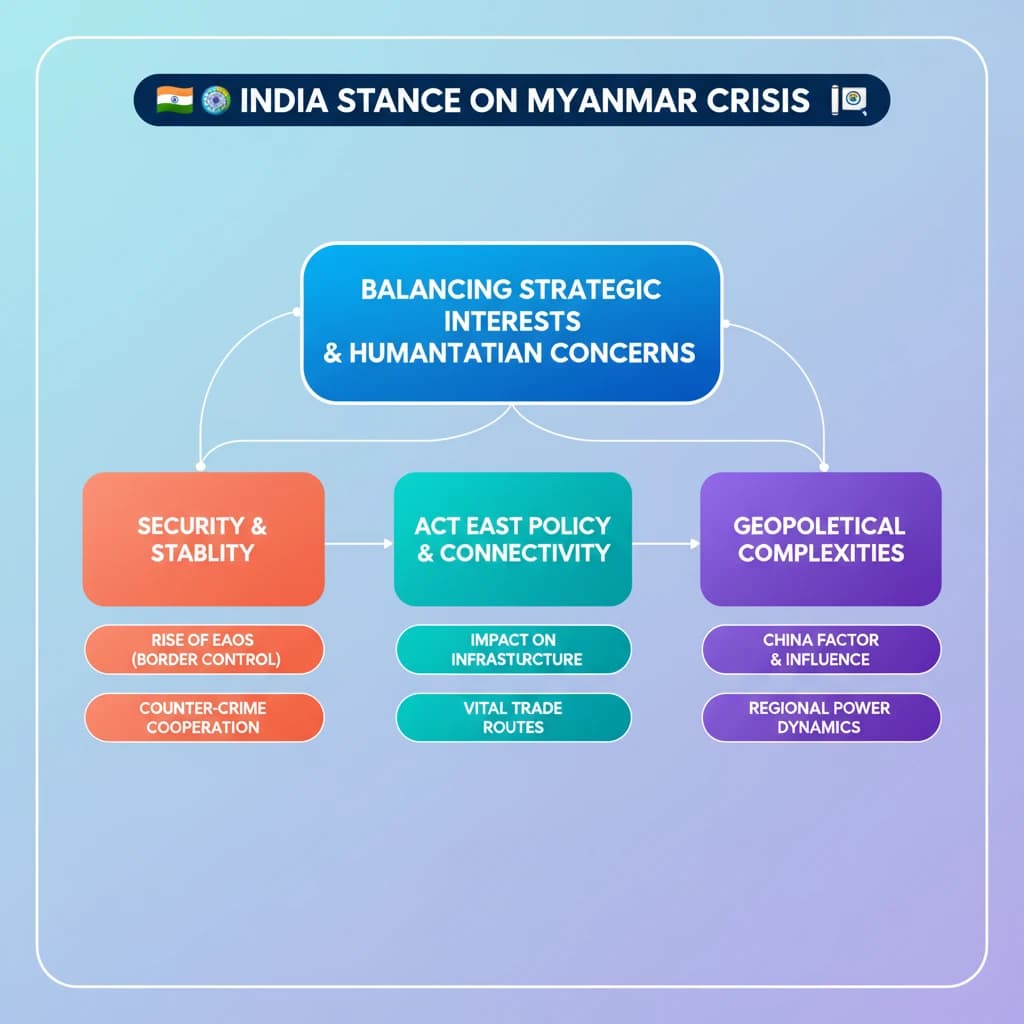
India Stance on Myanmar Crisis is a key topic under International Relations for UPSC Civil Services Examination. Key points include: India maintains a cautious stance on the Myanmar crisis, balancing strategic interests with humanitarian concerns.. The rise of Ethnic Armed Organizations (EAOs) and their control over border territories is a key factor in India's caution.. India actively cooperates with Myanmar on countering transnational crimes like cybercrime, narcotics, and illegal arms.. Understanding this topic is essential for both UPSC Prelims and Mains preparation.

Why is India Stance on Myanmar Crisis important for UPSC exam?

India Stance on Myanmar Crisis is a Medium-level topic in UPSC International Relations. It is tested in both Prelims (factual MCQs) and Mains (analytical answer writing). Previous year UPSC questions have frequently covered aspects of India Stance on Myanmar Crisis, making it essential for comprehensive IAS preparation.

How to prepare India Stance on Myanmar Crisis for UPSC?

To prepare India Stance on Myanmar Crisis for UPSC: (1) Study the comprehensive notes covering all key concepts on Vaidra. (2) Practice previous year questions on this topic. (3) Connect it with current affairs using daily updates. (4) Revise using key takeaways and mind maps available for International Relations. (5) Write practice answers linking India Stance on Myanmar Crisis to related GS Paper topics.

Key takeaways of India Stance on Myanmar Crisis for UPSC

  • India maintains a cautious stance on the Myanmar crisis, balancing strategic interests with humanitarian concerns.
  • The rise of Ethnic Armed Organizations (EAOs) and their control over border territories is a key factor in India's caution.
  • India actively cooperates with Myanmar on countering transnational crimes like cybercrime, narcotics, and illegal arms.
  • The crisis impacts India's Act East Policy and vital connectivity projects.
  • India's policy is a complex interplay of security, economic, and geopolitical considerations, including the China factor.
India Stance on Myanmar Crisis

India Stance on Myanmar Crisis

Medium⏱️ 7 min read✓ 95% Verified
international relations

📖 Introduction

<h4>India's Cautious Stance on the Myanmar Crisis</h4><p>India maintains a <strong>cautious stance</strong> regarding the ongoing crisis in <strong>Myanmar</strong>. This approach is primarily driven by complex geopolitical and security considerations along its shared border.</p><div class='key-point-box'><p>India's policy seeks to balance its strategic interests, regional stability, and humanitarian concerns without directly intervening in Myanmar's internal affairs.</p></div><h4>Impact of Ethnic Armed Organizations (EAOs)</h4><p>A significant factor influencing India's caution is the increasing control exerted by <strong>Ethnic Armed Organizations (EAOs)</strong>. These groups have consolidated power over crucial <strong>trade routes</strong> and territories adjacent to <strong>international borders</strong> with India.</p><div class='info-box'><p>The presence and activities of <strong>EAOs</strong> directly impact India's border security and economic connectivity projects in the region, such as the <strong>Kaladan Multi-Modal Transit Transport Project</strong>.</p></div><h4>Cooperation on Transnational Crimes</h4><p>Despite the political complexities, India continues to engage with Myanmar on critical security issues. This includes robust cooperation in countering various forms of <strong>transnational crimes</strong>.</p><ul><li><strong>Cybercrime:</strong> Joint efforts to combat online illicit activities and enhance digital security.</li><li><strong>Narcotics:</strong> Collaboration to disrupt drug trafficking networks, particularly along the porous border regions.</li><li><strong>Illegal Arms:</strong> Intelligence sharing and coordinated actions to curb the flow of illicit weapons.</li></ul><div class='exam-tip-box'><p>For <strong>UPSC Mains GS2 (International Relations)</strong>, understanding India's 'cautious' approach and the reasons behind it (<strong>EAOs</strong>, border security, transnational crime) is crucial for analyzing India's neighborhood policy.</p></div>
Concept Diagram

💡 Key Takeaways

  • •India maintains a cautious stance on the Myanmar crisis, balancing strategic interests with humanitarian concerns.
  • •The rise of Ethnic Armed Organizations (EAOs) and their control over border territories is a key factor in India's caution.
  • •India actively cooperates with Myanmar on countering transnational crimes like cybercrime, narcotics, and illegal arms.
  • •The crisis impacts India's Act East Policy and vital connectivity projects.
  • •India's policy is a complex interplay of security, economic, and geopolitical considerations, including the China factor.

🧠 Memory Techniques
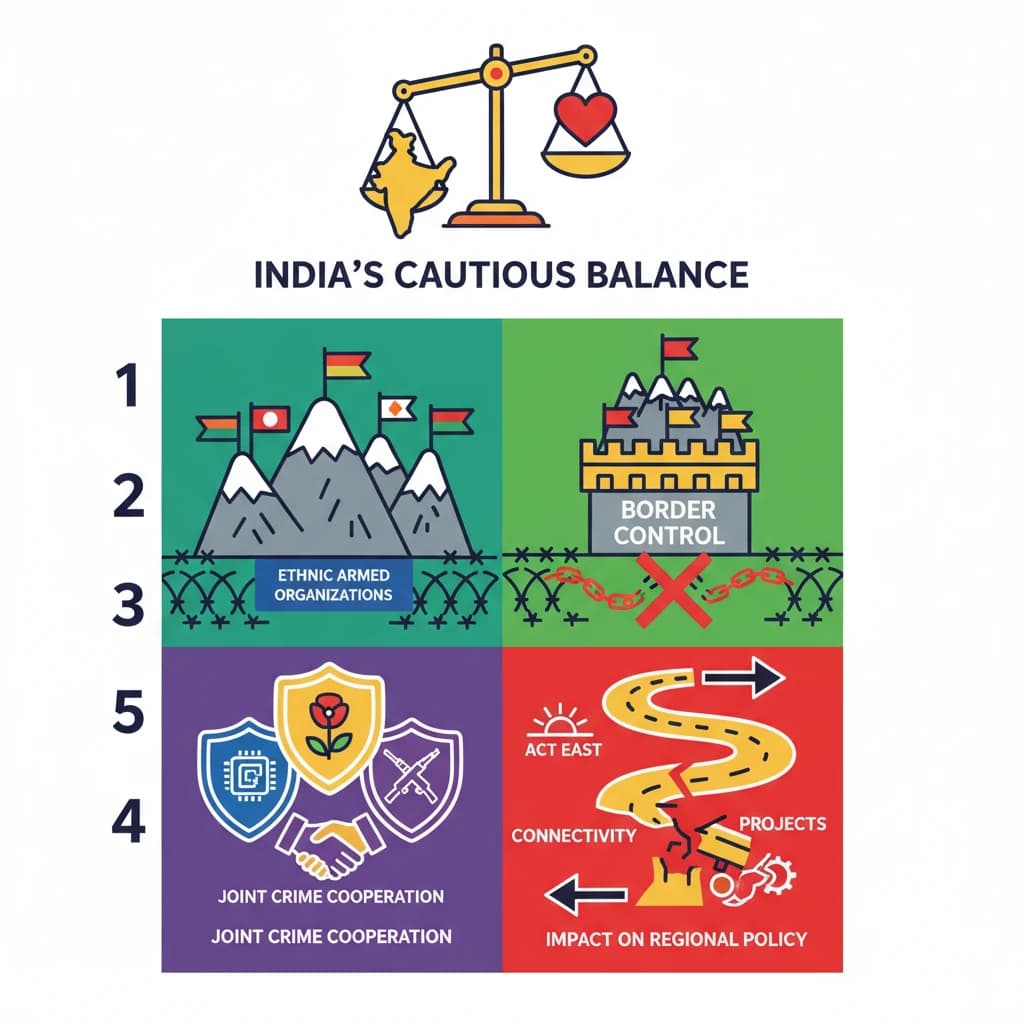
Memory Aid
95% Verified Content

📚 Reference Sources

•Ministry of External Affairs (MEA) statements and press releases on India-Myanmar relations
•Reports from reputable think tanks and news agencies on the Myanmar crisis and its regional impact (e.g., Observer Research Foundation, The Hindu, Indian Express)

Related Topics

Loading related topics...
Explore:International Relations Topics·All Subjects·Daily Current Affairs·Editorial Analysis·Previous Year Questions·UPSC GPT
Back
All Subjects

Topics

0 topics • 0 completed

Loading topics...
Loading...
Loading...
Loading...
Loading...
Loading...
Overall Progress0%
India Stance on Myanmar Crisis - UPSC International Relations