Loading page, please wait…
Vaidra Logo
Vaidra

Top 4 items + smart groups

UPSC GPT
New
Current Affairs
Daily Solutions
Daily Puzzle
Mains Evaluator

Version 2.0.0 • Built with ❤️ for UPSC aspirants

Loading...
Loading...
Loading...
Loading...
Loading...
Loading...
Loading...
Loading...
Loading...
Loading...
Loading...
Loading...
Loading...

India's Claim over Kalapani Region: Historical Basis - UPSC International Relations

What is India's Claim over Kalapani Region: Historical Basis in UPSC International Relations?

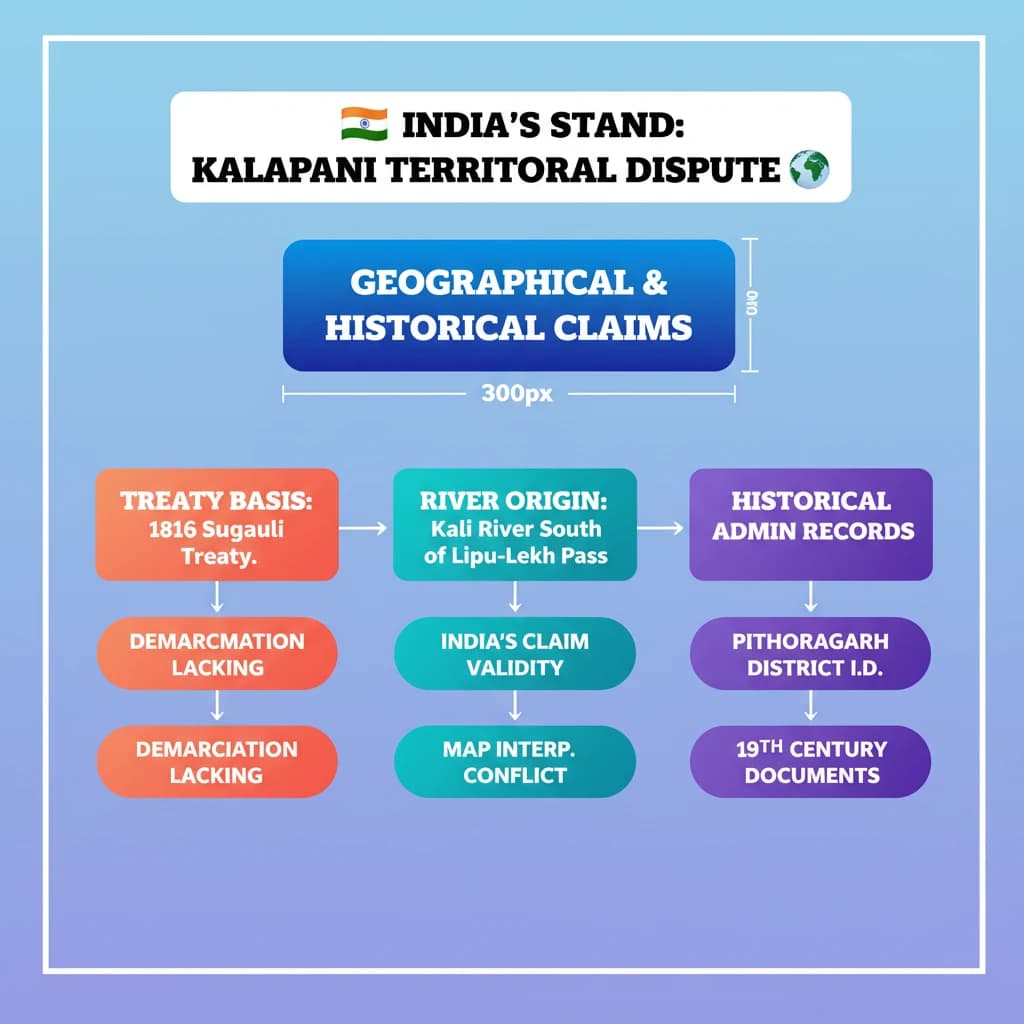
India's Claim over Kalapani Region: Historical Basis is a key topic under International Relations for UPSC Civil Services Examination. Key points include: India claims Kalapani region based on the Kali River's origin being south of Lipu-Lekh Pass.. The 1816 Sugauli Treaty lacks clear demarcation of the Kali River's northern headwaters.. Nineteenth-century administrative records show Kalapani as part of India's Pithoragarh district.. Understanding this topic is essential for both UPSC Prelims and Mains preparation.

Why is India's Claim over Kalapani Region: Historical Basis important for UPSC exam?

India's Claim over Kalapani Region: Historical Basis is a Medium-level topic in UPSC International Relations. It is tested in both Prelims (factual MCQs) and Mains (analytical answer writing). Previous year UPSC questions have frequently covered aspects of India's Claim over Kalapani Region: Historical Basis, making it essential for comprehensive IAS preparation.

How to prepare India's Claim over Kalapani Region: Historical Basis for UPSC?

To prepare India's Claim over Kalapani Region: Historical Basis for UPSC: (1) Study the comprehensive notes covering all key concepts on Vaidra. (2) Practice previous year questions on this topic. (3) Connect it with current affairs using daily updates. (4) Revise using key takeaways and mind maps available for International Relations. (5) Write practice answers linking India's Claim over Kalapani Region: Historical Basis to related GS Paper topics.

Key takeaways of India's Claim over Kalapani Region: Historical Basis for UPSC

  • India claims Kalapani region based on the Kali River's origin being south of Lipu-Lekh Pass.
  • The 1816 Sugauli Treaty lacks clear demarcation of the Kali River's northern headwaters.
  • Nineteenth-century administrative records show Kalapani as part of India's Pithoragarh district.
  • The dispute highlights the complexities of interpreting historical treaties and geographical features.
  • Kalapani remains a key point of contention in India-Nepal relations, requiring diplomatic resolution.
India's Claim over Kalapani Region: Historical Basis

India's Claim over Kalapani Region: Historical Basis

Medium⏱️ 8 min read✓ 95% Verified
international relations

📖 Introduction

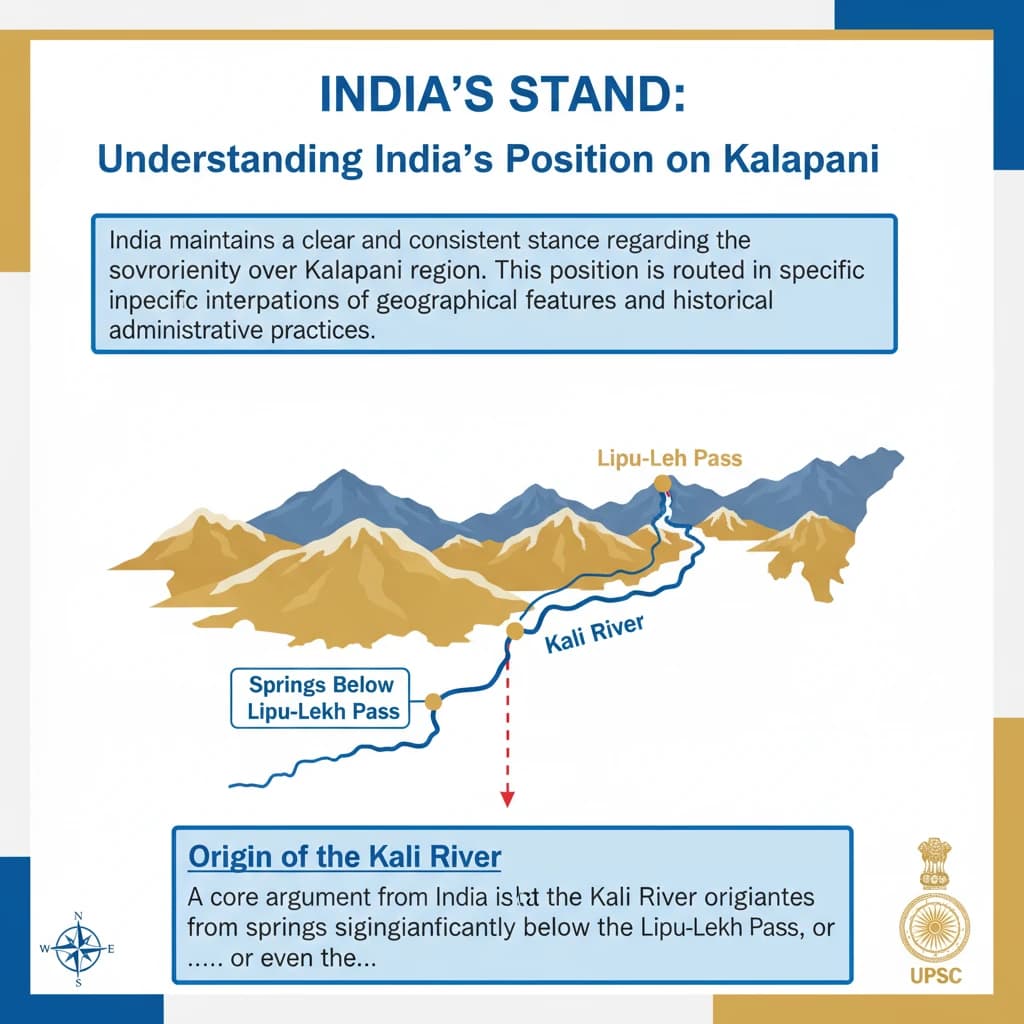
<h4>Understanding India's Position on Kalapani</h4><p>India maintains a clear and consistent stance regarding the sovereignty over the <strong>Kalapani region</strong>. This position is rooted in specific interpretations of geographical features and historical administrative practices.</p><h4>Origin of the Kali River</h4><p>A core argument from India is that the <strong>Kali River</strong> originates from springs located significantly below the <strong>Lipu-Lekh Pass</strong>, or even the <strong>Lipulekh Pass</strong> itself. This geographical interpretation is crucial to India's claim.</p><div class='info-box'><p><strong>Key Claim:</strong> India asserts the <strong>Kali River</strong>'s source is south of the disputed area, effectively placing the <strong>Kalapani region</strong> within Indian territory.</p></div><h4>Interpretation of the Sugauli Treaty</h4><p>India highlights that the <strong>Sugauli Treaty</strong>, signed in <strong>1816</strong>, which defines the boundary between India (then British India) and Nepal, does not explicitly demarcate the area located north of these specific streams identified as the source of the <strong>Kali River</strong>.</p><div class='key-point-box'><p>The ambiguity in the <strong>Sugauli Treaty</strong> regarding the precise northernmost origin of the <strong>Kali River</strong> is central to the ongoing dispute.</p></div><h4>Historical Administrative Records</h4><p>Further supporting its claim, India refers to extensive administrative and revenue records from the <strong>nineteenth century</strong>. These historical documents consistently indicate that the <strong>Kalapani region</strong> was administered as part of India.</p><p>Specifically, these records show <strong>Kalapani</strong> being counted as an integral part of the <strong>Pithoragarh district</strong>, which falls within the present-day state of <strong>Uttarakhand</strong>.</p><div class='exam-tip-box'><p>When discussing border disputes, always cite multiple forms of evidence: geographical, treaty-based, and historical administrative records. This strengthens your argument for <strong>UPSC Mains GS Paper 2</strong>.</p></div>
Concept Diagram

💡 Key Takeaways

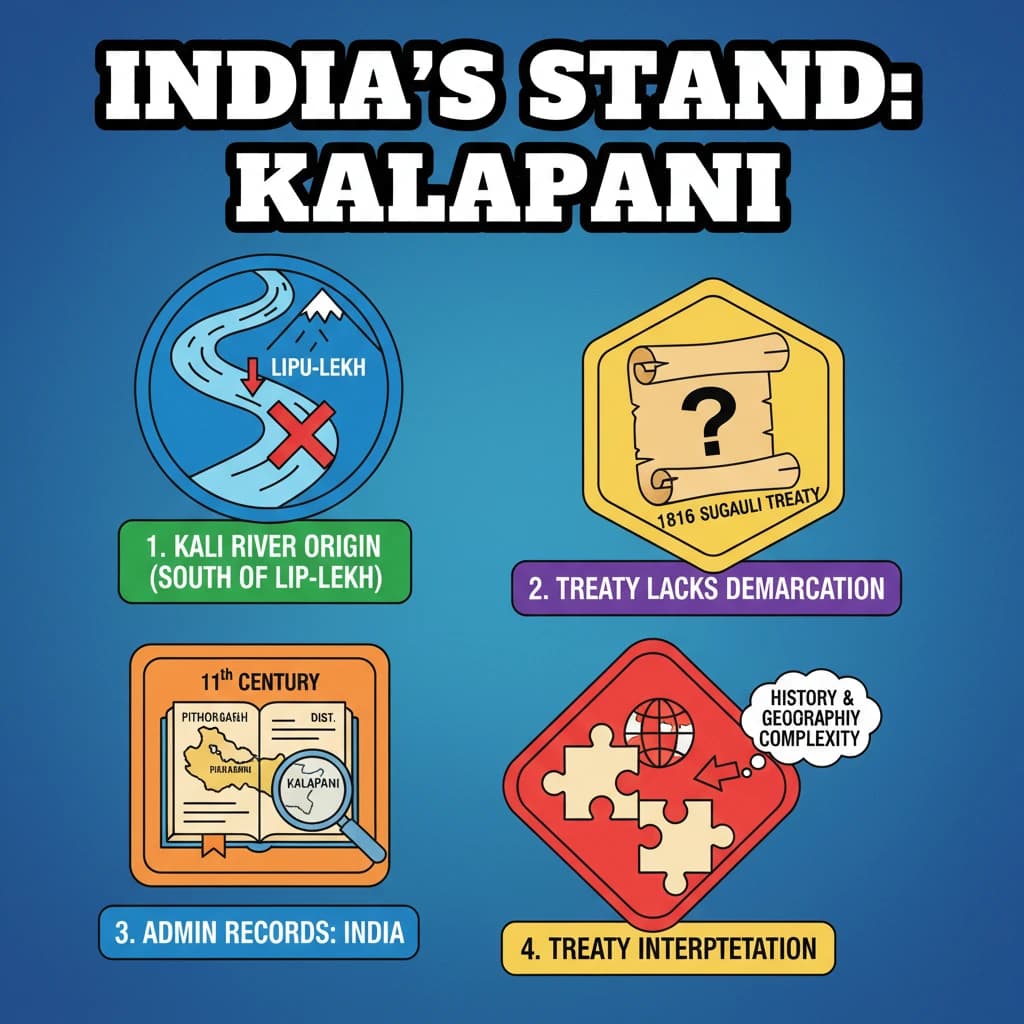
  • •India claims Kalapani region based on the Kali River's origin being south of Lipu-Lekh Pass.
  • •The 1816 Sugauli Treaty lacks clear demarcation of the Kali River's northern headwaters.
  • •Nineteenth-century administrative records show Kalapani as part of India's Pithoragarh district.
  • •The dispute highlights the complexities of interpreting historical treaties and geographical features.
  • •Kalapani remains a key point of contention in India-Nepal relations, requiring diplomatic resolution.

🧠 Memory Techniques
Memory Aid
95% Verified Content

📚 Reference Sources

•Official government statements on India-Nepal border issues
•Historical texts on the Sugauli Treaty and Anglo-Nepalese War

Related Topics

Loading related topics...
Explore:International Relations Topics·All Subjects·Daily Current Affairs·Editorial Analysis·Previous Year Questions·UPSC GPT
Back
All Subjects

Topics

0 topics • 0 completed

Loading topics...
Loading...
Loading...
Loading...
Loading...
Loading...
Overall Progress0%
India's Claim over Kalapani Region: Historical Basis - UPSC International Relations